The most expensive debt is not always the debt that can hurt you first.
A missed housing payment may threaten the place you live. A missed secured-loan payment may put an essential vehicle at risk. An unpaid utility bill may lead to disconnection. A court-ordered obligation, tax debt, or account already in collection may follow rules and timelines that an ordinary credit-card balance does not.
Only after those consequences are understood does “highest interest or smallest balance?” become the right question.
Quick decision: First protect basic needs and the income required to keep earning. Then identify overdue, secured, court-ordered, tax, co-signed, and collection-stage obligations and contact the relevant creditor or qualified adviser before deadlines pass. Keep required minimums current where possible. Once immediate consequences are stabilized, direct extra repayment using your chosen snowball, avalanche, or hybrid rule. Do not rank debts by rate alone when the cost of missing a payment includes losing housing, transportation, essential services, legal rights, or another person’s financial standing.

Start With Consequences, Not a Ranking App
A debt list usually displays balances and interest rates. A useful priority list needs more columns:
- Is the account current, late, in default, or in collection?
- Is property pledged as collateral?
- Does nonpayment threaten housing, transportation, utilities, insurance, employment, or a professional licence?
- Is there a court order, government claim, wage deduction, or filing deadline?
- Is another person jointly liable or a guarantor?
- Is a temporary hardship or payment arrangement available?
- What is the next deadline, and what happens after it?
FCAC advises addressing past-due accounts before selecting a general payoff strategy because fees, credit damage, collection activity, and legal action may escalate. CFPB’s bill-prioritization materials likewise focus on the consequences of falling behind, not simply the size of a balance.
This is triage, not permission to ignore lower-priority debts. Continue every required payment you can afford and contact creditors promptly when you cannot.
Level 1: Protect Basic Needs and the Ability to Earn
Debt repayment cannot be sustained if it removes the essentials needed to live or work. Before sending extra money to a creditor, account for:
- housing;
- food and necessary household supplies;
- utilities and communications needed for safety or work;
- required medicine and healthcare;
- necessary transportation;
- childcare or caregiving required to work;
- legally required insurance; and
- taxes or deductions that must be set aside from self-employment income.
These are not all “debts,” but they compete for the same cash. Paying an unsecured card aggressively while creating a rent, mortgage, utility, payroll, or tax crisis is not successful prioritization.
The exact order depends on the household and jurisdiction. A car may be essential for one worker and optional for another. Internet access may be necessary for employment or education. Document the consequence rather than relying on a universal label.
Level 2: Identify Debts With Fast or Serious Consequences
Housing debt and rent arrears
If you may miss a mortgage or rent payment, act early. Contact the lender, servicer, landlord, housing counsellor, legal clinic, or another appropriate local service before assuming the options. CFPB advises borrowers worried about missing a mortgage payment to contact their servicer promptly and prepare information about income, expenses, assets, and whether the hardship is temporary or permanent.
Do not send a large extra payment to another debt while leaving a housing deadline unexplored.
Secured vehicle or equipment debt
When a loan is secured by a vehicle or equipment, nonpayment may put the asset at risk. The priority increases when that asset is needed to earn income, manage a disability, reach medical care, or fulfil caregiving duties.
Check the contract and local law. Do not assume that returning the asset ends the balance; sale proceeds, fees, and a remaining deficiency may still matter depending on the agreement and jurisdiction.
Essential utilities and insurance
Utility disconnection, loss of required coverage, or cancellation of a policy can create immediate hardship. Contact providers before the deadline and ask about payment arrangements, assistance, due-date changes, or other available options. Terms vary, and an arrangement is not active until confirmed.
Court-ordered, support, and government obligations
Child or spousal support, tax debt, fines, and other government or court obligations may have enforcement tools and legal treatment unlike ordinary unsecured debt. Do not place them into a consumer-debt calculator without qualified local guidance.
Collection, lawsuit, or garnishment stage
Open and verify notices. Record response dates. Confirm the debt, creditor or collector, amount, and rights before paying or sharing information. Limitation periods, validation rights, court procedure, and collection rules are jurisdiction-specific. Ignoring a document does not reliably preserve a defence.
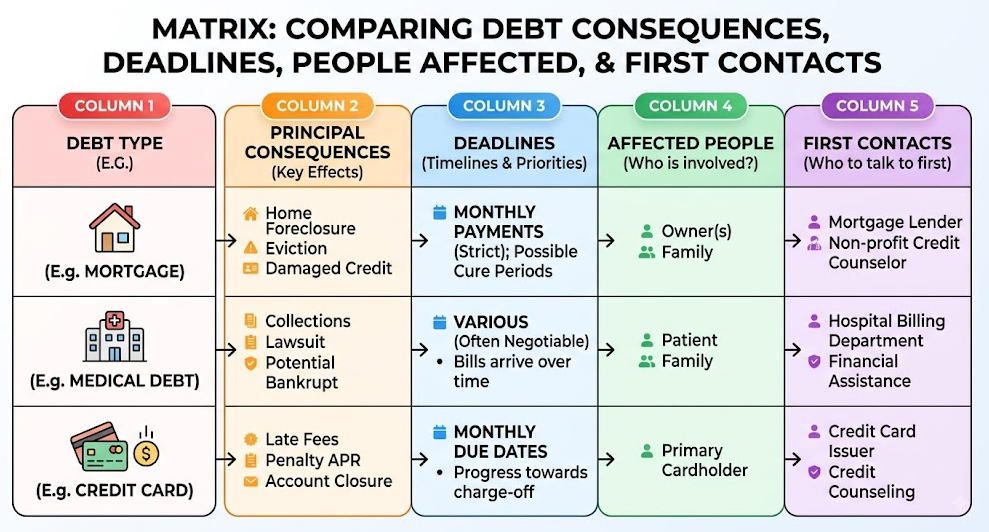
Level 3: Protect Other People and Contractual Relationships
Joint debt, co-signed debt, and family loans create consequences beyond the primary borrower’s credit file.
For each account, clarify:
- whose name is on the contract;
- whether liability is joint, several, guaranteed, or authorized-user only;
- who owns the collateral;
- who receives statements and notices;
- whether a private agreement changes the creditor’s rights; and
- what communication is required between the people involved.
A separation agreement or informal family understanding may not remove a name from the original contract. CFPB notes in the US context that a divorce decree does not automatically release a borrower from creditor liability; contracts and local law control. The broader lesson is global: do not infer release from a change in relationship.
Family and friend debt may have a low interest rate but a high relationship cost. Put the balance, schedule, and any change in writing. Do not secretly move it to the bottom because it lacks automated collection.
Level 4: Keep Minimums Current, Then Optimize
After urgent consequences are stabilized, return to the repayment method.
- Pay every required minimum by its due date where possible.
- Apply any agreed hardship terms exactly as documented.
- Send the planned extra amount to one target.
- Use highest effective interest for avalanche, lowest balance for snowball, or a written hybrid.
- Re-rank when a rate, status, deadline, or consequence changes.
This separates two decisions:
- Priority triage: What must be addressed to prevent disproportionate harm?
- Payoff optimization: Where should the next extra dollar go after that?
Article “Debt Snowball vs Debt Avalanche” compares snowball and avalanche. Those methods do not override an arrears deadline or secured-debt risk.
Jerome’s Experience: Different Debts, Different Roles
After immigrating to Canada, Jerome had a mortgage, vehicle financing, and a line of credit used for business investment. The three balances did not represent the same contract or household function. The mortgage was connected to housing, the vehicle loan to an asset, and the LOC was reusable revolving credit.
That experience supports one narrow lesson: a household should identify what each debt is attached to before sorting by rate or balance. It does not establish that Jerome missed payments, faced collection, risked foreclosure or repossession, or had any legal priority issue. None of those events was supplied.
His later ability to clear the car loan with a lump sum belongs mainly to the snowball-versus-avalanche comparison. His recurring insurance expenses and LOC reuse belong to the cash-buffer and timeline articles. Here, the experience is used only to show why debt type matters.
Build a Consequence-First Debt Map
Create one row for every obligation, including accounts that do not appear on a credit report.
| Field | What to record |
|---|---|
| Creditor or payee | Verified name and contact channel |
| Balance | Current amount and date checked |
| Required payment | Minimum, arrears amount, or arrangement |
| Due date | Next actual deadline |
| Status | Current, late, default, collection, legal action |
| Rate and fees | Effective rate, penalties, variable or promotional terms |
| Security | Home, vehicle, equipment, deposit, or none |
| Essential impact | Housing, work, utilities, care, insurance |
| Other people | Joint borrower, guarantor, family relationship |
| Next consequence | What happens, when, and source of information |
| First action | Pay, call, verify, dispute, or seek advice |
Use statements and contracts, not memory alone. Check the credit report for omissions or errors, but remember that rent, taxes, utilities, family debt, business obligations, and some other accounts may not appear there.
Colour or score can help, but avoid a single automated number. A legal deadline should not be averaged away by a low interest rate.
Call Before You Promise
When cash is insufficient, contact the creditor or provider before agreeing to a payment you cannot sustain. Prepare:
- the reason for the difficulty;
- whether it appears temporary or ongoing;
- current income and essential expenses;
- the amount and date you can realistically pay;
- the outcome you are requesting; and
- when you can review the arrangement.
Ask for the terms in writing. Confirm how interest, fees, account status, credit reporting, collateral, and missed arrangement payments will be handled. A lower monthly payment can extend the term and increase total cost.
Do not give sensitive information to an unverified caller. Use a statement, official website, or independently verified number to contact the creditor.
Avoid Five Priority Mistakes
Paying the loudest caller first
Collection pressure does not by itself prove the debt has the greatest consequence or even that the caller is legitimate. Verify the claim and compare deadlines.
Protecting a credit score over housing or food
Credit history matters, but it is not more important than immediate safety, shelter, essential care, or the ability to earn.
Treating every secured debt as automatically first
Security raises the consequence, but the asset’s necessity, arrears stage, available options, and total household plan still matter.
Paying extra while another account becomes late
An aggressive target payment can be reversed by late fees, default interest, collection costs, or loss of an arrangement elsewhere.
Assuming a hardship request is approved
A phone call or application is not the same as a confirmed agreement. Continue following the existing contract until written terms say otherwise, unless qualified advice directs a different lawful action.
When Self-Directed Prioritization Is Not Enough
Seek reputable qualified help when:
- income cannot cover essentials and required payments;
- housing, utilities, an essential vehicle, or insurance is at risk;
- legal papers, garnishment, tax enforcement, or collection disputes are involved;
- you are unsure who is legally responsible for joint or guaranteed debt;
- business and personal liabilities are mixed;
- creditors offer arrangements you do not understand; or
- repayment would take an unrealistic period even without new borrowing.
Depending on location and issue, useful help may include a credit counsellor, housing counsellor, legal clinic, tax professional, licensed insolvency professional, social-service agency, or the creditor’s hardship team. Verify credentials, costs, conflicts, and regulatory status.
Avoid firms that guarantee debt elimination, demand upfront fees, tell you to stop all creditor communication without explaining consequences, or pressure you to sign immediately.
Decision Summary
- Protect basic needs and the ability to earn before extra repayment.
- Identify arrears, collateral, essential-service, legal, tax, and collection consequences.
- Record the next deadline and verify what happens after it.
- Protect co-borrowers, guarantors, and family relationships with clear information.
- Contact creditors early and obtain arrangements in writing.
- Keep required minimums current where possible.
- Apply snowball, avalanche, or a hybrid only after urgent priorities are stabilized.
- Re-rank when status, rates, deadlines, or household needs change.
- Verify callers and notices before sharing information or paying.
- Seek qualified local help when consequences or cash-flow gaps exceed a self-directed plan.
Prioritizing debt is not choosing which obligation deserves respect. It is choosing the sequence that prevents the most serious avoidable harm while preserving a path to repay the rest.
This article provides general educational information, not individualized financial, legal, tax, credit, housing, or insolvency advice. Contracts, enforcement, limitation periods, assistance, and priority rules vary by jurisdiction.
FAQ
Should I always pay the highest-interest debt first?
Not when another missed payment creates a more immediate housing, collateral, utility, legal, or essential-work consequence. Stabilize urgent obligations first, then use highest-interest-first for extra repayment.
Are mortgage and car payments always higher priority than credit cards?
They often carry collateral consequences, but priority depends on arrears status, asset necessity, available arrangements, contract terms, and local law. Get help early when either is at risk.
What if one debt is already in collection?
Verify the debt, collector, amount, deadlines, and your rights. Do not ignore legal documents. Collection and limitation rules vary, so seek local advice when needed.
Should I pay family before banks?
There is no universal answer. Record the legal and relationship obligations, agree on a realistic schedule in writing, and do not hide the debt merely because formal collection is unlikely.
What if I cannot make every minimum payment?
Protect essentials, map the consequences, and contact creditors promptly. A payoff-order method is insufficient when required payments exceed available cash; qualified debt or legal guidance may be necessary.
Does a hardship plan stop interest and credit reporting?
Not automatically. Ask exactly how payments, interest, fees, account status, collateral, and reporting will work, and obtain the agreement in writing.
How often should I reprioritize debts?
Review monthly and whenever an account becomes late, a rate or promotion changes, a legal notice arrives, income changes, or an essential household need changes.
Sources
- FCAC – Paying Back Your Debt
- CFPB – Your Money, Your Goals Toolkit
- CFPB – Debt After Divorce
- CFPB – Can’t Pay Credit Card Bills
More in This Cluster: Debt Payoff Strategies
- Debt Snowball vs Debt Avalanche
- How to Prioritize Multiple Debts (you are here)
- Should You Save or Pay Off Debt First?
- How to Pay Off Credit Card Debt Without Losing Momentum
- Debt Consolidation: When It Helps and When It Does Not
- How to Build a Realistic Debt Payoff Timeline
- What to Do After You Become Debt-Free