An insurance premium is not an emergency just because it arrives in one large bill.
If that predictable payment goes back onto a line of credit, months of principal reduction can disappear. The problem is not only that the household saved too little. It may have sent every available dollar to debt without reserving money for costs that were already visible on the calendar.
The practical choice is rarely “save everything” or “pay debt with everything.” It is deciding what cash must remain available so the next disruption does not recreate the debt you just paid.
Quick decision: Keep essential bills and all required debt payments current. Build a small, accessible starter cushion for plausible near-term shocks, and separately fund known non-monthly expenses before accelerating repayment. Direct remaining extra cash toward high-cost debt. Increase the cushion when income is unstable, essential repairs are likely, credit access is unreliable, or a missed expense would threaten housing, work, health, or care. Do not use a universal dollar amount or three-to-six-month target as a prerequisite for beginning debt payoff.

Separate Three Different Buckets
The save-versus-debt question becomes clearer when cash is assigned to three jobs.
Required near-term cash
This covers expenses and minimum payments due before the next reliable income arrives: housing, food, utilities, necessary transportation, medicine, insurance, caregiving, taxes being set aside, and contractual minimums.
Sending this money to an extra debt payment can create an immediate shortfall, late fee, overdraft, or new borrowing.
Predictable irregular expenses
These costs are not monthly, but they are foreseeable:
- annual or semiannual insurance premiums;
- property taxes not escrowed;
- vehicle registration and routine maintenance;
- school supplies or tuition instalments;
- professional licences and business renewals;
- seasonal utilities;
- known medical or dental costs; and
- holiday or travel commitments you have chosen to keep.
FCAC explicitly distinguishes unexpected emergencies from occasional expenses such as school supplies, winter tires, and holidays, which should be planned in the budget.
Emergency savings
This is cash reserved for genuinely unplanned or uncertain events: urgent repairs, income interruption, uncovered medical needs, or another financial shock. CFPB defines an emergency fund as a cash reserve for unplanned expenses or emergencies and notes that even a small amount can provide some security.
Mixing these buckets creates false confidence. A $1,500 account is not a $1,500 emergency fund if $1,200 is already needed for next month’s insurance.
Why Paying Debt First Is Mathematically Attractive
Paying down a balance creates a return equal to avoided borrowing cost, subject to the contract and tax context. If a card charges 24% while cash earns much less, reducing the card generally improves the arithmetic.
FCAC notes that people are generally better off paying down debt before investing because debt interest is usually higher than investment returns. But accessible emergency cash is not primarily an investment. Its job is to prevent a shock from forcing a new high-cost balance, a late essential payment, or a distressed sale.
The debt-first case is strongest when:
- the debt has a very high effective rate;
- income is stable and the next major expenses are funded;
- the household has reliable access to cash for a true emergency;
- repayment does not trigger penalties or remove essential liquidity; and
- the account will not be used again.
Even then, reducing cash to zero can be fragile. A mathematically efficient plan may fail operationally when the first repair or income delay arrives.
Why a Starter Cushion Can Improve Debt Payoff
A starter cushion is not a complete long-term emergency fund. It is the first layer between a routine shock and new borrowing.
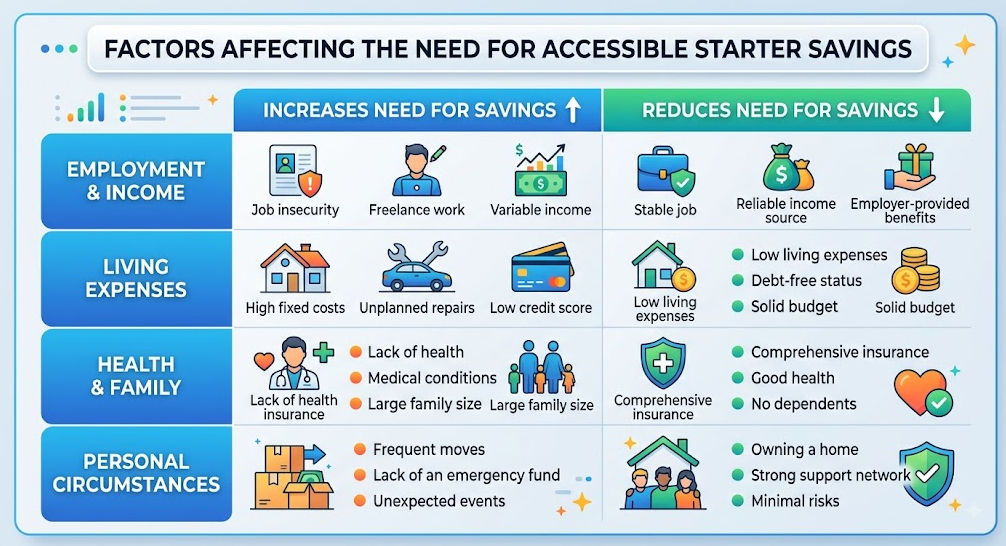
Choose its size from actual exposure rather than a slogan. Ask:
- What is the most likely necessary surprise in the next three months?
- What insurance deductible might be due?
- What repair keeps work or housing functioning?
- How variable is the time between income payments?
- What essential expense cannot be placed on credit?
- How quickly could I replace used savings?
The answer may be modest for someone with stable income, low deductibles, shared household support, and reliable paid leave. It may need to be larger for a contractor, single-income household, caregiver, homeowner with aging systems, or person whose vehicle is essential to work.
CFPB research using hypothetical choices found that participants commonly balanced both goals: most used some savings to reduce card debt while retaining a cushion. The experiment does not establish an ideal percentage or amount. It supports treating the decision as a trade-off rather than an all-or-nothing rule.
Jerome’s Experience: The Bill Was Predictable
Jerome made partial repayments on a business-related line of credit, but the balance rose again when large home or auto insurance payments occurred once or several times a year. The LOC rarely stayed below the same level.
This experience does not show that he chose a wrong emergency-fund amount, and no amounts, dates, rates, or payment structure were supplied. It illustrates a classification problem: insurance was not an unknowable shock. If the timing and approximate amount were known, it belonged in a sinking fund for predictable irregular expenses.
His experience also shows why available credit is not identical to savings. A LOC can provide liquidity, but using it increases debt, may involve a variable rate, and depends on continued access under the lender’s terms.
The article does not assume that Jerome could have fully funded every premium while maintaining all payments. When cash flow is tight, the first improvement may be visibility and partial funding rather than a perfect reserve.
Build a Sinking Fund Before Calling It Extra Cash
For each predictable non-monthly expense:
- Write the expected amount or a conservative range.
- Record the due date.
- Subtract any amount already reserved.
- Divide the remainder by the number of pay periods before it is due.
- Transfer that amount to a labelled account or category each payday.
Example: A $1,200 premium due in six months requires $200 per month if nothing is saved. If only $100 per month is affordable, the plan has identified a future $600 gap early enough to reduce the expense, change payment frequency if terms permit, adjust other spending, or contact the provider.
This is an illustration, not a recommendation. Paying premiums monthly may include fees or financing costs; compare total cost and cash-flow benefit.
Do not count a sinking fund as available for an avalanche payment. The cash already has a job.
Use a Layered Allocation Rule
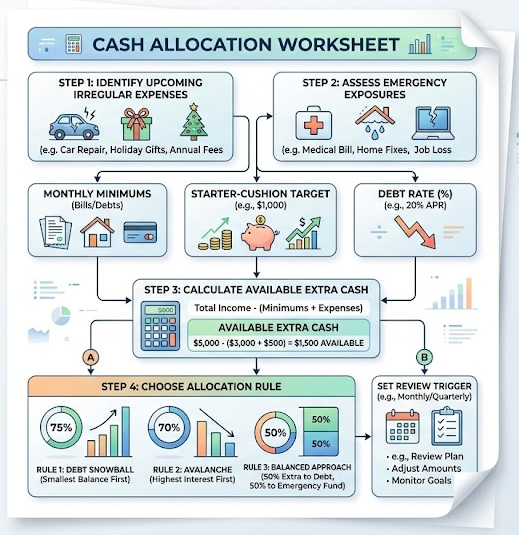
A practical sequence for each pay period is:
- Cover essential current expenses.
- Make required debt minimums and agreed arrears payments.
- Fund predictable expenses due before the next planning review.
- Build or restore the chosen starter cushion.
- Direct the remaining extra amount to the priority debt.
This does not mean saving always comes before debt. Steps 3 through 5 can happen simultaneously. For example, a household might send a fixed amount to annual insurance, a smaller amount to the starter cushion, and the majority of remaining cash to a high-rate card.
Write the rule in dollars or percentages based on actual cash flow. Review it after the cushion reaches its starter target; at that point, more of the transfer can move to debt.
If an employer offers a retirement-plan contribution or match, do not cancel it automatically to accelerate debt. Compare vesting, eligibility, withdrawal restrictions, taxes, fees, debt cost, and the amount of employer money that would be lost. This is a benefits-and-tax decision as well as a payoff decision, and the rules vary by country and plan. Preserve required minimums and urgent obligations first, then seek plan-specific guidance when the trade-off is material.
Adjust the Balance for Risk and Cost
Lean toward a larger accessible cushion when:
- income varies or employment is uncertain;
- one income supports several people;
- an essential home, vehicle, or medical device may need repair;
- insurance deductibles are high;
- paid leave or social benefits are limited;
- credit lines can be reduced, frozen, or repriced;
- a health condition creates volatile costs; or
- the next debt payment cannot be recovered after it is made.
Lean toward faster payoff when:
- debt cost is extremely high;
- required payments are current;
- predictable costs are fully reserved;
- income is stable;
- the starter cushion is intact;
- prepayment is permitted without material penalty; and
- continued access to the paid-down account would invite reuse.
Do not turn these factors into an automatic score. One severe housing or health exposure can outweigh several signs of stability.
Treat Windfalls as a Four-Way Decision
Before sending a refund, bonus, sale proceeds, gift, or investment proceeds entirely to debt, check:
- taxes or transaction obligations attached to the money;
- essential bills and arrears;
- predictable expenses due soon;
- the starter cushion; and
- prepayment terms.
Then allocate the remainder under the repayment rule. A split allocation can be reasonable when it prevents the next known bill from returning to credit.
Do not assume a windfall will repeat. Use it to improve the system: clear an account, establish a sinking fund, restore a cushion, or reduce a high-cost balance—then maintain regular transfers from ordinary income.
Keep Emergency Cash Accessible and Separate
Emergency money should generally be safe, accessible, and not exposed to substantial market loss when needed soon. CFPB recommends considering an account or other location that is accessible but not tempting for non-emergency spending.
Check:
- withdrawal time and limits;
- account fees or minimum balances;
- deposit protection applicable in your jurisdiction;
- whether the same institution has a contractual right of offset against overdue debt;
- joint-access needs; and
- what happens during a card, phone, or online-banking outage.
Do not place near-term emergency money in a volatile investment merely to earn a higher expected return. Do not keep unsafe amounts of physical cash without considering theft, loss, fire, and access by household members.
Define When the Cushion Can Be Used
Write a short rule before the expense occurs. A valid use is generally necessary, urgent, and not already funded elsewhere.
Examples may include an essential repair, income interruption, urgent care cost, or emergency travel for a dependent. A sale, holiday, annual premium, or routine maintenance is not unexpected merely because the exact price changed.
After using the cushion:
- stop or reduce extra debt payments if necessary;
- restore required minimums and essentials;
- rebuild the cushion to its target; and
- examine whether the event should become a future sinking-fund category.
Using emergency savings for a real emergency is not failure. That is its job.
Avoid Four Common Errors
Waiting for a full emergency fund before paying any extra debt
A three-to-six-month reserve is a longer-term benchmark in some guidance, not a universal gate before high-cost repayment. FCAC cites three to six months as an ideal emergency-fund goal, but the appropriate amount depends on circumstances. A starter layer can coexist with payoff.
Sending cash to debt and immediately borrowing it back
This may add interest, fees, or rate risk and can make progress hard to see. Preserve known upcoming cash needs first.
Treating available credit as the emergency fund
Credit can be reduced, repriced, unavailable for certain expenses, or difficult to repay after income loss. It is a backup source, not the same asset as cash.
Saving while required payments become late
Do not build a large reserve by missing minimums or ignoring urgent consequences. Return to the priority framework in EW-M-0043 and contact creditors early.
When the Trade-Off Signals a Larger Problem
If income cannot cover essentials, minimums, and even partial funding of predictable expenses, the issue is not finding the perfect percentage split. Contact creditors and seek reputable qualified help appropriate to the jurisdiction.
Review options carefully. A longer payment term may lower the monthly amount but raise total interest. Avoid debt-relief providers that promise guaranteed results, demand upfront fees, or instruct you to stop creditor communication without explaining the risks.
Decision Summary
- Separate required cash, predictable irregular expenses, and emergency savings.
- Keep essential bills and minimum debt payments current.
- Build a starter cushion from actual near-term risk, not a universal number.
- Fund known annual and seasonal costs through sinking funds.
- Direct remaining extra cash to the priority debt.
- Increase liquidity when income or essential expenses are volatile.
- Accelerate high-cost debt when near-term risks are funded and cash flow is stable.
- Review taxes, upcoming bills, and prepayment terms before using a windfall.
- Keep emergency money safe, accessible, and distinct from spending cash.
- Rebuild the cushion after a genuine emergency.
The point of keeping cash while carrying debt is not to accept interest forever. It is to prevent one predictable bill or ordinary shock from reversing the payoff plan.
This article provides general educational information, not individualized financial, investment, tax, legal, credit, or insolvency advice. Account protection, offset rights, benefits, contracts, and appropriate reserve amounts vary by jurisdiction and household.
FAQ
Should I save $1,000 before paying extra debt?
There is no universal starter amount. Base the first cushion on plausible essential shocks, income timing, deductibles, household support, and debt cost. Even a smaller amount may reduce reliance on credit.
Should I build three to six months of expenses before paying credit cards?
Not necessarily. That is a longer-term emergency goal, not a mandatory starting gate. Many households can build a smaller cushion while aggressively reducing high-cost debt.
Is an annual insurance premium an emergency?
Usually no if its timing is known. Treat it as a predictable irregular expense and save toward it each pay period, even if the exact premium may change.
Is a line of credit a substitute for emergency savings?
No. It can provide liquidity, but borrowing increases debt, rates may change, and access may not always remain available. Cash and credit play different roles.
Should I use all my savings to pay off a high-rate card?
Check essential bills, upcoming predictable expenses, taxes, and the minimum cushion you need first. Using some savings may reduce costly interest, but reducing cash to zero can force reborrowing.
Where should I keep emergency savings?
Generally in a safe, accessible place with low withdrawal friction and limited temptation. Review fees, access time, deposit protection, joint access, and possible offset rights.
What should I do after using my emergency fund?
Cover essentials and minimums, temporarily reduce extra payoff if needed, rebuild the cushion, and decide whether the expense should be planned as a future sinking-fund category.
Sources
- FCAC – Setting Up an Emergency Fund
- CFPB – Essential Guide to Building an Emergency Fund
- CFPB – Balancing Savings and Debt
- FCAC – Limiting Future Debt
More in This Cluster: Debt Payoff Strategies
- Debt Snowball vs Debt Avalanche
- How to Prioritize Multiple Debts
- Should You Save or Pay Off Debt First? (you are here)
- How to Pay Off Credit Card Debt Without Losing Momentum
- Debt Consolidation: When It Helps and When It Does Not
- How to Build a Realistic Debt Payoff Timeline
- What to Do After You Become Debt-Free