Turning five balances into one does not mean the debt became smaller. It means the debt was repackaged.
That new package can be useful. A genuinely lower cost, a clear payoff date, and one affordable payment may make repayment easier to execute. But a lower monthly payment can also hide a longer term, new fees, a variable rate, or collateral risk. And if the old cards or line of credit refill, consolidation can leave a household with both the new loan and new revolving debt.
The decision is therefore not “Can I get approved?” It is: Will this offer reduce total cost, preserve an affordable path to zero, and prevent the same balances from returning?
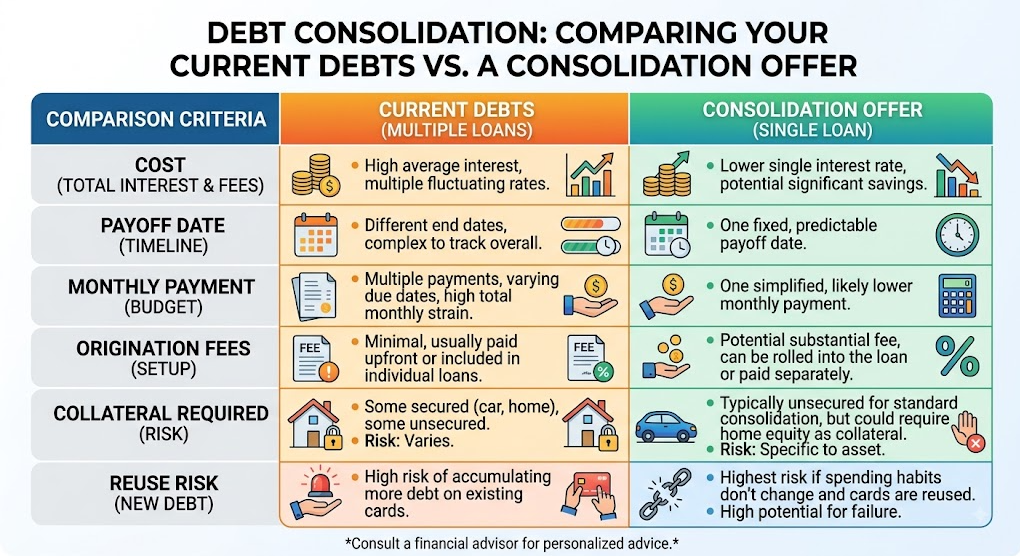
Quick decision: Compare the current debts with the proposed arrangement on the same page. Include every balance, rate, remaining term, minimum payment, fee, promotional expiry, and secured asset. Calculate the new opening balance after fees, the expected total payments through payoff, and the payment required to finish on time. Consolidation is more likely to help when it lowers total cost, keeps the payment sustainable, creates a credible payoff date, and comes with a written plan for the old accounts. It is less likely to help when savings depend on a temporary rate, the term stretches substantially, a home or other asset becomes collateral, or available credit will be reused.
First, Identify What Is Being Offered
“Debt consolidation” is used for several different arrangements:
- A personal or consolidation loan pays selected debts and replaces them with an instalment loan.
- A line of credit moves balances into a revolving account. The payment may be flexible, but the balance can be drawn again.
- A home-equity loan or line of credit may offer a lower rate because the debt is secured by a home. That changes the consequence of nonpayment.
- A credit-card balance transfer offers a promotional rate for a limited period and commonly charges a transfer fee.
- A debt management plan through a credit counsellor is not a new loan. The counsellor proposes one payment arrangement to participating creditors; fees, included debts, interest concessions, and creditor acceptance vary.
Debt settlement, a consumer proposal, and bankruptcy are not interchangeable with consolidation. They may involve reduced repayment, credit consequences, legal processes, or licensed professionals. If an advertisement blurs these categories, stop and obtain a written explanation of the product, provider, and obligations.
FCAC lists personal loans, consolidation loans, personal or home-equity lines of credit, home-equity loans, and balance transfers as possible consolidation tools. The product name alone does not reveal whether the offer is beneficial.
Build a Same-Page Comparison
Create two columns: keep current debts and accept proposed arrangement. Use written statements, agreements, and the lender’s disclosure—not a salesperson’s summary.
For the current path, record:
- each payoff balance;
- annual interest rate and whether it is fixed, variable, or promotional;
- required payment;
- remaining term for instalment debts;
- annual or account fees;
- prepayment terms; and
- whether the debt is secured.
For the proposed path, record:
- amount advanced and which creditors will be paid;
- any debt left outside the arrangement;
- origination, transfer, appraisal, legal, membership, or administration fees;
- whether fees are paid in cash or added to the balance;
- interest rate, rate type, and promotion expiry;
- required payment and full term;
- estimated total of all payments;
- late, returned-payment, prepayment, and renewal terms;
- collateral and the consequence of default; and
- whether old accounts remain open and usable.
Confirm creditor balances after funding. Do not assume that an estimated payout closed an account or covered interest that accrued before settlement.
Compare Total Cost, Not Just the Rate
A lower advertised rate is only one input. Use this practical comparison:
Estimated financing cost = total scheduled payments + upfront fees − amount used to repay existing principal
This is a screening measure, not a lender’s legal disclosure or a precise forecast. Variable rates, optional payments, late charges, and new borrowing can change the result.
Suppose a borrower can either continue paying $700 a month for 36 months or consolidate into a $475 payment for 60 months. The second payment feels easier, but the scheduled totals are $25,200 and $28,500 before comparing fees or different starting balances. The illustration does not prove either offer is good; it shows why payment size cannot answer the cost question.
FCAC warns that extending repayment to reduce the minimum monthly payment costs more interest. Ask for both the monthly payment and the total of payments through the contractual end date.
Test the Payoff Date
A useful consolidation arrangement has an exit. An instalment loan normally provides a scheduled end date if payments are made as agreed. A revolving line of credit may not. An interest-only or minimum-payment structure can make the account affordable today without establishing meaningful principal reduction.
Ask:
- What exact payment retires the balance by the stated date?
- Is that payment fixed, or could the rate and payment rise?
- What happens if only the minimum is paid?
- Can amounts be redrawn after repayment?
- Is there a balloon, renewal, or residual balance?
- Can extra principal be paid without penalty, and how is it applied?
If the proposed payment works only in an unusually strong month, the arrangement has not solved affordability. If the minimum works but creates no credible end date, it has not solved repayment.
Decide Whether the Lower Payment Is Actually Sustainable
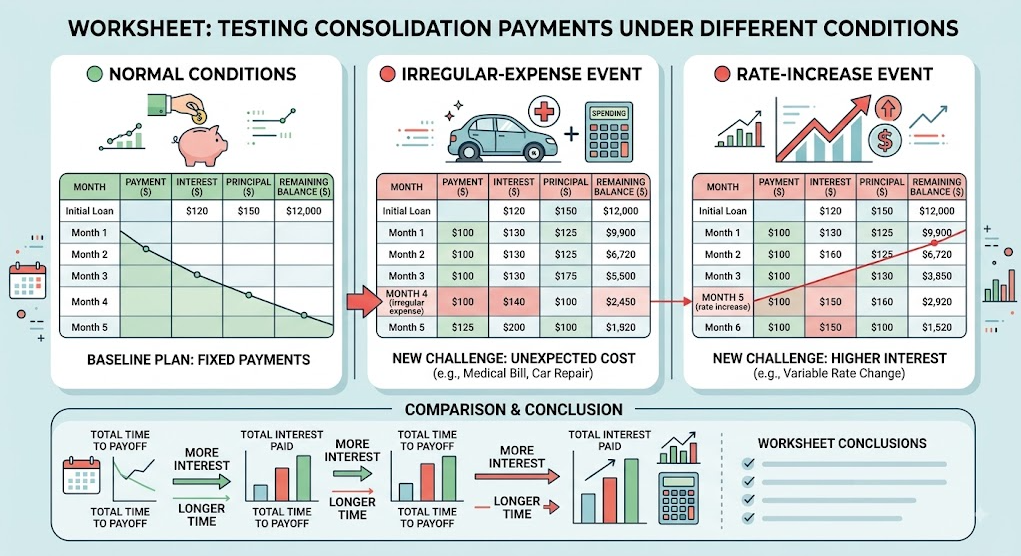
Affordability should be tested after essentials and predictable irregular expenses—not against income alone. Include housing, food, utilities, transportation, insurance premiums, taxes, minimums on excluded debts, and a modest cash buffer.
Approval is not evidence that the payment fits this budget. A lender evaluates its criteria; the household must evaluate its cash flow.
Stress-test the offer:
- Could the payment still be made after a variable-rate increase?
- Does the plan survive an annual insurance premium or necessary repair?
- Is income seasonal, commissioned, or otherwise irregular?
- Are excluded debts still affordable?
- Would one disrupted month immediately send expenses back to a card or LOC?
If the answer depends on borrowing again, the proposed payment is not yet sustainable.
Treat Collateral as a Separate Decision
Moving unsecured debt into a home-equity product may lower the rate, but it also changes what is at risk. A missed credit-card payment and a missed payment on debt secured by a home do not have the same potential consequences.
Do not compare the rates and ignore this transfer of risk. Ask:
- Which asset secures the debt?
- What default rights does the lender have?
- Are appraisal, legal, discharge, or renewal costs involved?
- Is the rate variable?
- Will the balance be repaid within a defined term?
- Is the asset jointly owned or used by other household members?
A lower cost may still be unacceptable if the collateral consequence is disproportionate. Independent legal or qualified financial advice may be appropriate before pledging a major asset.
Prevent the Old Debt From Returning
Consolidation succeeds only if the transferred balances stay transferred. Decide what happens to each old account before funding:
- close it after confirming all residual interest and recurring charges are cleared;
- reduce the limit;
- freeze or lock it;
- remove it from wallets and stored payment methods; or
- keep it open under a written, limited-use rule.
Account closure can affect access, fees, insurance, automatic payments, utilization, and credit history. It should not be automatic. But leaving every limit untouched without a use rule creates a clear relapse path.
Build sinking funds for annual insurance, taxes, repairs, and other predictable expenses. Without them, the first irregular bill can reopen the revolving balance even when ordinary monthly spending is controlled.
Jerome’s Experience: A Transfer Would Not Have Fixed the Refill
Jerome did not describe consolidating his debts. No consolidation event or outcome should be inferred.
His experience with a line of credit illustrates a narrower risk. Interest payments became familiar because they felt manageable, while regular principal repayment never became habitual. When large insurance costs arrived during the year, the LOC balance rose again after partial repayment.
Moving that balance to another product, by itself, would not have funded the insurance costs or created a principal-payment habit. A successful consolidation plan would have needed both: a defined payment that reduced principal and a separate reserve for the recurring large expenses.
This is a behavioural boundary, not evidence that a particular consolidation product would have been available or appropriate for him.
When Consolidation Is More Likely to Help
The arrangement deserves further consideration when all or most of these conditions are present:
- the effective cost is lower after all fees;
- the term does not erase the interest savings;
- the payment fits conservative cash flow;
- the payoff date is clear;
- variable-rate or promotional risk is manageable;
- no unacceptable collateral risk is introduced;
- selected creditors will actually be paid in full;
- excluded debts remain affordable;
- old credit has a deliberate control plan; and
- predictable expenses have a funding source other than new debt.
The benefit is not merely convenience. One payment must support a cheaper or more reliable route to zero.
When It Is Less Likely to Help
Pause when:
- the sales discussion focuses only on the monthly payment;
- fees are added to the new principal without a clear comparison;
- a short promotional rate is followed by a high or uncertain rate;
- the term becomes much longer;
- unsecured debt becomes secured without careful risk review;
- the offer excludes balances that still make the budget unworkable;
- the payment is affordable only if no irregular expense occurs;
- available credit will remain unrestricted and likely to refill;
- the provider cannot explain who pays creditors and when;
- the company promises guaranteed approval, debt elimination, or fast forgiveness; or
- you are told to stop communicating with creditors without a clear written explanation of consequences.
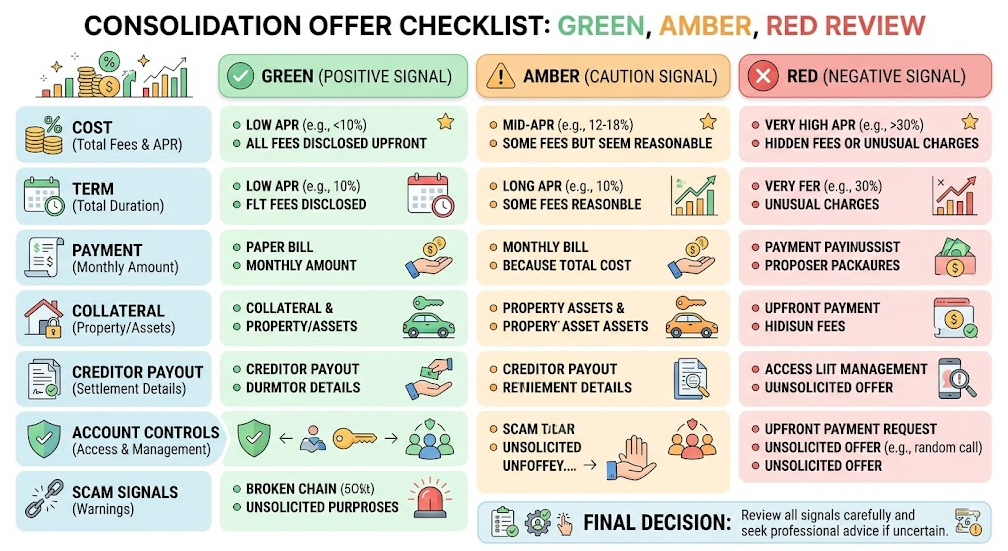
The FTC warns that unsolicited debt-relief offers, guarantees, requests for personal information, and demands for upfront payment are scam indicators. Canadian guidance similarly recommends comparing reputable sources and confirms that only a Licensed Insolvency Trustee can provide access to consumer proposals and bankruptcies.
Use a Written Offer Checklist
Before signing, obtain answers to these questions:
- What is the new principal, including financed fees?
- Which debts are included, and which remain?
- What are the annual rate, rate type, and change rules?
- What is the payment, term, and total of payments?
- What happens at the end of a promotion or term?
- Is any asset pledged?
- Are optional insurance or add-on products included?
- Who sends the creditor payouts, and how are residual balances handled?
- Can extra payments be made, and do they reduce principal immediately?
- What happens after a missed or returned payment?
- What happens to the old accounts?
- What complaint, cancellation, or cooling-off rights apply locally?
Take time to compare. A legitimate offer should survive a careful reading.
If the Numbers Do Not Work
If no consolidation offer produces an affordable and credible payoff, do not keep applying simply because approval feels like progress. Repeated applications may also affect credit depending on the jurisdiction and inquiry type.
Contact creditors before payments are missed when possible. Ask what hardship, rate, term, or due-date options exist and request the terms in writing. A reputable credit counsellor may help review the budget or discuss a debt management plan. FCAC notes that these plans may combine eligible payments, but fees apply, not all creditors must participate, and secured debts such as mortgages and car loans usually are not covered.
When debt cannot be repaid as contracted, consult the appropriately qualified or licensed professional for the jurisdiction. Do not let a consolidation salesperson present a new loan as the only available solution.
Decision Summary
- Consolidation moves debt; it does not erase principal.
- Identify the exact product before comparing it.
- Put the current path and proposed path on the same page.
- Compare total payments, fees, and payoff dates—not only rates or monthly payments.
- Test affordability against essentials, irregular expenses, and rate changes.
- Treat new collateral as a separate risk decision.
- Confirm which creditors are paid and what happens to old accounts.
- Prevent reuse with account controls and sinking funds.
- Walk away from guarantees, pressure, unexplained fees, or unclear provider roles.
- Seek reputable qualified help when the payment remains unaffordable.
A useful consolidation offer makes the route out of debt cheaper, clearer, and harder to reverse. If it only makes the balance look tidier, it has not solved the problem.
This article provides general educational information, not individualized financial, legal, tax, credit, mortgage, or insolvency advice. Product terms, consumer protections, credit reporting, tax treatment, and professional licensing vary by jurisdiction.
Frequently Asked Questions
Does debt consolidation reduce how much I owe?
Usually not at the moment of transfer. It combines or refinances balances, and fees may even increase the opening principal. Savings occur only if the new path reduces interest and other costs over time.
Is a lower monthly payment always better?
No. It may improve cash flow, but a longer term can increase total interest. Compare the total of payments, fees, and payoff date.
Should I consolidate credit cards into a line of credit?
Only after comparing rate, fees, payment structure, variable-rate risk, payoff date, and redraw risk. A revolving LOC without a principal rule may allow the balance to persist.
Is a balance-transfer card a consolidation loan?
No. It transfers balances to another revolving card, usually with a fee and limited promotional rate. The required payoff payment and post-promotion rate matter.
Should I close cards after consolidating them?
Not automatically. Review recurring charges, fees, credit history, utilization, and future access. Each account still needs a deliberate close, reduce, freeze, or limited-use decision.
Does approval mean I can afford the consolidation payment?
No. Test the payment against your own essential expenses, irregular costs, income variability, excluded debts, and a reasonable cash buffer.
Where can I get help if consolidation does not make the payment affordable?
Contact creditors early and compare reputable credit-counselling or other qualified options. For formal insolvency processes, use the professional licensed for that work in your jurisdiction.
Sources
- FCAC – Getting Help From a Credit Counsellor
- FCAC – Debt Consolidation
- FCAC – Paying Back Your Debt
- FTC – Looking for Debt Relief? Here’s How to Avoid a Scam
- FCAC – Debt/Credit-Repair Consumer Alert
More in This Cluster: Debt Payoff Strategies
- Debt Snowball vs Debt Avalanche
- How to Prioritize Multiple Debts
- Should You Save or Pay Off Debt First?
- How to Pay Off Credit Card Debt Without Losing Momentum
- Debt Consolidation: When It Helps and When It Does Not (you are here)
- How to Build a Realistic Debt Payoff Timeline
- What to Do After You Become Debt-Free