A credit score can change overnight without telling you why. The number may be lower than the one in your banking app, different from the score a lender quotes, or simply unfamiliar. Watching it more closely may confirm that something moved, but the explanation usually lives somewhere else.
That place is the credit report.
The report contains the account-level record supplied to a credit bureau. A scoring model reads selected information from that record and calculates a number. When the number raises a question, the report is the document that lets you investigate.
Quick decision: Use a credit score to see a summarized risk signal and track broad changes. Use the underlying credit reports to verify accounts, balances, limits, payment status, dates, and inquiries. Before an important application, review every relevant bureau’s report—not only the score shown by one app. If information appears wrong, preserve the report and supporting records, then dispute the specific item through the process for your country.
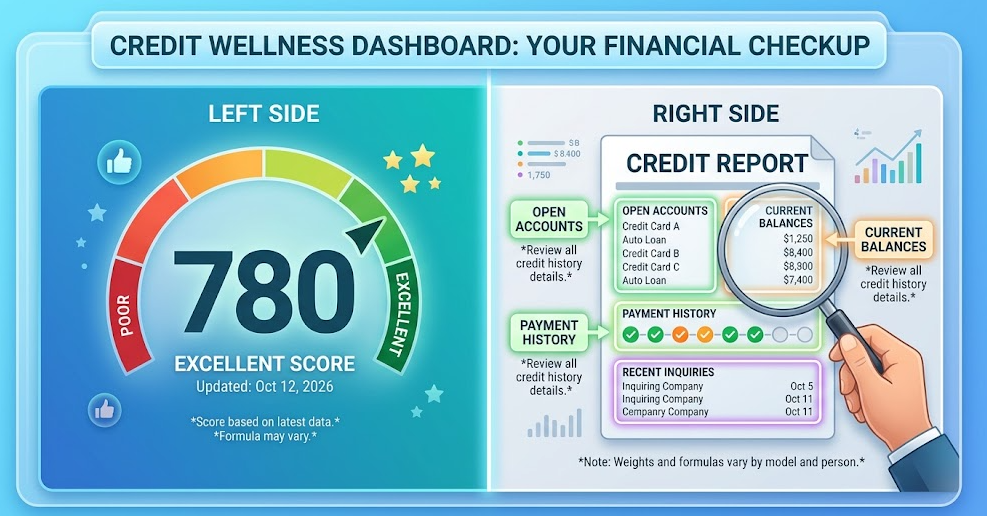
The Difference in One Example
Imagine that a banking app shows a score of 735. That number does not reveal whether one card reported a high statement balance, an auto loan was marked late, a new inquiry appeared, or an old account disappeared from one bureau’s file.
The corresponding report might show:
- a credit card with a $10,000 limit and a $7,200 reported balance;
- a loan identified as current or past due;
- the date each account was opened;
- a creditor name that differs from the brand on the card;
- a recent application inquiry; and
- an account the consumer does not recognize.
The score compresses many details into an output. The report preserves the details. Neither replaces the other.
| Credit report | Credit score |
|---|---|
| A record assembled by a credit bureau or reporting agency | A number calculated by applying a scoring model to report information |
| Shows accounts, balances, payment history, dates, inquiries, and other permitted data | Summarizes a defined type of credit risk |
| Can reveal the item that needs verification or correction | Can signal that the overall profile changed |
| Different bureaus may hold different records | Different bureaus, models, versions, dates, and purposes may produce different numbers |
| Reviewed line by line | Interpreted with its model, range, bureau, and date |
What Is Usually Inside a Credit Report?
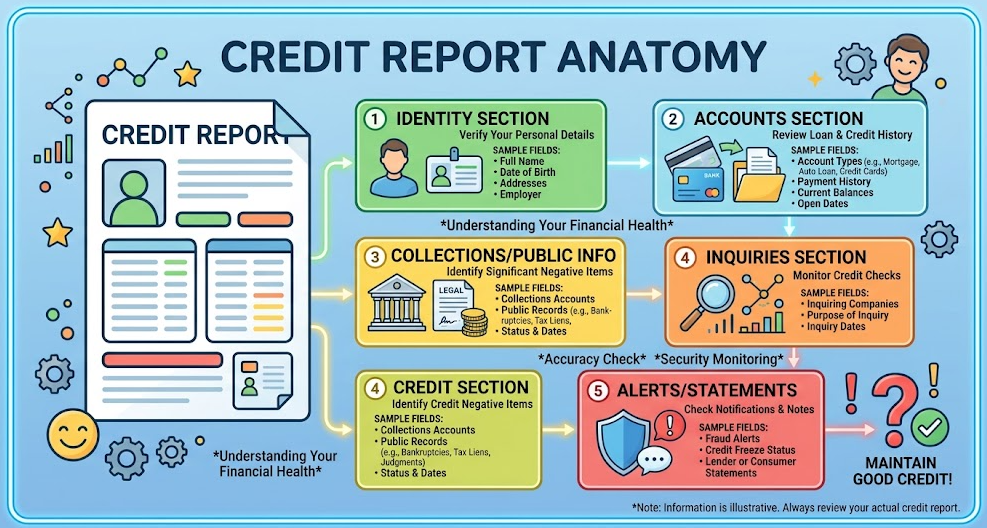
Formats differ, but reports commonly organize information into several sections.
Identifying information
This may include a name and variations, current and former addresses, birth date, telephone numbers, and government identification information allowed in that jurisdiction. Employers may appear as identifying history even when employment or salary is not a factor in a particular score.
A former address or old employer is not automatically harmful. Its importance is whether the information belongs to you and whether it suggests that another person’s file has been mixed with yours.
Credit accounts
Each account may be called a trade line. Typical fields include:
- creditor or account provider;
- account type, such as revolving, installment, mortgage, or line of credit;
- opening and closing dates;
- credit limit or original loan amount;
- current or recently reported balance;
- payment status and payment history;
- responsibility, such as individual, joint, or authorized user; and
- date last updated.
The “date updated” matters. A balance shown on the report may be the amount supplied on the creditor’s last reporting date, not the balance visible in the account today. Paying a card yesterday does not guarantee that every bureau will display the new balance today.
Collections, insolvency, and permitted public information
Reports may contain debts sent to collection and certain insolvency or public-record information, depending on the country, province, state, bureau, and current law. The type of information allowed and how long it may remain are jurisdiction-specific.
Do not use a U.S. retention period to interpret a Canadian report, or vice versa. Even within Canada, provincial rules and remedies can differ.
Inquiries
The inquiry section records organizations that accessed the report. Some inquiries arise from formal credit applications; others reflect account reviews, consumer requests, screening, or promotional activity.
An inquiry may be unfamiliar because an auto dealer sent an application to several lenders or because a creditor operates under a different legal name. It may also indicate an application you did not authorize. Compare the date with your records before deciding which explanation fits.
Consumer statements, alerts, and other notices
A report may include a fraud or identity alert, a security-freeze notation, or a consumer statement. These tools have different legal effects and availability. A statement can explain an unresolved dispute, but it does not force a lender to disregard information that remains on the report.
Why Reports From Different Bureaus May Not Match
Jerome once avoided looking at his own credit because he thought any check might damage the score. Learning that a self-check does not hurt it solves only the first barrier. The next surprise is that obtaining one report may not show the entire picture.
Creditors do not necessarily report to every bureau. They may send updates on different schedules, and bureaus may process or display information differently. An account can therefore appear on one report but not another, or show a different last-updated date.
That difference is not proof that either report is wrong. Begin with the source and timing:
- Which bureau produced the report?
- On what date was it obtained?
- When did the creditor last update the account?
- Does the creditor report to the other bureau?
- Are the account names or numbers formatted differently?
In the United States, the three nationwide credit reporting companies are Equifax, Experian, and TransUnion. In Canada, the two main credit bureaus are Equifax and TransUnion. Other countries use different systems, and specialty consumer-reporting companies may maintain separate records for areas such as tenant screening, insurance, employment, or bank-account history.
A conventional credit report is therefore not a universal dossier. It shows the information held by that reporting organization for the type of report requested.
How to Read a Report Without Getting Lost
Start with ownership before evaluating whether an item is “good” or “bad.”
Pass 1: Does everything belong to you?
Check names, addresses, accounts, joint relationships, and inquiries. Mark anything that could belong to another person or result from identity theft.
Pass 2: Are the account facts accurate?
Compare the creditor, account type, responsibility, limit or original amount, current balance, payment status, and open or closed dates with statements and contracts.
Pass 3: Are the dates internally plausible?
Look at the last-updated date before treating a balance as current. Confirm that an account was not reported as opened before the actual agreement or kept open after it was closed.
Pass 4: Is negative information accurate and still reportable?
An unfavorable item is not an error merely because it lowers a score. Verify the amount, status, ownership, dates, duplication, and applicable retention rule. Accurate current negative information generally cannot be removed simply by filing a dispute.
Pass 5: Who accessed the file?
Match inquiries to applications, existing-account reviews, landlord checks, or other authorized purposes. Investigate an inquiry that remains unexplained after checking merchant and lender names.
Use a copy of the report as a working document. Record the bureau, report date, confirmation number, disputed field, supporting document, submission date, and response. General complaints such as “my score is too low” give an investigator less to verify than a precise statement such as “Account 1234 reports a 60-day late payment for March; the attached statement and bank record show the full payment was received on February 27.”
Unfamiliar Does Not Always Mean Incorrect
Some entries look wrong at first and become understandable after one additional check.
- A retailer card may appear under the issuing bank’s legal name.
- A collection account may display the collector rather than the original creditor.
- A transferred mortgage or student loan may show an old account closed and a new servicer account opened.
- A zero balance may not appear until the next reporting cycle.
- An authorized-user account may appear even though the reader is not the primary borrower.
- An auto-shopping inquiry may use the name of a finance company the dealer contacted.
Contact the creditor using a trusted statement or official website and ask how it reports the account. Do not call a phone number found only in an unexpected message or unverified search result.
After that check, unresolved discrepancies fall into more actionable groups:
- Wrong identity: The account, address, or inquiry does not belong to you.
- Wrong account fact: The balance, limit, status, date, or responsibility is inaccurate.
- Duplicate reporting: The same obligation appears more than once in a way that misstates the debt.
- Stale information: A creditor has not supplied a correction or an item remains beyond the applicable reporting period.
- Possible fraud: An account or application may have been opened without authorization.
Each group may require different evidence and, for fraud, additional protective steps beyond an ordinary accuracy dispute.
Disputing an Error: Build a Verifiable Record
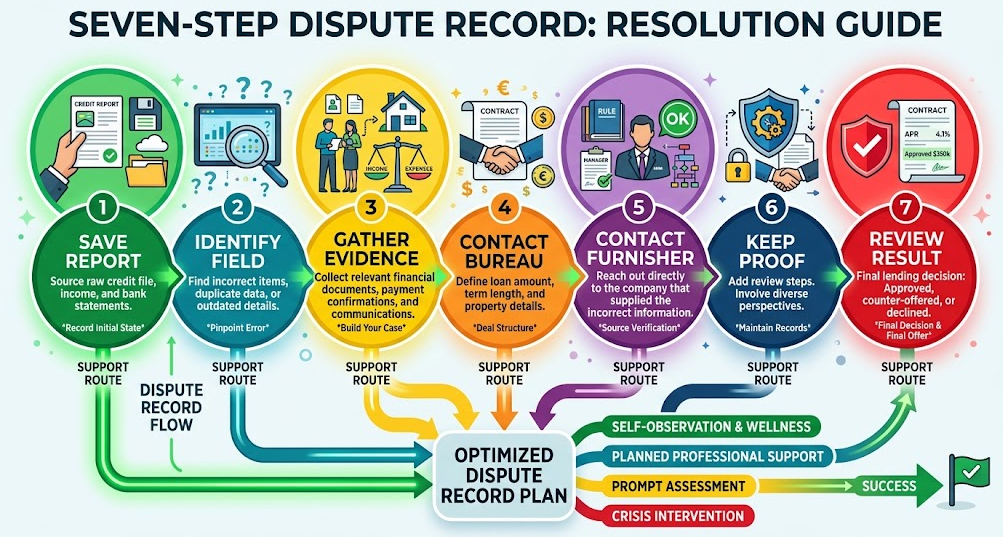
The basic workflow is similar across jurisdictions even though legal procedures and deadlines differ.
- Save the report. Keep the full report, bureau name, date, and reference or confirmation number.
- Identify the exact field. Name the account and the specific fact believed to be wrong.
- Gather evidence. Statements, cleared-payment records, closure letters, identity documents, or correspondence may support the claim.
- Contact the bureau. Use the bureau’s official dispute process.
- Contact the information provider. Notify the lender, collector, or other company that supplied the disputed data when appropriate.
- Keep proof of submission. Save upload confirmations, letters, attachments, and delivery records.
- Review the result. Compare the updated report with the original and check other bureaus that may contain the same item.
United States
CFPB advises disputing inaccurate information with both the credit reporting company and the company that furnished it. A U.S. credit reporting company generally must investigate within 30 days, although some circumstances allow up to 45 days, and it generally has five business days after completing the investigation to notify the consumer of the result.
If a credit application was denied based on a report, the adverse-action notice should identify the reporting company and explain access rights. CFPB states that a consumer may request a free copy from that company within 60 days of the notice.
Canada
The Financial Consumer Agency of Canada advises contacting the main credit bureaus and the lender or organization that supplied the information. Credit bureaus must correct verified errors for free. If the investigation does not resolve the matter, escalation and consumer-statement options may be available, with processes varying by province and institution.
If an account may result from identity theft, an accuracy dispute is only one part of the response. Contact affected lenders and both main Canadian bureaus, use the official fraud-reporting process, and ask about a fraud alert or any security-freeze option available in the province or territory.
What a Corrected Report Can—and Cannot—Do
Correcting a material error may change a score when a model recalculates using the corrected information. The timing and size of any change cannot be promised. The bureau, creditor-update cycle, model, and rest of the file still matter.
Removing an error also does not guarantee approval. A lender may use another score, another report, income and debt information, collateral, or separate policy rules. The goal of a dispute is an accurate file, not a guaranteed number or loan result.
Be cautious with a company that promises to create a new identity, erase accurate current negative information, or deliver a specific point increase. In the United States, CFPB emphasizes that consumers can dispute inaccuracies themselves at no cost. In Canada, FCAC likewise states that bureaus must correct errors for free.
What to Do Before a Major Application
Review reports early enough to investigate, rather than on the day a lender must decide.
- Obtain the relevant reports through official or government-recommended channels.
- Compare bureaus instead of assuming one file represents all of them.
- Preserve a dated copy of each report.
- Resolve identity-theft signals promptly.
- Submit precise disputes with supporting documents.
- Avoid applying repeatedly merely to discover which lender sees which record.
- Keep cash-flow and affordability planning separate from score monitoring.
For U.S. consumers, AnnualCreditReport.com is the federally authorized access point for the three nationwide reports, and CFPB says free online access is currently available weekly. In Canada, FCAC directs consumers to free Equifax and TransUnion reports. Checking your own reports does not lower your credit score in either country.
The Bottom Line
The score is a summary; the report is the evidence file beneath it. A score can tell you that a risk calculation changed. A report can show which account, balance, status, date, or inquiry may have contributed—and whether the information belongs to you.
When the number is surprising, write down its bureau, model, type, and date. Then inspect the corresponding report rather than trying to manipulate the score blindly. Accuracy comes first. The later Credit Fundamentals articles will address what builds credit, how late payments and utilization work, and how recovery unfolds over time.
Important Note
This article provides general educational information, not individualized financial, credit, identity-theft, or legal advice. Credit-report contents, dispute rights, investigation periods, fraud protections, and retention rules vary by jurisdiction. Use the official process for your country and seek qualified local assistance when a dispute, fraud event, or imminent lending decision has significant consequences.
Frequently Asked Questions
Does a free credit report include a credit score?
Not necessarily. A report-access service may provide the report without a score. A bank, card issuer, bureau, or separate service may provide a score under different terms.
Why is an account missing from one bureau’s report?
The creditor may not report to that bureau, may report on a different schedule, or may use a name or account format you do not recognize. Confirm with the creditor before labeling the omission an error.
Can I dispute a score directly?
A dispute normally identifies inaccurate or incomplete information in the underlying report. If the report is accurate but scores differ, compare the bureau, model, version or type, purpose, and calculation date.
Can accurate negative information be removed?
Generally, an item is not removable merely because it is unfavorable. Dispute inaccurate, duplicated, identity-theft-related, or unlawfully retained information through the applicable process.
Should I pay a credit-repair company to file a dispute?
Consumers can dispute inaccurate information directly. U.S. and Canadian regulators state that correction of verified errors is available without paying a company to submit the dispute.
What if I do not recognize a creditor’s name?
Check statements, recent applications, transferred accounts, issuing-bank names, and collection notices. Contact the known creditor through a verified channel. Treat the item as possible fraud if it remains unexplained.
How soon before a mortgage or auto loan should I review my reports?
Allow enough time to gather evidence and complete the dispute process if needed. The appropriate lead time depends on the jurisdiction and application date; reviewing several months ahead is generally more useful than waiting until closing.
Sources
- Consumer Financial Protection Bureau — What Is a Credit Report?
- Consumer Financial Protection Bureau — When Should I Review My Credit Report?
- Consumer Financial Protection Bureau — How Long Does It Take to Repair an Error?
- Consumer Financial Protection Bureau — Credit Application Denied Because of a Report
- Consumer Financial Protection Bureau — Can Accurate Negative Information Be Removed?
- Financial Consumer Agency of Canada — Credit Report and Score Basics
- Financial Consumer Agency of Canada — Getting Your Credit Report and Credit Score
- Financial Consumer Agency of Canada — Checking Your Credit Report for Errors and Fraud
- AnnualCreditReport.com — Official U.S. Credit Report Access
More in This Cluster: Credit Fundamentals
- How Credit Scores Work
- Credit Report vs. Credit Score: What Each One Tells You (you are here)
- What Actually Helps Build Credit?
- Common Credit Score Myths That Can Cost You Money
- How Late Payments Affect Your Credit—and What to Do Next
- Credit Utilization Explained: Which Balance Actually Counts?
- How Long Does It Take to Rebuild Credit?