A cardholder can pay every statement in full and still open a credit app to find a large balance on the report. The payment was not ignored. The app and the credit bureau may simply be showing two different moments in the account’s monthly cycle.
Credit utilization compares revolving balances with revolving credit limits. The calculation is simple; the timing is not. A current balance can change with every purchase and payment. A reported balance is the snapshot a creditor supplied to a bureau. A statement balance belongs to a completed billing cycle. The amount carried beyond the due date determines whether purchase interest may accrue under the card terms.
Once those amounts are separated, utilization becomes a manageable reporting question rather than a mysterious penalty.
Quick decision: Add the revolving balances shown on the relevant credit report and divide them by the corresponding reported limits. Also check each card separately. If utilization appears unexpectedly high, identify the report date, statement closing date, issuer’s reporting practice, recent payments, pending charges, and any limit change. Pay down debt according to cash flow and interest cost; do not borrow, pay interest, or move money repeatedly merely to display a particular percentage.
The Basic Calculation
For one revolving account:
Card utilization = reported balance ÷ reported credit limit × 100
If a card shows a $1,000 reported balance and a $5,000 reported limit:
$1,000 ÷ $5,000 × 100 = 20%
For several revolving accounts:
Aggregate utilization = total reported revolving balances ÷ total reported revolving limits × 100
Suppose a report shows:
| Card | Reported balance | Reported limit | Card utilization |
|---|---|---|---|
| A | $900 | $3,000 | 30% |
| B | $100 | $2,000 | 5% |
| C | $0 | $5,000 | 0% |
| Total | $1,000 | $10,000 | 10% aggregate |
The aggregate ratio is 10%, but Card A is at 30%. Some scoring systems consider both overall revolving utilization and the use of individual accounts. A low overall ratio therefore does not make a nearly maxed-out single card invisible.
This calculation usually concerns revolving credit such as credit cards and lines of credit. An installment loan has an original amount and a declining balance, but it is not normally placed into the same credit-limit ratio as a card. Scoring models may still consider installment debt through other parts of the file.
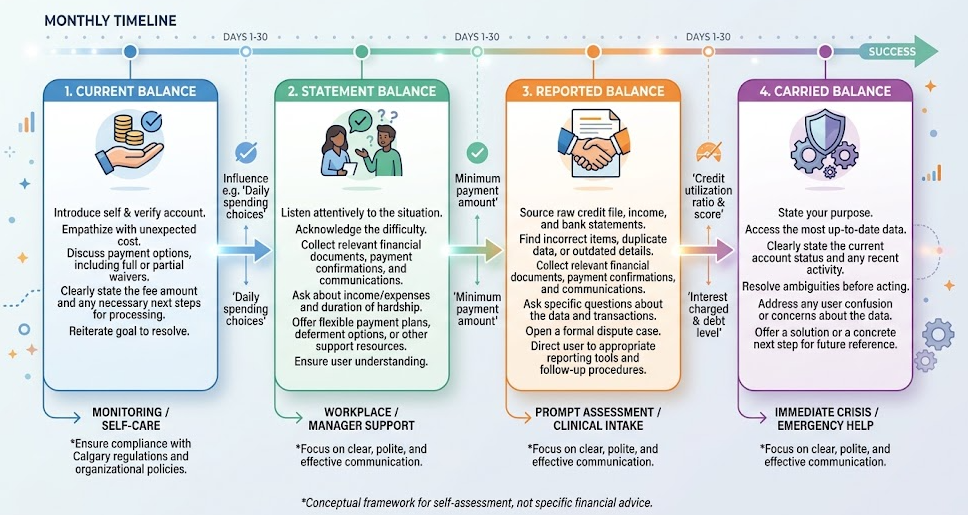
Four Balances That Answer Different Questions
Current balance
The current balance is what the issuer’s app or website shows now. It may include purchases since the last statement and may exclude pending transactions or a payment still being processed.
Use it to understand what is presently owed to the issuer. It may not be the balance most recently furnished to the bureau.
Statement balance
The statement balance is the amount at the end of a billing cycle. It appears on the monthly statement along with the minimum payment and due date.
Many issuers commonly report a cycle-ending or statement balance, but practices vary. Some report on another regular date or after particular account activity. Ask the issuer rather than assuming every card reports on its closing date.
Reported balance
The reported balance is the figure currently appearing in a particular bureau’s file. It may lag behind the app because the issuer has not sent—or the bureau has not yet incorporated—a newer update.
Different bureaus may show different balances when a creditor reports to them on different schedules or does not report to all of them.
Carried balance
A carried balance is the amount left unpaid beyond the statement due date. Under the card agreement, that amount may accrue interest and may affect the grace period for new purchases.
A reported balance does not prove that interest was paid. A cardholder can allow a statement to generate, then pay the full statement balance by the due date. The report may still show the statement snapshot even though no balance was carried past the due date.
Why Paying in Full Can Still Produce Utilization
Consider a card with a $2,000 limit:
- $800 in purchases posts before the statement closes.
- The statement is issued with an $800 balance.
- The issuer reports that balance.
- The cardholder pays all $800 by the due date.
The cardholder paid in full and may avoid purchase interest under the agreement. Until the next creditor update reaches the bureau, the report can still show $800, or 40% utilization on that card.
Nothing in this sequence requires the cardholder to carry debt. The report is showing a past snapshot, while the bank account and card app have moved forward.
This distinction matters before an important application. A lender may pull the report before the lower balance has been updated. If timing matters, ask the issuer when it normally reports and allow time for the bureau file to update. No issuer or bureau is required to respond instantly to a payment merely because an application is approaching.
Is 30% a Rule?
U.S. CFPB and Canada’s FCAC both use 30% as practical consumer guidance for keeping revolving use from becoming high. It is a useful warning level, not a universal scoring law.
There is no public rule saying that 29% is safe while 30% causes the same point loss for every person. Scoring models, bureau data, individual-card balances, overall balances, and the rest of the file matter. Lower revolving use generally indicates less dependence on available credit, but no single percentage guarantees a score or approval.
Use the percentage as a planning signal:
- Low enough for ordinary cash flow: purchases can be paid without carrying expensive debt.
- Room for normal variation: one grocery trip or hotel hold does not push the card near its limit.
- Appropriate for an upcoming application: reported balances reflect the debt level the borrower wants the lender to evaluate.
The household budget remains the primary control. A person should not delay food, rent, medication, insurance, or emergency needs to achieve a cosmetic utilization target without considering the consequences.
Individual-Card and Aggregate Utilization
Aggregate utilization can hide concentration.
Imagine two people who each report $2,000 of card debt against $10,000 of total limits.
- Person One has $1,000 on each of two $5,000 cards.
- Person Two has $2,000 on one $2,000 card and $0 on an $8,000 card.
Both have 20% aggregate utilization. Person Two also has one fully used card. Some scoring models consider the highest utilization on individual revolving accounts, and lenders can see the account-level balances on the report.
When deciding what to pay first, interest cost, minimum payments, hardship risk, and account status matter alongside utilization. Paying the highest-rate debt may save more money. Paying down a nearly maxed card may improve available room and reduce over-limit risk. Those objectives can point to the same account—or to different ones.
A score-only strategy should not override a sound debt-payoff plan without a clear reason.
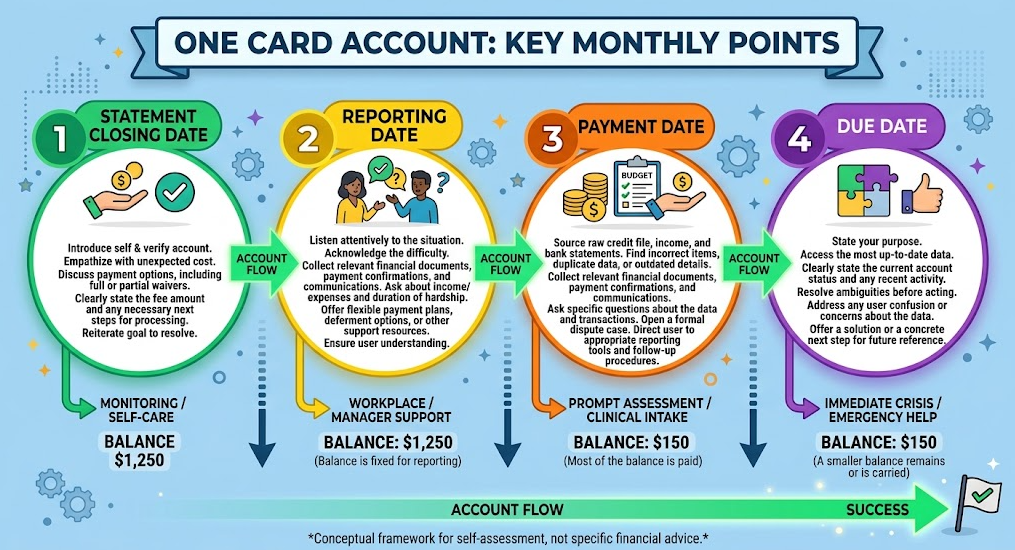
Statement Closing Date Versus Payment Due Date
These dates perform different jobs.
- Statement closing date: ends the billing cycle and produces the statement balance.
- Payment due date: deadline for the required payment and, when applicable, full payment needed to preserve a purchase grace period.
Paying before the due date protects payment status. Paying before the statement closes may reduce the cycle-ending balance that many issuers report. One payment can serve both purposes only when its timing and amount do so.
A common routine is:
- Keep purchases within cash already available.
- Make a payment before the closing date when a large temporary balance needs to be reduced for reporting.
- Review the issued statement.
- Pay the remaining statement balance by the due date.
This is optional cash-flow management, not a scoring requirement. It adds work and can fail if pending transactions post later, a payment processes slowly, or the issuer reports on another date. The simplest sustainable system may be one full payment by the due date and acceptance of normal monthly reporting variation.
What Changes the Ratio Without New Spending?
Utilization can move even when the cardholder makes no purchase.
A payment is reported
The numerator falls after the creditor updates the lower balance.
A credit limit changes
If a $5,000 limit falls to $3,000 while the reported balance remains $1,000, utilization rises from 20% to about 33%. An issuer may reduce a limit under its policies and applicable law.
An account closes
A closed card may stop contributing its unused limit to available revolving credit. The remaining balances are then divided by a smaller total limit. This is why account closure does not automatically improve a score.
A balance transfer posts
Moving debt may reduce one card’s ratio while increasing another’s. The total debt may remain similar, and a transfer fee can increase it. A new application may also add an inquiry and account.
A card is newly reported or omitted
A new account can change both totals. An issuer that does not report a limit consistently can also complicate the apparent calculation.
A temporary hold affects available credit
Hotels, rental-car companies, and fuel stations may place authorization holds that reduce available credit in the issuer’s app. A hold is not necessarily the same as a posted or bureau-reported balance, but it can reduce spending room and create practical risk near the limit.
Should You Ask for a Higher Limit?
A higher limit can lower the ratio if spending remains unchanged. It can also create a hard inquiry, tempt additional spending, or produce no increase at all.
Before requesting one, ask:
- Will the issuer use a hard inquiry?
- Has income or employment information been updated accurately?
- Can the existing account be managed without increasing purchases?
- Is a major loan application approaching?
- Would paying down debt be safer than expanding capacity?
In Canada, federally regulated institutions generally need express consent before increasing a card limit. In the United States, issuer practices and inquiry treatment vary. Get the process in writing or through the issuer’s verified channel.
An unsolicited limit-increase message should never require gift cards, cryptocurrency, or payment to release the new limit.
Zero Utilization Does Not Require an Interest Balance
Two ideas are often mixed together:
- allowing a small balance to appear on a report; and
- carrying that balance beyond the due date and paying interest.
They are separate. A card can report a small statement balance that is later paid in full by the due date. Consumers do not need to pay interest to demonstrate use.
Some FICO models may evaluate very low reported use differently from no revolving use at all, but that does not create a reason to manufacture debt or obsess over a few dollars. Models differ, and lenders evaluate more than one score. Normal, affordable card use followed by full payment is sufficient for most readers who choose to use a card.
If Utilization Jumps Unexpectedly
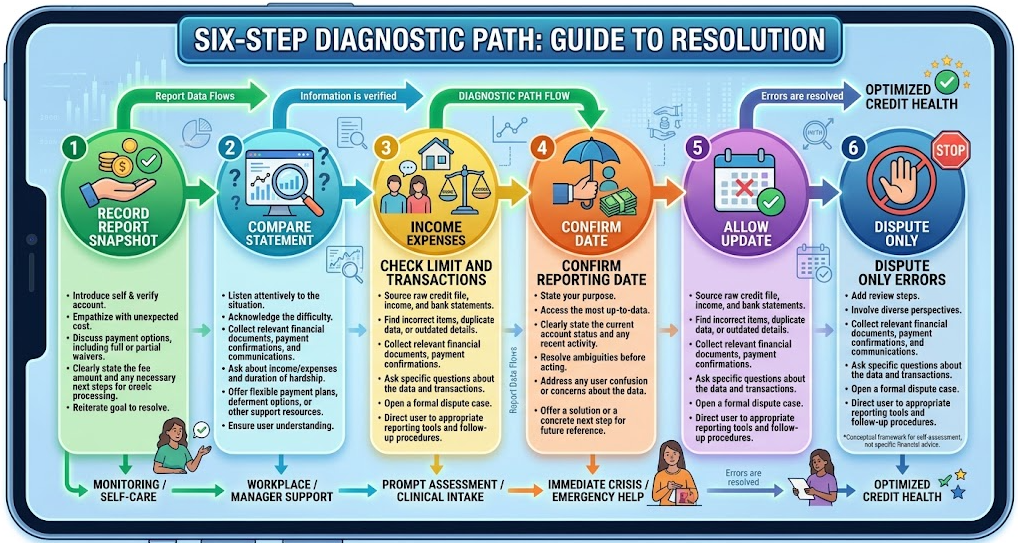
Work from the report backward.
- Record the bureau, report date, card balance, and reported limit.
- Compare them with the latest statement and current issuer account.
- Look for a lower limit, returned payment, interest charge, fee, balance transfer, or newly reported account.
- Confirm the issuer’s normal reporting date and bureau coverage.
- Allow completed payments time to post and reach the bureau.
- Dispute only information that is inaccurate or incomplete.
If the balance is correct but temporarily high, decide whether it can be paid from existing cash without disrupting essential obligations. If the balance cannot be paid in full, prioritize a sustainable payoff plan and on-time minimums. A lower score is less costly than replacing card debt with a more dangerous loan solely to change the
Preparing for a Mortgage, Auto Loan, or Rental Application
Utilization becomes more time-sensitive when a report will soon be reviewed.
Several weeks before the application:
- review reports from the relevant bureaus;
- list each revolving balance and limit;
- avoid new card applications unless necessary;
- ask issuers about reporting schedules;
- reduce balances with available cash according to the household plan; and
- preserve funds needed for closing, deposits, taxes, insurance, and emergencies.
Do not assume that paying a card today guarantees a lender will see the new balance tomorrow. Ask the lender when it expects to pull or refresh reports and what documentation it accepts. Avoid rapid-rescore or update promises unless they come through a verified lender process with clearly explained terms.
The lender may also consider income, required monthly debts, loan-to-value measures, rental criteria, or internal policy. A low utilization ratio is not an approval guarantee.
A Monthly Utilization Review
Once a month, record:
| Account | Reported balance | Reported limit | Individual rate | Statement close | Due date |
| Card A | |||||
| Card B | |||||
| Card C | |||||
| Total | Aggregate rate |
This table is a diagnostic tool, not a daily score ritual. Monthly review is usually enough to reveal concentration, limit changes, reporting lags, or a growing balance that no longer fits the budget.
The Bottom Line
Credit utilization is a snapshot of reported revolving balances divided by reported revolving limits. It can be calculated for each account and across the revolving accounts together.
The percentage may differ from what the card app suggests because current, statement, reported, and carried balances answer different questions. Paying in full can coexist with a reported balance. Reporting a balance does not require paying interest.
Keep revolving debt low enough that ordinary expenses and one unexpected charge do not place the account near its limit. Before an important application, review the actual reports and allow time for updates. Use 30% as a cautionary planning reference, not a universal score boundary.
Most importantly, reduce debt for financial stability and interest savings. A better ratio should be the result of manageable borrowing, not a reason to create new costs.
Important Note
This article provides general educational information, not individualized financial, credit, lending, legal, or tax advice. Reporting dates, bureau coverage, scoring treatment, credit-limit policies, inquiry practices, grace periods, and account terms vary by issuer, model, and jurisdiction. Verify account details with the creditor and review official credit reports before a material application. Seek qualified local help when debt payments compete with essential expenses or a lending deadline has significant consequences.
Frequently Asked Questions
Is credit utilization based on all debt?
The commonly discussed ratio focuses on revolving balances and limits. Installment loans remain part of the credit file but are not usually divided by card limits in the same calculation.
Is 30% the point where my score drops?
No universal threshold produces the same result for every file or model. Below 30% is widely used as consumer guidance, while lower use generally indicates less reliance on revolving credit.
Why does my report show a balance after I paid the card?
The report may contain an earlier creditor snapshot. Compare the report date, statement, payment-posting date, and issuer reporting schedule.
Should I pay before the statement closes or by the due date?
Payment by the due date protects the payment obligation. An earlier payment may reduce a balance that an issuer reports, but reporting dates vary. Never miss the due date while trying to manage the earlier snapshot.
Does carrying a small balance help utilization?
Carrying a balance past the due date can create interest and is unnecessary. A balance may appear on a report even when the statement is paid in full by the due date.
Will closing an unused card raise utilization?
It can if the account’s limit stops contributing to total available revolving credit. Fees, fraud risk, spending control, and the issuer’s treatment should also be considered.
How quickly will a lower balance change my score?
The creditor must first report the update, the bureau must incorporate it, and the score must be recalculated using that file. Timing varies, so no universal number of days can be promised.
Sources
- Consumer Financial Protection Bureau — How Do I Get and Keep a Good Credit Score?
- Consumer Financial Protection Bureau — Will Paying My Credit Card Balance Every Month Improve My Score?
- Consumer Financial Protection Bureau — Does It Hurt My Credit to Close a Credit Card?
- Consumer Financial Protection Bureau — What Is a Credit Report?
- Consumer Financial Protection Bureau — 2025 Consumer Credit Card Market Report
- Financial Consumer Agency of Canada — Improving Your Credit Score
- Financial Consumer Agency of Canada — Credit Report and Score Basics
- Financial Consumer Agency of Canada — How Credit Cards Work
- Financial Consumer Agency of Canada — Credit Limit Increase Consent Guidance
- FICO — Understanding Accounts That May Affect Credit Utilization
- FICO — How Owing Money Can Impact a FICO Score
More in This Cluster: Credit Fundamentals
- How Credit Scores Work
- Credit Report vs. Credit Score: What Each One Tells You
- What Actually Helps Build Credit?
- Common Credit Score Myths That Can Cost You Money
- How Late Payments Affect Your Credit—and What to Do Next
- Credit Utilization Explained: Which Balance Actually Counts? (you are here)
- How Long Does It Take to Rebuild Credit?