Someone with little or no credit history may be offered several ways to “build credit”: a regular card, a secured card, a store card, a credit-builder loan, rent reporting, or a place on someone else’s account. Taking more than one can look like faster progress. Each new product, however, can also bring a fee, an application inquiry, a payment date, and another chance for cash flow to break down.
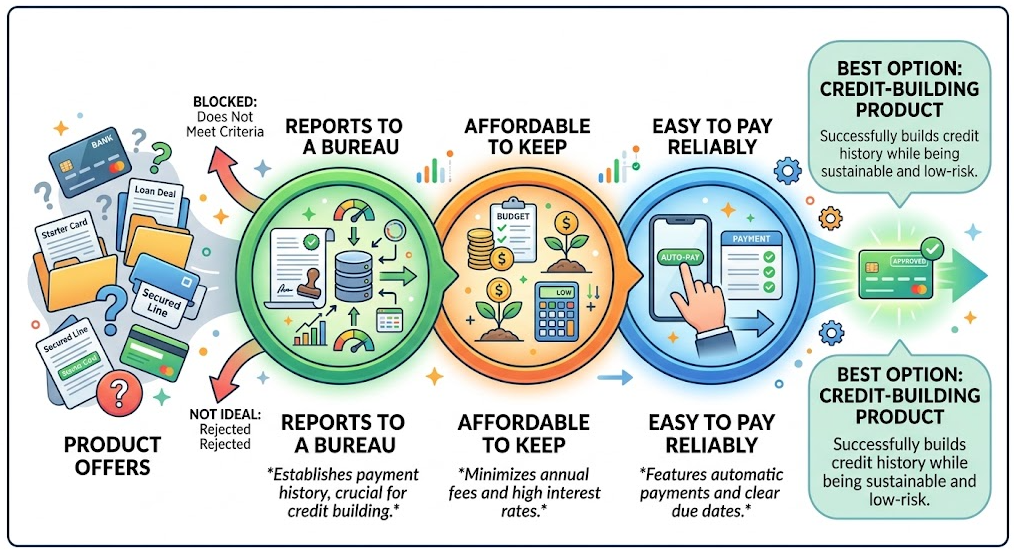
Credit history grows from information that reaches a credit report and shows how a real obligation was managed over time. A useful first product therefore has three qualities: it reports the account, it costs little enough to keep, and its payments fit comfortably inside the household budget.
Quick decision: Start by checking whether you already have a credit file and whether an existing account reports to the relevant credit bureau or bureaus. If you need a first account, compare one manageable product—often a low-fee card, a secured card, or a credit-builder loan where available—rather than applying for several at once. Confirm reporting, total cost, deposit rules, and payment dates before accepting. Use the account lightly, pay every required amount on time, and avoid carrying interest-bearing debt merely to create activity.
Credit Is Built From Reported Performance
A lender can only evaluate information it can obtain. In a conventional credit file, useful history normally begins when a creditor reports an account, its status, and the borrower’s payment performance to one or more credit bureaus.
That makes reporting the first question to ask about any “credit-building” product:
- Which bureau or bureaus receive information?
- Does the company report positive payment history as well as missed payments?
- Is the account reported in the applicant’s own name?
- When does reporting begin?
- What fees, interest, deposits, or membership requirements apply?
Answers can vary by provider and country. A lender may report to one bureau but not another. A service may send only selected information. Some products that resemble credit do not ordinarily create the kind of history used by mainstream scoring systems.
For example, cash, debit cards, and most prepaid cards spend money the consumer already has. They can be useful budgeting tools, but they usually do not demonstrate repayment of borrowed money. Some short-term loans and buy-now-pay-later products may not report routine on-time payments to major bureaus even though unpaid debt can eventually create negative consequences.
Before paying a fee for a special program, ask what exact account or payment record will appear, where it will appear, and how you can verify it.
Begin With the Smallest Sustainable Promise
Jerome opened his first credit card about 20 years ago. For much of that time, he did not follow score mechanics closely. His practical focus was simpler: pay card bills, mortgage payments, and installment obligations when promised.
That experience does not produce a guaranteed score formula. It does point to a durable operating principle. An account can contribute useful history only if the borrower can keep the agreement through ordinary months, expensive months, and busy months.
A $20 recurring purchase that is paid in full can create account activity without turning the card into a second income source. A modest credit-builder payment may be workable when it is already included in the monthly budget. A product with an attractive marketing promise may be a poor fit when its annual fee, deposit, or required payment competes with rent, food, utilities, or emergency savings.
The right starting amount is determined by cash flow, not by the size of the available credit line. Before opening an account, test the promise:
- Can the required payment be made from current income without using another debt?
- Can the due date be tracked during travel, illness, or a demanding work period?
- Can the account remain open without recurring fees becoming a burden?
- Is there enough cash to pay planned card purchases in full?
- Would one unexpected expense turn the account into carried debt?
If the payment depends on next month’s borrowing, the product is not yet a stable credit-building tool.
Path 1: A Regular Credit Card
A basic credit card may be the lowest-friction option for someone who qualifies and can use it within an existing budget. The card does not need a large balance or frequent purchases to establish activity.
A simple routine can be enough:
- assign one small, predictable expense to the card;
- keep the matching cash in the bank account;
- set an automatic minimum payment as a missed-payment safeguard;
- schedule a separate reminder to pay the full statement balance; and
- review the statement for errors and unexpected subscriptions.
The automatic minimum is a backup, not the complete plan. Paying only the minimum can leave a balance accruing interest for a long time. Paying the statement balance in full by the due date generally avoids purchase interest when the account’s grace-period conditions are met.
There is no credit-building requirement to pay interest on a revolving balance. U.S. CFPB guidance explicitly says a consumer does not need to carry a card balance to get a good score. Canadian federal guidance likewise encourages paying the balance by the due date and explains that unpaid balances add interest costs.
Rewards should remain secondary. A card that earns points but encourages extra spending, carries a high annual fee, or has terms the borrower cannot manage does not become a better credit-building product because it offers rewards.
Path 2: A Secured Credit Card
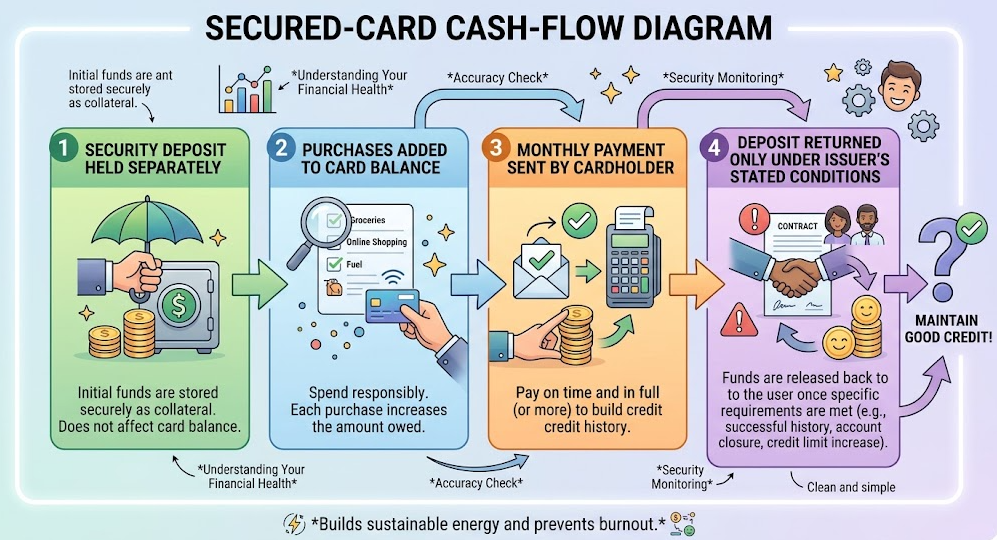
A secured credit card can be useful when a regular card is unavailable because the consumer has no history or a damaged file. The applicant provides a security deposit, and the issuer generally sets a credit limit related to that deposit.
The deposit does not normally pay the monthly bill. The cardholder still makes purchases and must pay the statement according to the agreement. If the account is not paid, the issuer may use the deposit against the amount owed.
Compare secured cards on more than the deposit amount:
- bureau reporting;
- annual, application, setup, and monthly fees;
- purchase and cash-advance interest rates;
- whether the deposit is held safely or insured where applicable;
- the conditions for returning the deposit;
- whether the account can later convert to an unsecured card; and
- customer-service and dispute access.
In Canada, the Financial Consumer Agency of Canada warns that application or setup fees may be separate from the security deposit and may not be refundable after a declined application. It also recommends caution with unknown or foreign issuers. In the United States, CFPB notes that secured-card fees and interest rates can be high even though the product may help establish a record.
Do not send a deposit in response to an unsolicited promise of guaranteed approval. Verify the institution, written terms, and payment channel independently.
Path 3: A Credit-Builder Loan
A credit-builder loan reverses the usual order of a loan. Instead of receiving spendable money first, the borrower makes scheduled payments while the proceeds are held in a savings account or similar arrangement. The funds are released under the provider’s terms, commonly after the loan is repaid.
This can create installment-payment history and savings at the same time, but the label “credit builder” does not make every offer worthwhile. Ask for the complete cost:
- interest and finance charges;
- origination, administration, or membership fees;
- payment amount and term;
- late-fee and default rules;
- early-payoff treatment;
- when and how funds are released; and
- which bureaus receive the payment history.
The product should not be used to manufacture a larger monthly obligation than the budget can support. A small reported loan with predictable payments may be more useful than a larger one that creates payment pressure.
Credit-builder loans are more established in the United States than in many other markets. Availability, product design, deposit protection, and reporting practices differ. Consumers elsewhere should use the same tests—reporting, total cost, control of funds, and payment fit—without assuming the U.S. structure applies locally.
Path 4: Joining Someone Else’s Account
Being added to another person’s credit card is often presented as a shortcut. The legal responsibility and reporting effect depend on the account structure, issuer, bureau, and jurisdiction.
United States
An authorized user may receive a card without becoming the primary account holder. Some issuers report authorized-user information, and some scoring models may consider it. Reporting is not universal, and the primary account holder remains responsible for the account under the issuer’s agreement unless a different contractual arrangement applies.
Before using this route, both people should ask the issuer:
- whether the account will appear on the authorized user’s reports;
- which bureaus receive it;
- whether the authorized user needs a card or may be added without spending access;
- how removal is handled; and
- who is legally responsible for charges.
The account’s existing history, high balances, or missed payments may also matter. Trust and a clear household agreement are essential.
Canada
An additional or supplementary cardholder generally does not own the account and is not responsible for its balance. FCAC states that purchases by an additional cardholder do not help that person build a credit history. A Canadian applicant who needs an account in their own file should ask about an individual account, a co-borrower arrangement, or a secured card instead—and should understand that co-borrowing creates real joint liability.
No one should co-sign or become jointly liable only for a hoped-for score benefit. The person may be required to repay the full debt if the other borrower does not.
What About Rent, Utilities, and Phone Bills?
Regular household payments demonstrate real financial discipline, but they do not automatically appear in every mainstream credit file.
Some landlords, utilities, telecom providers, or third-party services report payments. The arrangement may be limited to one bureau, may require enrollment, may charge a fee, or may handle only certain types of payment data. A missed account sent to collection can also create harm even when routine on-time payments were never reported.
Before enrolling in an alternative reporting service, confirm:
- the bureau and report section that will receive the data;
- whether both positive and negative payments are reported;
- the monthly or enrollment fee;
- what personal and bank data the service collects;
- whether past payments can be added and verified;
- how errors are disputed; and
- what happens after cancellation or a move.
Paying $10 every month for reporting can cost $120 a year. Compare that expense with a low-fee product that creates a conventional account in the consumer’s own name. Rent reporting may still be useful for some people, but its value depends on coverage, cost, privacy, and the lender or scoring system later used.
Build the Payment System Before the History
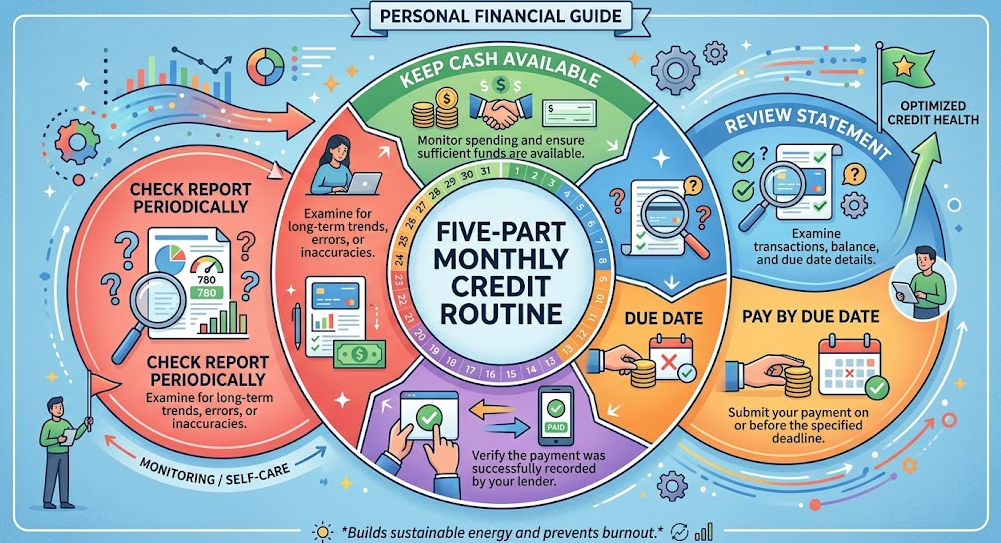
A credit account creates a due date immediately. Positive history takes time to accumulate. The operating system should therefore exist before the first purchase.
1. Choose one payment source
Use an account that normally holds enough money for the scheduled payment. Avoid routing the payment through an account that frequently approaches zero.
2. Use two safeguards
Set an automatic payment for at least the required minimum when that feature is reliable, then add a calendar reminder several days before the due date. The reminder creates time to review the statement and pay the full balance.
3. Watch processing time
A payment initiated on the due date may not be credited immediately under every method. Learn how the issuer defines the cutoff, business day, and completed payment.
4. Keep contact details current
Statements and fraud alerts fail when an email address, phone number, or mailing address is outdated. Paperless billing does not remove the need to review the account.
5. Review the first reports
After the provider’s stated reporting period, inspect the relevant credit report or reports. Confirm the account owner, opening date, limit or original amount, balance, and payment status. Article”Credit-Report-vs-Credit-Score” explains how to review and dispute report information.
Signs That the Plan Is Becoming Too Expensive
Credit building should not make the household less able to meet current obligations. Reassess the plan when:
- card purchases can no longer be paid from cash already available;
- one payment is being made with another form of credit;
- fees exceed the practical value of the account;
- several applications have been submitted because the first result was disappointing;
- a deposit has consumed the emergency reserve;
- minimum payments are replacing full-balance payments; or
- statements are being avoided because the balance feels difficult to face.
At that point, stop adding new products. Protect required payments, review cash flow, and contact the creditor early if a payment problem is likely. A smaller, stable plan supplies better evidence than a larger plan that cannot be maintained.
A Practical First-Account Comparison
Use a short comparison table before applying.
| Question | Product A | Product B | Product C |
|---|---|---|---|
| Reports to which bureau(s)? | |||
| Hard inquiry expected? | |||
| Deposit required? | |||
| Nonrefundable setup cost? | |||
| Annual or monthly fee? | |||
| Interest rate if a balance remains? | |||
| Minimum monthly payment? | |||
| Deposit or savings release terms? | |||
| Can the account be managed without new spending? | |||
| Is the provider independently verified? |
Do not treat approval odds as the only comparison. An easy approval can still lead to a high-cost product. The best candidate is the one that creates verifiable history while remaining boring enough to manage month after month.
The Bottom Line
Credit is built through reported evidence of manageable borrowing over time. One well-chosen account can provide that evidence. Several expensive accounts are not automatically better, and an interest charge is not an entry fee for a credit history.
Confirm that the product reports. Understand every fee and deposit. Keep the obligation small enough to pay from current cash flow. Create automatic and manual safeguards before the first due date. Then verify that the information reaches the report accurately.
This approach does not promise a particular point increase or approval date. It does create something more useful: a record of agreements the borrower could understand, afford, and keep.
Important Note
This article provides general educational information, not individualized financial, credit, legal, or tax advice. Product availability, bureau reporting, account ownership, deposit protection, consumer rights, and scoring treatment vary by country and provider. Verify written terms with the institution and use official credit-report channels for your jurisdiction. If existing debt is already difficult to pay, consider qualified nonprofit or regulated local credit counselling before adding another obligation.
Frequently Asked Questions
Do I need to carry a credit-card balance to build credit?
No. Carrying an interest-bearing balance is not required. Using the account within budget and paying on time can create history without paying avoidable interest.
How much should I spend on a new card?
There is no required purchase amount. A small planned charge can establish activity. Keep spending within cash already available and well below the limit; Article”Credit-Utilization-Explained” will explain utilization mechanics in detail.
Is a secured card the same as a prepaid card?
No. A secured card is a credit account backed by a deposit, and the monthly balance still must be paid. A prepaid card spends money loaded in advance and usually does not create conventional credit history.
Will every credit-builder loan help my credit?
Only if the provider reports the account in a useful way and the borrower maintains the agreement. Compare reporting, total cost, fund-release terms, and payment affordability before applying.
Can becoming an authorized user build my credit?
It may in some U.S. arrangements, but reporting and scoring treatment vary. In Canada, FCAC says an additional cardholder’s purchases do not build that person’s credit history. Confirm the account structure and legal responsibility directly with the issuer.
Should I open several accounts to build credit faster?
Usually, a first account should be allowed to establish history before another is considered. Multiple applications can create inquiries, fees, payment dates, and debt capacity without guaranteeing faster improvement.
How soon should I check whether a new account is reporting?
Ask the provider for its reporting schedule, then review the relevant reports after that period has passed. Reporting is not always immediate and may differ across bureaus.
Sources
- Consumer Financial Protection Bureau — Ways to Start or Rebuild a Good Credit History
- Consumer Financial Protection Bureau — How to Rebuild Your Credit
- Consumer Financial Protection Bureau — How Do I Get and Keep a Good Credit Score?
- Consumer Financial Protection Bureau — What Is a Credit Report?
- Financial Consumer Agency of Canada — Improving Your Credit Score
- Financial Consumer Agency of Canada — Choosing a Credit Card
- Financial Consumer Agency of Canada — Using Your Credit Card Responsibly
- Financial Consumer Agency of Canada — Joint Credit Cards and Additional Cardholders
- Financial Consumer Agency of Canada — Credit Report and Score Basics
More in This Cluster: Credit Fundamentals
- How Credit Scores Work
- Credit Report vs. Credit Score: What Each One Tells You
- What Actually Helps Build Credit? (you are here)
- Common Credit Score Myths That Can Cost You Money
- How Late Payments Affect Your Credit—and What to Do Next
- Credit Utilization Explained: Which Balance Actually Counts?
- How Long Does It Take to Rebuild Credit?