A credit-score myth rarely arrives as obviously bad advice. It often sounds cautious: never check your own score, keep a small balance, open several cards, or leave every account open forever. The advice may contain one familiar term, then attach a rule that does not follow from it.
That can change real decisions. Someone may pay interest unnecessarily, avoid reviewing an inaccurate report, keep an expensive card, or apply for credit they do not need. The score becomes a puzzle to manipulate instead of a summary of reported credit information.
Quick decision: Before acting on credit advice, identify the exact report, score, model, date, country, and lender decision involved. Checking your own report does not lower the score. Carrying interest-bearing debt is unnecessary. Income can affect approval without being a conventional score input. Closing or opening an account has effects that depend on the rest of the file. Reject any promise of a guaranteed point increase or instant removal of accurate negative information.
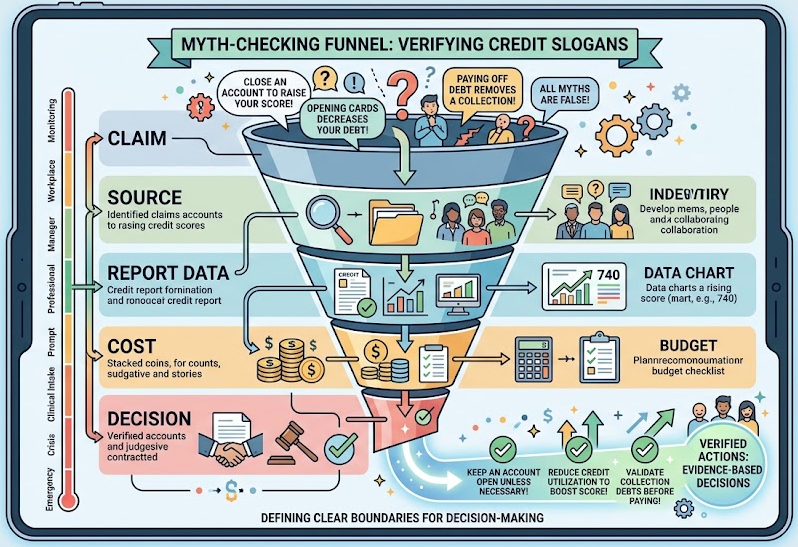
Myth 1: Checking Your Own Credit Hurts Your Score
Jerome heard that credit checks could lower a score. Because he did not clearly distinguish his own review from a lender’s application inquiry, he largely avoided looking at his score even while paying cards, mortgage obligations, and installments on time.
The missing distinction is the purpose of the inquiry.
When a consumer requests their own credit report or views a score through a legitimate self-access service, that is generally treated as a soft inquiry. CFPB states that requesting your own U.S. credit report does not affect the score. Canada’s FCAC gives the same guidance for checking your own Canadian report or score.
A lender’s review connected with a new application may be a hard inquiry and may affect a score. Existing-creditor account reviews, prequalification processes, and rate-shopping treatment can work differently. Ask whether an action will create a hard inquiry before authorizing it.
Avoiding self-review offers no protection. It can delay discovery of an unfamiliar account, wrong late-payment notation, incorrect balance, or identity information that belongs to someone else.
Myth 2: Everyone Has One True Credit Score
The number in a banking app may differ from the number shown by a car dealer. Neither number is automatically fake.
A score depends on several inputs:
- the credit bureau’s file;
- the scoring company and model family;
- the model version or industry purpose;
- the date the data was captured; and
- the range used by that score.
The United States commonly uses models with a 300–850 range, while Canadian consumer scores commonly use 300–900. Those ranges do not make every score within a country directly interchangeable. A lender may also use report information, income, existing debt, collateral, and its own policy outside the score.
When two numbers differ, record the bureau, model or score type, date, and range. EW-M-0043 explains this data chain; EW-M-0044 shows how to inspect the underlying reports.
Myth 3: A Higher Income Automatically Creates a Higher Score
Income matters greatly to affordability and underwriting. It does not follow that a pay raise automatically changes a conventional credit score.
Credit reports primarily record credit accounts and how they have been managed. Standard score explanations focus on reported payment history, debt and limits, account age, account mix, and applications. Salary is generally not listed as a scoring factor in the consumer guidance from CFPB or FCAC.
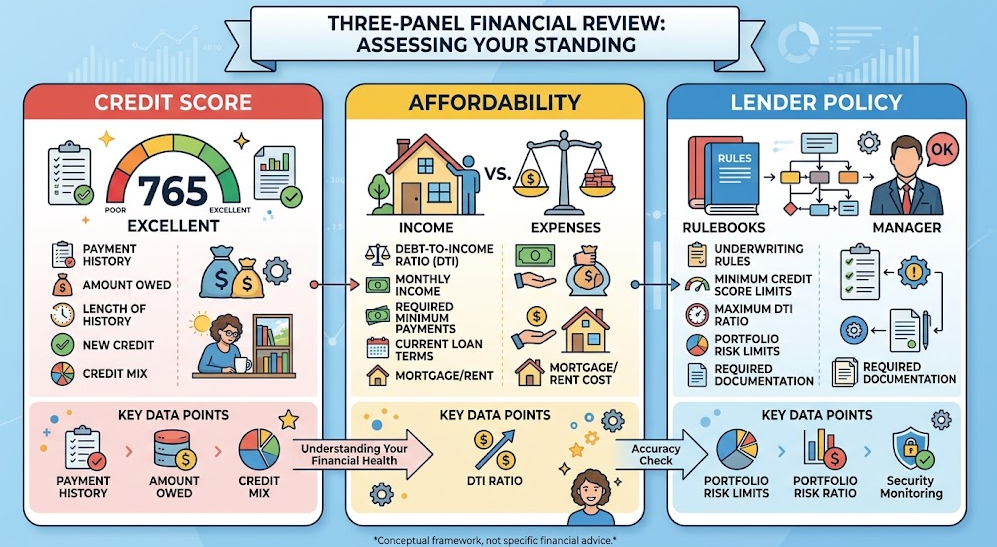
A lender can still ask for income and employment information. It may compare income with required debt payments when deciding whether the applicant can afford a new obligation. Two people with the same score may therefore receive different offers, and two people with different incomes may have similar scores.
Keep the decisions separate:
- Score question: What does the reported credit history indicate?
- Affordability question: Can present income support the requested payment?
- Lender-policy question: Does the application meet this lender’s rules?
A higher income can make repayment easier when spending remains controlled. The improved cash flow may support better credit behavior over time, but income itself should not be treated as a score button.
Myth 4: Carrying a Balance Helps More Than Paying in Full
This myth converts interest into a supposed credit-building fee.
A card issuer can report an account, balance, limit, and payment status even when the statement balance is paid in full by the due date. CFPB explicitly says a consumer does not need to carry a credit-card balance to obtain a good score. FCAC encourages Canadian cardholders to pay the balance by the due date and explains that unpaid balances add interest costs.
Two balances are easily confused:
- the balance reported when the issuer sends its periodic update; and
- the amount carried beyond the payment due date and charged interest.
An account can show activity on a report without the cardholder carrying interest-bearing debt. Use the card within the household budget, review the statement, and pay according to the agreement. Article”Credit-Utilization-Explained” will examine reported balances and utilization timing in detail.
Myth 5: Debit Cards and Prepaid Cards Build Credit Like Credit Cards
Debit and prepaid cards can help control spending because they use money already held by the consumer. That feature also explains why they usually do not establish conventional borrowing history.
A credit card creates a repayment obligation. A debit purchase removes money from a deposit account. A prepaid purchase uses value loaded in advance. CFPB identifies debit, cash, and prepaid payments as activities that generally do not demonstrate repayment of debt to nationwide credit reporting companies.
This does not make debit or prepaid cards inferior financial tools. They may be the safer choice for someone who wants no revolving debt. Their budgeting value and their credit-reporting function are simply different.
If a company claims that an alternative card builds credit, ask for the name of the account that will appear, the bureaus receiving it, the data reported, the fee, and the dispute process.
Myth 6: More Credit Cards Build Credit Faster
Each new card can create another application inquiry, a new account, a fee, and a due date. Several accounts may eventually contribute to a broader file, but quantity alone does not establish reliable management.
CFPB warns that applying for or opening many accounts in a short period can affect a score. FCAC similarly advises consumers to apply only for credit they need and to avoid multiple applications close together.
The practical test is capacity:
- Can every statement be reviewed?
- Can every due date be protected?
- Do annual fees provide real value?
- Is each purchase backed by available cash?
- Does the next account solve a household need beyond score speculation?
One account managed consistently may be a stronger beginning than four accounts opened in one afternoon. Article”What-Actually-Helps-Build-Credit-admin” explains how to compare first-credit pathways.
Myth 7: Closing a Credit Card Always Improves—or Always Hurts—Your Score
Both absolute versions are unreliable.
Closing a card reduces available revolving credit and may change the relationship between reported balances and total limits. An older account may also contribute history. These effects can make closure unhelpful for some profiles.
Keeping every account open can also carry costs. An unused card may have an annual fee, poor terms, fraud exposure, or access to credit that the household does not want. CFPB advises that closure can be reasonable when fees or debt risk outweigh benefits, even though the score may change.
Before deciding:
- Pay or transfer any remaining balance under a deliberate plan.
- Move recurring charges and confirm they stopped.
- Redeem or understand the treatment of rewards.
- Check the annual fee and renewal date.
- Consider upcoming mortgage, auto, or rental applications.
- Request written confirmation and review later statements.
The best financial decision and the highest possible score are not always the same objective. Avoiding an unaffordable fee or uncontrolled spending may matter more than preserving every scoring input.
Myth 8: Marriage Combines Two Credit Scores
Marriage does not normally merge two individual credit files into one score. Each person retains their own report and scores.
Shared financial activity can affect both files when both people are legally connected to the account. A joint loan, co-borrowed card, or co-signed obligation may appear for each responsible borrower. An individual account generally remains with its owner. In Canada, an additional cardholder is not the same as a co-borrower; FCAC states that the additional cardholder does not own the account and their purchases do not build their own history.
A household may make one budget, yet lenders can still see different individual credit records. Before signing jointly, each person should understand ownership, repayment liability, reporting, and what happens if the relationship or household finances change.
Myth 9: A Perfect Score Is Required for the Best Decision
Credit-score ranges invite comparison, but a maximum number is not a universal admission ticket.
Lenders select different models and approval thresholds. They may also evaluate income, debt obligations, loan size, down payment, collateral, and product rules. A score that qualifies for one product may not qualify for another. The price difference between two scores also varies by lender and market.
Chasing a few points can become expensive when it leads to unnecessary products, delayed essential decisions, or payment of interest and fees. A more useful preparation question is whether the reports are accurate, required payments are current, balances are manageable, applications are limited, and the proposed loan fits the budget.
Ask lenders for actual quotes and adverse-action reasons rather than relying on a generic online label such as “excellent.” No single public cutoff describes every lending decision in every country.
Myth 10: A Credit-Repair Company Can Remove Any Negative Item
An inaccurate account, duplicate entry, or identity-theft item should be disputed. Accurate and timely negative information generally cannot be removed simply because it is unfavorable.
CFPB warns against companies that promise a specific score increase, a new credit identity, or rapid removal of accurate negative information. U.S. consumers can dispute inaccuracies themselves without paying a credit-repair company. FCAC likewise warns Canadians that companies cannot quickly and easily fix a score or erase accurate credit history.
Watch for these signals:
- guaranteed point gains or approval;
- instructions to dispute every negative item regardless of accuracy;
- pressure to provide false identity information;
- fees that are unclear or demanded before promised work;
- advice to stop communicating with legitimate creditors; or
- claims that a new government number will replace a damaged credit identity.
Preserve the report, identify the exact field, gather evidence, and use the official bureau and creditor process described in Article“Credit-Report-vs-Credit-Score”. Rebuilding after accurate negative history is a separate process; Article”How-Long-Does-It-Take-to-Rebuild-Credit” will address expectations without promising a fixed timetable.
A Five-Minute Myth Test
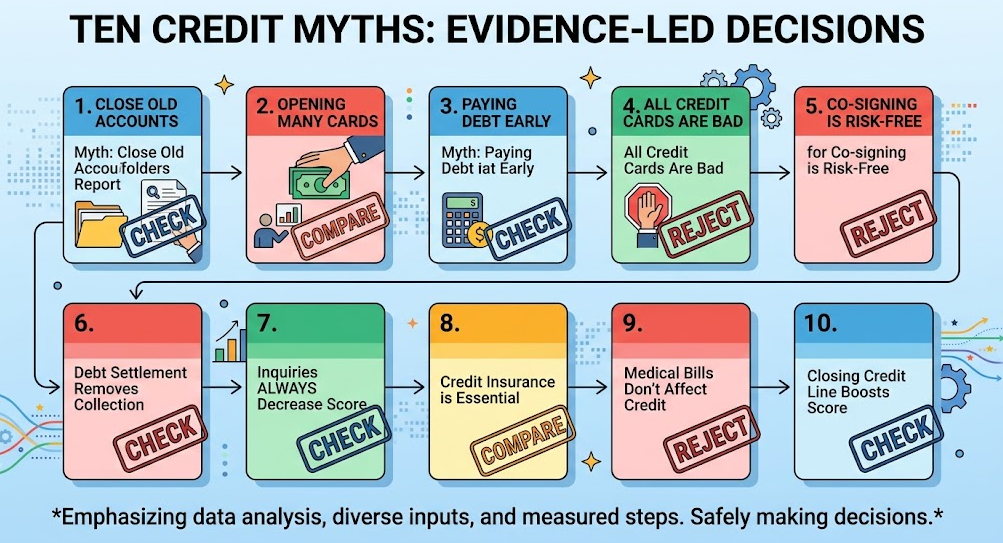
When new advice appears, run five checks before acting.
1. What exact action is being proposed?
“Improve your credit” is not specific. Identify whether the advice asks you to apply, borrow, carry a balance, close an account, pay a fee, or dispute information.
2. What report data would change?
If the speaker cannot explain which account, balance, status, age, or inquiry changes, the claim may be marketing rather than guidance.
3. What will it cost?
Count interest, annual fees, deposits, subscriptions, application charges, and the risk of additional debt.
4. Does the rule depend on country, bureau, or model?
Reporting systems and consumer rights differ. Even within one country, bureaus and scoring models may receive different data.
5. Does the action improve the household decision?
A score is useful when it supports affordable access to housing, transportation, or necessary credit. It should not become a reason to borrow without purpose.
The Bottom Line
Most credit myths take a real concept—an inquiry, balance, account age, or payment record—and turn it into a universal command. Credit files are too dependent on data, timing, jurisdiction, and individual circumstances for those commands to remain reliable.
Review your own reports. Pay required obligations on time. Avoid interest that serves no household purpose. Open credit only when it is useful and manageable. Close an account when its costs or risks justify the decision, after checking the consequences. Treat guaranteed point claims as warnings, not plans.
The goal is an accurate record and sustainable financial choices. The score is one output of that record, not a measure of income, character, or personal worth.
Important Note
This article provides general educational information, not individualized financial, credit, legal, or tax advice. Credit-report contents, scoring models, inquiry treatment, joint-account rules, dispute rights, and credit-repair laws vary by country and provider. Verify material decisions through official sources and written product terms. Seek qualified local assistance when debt, fraud, insolvency, or an imminent lending decision creates significant consequences.
Frequently Asked Questions
Does checking my score every day lower it?
Your own legitimate self-check is generally a soft inquiry and does not lower the score. A new-credit application may create a hard inquiry, so confirm the type before authorizing it.
Does paying a card to zero close the account?
No. Paying the balance and closing the account are separate actions. An issuer may close an inactive account under its terms, so continue monitoring notices.
Will a pay raise appear on my credit report?
Conventional credit reports generally focus on accounts and payment history, not current salary. A lender may request income separately for affordability and approval.
Is 30 percent utilization a magic threshold?
No single percentage guarantees a result. Lower reported revolving balances generally reduce reliance on available credit, but model and file details matter. Article”Credit-Utilization-Explained” will cover the calculation.
Will one late payment destroy my score?
The effect depends on whether and when it is reported, the model, recency, severity, and the rest of the file. Contact the creditor promptly; Article”Credit-Utilization-Explained” covers late payments in detail.
Can my spouse’s score change mine?
Not directly merely because of marriage. Joint or co-signed accounts can affect both individual files because both people are connected to the obligation.
Can anyone promise a precise score increase?
No reliable adviser can guarantee a universal point increase. Scores depend on the complete bureau file, model, date, and later reporting changes.
Sources
- Consumer Financial Protection Bureau — Does Requesting My Credit Report Hurt My Credit Score?
- Consumer Financial Protection Bureau — Understand Your Credit Score
- Consumer Financial Protection Bureau — How Do I Get and Keep a Good Credit Score?
- Consumer Financial Protection Bureau — Does It Hurt My Credit to Close a Credit Card?
- Consumer Financial Protection Bureau — How to Rebuild Your Credit
- Consumer Financial Protection Bureau — Can Accurate Negative Information Be Removed?
- Financial Consumer Agency of Canada — Improving Your Credit Score
- Financial Consumer Agency of Canada — Credit Report and Score Basics
- Financial Consumer Agency of Canada — Using Your Credit Card Responsibly
- Financial Consumer Agency of Canada — Joint Credit Cards
- Financial Consumer Agency of Canada — Consumer Alert on Debt and Credit Repair
More in This Cluster: Credit Fundamentals
- How Credit Scores Work
- Credit Report vs. Credit Score: What Each One Tells You
- What Actually Helps Build Credit?
- Common Credit Score Myths That Can Cost You Money (you are here)
- How Late Payments Affect Your Credit—and What to Do Next
- Credit Utilization Explained: Which Balance Actually Counts?
- How Long Does It Take to Rebuild Credit?