The wrong storage method often announces itself through a small recurring failure. Sweaters develop shoulder bumps. A neat drawer becomes unsearchable after two laundry cycles. Socks disappear into a deep container. Shirts remain on a chair because returning them requires too many steps.
Each of those problems points to a different mismatch among the garment, the person using it, and the storage method. Hangers are strong for visibility and shape when a garment can support its own weight. Drawers give folded clothing a stable daily home. Bins define broad categories and move easily between access levels. Most wardrobes work best with a deliberate combination.
From Jerome, EverydayWise Contributor
Children’s socks have been one of the surprisingly difficult clothing categories in our home. They are small, and folding them into stable piles inside a drawer does not work very well. Children’s clothes also become less useful when they are stored above the child’s reach. If the child cannot see or reach the clothes safely, those clothes are less likely to be chosen or returned after laundry.
The passage above comes from an EverydayWise contributor’s household experience. It shows why a storage method should be judged during ordinary use. A system that looks orderly after a reset can still fail when someone must find one item quickly or return a full load of clean laundry.
Quick decision: Hang garments that benefit from visibility, airflow, or shape support and are strong enough to carry their own weight. Use drawers for active folded categories that need a fixed, reachable home. Use shallow or divided bins for small, flexible, irregular, or secondary groups. Test every choice by retrieving one item and returning it with one hand; change the method when the surrounding category collapses or disappears.
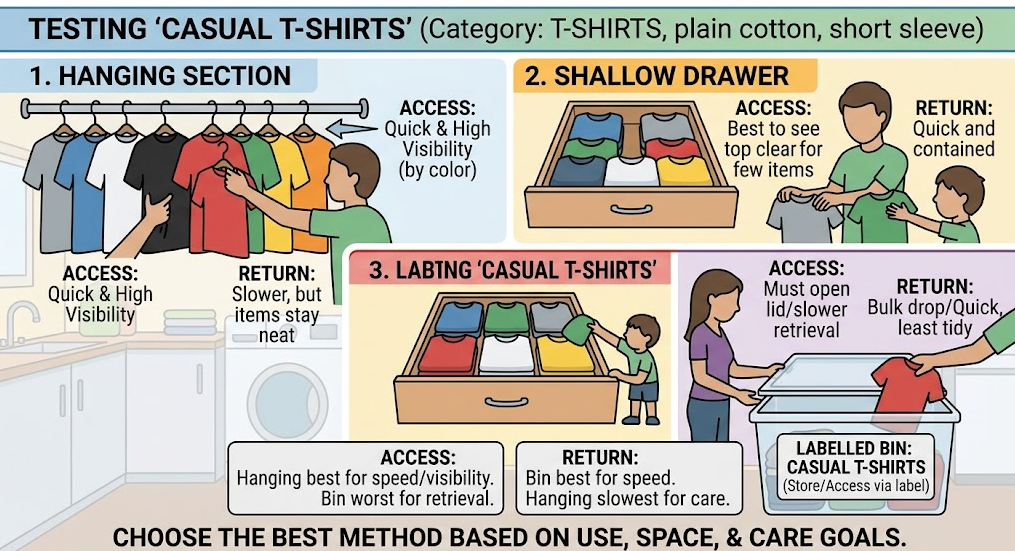
Compare the Job Before Comparing the Product
A hanger, drawer, or bin can perform several jobs, but each usually has a primary strength.
- Hangers keep garments separated along a rail, display much of the item, and reduce folding.
- Drawers provide an enclosed, fixed location for folded active clothing.
- Bins create portable boundaries for broad groups, small items, backups, or secondary storage.
Begin with the clothing category and its use pattern. Ask:
- Does the garment tolerate hanging under its own weight?
- Does it need to be visible to be remembered?
- How often is it used and returned?
- Can it remain identifiable when folded?
- Does the person need a lower, lighter, or simpler destination?
- Would a deep container hide items behind or below one another?
- Is the storage meant for daily access, transition backup, or longer storage?
How Many Clothes Do You Really Need? establishes how much clothing the category needs. This article assigns that decided quantity to an appropriate storage method. A container cannot correct an oversized category, and fewer garments do not repair a method that distorts them.
When Hangers Work Well
Hanging is useful when seeing the garment helps selection, when folds are inconvenient, or when the garment’s construction is stable enough for the rail.
Common candidates include:
- shirts, blouses, dresses, skirts, and trousers designed to hang;
- uniforms or work outfits chosen frequently;
- jackets and light outerwear on appropriately strong supports;
- garments that wrinkle noticeably when folded; and
- current-season clothing that otherwise disappears from view.
Choose the hanger by the garment rather than by visual uniformity. The support should be wide enough to follow the shoulders without pushing into sleeves, strong enough for the garment’s weight, smooth enough to avoid snags, and suitable for any loops or clips the garment was designed to use. Clips should not crush or mark delicate material.
Leave enough rail movement to separate garments and return them without force. When hangers must be compressed tightly to create a gap, visibility remains high but operating access has been lost.
Warning signs that hanging is failing
- shoulder points, stretching, sagging, or distorted seams;
- garments sliding onto the floor;
- clips leaving marks;
- heavy clothing bending the hanger;
- long garments resting in dampness, dirt, or items below;
- rail crowding that makes retrieval difficult; or
- clothing repeatedly bypassing the closet because hanging takes too long.
The Canadian Conservation Institute writes for historic and important textiles, so an everyday wardrobe generally does not require its archival materials or procedures. Its support principle is still useful: fragile, knitted, bias-cut, heavily decorated, or weak-shouldered garments may be harmed by hanging. The garment’s construction and condition should determine whether it can carry its weight.
For ordinary clothing, follow the care label and manufacturer instructions. A special or valuable garment may require a tailor, cleaner, conservator, or other appropriate professional rather than a generic organizer.
When Drawers Work Well
Drawers are often the most direct home for active folded clothing. They protect the category from dust and visual spill, keep the destination fixed, and can place daily items at a convenient height.
They tend to work well for:
- undergarments and sleepwear;
- T-shirts and casual tops that tolerate folding;
- lightweight knitwear with enough support beneath it;
- shorts, leggings, and flexible everyday clothing;
- children’s current-size daily categories; and
- items that need a stable home near the dressing area.
The main drawer decision is orientation. Horizontal stacks can use depth efficiently, but lower items disappear and removing one may disturb the rest. Vertical or file-style folding exposes more edges, but it requires garments and drawer dimensions that can hold the folds without collapsing. Loose placement may be entirely appropriate for a small category that remains visible.
Use the simplest orientation that survives ordinary laundry return. A folding method that works only when one person completes it precisely is a fragile household system.
Warning signs that a drawer is failing
- the drawer will not close without compression;
- a lower layer is rarely seen;
- folded rows collapse whenever one item leaves;
- clothing catches in the mechanism;
- clean laundry stops beside the drawer;
- the assigned person cannot reach or operate it safely; or
- several unrelated categories migrate together until none is identifiable.
Do not treat the top surface or an open drawer as extra permanent storage. A partially open drawer creates a climbing and stability risk, obstructs movement, and prevents the unit from operating as intended.
When Bins Work Well
A bin is most useful as a boundary. It can turn a shelf, drawer, cubby, or larger container into a recognizable category and can move as a group during a seasonal exchange.
Useful bin categories may include:
- children’s socks or other small items that do not form stable stacks;
- swimwear, hats, gloves, or flexible weather accessories;
- uniforms or activity clothing used together;
- repair items with a near-term deadline;
- transition backup from Seasonal Clothing Rotation;
- next-size children’s clothes with a named review point; and
- light, infrequently used clothing on an upper shelf when safe to retrieve.
Depth changes how a bin behaves. A shallow open bin can make small active items easy to sweep together and see. A deep opaque bin can hold more volume while hiding most of it. Lids protect from dust and help stacking, yet they add a step that may be unsuitable for a high-frequency category.
Labels should describe the decision the user needs to make. “Mina—current school socks” is more useful than “miscellaneous.” For someone who cannot read the label easily, a colour cue, simple image, or transparent front may help, provided the cue remains consistent and accessible.
Warning signs that a bin is failing
- it must be emptied to locate one item;
- unrelated categories accumulate inside;
- the label cannot be read from the normal position;
- the bin is too heavy or awkward for its shelf;
- a lid is rarely replaced;
- clothing is closed away while damp;
- stacked bins make the needed one inaccessible; or
- the container becomes an indefinite holding place without a review date.
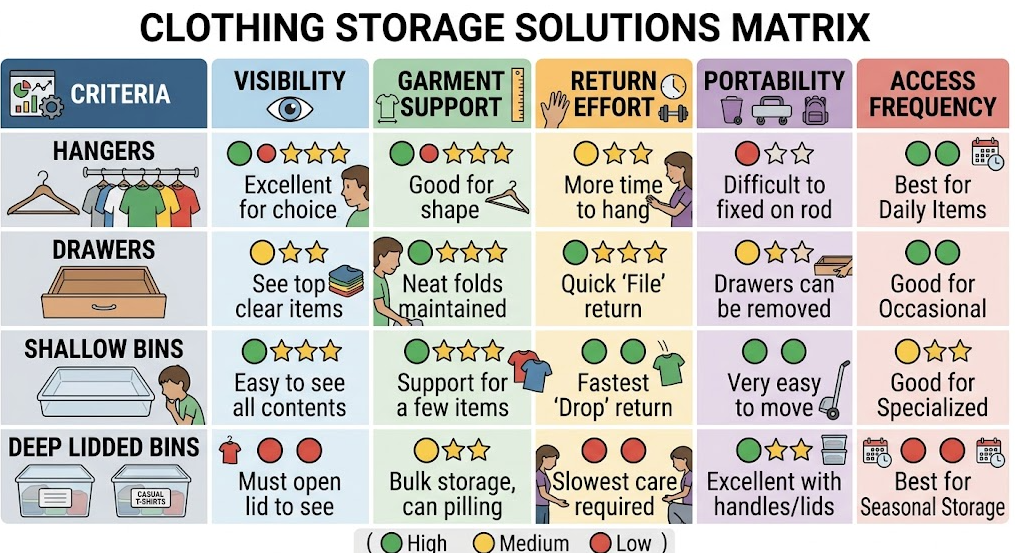
Match the Method to Access Frequency
The same garment may need a different method when its access level changes.
Daily or weekly access
Prioritize visibility, reach, and a short return path. Current work shirts might hang. T-shirts may stand in a drawer. Children’s socks may sit loose in one shallow divided section. Opening several lids or moving one container to reach another adds friction each time the category is used.
Transition or occasional access
A labelled open bin, drawer section, or less prominent rail area can keep the group recognizable without occupying the easiest space. The boundary should remain small enough that the category can be reviewed together.
Longer storage
Protection, condition, environment, and future retrieval become more important. Clothing should be clean and completely dry. The container or hanging method should not trap moisture, distort the garment, or make inspection impossible. Seasonal Clothing Rotation covers the complete seasonal storage and retrieval process.
An access change is also a useful review moment. If an occasional item returns to daily life, move it forward. If an active category remains untouched, verify its role using How Many Clothes Do You Really Need? before buying a different organizer.
Use a Mixed System Inside One Category
One category does not always require one method. Knit tops might be folded while structured shirts hang. Most children’s socks might share a shallow section while thick weather socks occupy a separate seasonal bin. Frequently used trousers may hang near work shirts while casual pairs remain folded.
Divide only where the split improves a real decision. Too many small compartments create additional sorting and consume usable space. Too little division allows categories to blend.
A practical test is whether a person can answer these questions without searching:
- Where does this clean item return?
- Can I see or identify the usable choices?
- Can I remove one without rebuilding the group?
- Can I return it using the effort available on an ordinary day?
If the answers differ among garments, a mixed system is justified. If every subgroup follows the same access and care requirements, additional division may be unnecessary.
Design Children’s Storage for Participation
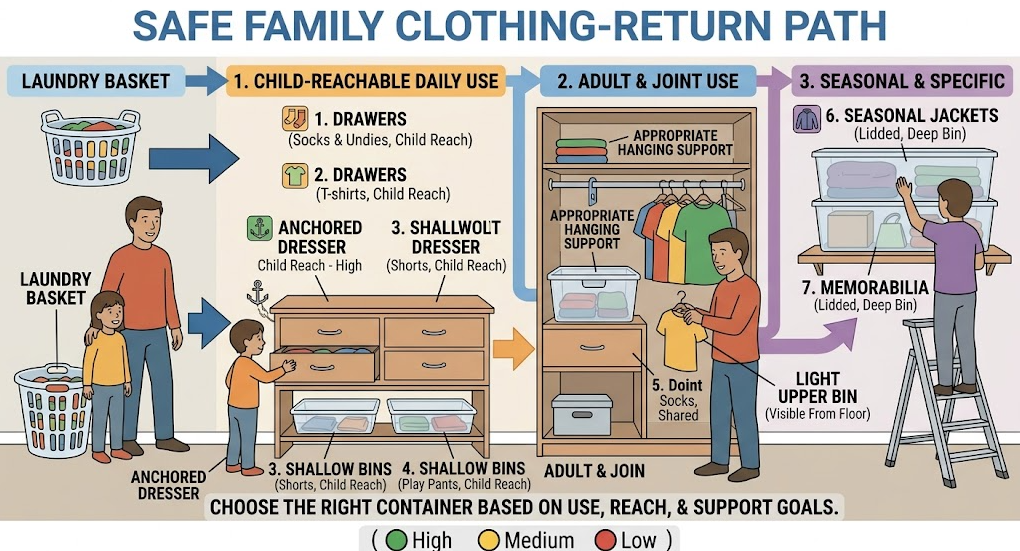
Children’s storage works differently when the goal includes choosing clothes and putting them away. The category must be reachable, recognizable, safe, and simple enough for the child’s current ability.
Jerome’s experience with small socks points toward a broad, shallow boundary rather than a precise stack. Pairs can remain together without requiring a tower that collapses. Depending on the child and drawer, one shallow section, a low open bin, or a simple divider may work. The method should be tested with the child rather than assumed from an adult’s reach and folding habits.
For daily clothing:
- place a limited current-size selection within safe reach;
- use broad categories before detailed subcategories;
- keep containers light enough for intended use;
- avoid destinations that invite climbing;
- ensure drawers open and close without trapped fingers or excessive force; and
- adjust the method as the child grows and preferences change.
This article owns the tool choice. How a family allocates shared space, obtains consent, and divides responsibility belongs to Closet Organization for Shared Spaces.
Keep Drawers and Freestanding Units Safe
Storage efficiency does not override furniture stability. A dresser or freestanding clothing unit can become unstable when drawers are opened, climbed, loaded differently than intended, or used on an unsuitable surface.
The U.S. Consumer Product Safety Commission recommends anchoring furniture, including dressers, securely to the wall. Its mandatory U.S. stability standard addresses clothing-storage units and includes testing with loaded and multiple open drawers. Product rules differ by jurisdiction, and compliance with a product standard does not replace correct installation and use.
Follow the manufacturer’s assembly, anchoring, wall-material, loading, and maintenance instructions. Use compatible hardware and seek qualified local help when the wall, hardware, unit, or installation is uncertain. Do not allow anyone to climb drawers or shelves. Do not place objects that attract children on top of a unit, and do not defeat stops or other safety components.
Upper bins introduce a different risk. Store only light, manageable groups where they can be retrieved from a stable position. A label should be visible from the floor. Reaching above safe control, standing on furniture, or catching a falling container is not a reasonable price for unused vertical capacity.
Run a One-Cycle Storage Test
Do not replace every hanger or buy a full set of containers before testing the method.
Choose one category and one representative laundry cycle:
- Confirm the quantity already decided using How Many Clothes Do You Really Need?
- Check garment construction and care instructions.
- Assign the likely method: hang, drawer, bin, or a simple combination.
- Place it at the correct access level.
- Retrieve ordinary outfits without restoring the display between choices.
- Return the complete clean category using the normal household process.
- Observe crowding, collapse, hidden items, strain, unsafe reach, and abandoned laundry.
- Adjust depth, division, placement, or method before purchasing more products.
The best result may be surprisingly plain: a few appropriate hangers, a drawer with broad zones, and one shallow bin. The test succeeds when clothing keeps its useful shape, remains identifiable, and returns without requiring a special organizing session.
FAQ
Which clothes should be hung rather than folded?
Hang garments that benefit from visibility or reduced creasing and are structurally able to support their own weight. Fold heavy knits, fragile pieces, bias-cut garments, weak-shouldered items, and heavily decorated clothing when hanging may stretch or distort them. Follow the care label and garment-specific guidance.
Is it better to stack or file-fold clothes in a drawer?
Use the orientation that keeps items visible and survives normal removal and laundry return. File folding can expose more choices; stacking may suit shallow or low-volume categories. Neither method helps if the drawer is overfilled or the folds collapse during ordinary use.
Are clear bins better than opaque bins?
Clear bins improve visual identification, while opaque bins reduce visual clutter and may protect contents from some light exposure. Labels, depth, access frequency, weight, ventilation, and safe placement often matter more than transparency alone.
Should storage bins have lids?
Lids may help with dust and stacking in secondary storage, but they add effort and can encourage damp clothing to be closed away. Daily categories often work better in open or easily accessed boundaries. Store only clean, completely dry clothing.
What is the easiest way to organize children’s socks?
Try one shallow, reachable section or low bin that keeps the category bounded without requiring unstable piles. Use only as much division as the child can recognize and maintain safely.
Do all hangers need to match?
No. Consistent hangers can improve rail spacing, but garment support is the controlling decision. Different weights, shoulders, clips, and fabrics may require different hanger shapes or a folded method.
How do I know whether a storage system is working?
Observe one complete use and laundry cycle. The system is working when items remain identifiable, one can be removed without disturbing the group, garments keep their shape, users can reach them safely, and clean clothing returns without accumulating elsewhere.
Sources
- Basic Care — Textiles — Canadian Conservation Institute
- CPSC Clothing Storage Unit Tip-Over Safety Standard and Anchoring Guidance
More in This Cluster: Closet and Clothing Organization
- How to Organize a Small Closet
- Seasonal Clothing Rotation
- How Many Clothes Do You Really Need?
- Hanger, Drawer, and Bin Storage Compared (you are here)
- How to Store Shoes and Accessories
- Closet Organization for Shared Spaces
- How to Keep a Closet Organized After the Reset