A closet reset can appear successful for several days. Then clean laundry waits in a basket, a sweater worn for an hour lands on a chair, a new purchase arrives, and a child outgrows another size. None of these events is unusual. Together, they reveal whether the closet has a workable return path or only a finished appearance.
Maintaining a closet does not require preserving a perfect arrangement. Clothing is always moving: onto a person, into the wash, back into storage, between seasons, and eventually out of the active wardrobe. A durable system makes those movements easy to complete and makes small problems visible before another full reset feels necessary.
Quick decision
To maintain the closet, decide:
- where clean laundry returns;
- where clothing that may be worn again waits;
- which signs mean a section needs attention;
- how new clothing enters the available space;
- what event will prompt a seasonal review; and
- how the household will recover when the routine breaks down.
Maintain the Return, Not the Reveal
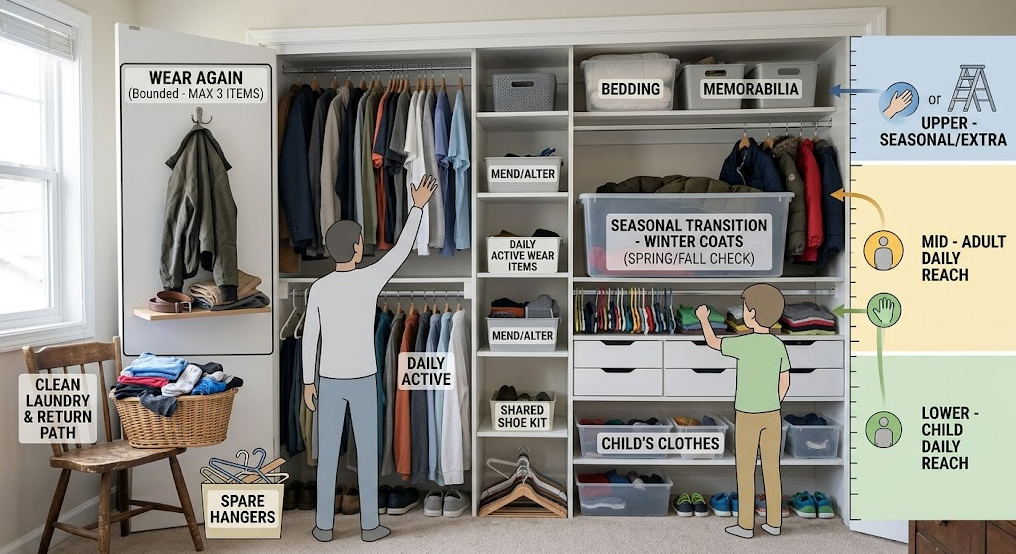
The most important maintenance test happens after clothing leaves the closet. Can it return without opening several containers, rearranging a crowded rod, or making a new decision every time?
Walk through the return process for the categories used most often. A clean shirt may need to travel from the laundry area to a hanger. Socks may need to reach an open drawer. A coat may need enough clearance to go back on its hook without pushing aside bags. Each repeated obstacle creates a reasonable place to postpone the task.
Look for the smallest point of friction:
- no empty hangers near the hanging section;
- a drawer that must be compressed before it will close;
- folded stacks that collapse when one item is removed;
- categories with similar destinations but inconsistent storage;
- an upper shelf that requires help for every return; or
- a container that cannot be reached while carrying laundry.
Correct the recurring motion before adding a maintenance rule. How to Organize a Small Closet explains how access and zones support the initial setup, while Hanger, Drawer, and Bin Storage Compared helps when the storage method itself does not suit the clothing or the user.
Connect the Closet to the Laundry Cycle
Clean clothing left in a basket is sometimes described as laziness or failure to finish. Often, the final step is simply harder than the earlier ones. The laundry area has a container and a clear task; the closet may have crowded destinations and many small decisions.
A complete laundry-return path has four parts:
- clean clothing is separated by destination or user;
- hangers, drawers, and bins are ready to receive it;
- items needing special attention do not stop the whole load; and
- the basket returns to its normal location after it is emptied.
Keep a small, defined place for a garment awaiting repair, stain treatment, or another decision. This prevents one unresolved item from holding the rest of the laundry in place. Follow the garment’s care label and manufacturer instructions before washing, drying, ironing, or treating it. In the United States, the Federal Trade Commission’s Care Labeling Rule requires covered clothing labels to provide regular-care instructions and relevant warnings; requirements and label systems differ elsewhere.
If several household members use the closet, sorting clean laundry by person can reduce crossing between zones. That does not determine who must do the laundry. It simply makes the destination visible once the clothing reaches the closet.
Give In-Between Clothing One Bounded Place
Some garments are neither freshly clean nor ready for the laundry. A cardigan worn briefly, pajamas intended for another night, or work clothing needed again the next morning may reasonably wait outside the active clean section.
Choose one hook, shelf, valet, or small basket for these items. The boundary matters more than the product. It prevents a chair, floor, or closet door from becoming an unlimited second wardrobe.
When the designated place fills, review what is there. Return suitable items to storage, send clothing to the laundry according to its care needs, and address anything requiring repair. The full boundary provides the prompt; it does not assign a moral meaning to how the clothing arrived there.
Households may draw the clean, worn-again, and laundry boundaries differently. Garment type, activity, climate, allergies, illness, and personal preference can all affect care decisions. Use the article’s zone as an organizational tool, not as a universal hygiene rule.
Read Drift Before the Closet Looks Disorganized
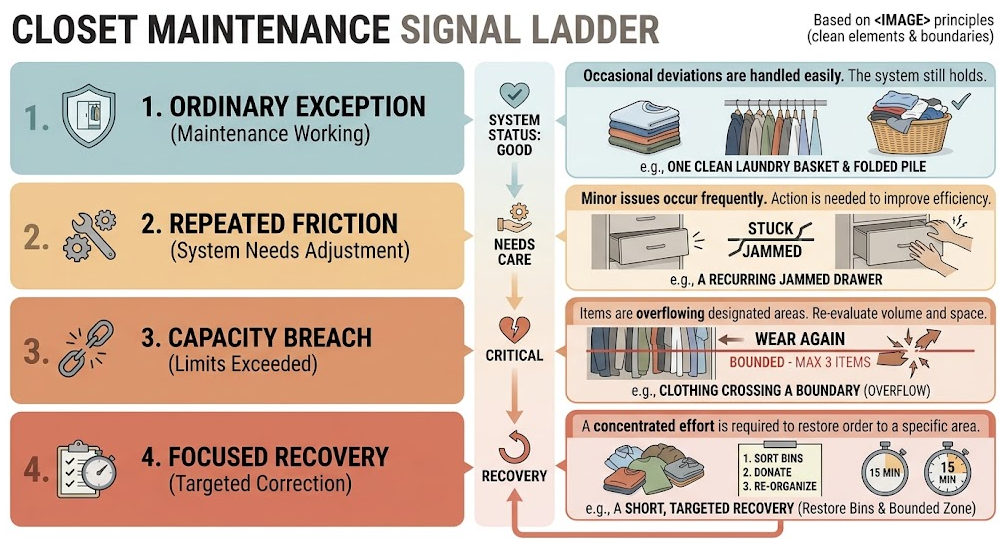
A maintenance system usually gives early signals before clothing spreads across the room. The useful question is which signal repeats.
- Clean laundry regularly stays outside the closet.
- One section of the rod becomes difficult to slide.
- A drawer no longer closes without pressure.
- Clothing begins to cover the floor or block the door.
- One category repeatedly enters another person’s zone.
- The worn-again area stays full.
- Future-size, repair, or undecided clothing expands beyond its boundary.
- Items disappear behind stacks or are purchased again because they cannot be found.
One occurrence may be an ordinary busy day. A recurring signal points to a return problem, capacity mismatch, unclear destination, or household change. Treat it as information about the system. That response is more useful than waiting until every category needs to be emptied again.
Attach Small Actions to Events That Already Happen
A rigid daily or weekly schedule will not suit every household. Work shifts, sports, caregiving, laundry frequency, and wardrobe size change how often a closet is used. Event-based prompts can be easier to remember because the prompt arrives with the clothing.
For example:
- When clean laundry enters the room, return one full destination group before starting another household task.
- When the worn-again place reaches its boundary, route those garments.
- When a new item comes home, identify its active destination before it disappears into a bag.
- When a child changes size, move the affected category out of the daily zone for a separate decision.
- When the weather changes enough to alter daily clothing, check the active and secondary zones.
These are choices, not a required calendar. Select the prompts that match the household’s actual points of drift. A family that reliably returns laundry but accumulates outgrown clothes needs a different cue from someone whose clean clothes never reach the closet.
Let New Clothing Expose a Capacity Problem
A new garment needs a visible destination. Before placing it in the closet, confirm that its category has enough working space and that the item can be found and returned normally. Keep receipts, tags, and return conditions together until the purchase decision is settled.
If the destination is already full, pause at that category. The answer may be a different fold, another suitable location, or a review of what belongs in the active wardrobe. Avoid shifting the crowding into another category merely to make the new item fit.
How Many Clothes Do You Really Need? addresses quantity and wardrobe-capacity decisions in detail. Ongoing maintenance only needs to reveal when that decision has arrived.
Use Seasonal Change as a Checkpoint
Seasonal review does not have to occur on a fixed date. A practical cue may be the first sustained change in temperature, a school term, a sports season, or the point when another layer begins to enter daily use. Seasonal Clothing Rotation covers the exchange process itself; the maintenance role is to notice that the active closet no longer matches current use.
From Jerome, EverydayWise Contributor
Our family usually does a larger clothing review when summer or winter arrives. The children help identify clothes that have become too small, clothes they no longer wear, and clothes that should move deeper into the closet for the next season. My wife and I also notice garments we have not touched for about a year and pieces that no longer fit after a change in weight. We then decide what should be discarded or donated.
Jerome’s family uses the season as a shared cue rather than treating every garment as an isolated decision. The same checkpoint can identify several kinds of change at once: growth, fit, actual use, and the next season’s needs. It does not establish a universal one-year rule. A special-purpose garment may remain useful despite infrequent use, and another item may need attention much sooner.
Keep the checkpoint narrow enough to finish. Review the categories affected by the new season or size change, record unresolved items in a bounded transition area, and route confirmed outgoing clothing through the household’s established donation, recycling, sale, or disposal process.
Keep Shared Responsibilities Visible
In a shared closet, an agreed responsibility should be as clear as the physical zone. One person may return their own clothing, an adult may manage future-size children’s clothes, or the household may sort a shared load before individuals put items away. The arrangement can vary; hidden expectations create avoidable friction.
When one zone repeatedly overflows, describe the observation and the blocked task. “The clean shirts no longer fit on this rod” provides information that can be acted on. A statement about someone’s character does not explain whether the cause is capacity, access, time, or an unclear responsibility.
Revisit the agreement when height, mobility, work clothing, school needs, or household membership changes. Closet Organization for Shared Spaces explains allocation, consent, and ownership boundaries. Maintenance should preserve those decisions or signal when they no longer work.
Recover Without Repeating the Entire Reset
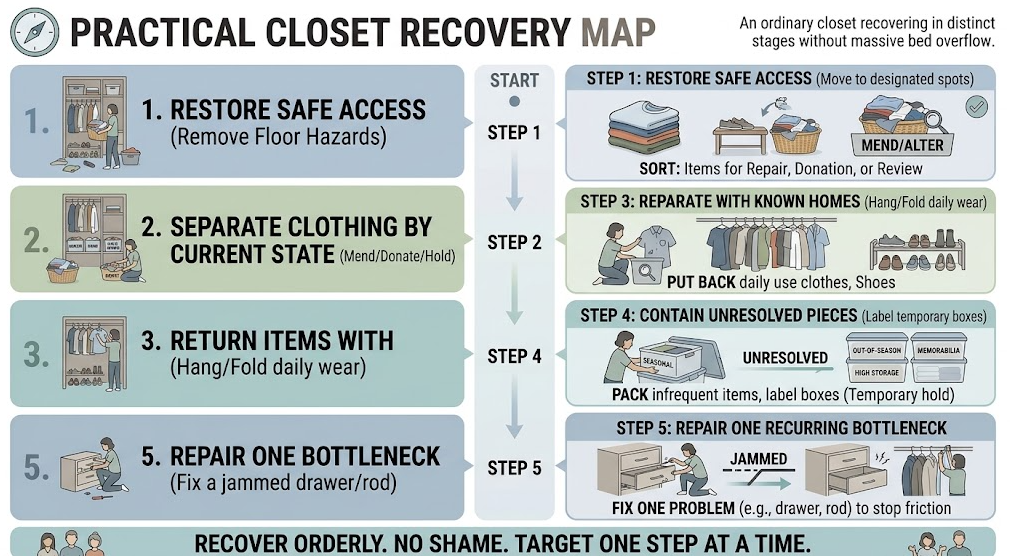
A difficult week, illness, travel, deadline, or family transition can interrupt even a useful system. Recovery becomes more manageable when it restores movement first.
Use this sequence:
- Clear any blocked walking area or door operation.
- Separate obvious laundry, clean clothing, and worn-again clothing.
- Return items whose destinations are already clear.
- Contain unresolved clothing in one bounded place.
- Identify the single repeated bottleneck that allowed the buildup.
- Adjust that return path, capacity, or responsibility before doing cosmetic refinements.
Do not empty the entire closet merely because one drawer or category failed. A focused recovery preserves the parts that still work. If multiple zones have become unusable, the household’s clothing needs may have changed enough to justify a broader reset.
Know When Maintenance Is No Longer Enough
Maintenance cannot solve every mismatch. A broader review may be appropriate when:
- several categories have no usable destination;
- clothing volume consistently exceeds available space;
- a child’s reach or size has changed substantially;
- a mobility change makes former locations unsafe or unusable;
- seasonal clothing has nowhere suitable to move;
- shared boundaries no longer reflect who uses the closet; or
- returning ordinary laundry requires rearranging other belongings every time.
At that point, revisit the relevant decision rather than increasing the maintenance burden. The system may need a new zone, a different storage method, a quantity review, or a revised shared allocation. A closet should adapt to the people using it.
Decision Summary
A closet remains organized when ordinary clothing can complete its cycle. Build a clear path from wearing and laundering back to the correct destination. Give in-between clothing a bounded place, watch recurring drift signals, and connect small actions to events the household already experiences.
Use seasonal or size changes as review cues, make shared responsibilities visible, and recover by restoring movement before appearance. When the same bottleneck returns despite those efforts, revise the underlying closet decision. Maintenance should reduce repeated work, not demand constant vigilance.
Frequently Asked Questions
How often should I reorganize my closet?
There is no universal schedule. Use recurring drift, a meaningful seasonal change, a size change, or difficulty returning ordinary laundry as prompts. Address the affected category first rather than assuming the whole closet needs another reset.
What should I do with clothes I plan to wear again?
Give them one bounded hook, shelf, valet, or basket separate from the active clean wardrobe and the laundry. When that space fills, route the items according to their condition, care needs, and your household’s practices.
Why does clean laundry stay in baskets even after I organize?
The final destinations may still be crowded, difficult to reach, or slow to use. Follow one load through the return process and correct the repeated obstacle, such as missing hangers, an overfilled drawer, or unclear categories.
Should every new item replace an old one?
Not automatically. The important maintenance decision is whether the new item has a usable destination within the available capacity. If it does not, review that category rather than shifting the crowding elsewhere.
Is one year without wearing something a rule for removal?
No. A year can be an observation cue, but climate, formal occasions, work, health, and special uses affect frequency. Consider why the item was unused, whether it still fits its purpose, and whether its storage cost is reasonable.
How can a family maintain a shared closet without one person managing everything?
Make destinations and responsibilities visible. Agree who returns personal clothing, who handles shared laundry or children’s future sizes, and what signal prompts a joint review. Revisit the agreement when routines or needs change.
What is the fastest way to recover a closet after a busy period?
Restore safe access, separate clothing by its current state, return items with known homes, contain unresolved pieces, and correct one recurring bottleneck. A complete empty-out is unnecessary when most zones still function.
Sources
- Federal Trade Commission. “Clothes Captioning: Complying with the Care Labeling Rule.” https://www.ftc.gov/business-guidance/resources/clothes-captioning-complying-care-labeling-rule
Cluster Reommendation
More in This Cluster: Closet and Clothing Organization
- How to Organize a Small Closet
- Seasonal Clothing Rotation
- How Many Clothes Do You Really Need?
- Hanger, Drawer, and Bin Storage Compared
- How to Store Shoes and Accessories
- Closet Organization for Shared Spaces
- How to Keep a Closet Organized After the Reset (you are here)