A kitchen zone is not a label on a drawer. It is a short path for completing a real task. Coffee works when the cups, coffee, water, machine, and waste route make sense together. Dinner preparation works when food can move from storage to a clean surface, through cooking, and into serving without raw juices crossing ready-to-eat food or a person carrying a hot pan through a crowded doorway.
The best zones are discovered by watching the kitchen work. They are not copied from a floor plan or imposed by a matching set of containers.
Quick decision: Observe one ordinary meal from groceries entering the home through cleanup. Create zones around repeated actions: Arrival, Storage, Preparation, Cooking, Serving, and Cleanup. Put frequently used tools at their point of use, preserve a clear work surface and route, keep raw-food and ready-to-eat paths separate, and protect the cooking area from traffic and combustible storage. Let one surface serve different zones at different times when space is limited.
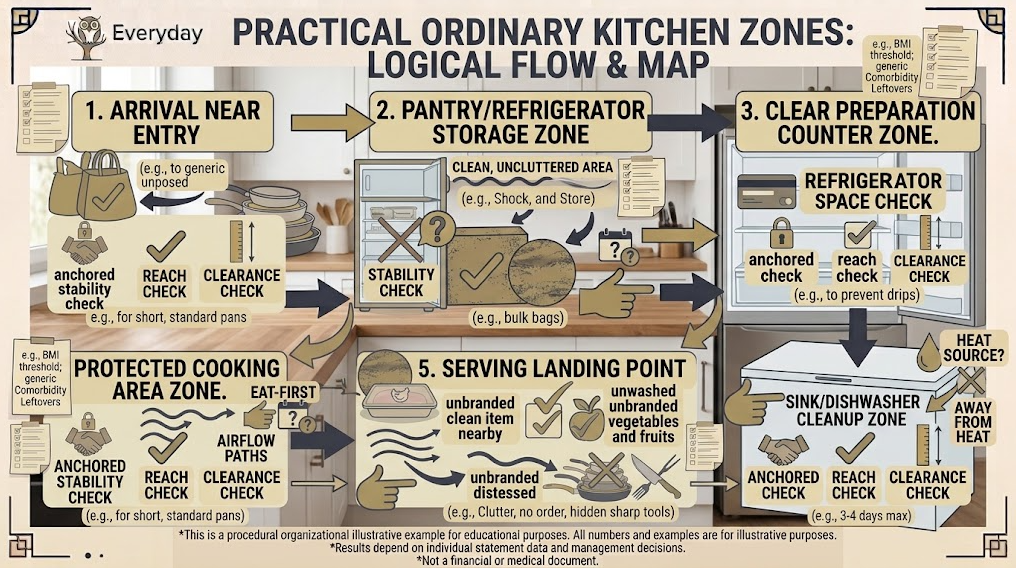
Map Actions Before Moving Objects
The familiar refrigerator-sink-stove “work triangle” can describe some kitchens, but it does not capture every household, galley, island, accessible layout, multiple-cook routine, or appliance setup. Do not force the kitchen into a geometric rule before identifying the work.
Choose one ordinary meal and record each action:
- Ingredients leave the pantry, refrigerator, or freezer.
- Packaging is opened and waste appears.
- Produce or hands are washed as appropriate.
- Ingredients are measured, cut, mixed, or assembled.
- Food moves to the stove, oven, microwave, or another appliance.
- Plates, bowls, and utensils are collected.
- Food is served or packed.
- Leftovers are cooled and stored safely.
- Dishes and surfaces are cleaned.
- Tools return to storage.
Mark each repeated crossing, search, lift, collision, and wait. Did someone walk across the room for a knife three times? Did the refrigerator door block the route? Did dirty dishes consume the only preparation surface? Did guests pass beside hot cookware to reach drinks?
These frictions show where a zone is missing, oversized, or competing with another task. The objective is not zero movement. It is fewer unnecessary movements and safer boundaries around contamination, heat, water, sharp tools, and people.
Zone 1: Arrival
The arrival zone handles food and supplies before they disperse. It may be a section of counter near the entrance, a sturdy table, or simply a temporary cleared surface.
It needs enough function to:
- set down bags without blocking a walkway or hot appliance;
- separate leaking raw-food packages from ready-to-eat items;
- identify refrigerator and freezer food first;
- check packages, dates, damage, and recall information;
- route pantry goods to their assigned areas;
- add missing items to the household list; and
- remove outer packaging and waste appropriately.
The arrival zone should be temporary. Grocery bags, mail, keys, and delivery boxes should not permanently occupy food-preparation space. If raw meat, poultry, seafood, or another perishable item arrives, move it to safe cold storage promptly under current food-safety guidance.
When the entrance is far from the kitchen, use a planned carrying method that preserves cold food and avoids overloading the person carrying it. Do not place bags on the stove or block an exit because that surface happens to be empty.
Zone 2: Storage
Storage includes pantry, refrigerator, freezer, cookware, and everyday supplies, but this zone should not become one physical corner. Put each category near the task it supports and under the conditions it requires.
The earlier cluster articles provide the detailed systems:
- Article”How to Organize a Pantry by Use” organizes pantry food by use and rotation.
- Article”Small-Kitchen Storage Ideas That Preserve Access” preserves access in small kitchens.
- Article”How to Store Pots, Pans, and Lids” handles pots, pans, lids, and cookware weight.
- Article”Refrigerator Organization for Food Safety” organizes the refrigerator around temperature and separation.
- Article”How to Create a Snack Station” defines snack access.
- Article”Bulk Food Storage Without Waste” connects bulk purchasing to portioning and freezer inventory.
At the whole-kitchen level, ask whether storage creates unnecessary crossing. Breakfast dishes may belong near the place breakfast is assembled. Baking ingredients may work near the main mixing surface. Dish towels may belong near cleanup rather than across the cooking route.
Do not move food or tools closer when the new location violates temperature, moisture, ventilation, child safety, allergen controls, weight support, or manufacturer instructions. Proximity is useful only after suitability.
Zone 3: Preparation
The preparation zone needs a clean, stable work surface and access to the tools used before heat is applied. Protect enough continuous space for the household’s ordinary meal.
Typical supporting items include:
- cutting boards appropriate to the task;
- knives and other tools stored safely;
- mixing bowls and measuring tools;
- frequently used seasonings;
- a waste or compost route;
- clean towels or disposable alternatives used appropriately; and
- a food thermometer when preparation leads to cooking.
FoodSafety.gov organizes home food safety around Clean, Separate, Cook, and Chill. The preparation zone should make “separate” visible. Raw meat, poultry, seafood, and eggs can spread germs to ready-to-eat foods. Use separate cutting boards or appropriately clean and sanitize equipment between tasks according to current guidance. Keep raw packages and juices away from washed produce, bread, garnishes, and finished food.
If the kitchen has one main work surface, separate tasks by time:
- Prepare ready-to-eat food first when appropriate.
- Move and protect it.
- Handle raw animal foods with dedicated or properly cleaned equipment.
- Clean and sanitize affected surfaces as guidance requires.
- Begin the next task only after the surface is ready.
A decorative counter display is secondary to usable preparation space. Appliances and containers that remain on the counter should earn their position through frequent use, difficult relocation, or an access need.
Zone 4: Cooking
The cooking zone includes the range, oven, microwave, countertop appliances, controls, landing space for hot cookware, ventilation, and the immediate tools required for safe use.
NFPA advises keeping combustible items such as oven mitts, wooden utensils, food packaging, towels, and curtains away from the stovetop. This does not mean oven mitts should be stored across the room; it means their storage must be close enough to retrieve before handling heat while remaining outside the area where they can ignite.
Protect the cooking zone from:
- people passing through to reach drinks, snacks, or an exit;
- children and pets entering the hot-work area;
- hanging items that require reaching across burners;
- paper, plastic, oils, and towels accumulating beside heat;
- cords crossing water, heat, or walking routes;
- blocked appliance vents and controls; and
- a landing surface already filled with unrelated objects.
Keep frequently used pots and pans accessible without lifting an unstable stack. Heavy cookware should have a suitable supported location. Knives, graters, and other sharp tools need dedicated storage rather than hiding among cookware.
CPSC advises that freestanding ranges use anti-tip brackets to reduce crushing and scalding hazards. Do not let a storage addition interfere with that installation, ventilation, shutoffs, controls, or maintenance access.
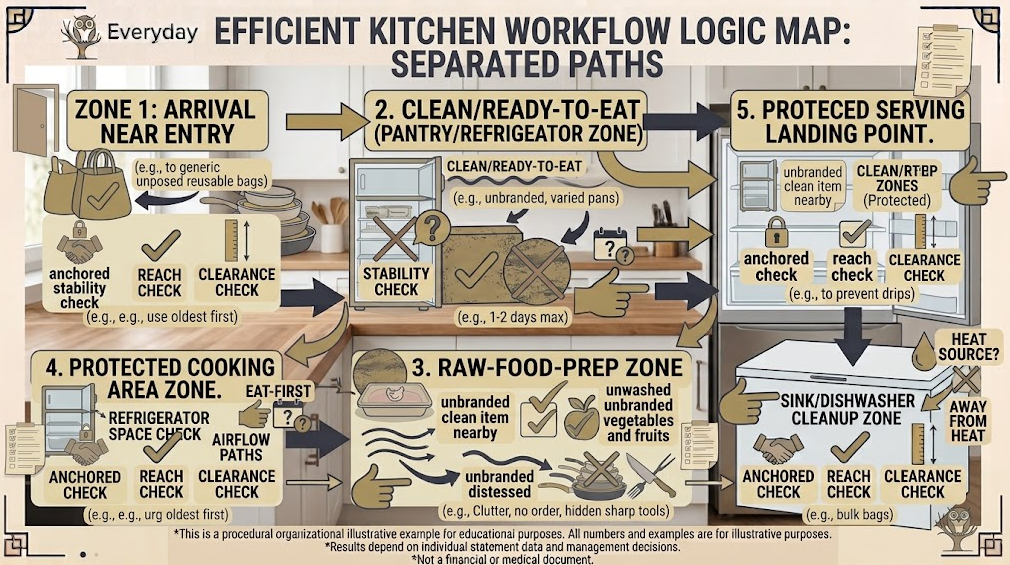
Zone 5: Serving
Serving often lacks a zone, so finished food competes with dirty utensils, grocery bags, and preparation scraps. Reserve a landing point where hot or completed dishes can be set safely before moving to the table or containers.
The serving zone may include:
- plates, bowls, and cutlery;
- trivets or heat-safe landing equipment;
- serving utensils;
- water and approved drinks;
- reusable lunch containers; and
- a place to identify foods for guests when needed.
It should not require a guest to reach across the stove or enter the cook’s turning area. For gatherings, move drinks, glasses, and self-serve items to a separate safe location when possible. Keep perishable foods under proper temperature control and do not allow a buffet or conversation to extend safe holding times.
When allergies are relevant, keep complete product information available, prevent cross-contact, and follow the allergic person’s medical plan. A handwritten serving label may improve communication but cannot establish that food is allergen-safe.
The serving zone also needs a return route. Decide where used plates go so they do not travel back through active food preparation or collect on the only clean surface.
Zone 6: Cleanup
Cleanup includes the sink, dishwasher, drying area, waste, cleaning products, and return path for dishes and tools. A good cleanup zone resets the kitchen without spreading raw-food contamination or making someone cross the hot zone repeatedly.
Keep:
- dishwashing supplies near their point of use but protected from children and food;
- cleaning chemicals in suitable original or clearly identified containers according to instructions;
- waste and recycling accessible without blocking cabinets or movement;
- drying racks clear of raw-food splash; and
- frequently returned dishes reasonably close to the dishwasher or drying area.
Do not mix cleaning chemicals. Use products only on approved surfaces and according to label directions. Separate handwashing needs from a sink full of raw-food tools when possible; clear and clean the area so hands can be washed effectively.
The final step of cleanup is return, not merely washing. If a pan, board, or appliance has no practical home, it will remain on the counter and reduce tomorrow’s preparation zone. Storage and cleanup must connect.
Use Jerome’s Hosting Experience to Test the Zones
From Jerome, EverydayWise Contributor
After moving from Korea to Canada, I found myself cooking much more and inviting people to our home more often. Restaurant meals were expensive, and home gave us more time to sit and talk comfortably. As the amount of cooking and hosting increased, we also accumulated more ingredients and kitchen tools. The kitchen had to support everyday family meals as well as the movement of guests, serving dishes, and cleanup.
The passage above comes from an EverydayWise contributor’s household experience. It shows why a kitchen that works for one cook on a quiet evening may fail when several people arrive.
Test two versions of the map:
Ordinary meal map
Follow one person from storage through preparation, cooking, serving, leftover storage, and cleanup. Put the most-used items where they reduce repeated crossings.
Hosting map
Add coats, bags, drinks, appetizers, guests, children, serving platters, extra dishes, waste, and conversation. Identify where visitors naturally gather and whether that point conflicts with hot cookware, raw-food preparation, the refrigerator door, or the cleanup route.
Do not permanently redesign the kitchen around occasional gatherings. Use temporary hosting zones: a drink station outside the cooking area, a tray for used glasses, a labelled refrigerator shelf, or a cleared table for serving. Everyday access should remain the priority unless hosting is genuinely frequent.
Let Zones Overlap in Time, Not in Hazard
Small kitchens often cannot dedicate a surface to every function. One counter can be:
- an arrival surface after shopping;
- a preparation surface before dinner;
- a serving surface during the meal; and
- a drying or packing surface afterward.
This works when the transition is explicit. Empty the previous task, clean or sanitize as appropriate, retrieve the next task’s kit, and restore the surface afterward.
Some overlaps are inappropriate even temporarily. Do not combine:
- raw-food leakage with ready-to-eat preparation;
- hot-pan landing with paper storage;
- cleaning chemicals with food or medicine;
- sharp-tool storage with an unprotected child-access zone;
- pet feeding with clean dish drying; or
- blocked exits and appliance doors with temporary carts or bags.
Use portable trays or bins only for complete, low-risk task kits. A baking tray might hold measuring tools and decorations in storage, then move to the preparation area. It should not conceal damaged cords, raw-food residue, or expired ingredients.
Design for More Than One Body
A zone is not functional if the person who needs it cannot approach, see, grip, lift, or operate it.
Ask each household member:
- Which daily task requires help?
- Where do doors or another person block the approach?
- Which reach causes pain, imbalance, or unsafe climbing?
- Which item is too heavy or awkward?
- Can labels and controls be seen?
- Is there enough time and space to complete the task without rushing?
Move a limited set of essential items into the easiest range for the person using them. A seated user may need a suitable work surface and clear approach. A person with low vision may need stronger contrast and consistent placement. Someone with reduced grip may benefit from easier handles or smaller containers.
ADA standards contain important clear-floor, approach, reach, and kitchen requirements for covered facilities. They should not be presented as universal dimensions for every private home. Structural accessibility work may require an occupational therapist, accessibility specialist, landlord, building authority, designer, or qualified contractor familiar with the resident and local rules.
Preserve floor space and appliance approaches even when no formal standard applies. A rolling cart, open dishwasher, trash bin, or guest stool can remove the space a household member needs.
Make a Zone Kit Before Buying an Organizer
Choose one repeated task such as coffee, lunch packing, baking, medication-safe meal preparation, or weekday dinner.
Gather only the tools and supplies used in that task. Then ask:
- Which items must stay at a controlled temperature?
- Which are sharp, heavy, hot, fragile, allergenic, or child-sensitive?
- Which can live together safely?
- Which must remain in original packaging?
- Where does the task begin and end?
- What surface and cleanup route does it require?
Use a temporary tray, drawer section, or shelf to test the kit. Do not buy a caddy before confirming that carrying the complete load is safe and that it does not block the work surface.
One tool may belong to several tasks. Store it at the zone where it is used most often or where retrieval has the greatest safety consequence. Duplication is sometimes reasonable for an inexpensive frequently used tool, but should solve a verified crossing rather than fill every zone with copies.
A 30-Minute Zone Reset
Do not empty the whole kitchen.
- Choose one meal cooked regularly.
- Record every retrieval, crossing, and blocked surface.
- Mark Arrival, Storage, Preparation, Cooking, Serving, and Cleanup on a simple sketch.
- Identify one unsafe crossing or repeated search.
- Move only the items needed to correct that problem.
- Preserve raw/ready-to-eat separation, heat clearance, ventilation, doors, and walking routes.
- Cook the meal again.
- Keep, adjust, or reverse the change based on actual work.
After the ordinary map works, test a second user or a small gathering. The kitchen does not need perfectly fixed zones. It needs reliable transitions and clear safety boundaries.
The finished system may look ordinary: a clear section of counter, pans near the stove but outside the heat hazard, plates near serving, leftovers containers near the refrigerator, and cleaning supplies near cleanup. Its value appears in motion. Food travels forward, people interrupt one another less, and the kitchen can return to ready condition after the meal.
FAQ
What are the basic zones in a kitchen?
A practical starting set is Arrival, Storage, Preparation, Cooking, Serving, and Cleanup. Combine or separate them according to the household’s actual tasks and space.
Do I need to follow the kitchen work triangle?
No single geometry fits every kitchen or user. Use the triangle as an observation aid if helpful, but map actual appliance doors, people, food-safety paths, work surfaces, and repeated tasks.
Can one counter belong to several zones?
Yes, at different times. Complete the first task, remove its materials, clean or sanitize as appropriate, and set up the next. Do not overlap raw-food, chemical, heat, or allergen hazards.
Where should frequently used kitchen tools go?
Place them near the point of use when that location supports safe reach, weight, temperature, ventilation, child safety, and cleaning. Frequency does not override suitability.
How do I zone a very small kitchen?
Use time-based zones, compact task kits, and remote storage for occasional items. Protect one preparation surface, appliance operation, airflow, and the walking route before adding storage.
How should kitchen zones change when guests visit?
Create temporary drink, serving, and used-dish points outside the hot cooking and raw-preparation areas. Keep everyday zones intact unless hosting is frequent enough to justify a permanent change.
Can kitchen zones improve accessibility?
They can reduce unnecessary reach and travel when designed for the actual user. Assess approach, grip, sight, lifting, pain, and mobility; seek qualified help for structural or individualized accessibility work.
Sources
- FoodSafety.gov — 4 Steps to Food Safety
- National Fire Protection Association — Safety With Cooking Equipment
- U.S. Consumer Product Safety Commission — Childproofing Your Home
- U.S. Department of Justice — 2010 ADA Standards for Accessible Design
- Health Canada — Safe Food Handling in the Home