From Jerome, EverydayWise Contributor
I probably start a diet three or four times a year. I check my weight regularly and try not to let it cross a line I have set for myself. When the number moves beyond that line, I become more deliberate about what I eat.
Lately I have been boiling eggs and eating more cheese and bananas. When I want a snack, I try to eat an egg or some cheese instead of automatically choosing something else. I am looking for food that feels more substantial and helps me regain control of the routine.
The difficult part is that I am not feeding only myself. Our children are growing and often hungry, my wife is naturally leaner, and everyone in the family likes carbohydrate-rich foods. A change that makes sense for my own weight does not automatically make sense for the whole table.
The passage above comes from Jerome, an EverydayWise contributor. His repeated restarts are familiar: a boundary is crossed, attention sharpens, several foods change, and the household tries to settle into a new routine. That pattern is not evidence of laziness or lack of discipline. It may simply mean the change was designed as a temporary response rather than a routine that could survive ordinary life.
Gradual dietary change is not necessarily slow in every detail. It means changing a small number of repeatable decisions, learning from what happens, and adjusting without treating one difficult meal as a collapse of the entire plan.

Why “Starting Over” Feels Powerful
A new diet creates a clear boundary between before and after. Rules reduce decisions. Early effort can create a sense of control. The problem is that strict rules often depend on conditions that do not last:
- high motivation;
- extra planning time;
- no travel or celebrations;
- predictable work hours;
- a cooperative household;
- enough energy to cook;
- no illness, stress, or poor sleep.
When ordinary life returns, the plan may become difficult to follow. If the person interprets one deviation as failure, a single restaurant meal can end the effort until the next restart.
NIDDK describes behaviour change as a process that may move through contemplation, preparation, action, and maintenance. People can revisit stages rather than progressing in a perfect line. A setback is therefore information about the plan and environment, not proof that change is impossible.
The better question after a restart is not “How can I be stricter?” It is “Which part of the routine was too demanding, unclear, or unsupported?”
Choose One Decision Point, Not an Entire New Identity
“Eat healthier” is too broad to guide behaviour. “Never eat processed food again” is clear but often unnecessarily rigid.
A workable first change identifies:
- a specific situation;
- one action;
- an available alternative;
- a frequency; and
- a review date.
Examples:
- At weekday lunch, add one vegetable or fruit before buying extra food.
- On three mornings this week, eat a planned breakfast instead of relying on snacks.
- Keep water visible at dinner and choose it first.
- Add beans to one familiar meal twice this week.
- When an afternoon snack is needed, choose from two prepared options.
- Order the usual restaurant meal but add a vegetable side or choose a smaller fried portion.
The goal is not to select the smallest possible change. It is to choose a change large enough to matter and small enough to repeat.
Make the Goal About an Action You Control
Body weight, blood pressure, cholesterol, blood glucose, and energy level can be meaningful health outcomes, but they are not fully controllable from day to day. They respond to many influences and may change more slowly than behaviour.
Pair an outcome goal with one or two action goals.
Outcome goal: Keep weight within a range discussed with a health professional.
Action goals: Prepare tomorrow’s snack on four evenings and include vegetables at five dinners.
Outcome goal: Improve blood pressure.
Action goals: Compare sodium in two frequently purchased products and cook one additional meal at home each week.
Outcome goal: Feel less hungry late at night.
Action goals: Eat a planned afternoon snack and record whether dinner timing or portion changes the evening.
Action goals provide evidence even when the outcome fluctuates. They also reveal whether the selected behaviour is realistic.
Observe Before You Remove
For one week, notice the eating moment you want to change. You do not need to record every calorie.
Capture:
- time and place;
- physical hunger;
- what food was available;
- mood or stress;
- who was present;
- what happened earlier in the day;
- what you chose; and
- how you felt afterward.
This can separate different problems that all look like “snacking.”
One snack may follow a skipped lunch and reflect real hunger. Another may happen because food is visible during television. Another may be social. Another may provide relief after a difficult day. The same replacement will not solve all four.
If Jerome’s egg or cheese snack leaves him comfortably satisfied until dinner, it may be useful. If it is added on top of another snack without changing hunger or routine, it may not serve the intended goal. If he wants something refreshing rather than substantial, fruit or yogurt may fit better. The experiment tests function rather than declaring a food universally superior.
Change the Environment Before Demanding More Willpower
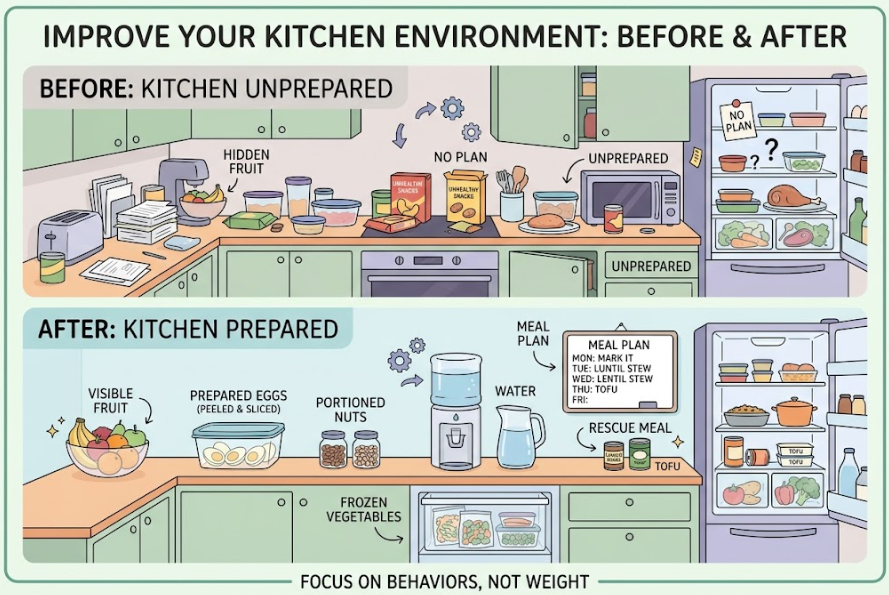
Health Canada recommends making changes to the eating environment so a healthy choice becomes easier. Environment includes what is purchased, where it is stored, what is prepared, how visible it is, and how much effort it requires.
Practical changes include:
- boil several eggs before the busy part of the week;
- wash fruit and place it where it will be seen;
- keep frozen vegetables for low-energy evenings;
- portion nuts into practical containers;
- store tempting foods less visibly without calling them forbidden;
- keep water available at meals;
- maintain one rescue dinner;
- put the planned snack in the work bag before morning; and
- avoid shopping hungry when that predictably changes purchases.
These choices do not eliminate personal agency. They reduce the number of times agency must fight convenience.
Use Addition to Make Reduction Easier
Diet changes are often framed as removal: less rice, less sugar, less fried food, fewer snacks. Reduction may be appropriate, but adding something useful can make it more sustainable.
Examples:
- add vegetables and protein before reducing a large noodle portion;
- add fruit to plain yogurt instead of demanding unsweetened food immediately;
- add beans to meat sauce rather than removing meat overnight;
- add water before deciding whether another sweet drink is wanted;
- add a planned afternoon snack before trying to eliminate evening eating;
- add a familiar vegetable beside restaurant fried food.
Addition protects adequacy and satisfaction. It can also reveal whether the original behaviour was driven by hunger. Reducing food while leaving the person underfed is unlikely to create a stable routine.
For children, addition is especially important. A parent’s weight goal should not turn the family table into a restriction program. Growing children need adequate energy and nutrients, and their hunger can change rapidly. Adults can adjust their own proportions while offering the child sufficient food.
Design a Minimum Version for Difficult Days
A habit that works only on ideal days is a temporary project. Create a minimum version.
| Full plan | Minimum version |
|---|---|
| Cook a balanced dinner | Use a frozen meal and add frozen vegetables or fruit |
| Prepare yogurt, fruit, and nuts | Eat a banana with yogurt or a nut-safe alternative |
| Pack a full lunch | Pack a sandwich, fruit, and water |
| Cook beans from dry | Use lower-sodium canned beans |
| Exercise and cook after work | Use the rescue meal and rest if needed |
The minimum version is not a loophole. It preserves the direction of change when capacity is low.
Set the threshold in advance: “If I arrive home after 8 p.m., I use the rescue meal.” This prevents the tired version of you from having to negotiate with the ambitious version.
Review the Change Like an Experiment
After one or two weeks, ask:
- Did the action happen often enough to evaluate?
- What made it easier?
- What repeatedly blocked it?
- Did hunger, satisfaction, energy, digestion, or mood change?
- Did it create extra cost, time, or family conflict?
- Is the change still nutritionally adequate?
- Should it continue, shrink, expand, or be replaced?
Avoid judging success only by the scale. Body weight can fluctuate because of water, food in the digestive tract, sodium, hormones, and other factors. A short observation period may not show a meaningful trend.
If weight monitoring is useful, decide how the information will change an action. A number without a plan can create anxiety rather than clarity. Some people prefer daily measurements interpreted as a trend; others benefit from less frequent measurement; some should avoid self-weighing because it worsens eating-disorder symptoms. A clinician can help determine an appropriate method.
Add Changes Only After the First One Has a Home
Once a behaviour feels ordinary, decide whether to maintain it alone or add another.
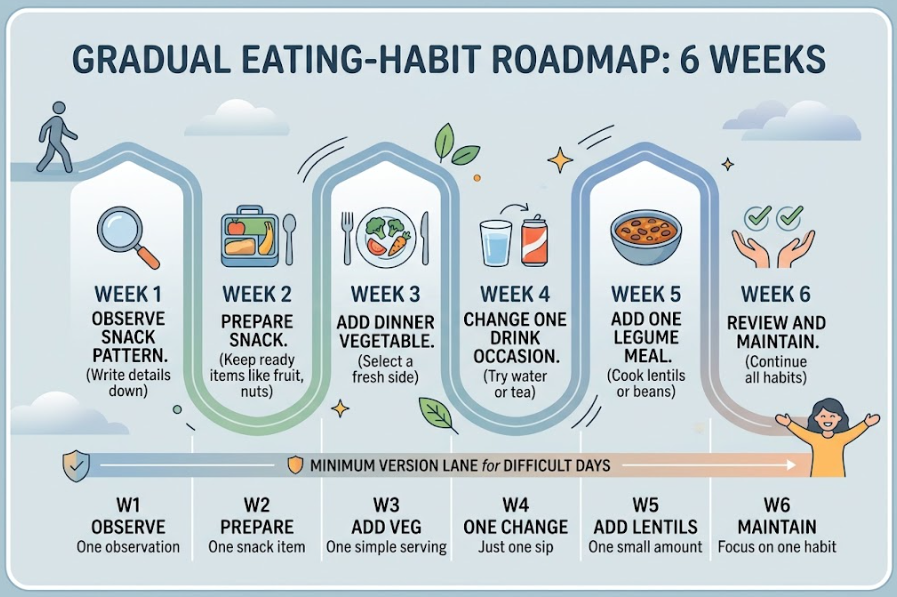
A gradual sequence might look like this:
- Prepare an afternoon snack four days per week.
- Add a vegetable to three dinners.
- Replace one sweetened drink occasion with water.
- Add one bean- or lentil-based meal.
- Change one frequently purchased product after comparing labels.
Not every step must remain forever. If a change offers little benefit or causes disproportionate burden, revise it.
Avoid changing breakfast, lunch, dinner, snacks, drinks, shopping, exercise, and sleep simultaneously. When everything changes, it becomes hard to know what helped or what caused the plan to fail.
What to Do After an Off-Plan Meal
Do not compensate by fasting, skipping the next meal, purging, or exercising as punishment. Return to the next ordinary meal.
Ask only what is useful:
- Was the meal planned and enjoyable?
- Was I unusually hungry because I had eaten too little earlier?
- Did the environment make the choice automatic?
- Does the plan need more flexibility?
A restaurant meal, holiday, or dessert can belong in a healthy pattern. Planned flexibility may be more sustainable than pretending those events will disappear.
If the same difficulty repeats, adjust the system. Eat before becoming extremely hungry, plan what to order, share a large portion if desired, or decide deliberately that this is a meal for enjoyment without trying to optimize it.
Weight Goals Need Context
CDC guidance describes healthy weight loss as involving eating patterns, physical activity, sleep, and stress management—not food restriction alone. Age, genes, medications, illness, hormones, and environment also affect weight.
If weight loss is a goal, a clinician can help determine whether it is appropriate and whether medications or health conditions change the plan. Rapid loss is not automatically better, and no general weekly rate is appropriate for everyone.
Weight is also not the only outcome. Blood pressure, glucose, lipids, strength, mobility, sleep, energy, digestive symptoms, and relationship with food may be relevant. For some people, maintaining weight while improving eating quality is meaningful progress.
Children should not be placed on an adult weight-loss plan. Growth is assessed using age- and sex-specific patterns over time, not adult BMI cutoffs or a parent’s preferred weight threshold.
When Gradual Change Is Not Enough
Seek medical or registered-dietitian guidance when:
- weight changes rapidly or without explanation;
- a condition or medication affects appetite, digestion, or nutrient needs;
- diabetes medication raises the risk of low blood glucose during diet changes;
- a child’s growth or intake is concerning;
- food allergies or gastrointestinal symptoms severely limit choices;
- fatigue, dizziness, fainting, weakness, or menstrual changes accompany restriction; or
- a structured treatment plan is needed for obesity or another condition.
Eating disorders can occur at any body size. NIMH identifies severe restriction, binge eating, vomiting, laxative use, fasting, excessive exercise, and unhealthy fixation on weight, shape, weight loss, or food intake as warning signs across eating disorders.
If dietary change creates fear, secrecy, guilt, social withdrawal, loss of control, or compensatory behaviour, seek professional help rather than making the rules stricter. Early treatment matters.
A Practical Seven-Day Start
For the next week:
- Choose one eating moment.
- Observe it for three days without trying to perfect it.
- Select one action that addresses the actual barrier.
- Prepare the environment once.
- Define a minimum version.
- Track completion, hunger, and burden—not every nutrient.
- Review the result before adding another rule.
Example: “At 3 p.m. on workdays, I will choose yogurt and fruit, an egg and fruit, or nuts and a banana. I will prepare the option the night before. If none is available, I will buy one planned alternative rather than skip the snack. After seven days, I will review hunger before dinner and whether the routine was practical.”
This is specific enough to test and flexible enough to survive variation.
The EverydayWise Perspective
Lasting dietary change usually looks less dramatic than a diet restart. It is a planned snack in the refrigerator, a vegetable added to a familiar meal, water placed on the table, or a rescue dinner used before hunger becomes urgent.
Jerome’s eggs and cheese may be useful if they answer the actual snack problem. His weight threshold may be useful if it prompts a calm review rather than punishment or escalating restriction. The evidence comes from what the routine does over time—not from whether the food sounds disciplined.
Choose one decision point. Change the environment. Protect adequacy and enjoyment. Review what happened. A sustainable eating pattern is not one that never bends; it is one that has a way to continue after it does.
FAQ
How small should the first dietary change be?
It should be meaningful enough to affect a repeated decision and realistic enough to perform under ordinary conditions. One specific meal, snack, drink, or shopping action is usually easier to evaluate than an entire diet overhaul.
How long should I test a new habit?
One or two weeks can reveal practical barriers, but longer may be needed to judge health outcomes. Review the action first—whether it happened and what burden it created—before expecting a body-weight or laboratory change.
Is replacing snacks with eggs or cheese a good strategy?
It can be useful when protein and fat make the snack more satisfying, but it is not universal. Consider hunger, sodium, saturated fat, allergies, total intake, and preference. Fruit, yogurt, nuts, beans, or whole grain foods may also fit.
Should I weigh myself every day?
There is no single answer. Daily weighing may help some adults see trends, while it increases anxiety or obsessive behaviour for others. Decide what action the information supports and seek professional guidance if weighing affects mood or eating.
What should I do after eating more than planned?
Return to the next ordinary meal. Do not compensate through fasting, purging, or punishment exercise. Review the event only if it reveals a useful change to hunger, planning, or flexibility.
Can the whole family follow my dietary change?
Some household changes—more vegetables, water access, regular meals—may benefit everyone. Portions and restrictions should not be identical. Children need enough energy and nutrients for growth and should not automatically follow an adult weight-loss plan.
When is a diet becoming too restrictive?
Warning signs include severe food limitation, fear or guilt around eating, fixation on weight or purity, bingeing, vomiting, laxative use, fasting, compulsive exercise, social avoidance, or inadequate growth and nutrition. Seek professional help promptly.
Reference Log
- Changing Your Habits for Better Health — National Institute of Diabetes and Digestive and Kidney Diseases. Used for: Stages of change, planning, setbacks, support. Accessed 2026-08-27.
- Be Mindful of Your Eating Habits — Health Canada, May 4, 2026. Used for: Eating environment and attention to habits. Accessed 2026-08-27.
- Improving Your Eating Habits — Health Canada, March 21, 2026. Used for: Planning, family involvement, convenient foods. Accessed 2026-08-27.
- Diets and Food Trends — Health Canada, March 21, 2026. Used for: Individual goals, hunger/fullness awareness, meal planning. Accessed 2026-08-27.
- Steps for Losing Weight — U.S. Centers for Disease Control and Prevention. Used for: Specific planning; eating, activity, sleep, and stress context. Accessed 2026-08-27.
- Tips for Maintaining Healthy Weight — U.S. Centers for Disease Control and Prevention, March 27, 2026. Used for: Weight influences beyond food. Accessed 2026-08-27.
- Take Charge of Your Health: A Guide for Teenagers — National Institute of Diabetes and Digestive and Kidney Diseases. Used for: Slow change and limits of changing too much at once. Accessed 2026-08-27.
- Eating Disorders: What You Need to Know — National Institute of Mental Health. Used for: Restriction, bingeing, compensatory behaviours, ARFID signs. Accessed 2026-08-27.
- Eating Disorders — National Institute of Mental Health. Used for: Seriousness, treatment, and early detection. Accessed 2026-08-27.
More in This Cluster: Healthy Eating Foundations
- How to Build a Balanced Plate for Real Family Meals
- How to Read Nutrition Labels Without Getting Misled
- Protein, Carbohydrates, and Fat: What Each One Does
- How to Plan Healthy Meals on a Realistic Budget
- Whole Foods vs Processed Foods: What Actually Matters
- How to Make Gradual Dietary Changes That Can Last (you are here)
- When Nutrition Advice Needs Professional Guidance