Most loan decisions do not feel like contract negotiations. They happen while a vehicle is waiting at a dealership, a repair invoice is due, a banking app displays “pre-approved,” or a checkout screen divides a purchase into manageable-looking payments.
The approved amount and monthly payment are easy to see. The margin above prime, origination charge, optional insurance, lien, late-payment rule, automatic debit authority, or early-exit cost may sit several screens or pages away.
Convenience compresses the decision. The debt does not stay compressed after acceptance.
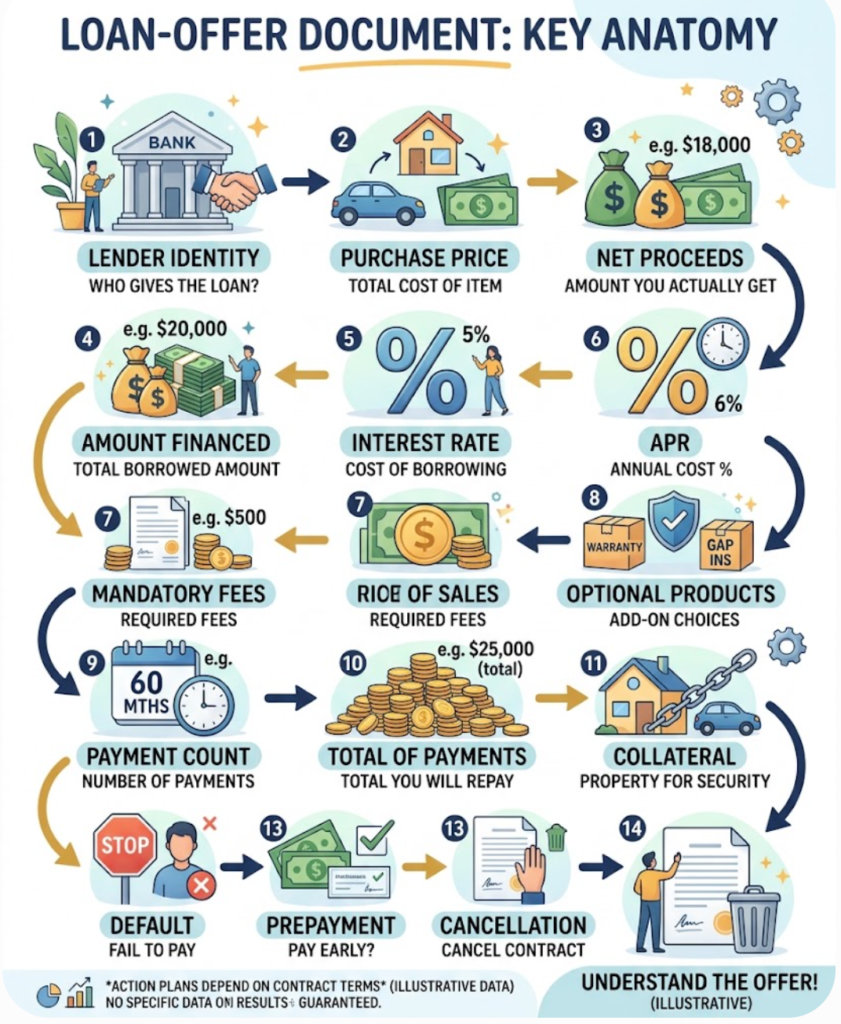
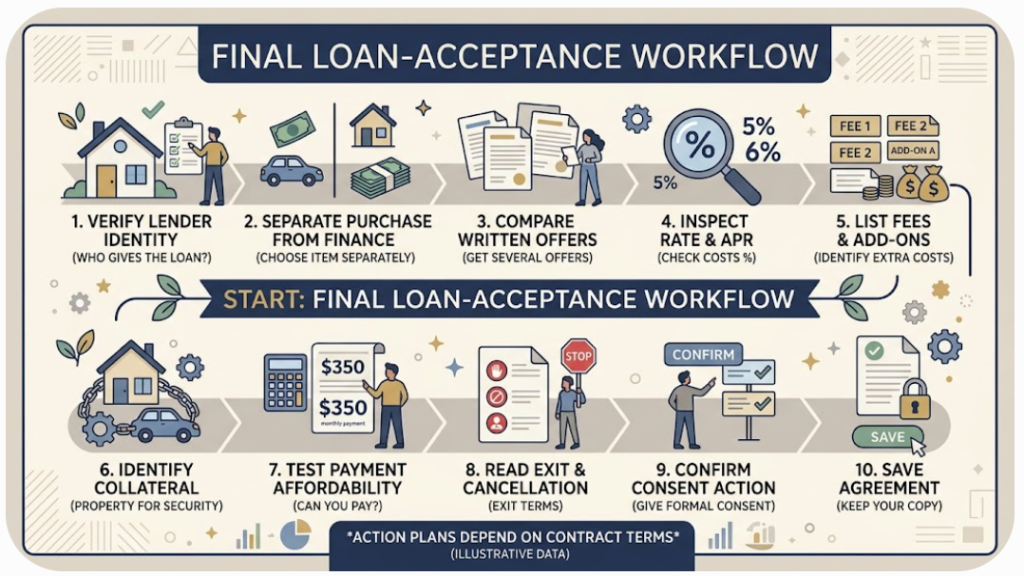
Quick decision: Do not accept until you can identify the lender, amount received, amount financed, interest rate, APR or comparable annual-cost disclosure, fixed or variable rule, every mandatory fee, optional product, payment schedule, total of payments, collateral, default consequence, prepayment terms, and cancellation rights. Compare at least one alternative using the same amount and repayment period, and keep the final agreement.

First Confirm Who Is Lending the Money
A familiar seller is not always the lender. A dealership, contractor, retailer, broker, app, or comparison site may arrange financing through another company.
Before sharing sensitive information or paying anything, record:
- lender’s legal name;
- business address and reliable contact information;
- regulator, licence, or registration where applicable;
- broker or intermediary name;
- who services the loan after funding;
- where payments will be sent;
- who receives any upfront fee; and
- how complaints and disputes are handled.
Verify the lender through the appropriate government or regulatory source in your country, state, province, or territory. Do not rely only on a link, phone number, or badge supplied inside the offer.
Be cautious when a lender guarantees approval, demands payment by gift card or cryptocurrency, asks for an advance fee before releasing funds, pressures immediate action, or contacts you unexpectedly for identity and banking information. A legitimate-looking pre-approved offer may still be expensive, and a fake offer may be designed to steal information.
CFPB warns that unexpected live-check and pre-approved loan offers can be confused with scams. Cashing or depositing a genuine live check may constitute acceptance of the loan terms. Do not activate an offer until the lender and contract have been verified.
Separate the Purchase From the Financing
When credit is attached to a purchase, complete two negotiations:
- What does the product or service cost without financing?
- What does the financing cost for the agreed purchase?
For a vehicle, renovation, appliance, or other financed purchase, write down:
- cash price;
- taxes and unavoidable government charges;
- seller or dealer fees;
- optional products and services;
- down payment;
- trade-in or rebate;
- unpaid balance rolled in from another debt; and
- final amount financed.
An affordable payment can be created by extending the term or financing add-ons. CFPB notes that optional auto-loan products increase both the monthly payment and the amount that must be repaid. Ask for the price of each item separately and whether it is required.
Do not let financing approval determine the purchase budget. The lender’s maximum is not evidence that the asset, project, or service is worth that amount.
Distinguish Amount Received From Amount Financed
If a borrower needs $10,000 but an origination fee is deducted from the proceeds, the cash received may be less than $10,000 while the debt is still based on the larger amount. Alternatively, a fee may be added to principal, creating a balance above the amount delivered.
Ask for three figures:
- Gross loan amount: The starting amount in the contract.
- Net proceeds: The amount actually delivered to the borrower or seller.
- Amount financed: The amount on which repayment is based under the disclosure rules that apply.
The exact definitions vary by jurisdiction and product. The decision question is simple: How much usable value do I receive, and how much debt do I create?
If an old loan, negative vehicle equity, insurance premium, warranty, broker charge, or other amount is included, identify it line by line. A borrower can unknowingly finance yesterday’s obligation inside today’s purchase.
Compare Interest Rate and APR Carefully
The interest rate is the price applied to principal under the contract. APR is intended to express an annualized borrowing cost using the charges included by the applicable rules. In the United States, CFPB explains that APR includes the interest rate plus certain lender fees such as origination charges.
APR is useful, but it is not a universal all-in number:
- inclusion rules vary by country and product;
- optional products may be excluded;
- late, missed-payment, or event-based charges may not be reflected;
- a variable APR can change;
- short-term loans can produce unusually large annualized figures; and
- offers with different terms or amounts still need additional comparison.
For each offer, record both the stated interest rate and APR or the comparable annual-cost measure required where you live. If they differ, ask which charges create the difference.
Do not compare one lender’s interest rate with another lender’s APR. Use the same measure and confirm what it includes.
Find the Rate-Change Formula
If the rate is variable, “current rate” is not enough. Locate:
- reference rate or index;
- lender margin;
- current combined rate;
- adjustment frequency;
- floor and cap, if any;
- introductory period;
- notice process;
- effect on payment, principal allocation, or repayment time; and
- conversion terms.
If the offer is fixed, determine how long it is fixed. A fixed mortgage term may end before the amortization period. A fixed personal loan may hold the rate for its full scheduled life. The product and contract control.
Article”Fixed vs. Variable Interest Rates” provides the full fixed-versus-variable framework. At the offer stage, the minimum requirement is the ability to explain what can change, when, and what the borrower must pay afterward.
List Every Fee and Trigger
CFPB notes that fees and charges often add to the cost of personal installment loans. The names vary, so ask for both recurring and event-based charges.
Possible charges include:
- application or origination fee;
- broker fee;
- document or administration fee;
- appraisal, registration, title, or lien fee;
- annual or access fee;
- payment-processing fee;
- insufficient-funds or returned-payment fee;
- late-payment fee;
- collection or legal cost;
- discharge or closure fee;
- early-payment or break penalty;
- conversion or refinance fee; and
- optional insurance or service product.
For each one, ask:
- Is it mandatory?
- Is it paid upfront, deducted, financed, or charged later?
- Does it accrue interest if financed?
- What event triggers it?
- Is it refundable?
- Is it included in APR or the disclosed borrowing cost?
A “no application fee” claim does not establish that the loan has no other charges.
Challenge Optional Products
Credit insurance, payment protection, extended warranties, service plans, monitoring, memberships, and other add-ons may be presented beside the loan. Some may be useful in particular circumstances. They should not appear without informed consent or be treated as mandatory when they are not.
Ask:
- Is this required to receive the loan or advertised rate?
- Who provides the product?
- What does it cover and exclude?
- How are benefits calculated?
- Does existing insurance already cover the risk?
- Is the premium paid monthly, upfront, or financed?
- Does interest apply to a financed premium?
- Can it be cancelled, and what refund method applies?
- Does cancellation change the loan rate or approval?
In Canada, federally regulated institutions must obtain express consent before providing a financial product or service and must provide the agreement. Local protections differ elsewhere. Regardless of location, do not accept an unexplained box that changes the amount financed.
Confirm the Payment Schedule and Total
Write the schedule in full:
- payment amount;
- first payment date;
- frequency;
- number of payments;
- last scheduled payment date;
- any different final or balloon payment;
- total of payments;
- whether payments can change; and
- projected balance at important dates.
If the payment is weekly or biweekly, calculate the annual total rather than multiplying by 12. If a payment is deferred, ask whether interest accrues and how the final cost and payoff date change.
Check that the schedule matches income timing without leaving essential bills exposed. A loan can satisfy a lender’s underwriting and still be too fragile for the household.
Article”How Loan Terms Change the Total Cost“ explains how longer terms lower required payments while usually increasing interest. The offer should be tested at both the contractual payment and any higher payment the borrower plans to make.
Identify the Collateral and Default Consequence
Secured credit places an asset behind the debt. The collateral may be the purchased vehicle, a deposit, investments, business property, or a home.
Ask:
- What exact property secures the loan?
- Is a lien or security interest registered?
- Can the security cover other debts with the same lender?
- What happens after a missed payment?
- When can the lender accelerate or demand the balance?
- What repossession, sale, legal, or collection costs may be charged?
- If the asset is sold for less than the balance, can a shortfall remain?
- What releases the lien after repayment?
A lower secured rate may be valuable, but it is not a free discount. It exchanges part of the lender’s risk for a more serious borrower consequence.
For a co-signed or jointly borrowed loan, identify each person’s liability. A co-signer may be responsible for the debt even if that person never uses the money or asset.
Read Prepayment and Exit Terms Before Entry
The moment before acceptance is often the best time to understand how the debt ends.
Confirm:
- whether extra principal is permitted;
- annual or periodic limits;
- minimum extra-payment amount;
- whether a penalty applies;
- how the penalty is calculated;
- how extra money is applied;
- whether the payment changes afterward;
- discharge or closure fee;
- refinancing and transfer conditions; and
- any balance due on sale of collateral.
Do not assume all personal loans, government student loans, private student loans, auto loans, lines of credit, or mortgages share the same rules. Article”How to Compare Early-Payment and Penalty Terms“ will compare early-payment and penalty terms in detail.
Do Not Assume a Cancellation Period
Some products or jurisdictions provide a right to cancel within a defined period. Others do not. A seller’s return policy is not necessarily a loan-cancellation right, and cancelling an add-on may not cancel the underlying debt.
Before signing or activating:
- identify whether a cooling-off or rescission right exists;
- confirm the deadline and required delivery method;
- ask what money or property must be returned;
- determine whether fees remain due;
- separate purchase cancellation from credit cancellation; and
- save proof of any cancellation notice.
If no applicable right exists, acceptance may be difficult or expensive to reverse. “I planned to review it later” is not a contract term.
Understand How Consent Occurs
Acceptance may happen through a handwritten signature, electronic signature, verbal agreement, checkbox, account activation, funds transfer, or deposit of a live loan check, depending on the offer and law.
Do not click, sign, cash, deposit, or verbally approve until the final terms match the version reviewed. Look for blank spaces, changed figures, preselected add-ons, or documents that incorporate other terms by reference.
FCAC states that Canadian federally regulated institutions must obtain express consent for a personal loan and provide clear, simple, non-misleading information. Those protections are jurisdiction-specific, but the practical rule is global: know which action creates the debt.
Compare Written Offers Side by Side
Use the same requested amount and repayment period where possible.
| Item | Offer A | Offer B |
|---|---|---|
| Net proceeds or purchase value received | ||
| Amount financed | ||
| Interest rate | ||
| APR/comparable annual cost | ||
| Fixed or variable | ||
| Mandatory fees | ||
| Optional products | ||
| Payment and frequency | ||
| Number of payments | ||
| Total of payments | ||
| Collateral | ||
| Prepayment/exit cost | ||
| Cancellation right |
If one cell cannot be completed, that is a question for the lender—not a reason to guess.
Pause the Offer When
- the lender cannot be independently verified;
- terms arrive only after payment or acceptance;
- the written figures differ from the verbal promise;
- mandatory and optional charges cannot be separated;
- the lender refuses time to read the agreement;
- approval requires false income, employment, occupancy, or purchase information;
- repayment depends on refinancing or an uncertain future event;
- the collateral consequence is unacceptable;
- the payment leaves no room for ordinary irregular expenses; or
- the borrower cannot explain how and when the balance reaches zero.
An urgent expense may still require borrowing. Urgency should narrow the purchase or increase verification—not transfer control of the decision to the first offer.
A Final 15-Point Review
Before accepting, confirm:
- lender and servicer identity;
- purchase price or borrowing purpose;
- net proceeds and amount financed;
- interest rate;
- APR or comparable annual-cost disclosure;
- fixed or variable formula;
- mandatory fees;
- optional products and consent;
- payment amount and number;
- total of payments;
- collateral and co-signer liability;
- default and collection consequences;
- prepayment and exit terms;
- cancellation rights and acceptance action; and
- final agreement saved in a retrievable place.
Approval means the lender is willing to create the debt. Acceptance should mean the borrower understands the obligation well enough to choose it.
FAQ
Is the lowest interest rate always the best offer?
No. Compare APR or the relevant annual-cost measure, mandatory fees, amount financed, total payments, rate-change rules, collateral, and exit terms. A lower rate can accompany higher fees or greater risk.
What is the difference between interest rate and APR?
The interest rate is the price applied to principal. APR generally combines the rate with certain included fees under applicable rules. The inclusions vary by jurisdiction and product, so ask what the disclosed APR contains.
Is pre-approved the same as guaranteed approval?
Not necessarily. Pre-approval may rely on limited information and remain subject to verification or final underwriting. It also does not establish that the offer is affordable or competitively priced.
Can a lender deduct a fee before giving me the money?
Some legitimate loans deduct or finance disclosed fees, but advance-fee scams also exist. Verify the lender and compare gross amount, net proceeds, amount financed, APR, and total repayment before paying or accepting anything.
Is loan insurance mandatory?
It depends on the product and jurisdiction, but many credit-insurance products are optional. Ask in writing whether it is required, its price, exclusions, cancellation and refund terms, and whether declining it changes the loan offer.
Can I cancel a loan after signing?
Do not assume so. Cancellation or rescission rights vary by product, transaction, and location. Confirm the deadline, process, fees, and relationship to the underlying purchase before accepting.
What should I keep after accepting?
Keep the signed agreement, disclosures, payment schedule, add-on contracts, proof of down payment, communications, cancellation instructions, and any document showing how to contact the lender, servicer, and complaint body.
Sources
- Personal Loans: Know Your Rights — Financial Consumer Agency of Canada
- Clear Disclosure in Financial Documents — Financial Consumer Agency of Canada
- Financial Consumer Protection Framework — Financial Consumer Agency of Canada
- Interest Rate vs. APR — Consumer Financial Protection Bureau
- Fees on Personal Installment Loans — Consumer Financial Protection Bureau
- Unexpected Pre-Approved or Live-Check Loan Offers — Consumer Financial Protection Bureau
- Compare Auto Loan Offers — Consumer Financial Protection Bureau
- Auto Loan Shopping Worksheet — Consumer Financial Protection Bureau
More in This Cluster: Borrowing and Personal Loans
- Personal Loan vs. Line of Credit: How to Choose
- Fixed vs. Variable Interest Rates: What Risk Are You Choosing?
- How Loan Terms Change the Total Cost
- What to Check Before Accepting a Loan Offer (you are here)
- Good Debt vs. Bad Debt: A More Useful Framework
- When Borrowing for a Major Purchase May Be Reasonable
- How to Compare Early-Payment and Penalty Terms