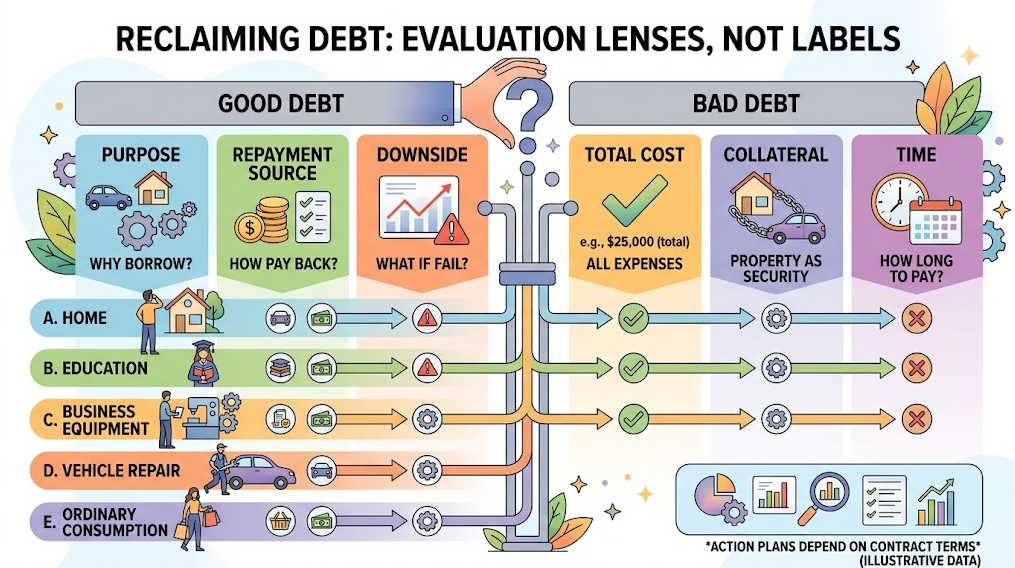
“Is this good debt or bad debt?” sounds like a request to classify the purchase. A mortgage, education loan, or business loan is often placed in the good column; credit-card debt, a payday loan, or borrowing for consumption goes in the bad column.
A more useful question is: What must remain true for this debt to improve rather than weaken the borrower’s position?
The purpose matters, but it does not decide the outcome. A degree may not raise income. A home may become unaffordable. A business investment may fail. An emergency repair placed on expensive credit may still protect someone’s job or safety. The quality of debt depends on the complete arrangement, not the moral reputation of the purchase.
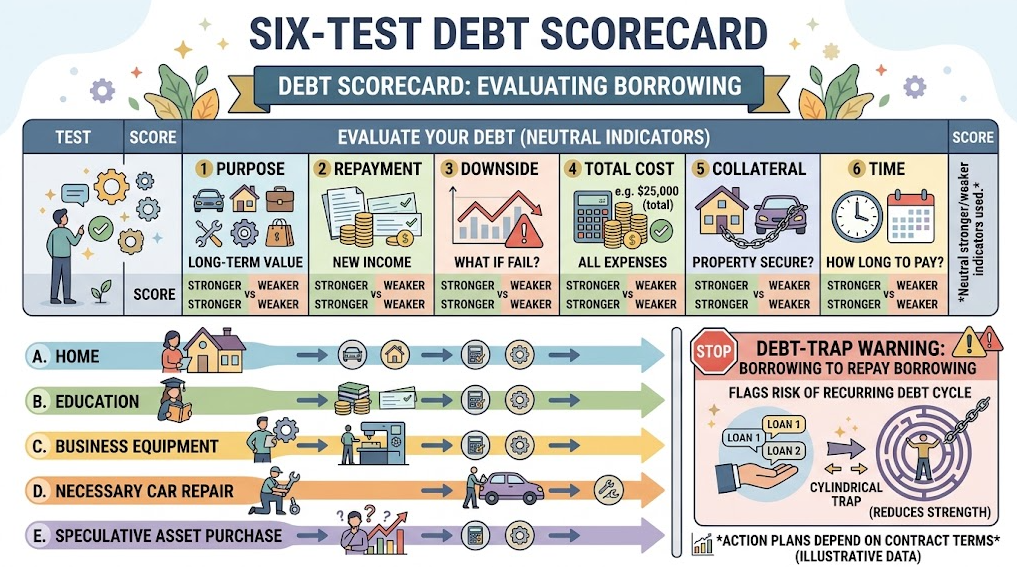
Quick decision: Evaluate debt across six tests: purpose, repayment source, downside if the expected benefit fails, total cost, collateral and other consequences, and the time until the debt ends. A potentially productive purpose does not rescue unaffordable terms; a necessary but nonproductive expense is not a personal failure. The strongest borrowing plan remains survivable without the hoped-for upside.
Why the Labels Are Attractive
Good and bad are easy to remember. They can encourage people to distinguish borrowing that may build capacity from borrowing that funds short-lived consumption at high cost.
FCAC describes good debt as money owed for something that may build wealth or increase income, with student loans as one example. It describes bad debt as borrowing that can reduce wealth or quality of life, often involving unnecessary items, depreciating purchases, or high costs. FCAC also adds the crucial qualification: whether debt is good or bad depends on the person’s circumstances, and debt that cannot be repaid on time can become harmful.
The labels become unreliable when they are used as permission or blame.
- “Good debt” may permit a borrower to ignore price, rate, risk, or excessive scale.
- “Bad debt” may shame someone who borrowed during illness, job loss, family need, or an unsafe situation.
- The label may focus on the item while overlooking the contract.
- The same purpose can produce different outcomes for two households.
- A debt can change character as income, rates, health, or asset value changes.
Classification is useful only if it leads to a better decision.
From Jerome: Debt as a Tool, Not a Free Pass
From Jerome, EverydayWise Contributor
I would prefer not to carry debt that I cannot manage, but I do not believe borrowing for investment or business is automatically bad. I operate a business, and I have used borrowing for a home, used vehicles, and business investment. When there is preparation, regular income, and a real purpose, debt can help someone take an opportunity or obtain something that improves life.
The line changes when borrowing becomes closer to speculation or grows beyond what the borrower can carry. A possible return is not enough by itself. Debt still has to be repaid if the opportunity does not work as expected.
Jerome’s distinction is not between productive and unproductive nouns. It is between a prepared use of leverage and a plan whose survival depends on success. His experience does not establish that any specific business investment, home, or vehicle debt produced a positive return. It supplies a decision principle: expected benefit should be examined together with repayment capacity and downside.
That principle also protects against romanticizing entrepreneurship. A business purpose may be serious and well researched while still being too large, too expensive, too concentrated, or secured by an asset the household cannot afford to lose.
Test 1: What Does the Debt Accomplish?
Name the practical result rather than the category.
Instead of “education debt,” write:
Completes a credential required for a defined occupation, including tuition and living costs for two years.
Instead of “business debt,” write:
Purchases equipment needed to fulfill signed contracts, with a useful life of five years.
Instead of “car debt,” write:
Replaces an unreliable vehicle required to reach work where public transit does not operate.
A precise purpose allows the borrower to test alternatives, scale, timing, and whether the benefit lasts.
Purpose questions include:
- Is the borrowing necessary, useful, optional, or speculative?
- Does it protect income, health, housing, or safety?
- Does it create an asset or skill with continuing value?
- Is there evidence of demand or only hope?
- Can the same result be achieved for less?
- Would delay improve the decision?
- Is the debt funding the core need or extras attached to it?
A worthy purpose can justify analysis. It cannot by itself justify the loan.
Test 2: What Repays the Debt?
Identify the primary repayment source without counting the borrowed money itself.
Possible sources include:
- existing salary or household cash flow;
- contracted business revenue;
- income from a completed credential;
- savings released on a planned schedule;
- sale of an asset; or
- cash flow generated by the financed asset.
Then separate existing income from expected income.
Existing reliable income can support the debt even if the investment underperforms. Expected income depends on a future event. A plan that needs a salary increase, tenant, business launch, asset sale, refinancing, or market gain should state what happens if that event is late or smaller than projected.
CFPB defines debt-to-income ratio as monthly debt payments divided by gross monthly income. DTI is useful as one measure of obligation, but a household also needs an after-tax cash-flow test that includes childcare, food, transportation, irregular bills, savings needs, and expenses not captured in a lender’s ratio.
Lender approval is not the repayment source. It is permission to borrow under the lender’s model.
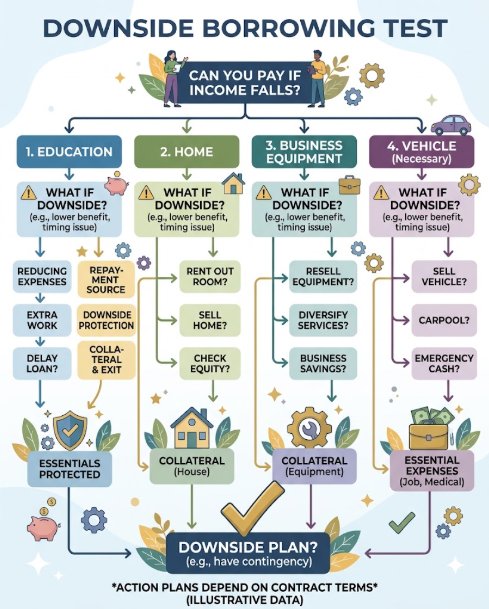
Test 3: What Happens if the Benefit Does Not Arrive?
Every debt has a base case and a downside case.
For a business loan, ask:
- Can existing income cover payments if sales are delayed?
- Can the equipment be sold, and for how much after costs?
- Is the owner personally liable?
- Is the home or another essential asset pledged?
- What expenses can be reduced without destroying the business?
For education debt:
- What if completion takes longer?
- What if the expected occupation is unavailable?
- Are repayment protections attached to the original government loan but lost through refinancing?
- Can the borrower carry the payment on a lower starting income?
For a home:
- What if rates rise at renewal?
- What if one income stops?
- What if repair, tax, insurance, or condominium costs rise?
- How expensive would a forced sale be?
The strongest plan is not the one with the highest expected return. It is the one that can survive an ordinary disappointment without forcing a second crisis.
Test 4: What Is the Full Cost?
A low rate can support a productive use, but cost includes more than the advertised rate.
Review:
- interest rate and APR or comparable annual-cost measure;
- fixed or variable exposure;
- mandatory fees;
- optional products;
- repayment period and total of payments;
- collateral registration or appraisal;
- prepayment and exit terms;
- tax treatment, verified with a qualified professional where relevant; and
- opportunity cost of the required payment.
Opportunity cost is what the payment prevents the household from doing. Debt for an investment may still be weak if it eliminates emergency savings, employer retirement matching, necessary maintenance, or flexibility needed for a likely family change.
Do not assume tax deductibility. Eligibility depends on jurisdiction, use of funds, records, entity structure, and current law. A deduction also reduces taxable income; it does not make the borrowing free.
Article”Fixed vs. Variable Interest Rates: What Risk Are You Choosing?” and Article”How Loan Terms Change the Total Cost” provide the detailed rate and term frameworks. This test asks whether the expected benefit remains worthwhile after the complete financing cost.
Test 5: What Is at Risk Besides Money?
Secured debt may carry a lower rate because the lender has a claim against collateral. If payments fail, the consequence may involve a home, vehicle, deposit, equipment, or other asset.
Also examine:
- co-signer liability;
- personal guarantee for business debt;
- impact on household credit capacity;
- effect on future mortgage or rental qualification;
- stress placed on joint finances;
- loss of time or mobility if an asset is repossessed;
- legal and collection costs; and
- concentration in one business, property, employer, or market.
CFPB defines collateral as an asset securing the debt that the lender can take if repayment fails. FCAC similarly distinguishes secured debt and warns that the pledged asset may be taken after default.
The expected return belongs to the borrower. The lender’s repayment claim usually does not disappear because the project failed.
Test 6: Do the Debt and Benefit Share a Timeline?
Compare:
- when the benefit begins;
- how long it is expected to last;
- when payments start;
- when the debt ends;
- when the rate resets or contract renews; and
- when the asset may need replacement.
Borrowing for equipment expected to generate value for five years is different from paying for that equipment over ten years. Borrowing for a short event may leave years of payments after the benefit is gone. Education may require borrowing before income begins, creating a timing gap that needs explicit funding.
A long-lived asset can support longer financing, but durability does not guarantee affordability or appreciation. A house can last while a household’s income changes. A degree can remain valuable while its earnings premium varies.
Term alignment reduces one form of risk: paying for a benefit that no longer exists. It does not eliminate market, income, rate, or collateral risk.
Put the Six Tests Together
Use a neutral scorecard rather than a moral label.
| Test | Stronger arrangement | Weaker arrangement |
|---|---|---|
| Purpose | Defined need or evidence-based opportunity | Vague hope, pressure, or speculative impulse |
| Repayment source | Existing resilient cash flow | Depends mainly on hoped-for upside |
| Downside | Plan remains operable after disappointment | One setback causes missed essentials or new debt |
| Full cost | Benefit remains worthwhile after all costs | Payment hides high total cost or lost priorities |
| Consequence | Collateral and guarantees are acceptable | Essential asset or another person bears excessive risk |
| Timeline | Debt ends within a defensible benefit horizon | Payments outlast use or require uncertain refinancing |
No single row decides the outcome. A strong purpose with a weak repayment source remains weak. A necessary purchase with high cost may still be chosen when the alternative is more damaging, but the household should treat it as a constrained decision and look for refinancing, assistance, negotiation, or faster payoff when practical.
Necessary Debt Is Not Automatically Bad Judgment
People sometimes borrow because rent is due, a vehicle must be repaired to reach work, a medical or dental cost cannot wait, or a family member needs help. The purchase may not build an asset or income. That does not make the borrower irresponsible.
The decision can still be evaluated:
- Is there a less expensive source of help?
- Can the provider offer a payment plan?
- Are public, employer, insurance, community, or family resources available?
- Can the amount be reduced?
- What cost prevents a worse consequence?
- How will the debt stop growing?
High-cost emergency credit can create a debt trap when repayment requires another loan. CFPB’s financial toolkit describes a debt trap as borrowing again to make the first payment while still trying to cover essentials. The correct response is not moral judgment; it is early intervention and a plan that breaks repeated borrowing.
Productive Debt Can Still Become Speculation
Borrowing moves closer to speculation when:
- repayment depends primarily on an asset price rising;
- the borrower cannot carry payments from current income;
- returns are presented as certain;
- the amount is concentrated in one uncertain project;
- essential collateral secures a nonessential wager;
- refinancing is assumed to be available;
- losses would require new borrowing; or
- there is no predefined point to stop.
Business ownership and investing always involve uncertainty. Preparation does not eliminate it. A prepared borrowing decision defines what evidence supports the opportunity, limits the amount at risk, preserves a repayment source, and identifies failure conditions before funds are drawn.
This is the boundary in Jerome’s account. Debt can help capture an opportunity, but the word “investment” should not exempt it from downside analysis.
Review Existing Debt Again
A debt that once passed the framework may no longer do so.
Review when:
- income changes;
- a variable rate rises;
- the asset loses usefulness;
- business revenue misses the plan;
- a co-borrower relationship changes;
- collateral value or insurance changes;
- refinancing is proposed;
- the balance is not declining; or
- new debt is needed to make payments.
The response may include reducing new borrowing, paying principal, selling an asset deliberately, renegotiating the project, contacting the lender before missing payments, or using qualified nonprofit credit counseling. The appropriate action depends on contract, jurisdiction, tax, and household circumstances.
Reclassification is not an admission that the original decision was foolish. It recognizes that debt quality is dynamic.
A Practical Borrowing Memo
Before taking debt for a potentially valuable purpose, write one page:
- Purpose: What exactly will the money accomplish?
- Amount: What is the smallest amount that completes the core purpose?
- Repayment source: Which existing income pays the debt?
- Expected upside: What benefit is reasonably supported?
- Downside: What if the upside is late, smaller, or absent?
- Cost: What are APR, fees, total payments, and opportunity costs?
- Consequences: What collateral, guarantee, and essential capacity are exposed?
- Timeline: When do benefit, payment, rate reset, and payoff occur?
- Stop rule: What evidence would cancel, shrink, or end the plan?
- Alternative: What happens if the household waits or chooses a smaller option?
If the memo cannot identify repayment without relying on success, the debt is not yet prepared.
FAQ
Is a mortgage always good debt?
No. A home may provide housing and build equity, but price, rate, maintenance, taxes, insurance, income stability, collateral risk, and time horizon determine whether the debt is sustainable.
Is student debt always an investment?
No. Evaluate completion likelihood, total cost, expected occupation and income range, repayment protections, alternatives, and the payment under a less favorable employment outcome.
Is credit-card debt always bad debt?
It is often expensive revolving debt, but the context matters. A necessary expense may prevent greater harm. The priority is to stop balance growth, preserve essentials, and replace repeated high-cost borrowing with a workable plan when possible.
Can business borrowing be good debt?
It can finance productive capacity, but only if evidence supports the use, repayment does not depend solely on hoped-for success, downside is limited, and guarantees or collateral are acceptable.
Does a tax deduction make debt good?
No. Tax treatment is jurisdiction- and use-specific, and a deduction does not reimburse the full cost. Verify eligibility professionally and evaluate the debt before tax benefits.
What is the most important test?
No single test is sufficient, but repayment source and downside are critical. A valuable purpose cannot protect the household when the payment depends entirely on an uncertain benefit.
Can good debt become bad over time?
Yes. Income, rates, costs, asset usefulness, business performance, and household needs can change. Review the debt when assumptions change rather than relying on its original label.
Sources
- Understanding Debt — Financial Consumer Agency of Canada
- What to Consider Before Borrowing Money — Financial Consumer Agency of Canada
- Managing Your Money in Challenging Times — Financial Consumer Agency of Canada
- Getting Help From a Credit Counsellor — Financial Consumer Agency of Canada
- What Is a Debt-to-Income Ratio? — Consumer Financial Protection Bureau
- Financial Terms Glossary: Collateral — Consumer Financial Protection Bureau
- Your Money, Your Goals: Financial Empowerment Toolkit — Consumer Financial Protection Bureau
More in This Cluster: Borrowing and Personal Loans
- Personal Loan vs. Line of Credit: How to Choose
- Fixed vs. Variable Interest Rates: What Risk Are You Choosing?
- How Loan Terms Change the Total Cost
- What to Check Before Accepting a Loan Offer
- Good Debt vs. Bad Debt: A More Useful Framework (you are here)
- When Borrowing for a Major Purchase May Be Reasonable
- How to Compare Early-Payment and Penalty Terms