A refrigerator may last twelve years. A reliable car may keep a job within reach for eight. A roof repair may protect a home for much longer. Yet the money is due now.
That mismatch—between when an essential asset is needed and when a household can fully pay for it—is one reason borrowing exists. It does not make every large purchase affordable, and it does not turn debt into savings. It means that paying over time can sometimes match the cost of an asset to the years in which it provides value.
The decision becomes weaker when the loan lasts longer than the useful benefit, depends on optimistic future income, empties every cash reserve, or makes an already expensive purchase appear manageable through a small monthly payment.
Quick decision: Borrowing for a major purchase may be reasonable when the purchase serves a defined need, the amount is kept to the smallest workable level, payments fit the household’s real budget under a downside scenario, the benefit is likely to last at least as long as the debt, and safer alternatives have been compared. Approval for a larger amount is not evidence that the larger purchase is affordable.
Start With the Purchase, Not the Loan
Financing conversations often begin too late in the decision. The buyer has already chosen the house, vehicle, renovation, equipment, or appliance and is asking only how to make the payment fit.
Reverse that order. Define the purchase before choosing the financing.
Write down:
- the practical need the purchase solves;
- the minimum specification that solves it;
- the date by which it is needed;
- the expected useful life;
- the all-in cash price;
- continuing ownership costs;
- realistic alternatives; and
- what happens if the purchase is delayed.
This prevents the loan offer from defining the need. A seven-seat vehicle may be necessary for one family; a particular trim package is not necessarily part of that need. A leaking roof may require prompt repair; unrelated renovations do not become urgent because a lender will finance them together.
Major purchases are not automatically productive. A house can support stability while stretching a budget too far. A car can protect employment while being more expensive than the job requires. Business equipment can generate revenue while concentrating household risk. The item and the financing must both pass.
Five Conditions That Make Borrowing More Defensible
1. The Purchase Solves a Real, Defined Problem
Borrowing is easier to defend when delay would create a meaningful cost: lost income, unsafe housing, worsening damage, disrupted caregiving, or inability to perform contracted work.
Urgency should still be tested. Ask whether the entire purchase is urgent or only one part of it. A repair may restore safe use at a lower cost than replacement. Renting equipment may bridge a short need. A smaller used vehicle may provide reliable transportation. A staged renovation may protect the structure before improving appearance.
The question is not whether the purchase is emotionally important. It is whether the borrowed amount is proportionate to the problem being solved.
2. The Benefit Is Durable
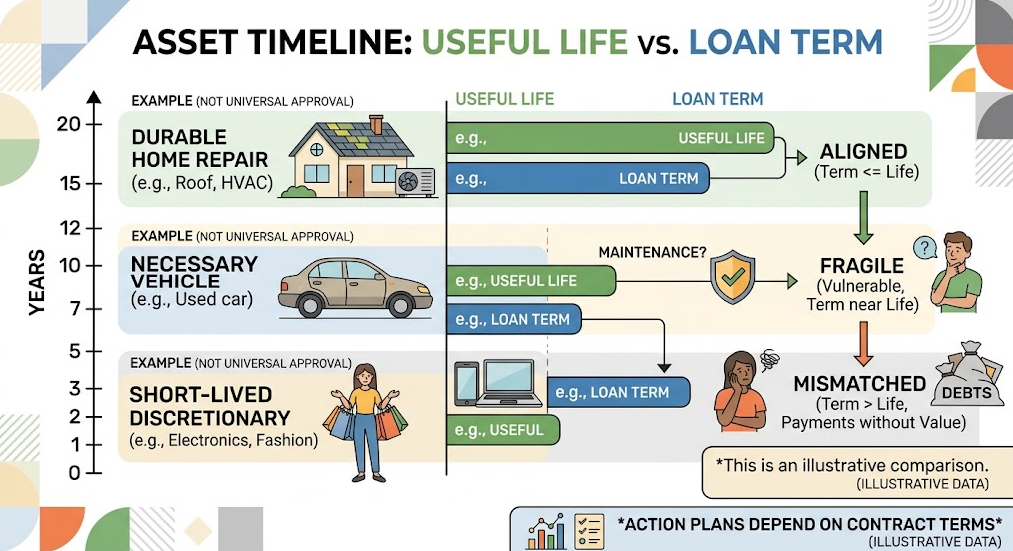
The debt should not routinely outlive the value it financed. This is not a precise accounting rule; useful life is uncertain. It is a warning against paying for yesterday’s benefit with tomorrow’s income.
- Useful-life timeline: How long should the asset or improvement serve the household?
- Debt timeline: When will the balance actually reach zero?
- Decision timeline: When might the household sell, move, replace, or stop using it?
A vehicle loan that extends beyond the period the buyer expects to keep the car can create a rollover problem. FCAC warns that long vehicle terms increase total interest and can leave a borrower owing more than the vehicle is worth. A long term does not make the car cheaper; it reallocates the cost into later years.
Durability alone is not permission. A home lasts, but an unaffordable mortgage remains unaffordable. The condition matters only together with cash flow and downside.
3. The Payment Fits Without Sacrificing the Rest of the Household
Lenders evaluate repayment under their criteria. The household must evaluate life after the payment.
Build an after-tax monthly test that includes:
- housing and utilities;
- food and transportation;
- childcare and care obligations;
- insurance, taxes, and maintenance;
- existing debt payments;
- irregular annual costs;
- retirement or other essential saving; and
- a margin for error.
Then add the ownership costs that do not appear in the loan payment. A vehicle brings insurance, fuel or charging, maintenance, tires, registration, and parking. A home brings taxes, insurance, utilities, repairs, closing costs, moving costs, and possibly association or condominium fees. Equipment may need installation, training, supplies, maintenance, and downtime coverage.
CFPB distinguishes how much a lender may qualify someone to borrow from how much that household can repay without squeezing other priorities. FCAC likewise notes that a mortgage preapproval is a maximum, not a guarantee or a spending target, and reminds buyers to budget for closing, moving, and ongoing maintenance costs.
Run a downside version using a smaller income, higher variable rate where relevant, or a major repair. If one ordinary setback immediately requires new debt, the purchase is operating without enough margin.
4. The Cash Contribution Does Not Destroy Resilience
A larger down payment generally reduces the amount borrowed. But using every available dollar can leave the household with an asset and no capacity to absorb the first repair, deductible, income interruption, or moving expense.
Compare at least three options:
- buy now with the planned down payment;
- buy a less expensive version and retain a reserve; or
- wait and increase both the down payment and the remaining reserve.
There is no universal correct cash percentage across countries and products. Minimum down-payment rules, mortgage insurance, taxes, and lender requirements differ. The planning principle is broader: a cash contribution should reduce risk without transferring all risk into an empty emergency fund.
Do not count an unused credit line as the reserve. It is borrowing capacity that may carry a variable rate, change in availability, or become harder to use precisely when income is under pressure.
5. The Exit Is Understandable
Before borrowing, describe how the obligation ends under three outcomes:
- Normal: payments continue as planned until payoff.
- Early exit: the asset is sold, the household moves, or the debt is refinanced or prepaid.
- Stress exit: income falls, the asset loses value, or payments become difficult.
Identify whether the debt is secured, what asset is pledged, whether another person guarantees it, whether the sale proceeds could be less than the balance, and what early-payment or termination costs may apply. Do not assume an appreciating sale price or easy refinancing.
If the only exit is “income will probably rise,” the plan has a forecast, not an exit.
From Jerome: Match the Tool to the Purchase
From Jerome, EverydayWise Contributor
The three largest kinds of borrowing in my life have been a mortgage, a line of credit connected with the borrowing available around my home financing, and borrowing used for business or vehicles. A mortgage made buying a home possible over a long period. For used vehicles, I have sometimes used my line of credit because the used-car financing rate offered to me was higher.
The line of credit was convenient: I could access it almost like transferring my own money. That convenience was also the risk. It made it easy to think, “If something comes up, I can borrow a little.” I believe debt can help with a prepared business investment or a purchase supported by regular income, but it becomes a problem when it grows beyond what I can carry or when the plan is closer to speculation.
Jerome’s experience illustrates a comparison process, not a general endorsement of home-backed borrowing. The relevant decision was not “line of credit good, vehicle loan bad.” It was whether the available line truly had a lower all-in cost, how its rate could change, whether the home or another asset was connected to the obligation, and whether the balance would be repaid on a vehicle-sized schedule rather than allowed to remain open indefinitely.
The exact product in Jerome’s account cannot be classified from the experience alone. A personal line of credit, home-equity line, and readvanceable mortgage can carry different security, demand, rate, and repayment terms. The agreement—not the ease of accessing funds—determines the risk.
Apply the Test to Common Major Purchases
A Home
Borrowing may be reasonable when the household expects to remain long enough for ownership to serve its housing plan, has stable capacity for the full housing cost, retains reserves, and understands rate and renewal or refinancing risk.
Do not use the preapproval maximum as the home budget. Compare the proposed payment plus taxes, insurance, utilities, maintenance, and fees with the household’s current housing cost and other goals. Test a repair soon after closing and, where the product permits future rate changes, a higher payment.
The house may be durable; the household’s ability to carry it is the decisive constraint.
A Vehicle
A vehicle can protect access to work, school, care, and essential services. Borrowing may be reasonable when reliable transportation is needed now, the chosen vehicle is proportionate to that need, and the loan is likely to end before replacement.
Compare the out-the-door price, interest or APR where applicable, term, fees, optional add-ons, insurance, maintenance, and expected resale value—not only the payment. CFPB warns that add-ons included in financing increase both the monthly payment and the amount repaid. Shopping among banks, credit unions, finance companies, and dealer-arranged options can reveal different rates and terms.
A smaller monthly payment achieved only by extending the term can increase total interest and negative-equity exposure.
A Necessary Home Repair
Borrowing can be defensible when delay would allow water, structural, electrical, heating, or safety damage to grow and the repair protects an essential asset.
First separate stabilization from improvement. Obtain written scopes and multiple quotes when time allows. Check insurance, warranty, government or utility programs, staged work, and contractor payment schedules. Finance the necessary scope rather than using the emergency to bundle unrelated upgrades.
Education or Training
The purchase is not the credential alone; it is the realistic path from enrollment to completion and employment. Compare total tuition and living costs, completion probability, licensing requirements, likely entry-level—not peak—income, and the terms and protections of available public and private loans.
Borrowing becomes more fragile when repayment assumes immediate high earnings or when refinancing would give up valuable protections. Country-specific student-aid rules require direct verification.
Business Equipment
Debt may help a business acquire an asset before enough cash has accumulated. The case is stronger when the equipment serves demonstrated demand, has a useful life longer than the debt, and payments can be covered without relying entirely on aggressive growth.
Separate business capacity from household survival. Identify personal guarantees and pledged assets. A business opportunity should not silently become an unlimited claim on the family’s housing and essential cash flow.
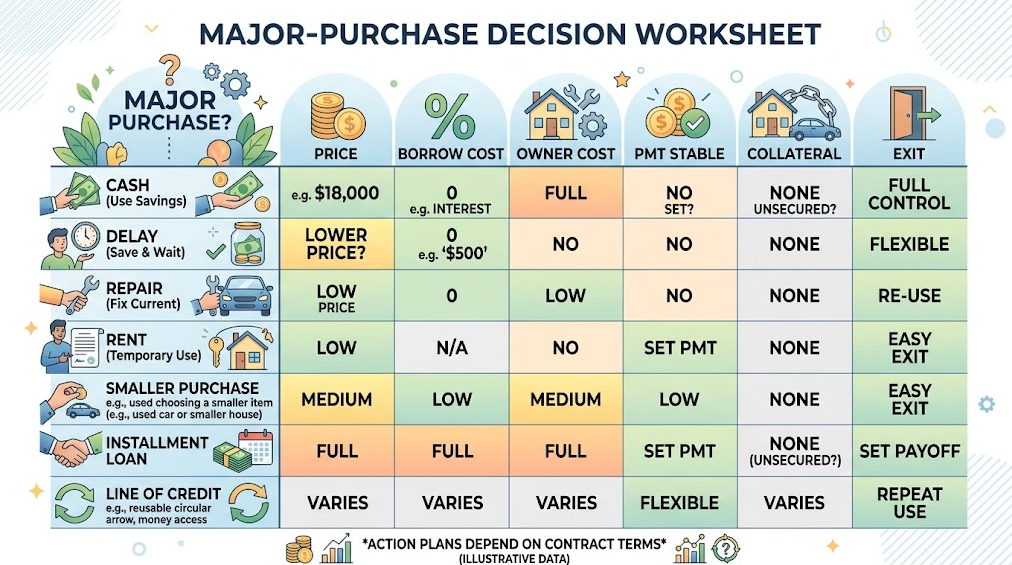
Compare Alternatives on the Same Page
For every option, record:
| Question | What to compare |
|---|---|
| What solves the need? | Repair, rent, delay, buy used, buy smaller, or buy planned item |
| What is paid today? | Down payment, taxes, fees, setup, and immediate repairs |
| What is paid later? | Principal, interest, fees, add-ons, and balloon or residual amounts |
| What does ownership cost? | Insurance, maintenance, utilities, storage, and operating costs |
| What can change? | Variable rate, income, maintenance, value, or required use |
| What is pledged? | Vehicle, home, deposit, guarantee, or nothing |
| How does it end? | Scheduled payoff, sale, prepayment, refinance, return, or termination |
Use the same purchase price and assumed payoff date when comparing financing. Otherwise a longer term can appear cheaper merely because more of the cost has been moved beyond the comparison window.
Warning Signs That the Purchase or Financing Is Too Large
Pause when:
- the decision is framed only as a monthly payment;
- the lender’s maximum becomes the shopping budget;
- taxes, fees, add-ons, or continuing costs are excluded;
- the household must use all cash and all available credit;
- repayment depends on a raise, bonus, tenant, sale, or investment return;
- the loan may outlast the expected use of the asset;
- existing negative equity is rolled into a new purchase;
- a home secures a purchase without a deliberate review of that consequence;
- the buyer cannot explain early exit or missed-payment consequences; or
- the transaction must be signed before written terms can be compared.
Urgency sometimes cannot be removed. But urgency is a reason to narrow the purchase to the essential solution, not a reason to abandon comparison.
A Written Decision Before Signing
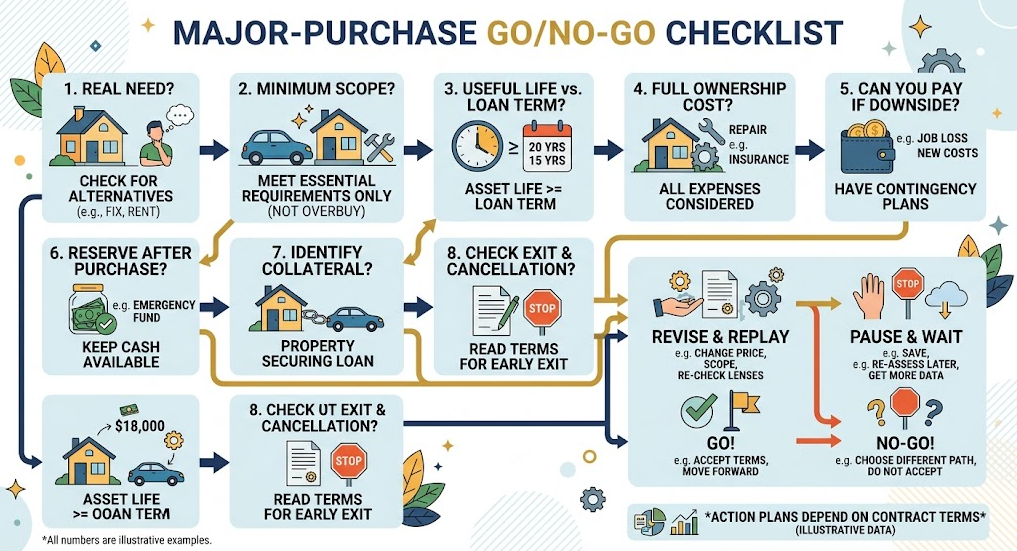
Complete these sentences:
The purchase solves ______. The least expensive workable alternative is ______. We need it by ______.
The asset should remain useful until ______. The debt should end by ______.
The full cash price is ______. Total borrowing cost under the written terms is ______. Continuing monthly and annual ownership costs are ______.
After the down payment and closing costs, liquid reserves will be ______.
Payments come from ______. If income falls or costs rise, we will ______.
The collateral or guarantee is ______. If we sell early, the expected process and possible shortfall are ______.
We compared ______ alternatives and rejected them because ______.
The memo does not guarantee a good outcome. It exposes where the decision depends on an unstated hope.
The EverydayWise View
Borrowing can bring a durable and necessary purchase forward in time. That can support housing, mobility, safety, education, caregiving, or productive work. The benefit is real only if the financing leaves enough room for the rest of life.
The strongest major-purchase decision is not the one that obtains the largest asset a lender will approve. It is the one that solves the actual problem at a scale the household can carry, preserves a margin for setbacks, and has an understandable ending.
FAQ
Is it better to pay cash for every major purchase?
Not necessarily. Cash avoids interest and future payment obligations, but using all available cash may weaken emergency resilience. Compare the cost of borrowing with the value of retaining an adequate reserve and the cost of delaying the purchase.
How do I know whether a car loan is too long?
Compare the loan payoff date with how long you realistically expect to keep a reliable vehicle. A term that lowers the payment but is likely to outlast ownership increases the risk of owing money when replacing or selling the car.
Should I use a home-equity line for a car or renovation?
Only after comparing the full cost, variable-rate exposure, repayment schedule, security, and exit with other options. A lower initial rate does not remove the consequence of linking household borrowing to the home. Verify the exact agreement.
Does mortgage preapproval show what I can afford?
It shows what a lender may be willing to lend under its criteria, not what comfortably fits every family priority. Build a budget that includes full ownership costs, reserves, and a downside scenario.
Can business borrowing be reasonable?
Yes, when it supports demonstrated demand, the amount and term fit the asset, and repayment is survivable if growth is slower than expected. Personal guarantees and household collateral require separate scrutiny.
What if the purchase is urgent and I cannot compare many options?
Define the minimum safe solution, request written price and financing terms, remove optional extras, and compare at least one alternative source if possible. If repayment would displace essentials or require repeated borrowing, seek early help from a reputable nonprofit credit counselor or appropriate local service.
Sources
- Financial Consumer Agency of Canada — What to Consider Before Borrowing
- Financial Consumer Agency of Canada — Getting Preapproved for a Mortgage
- Financial Consumer Agency of Canada — Financial Risks When Buying a Car
- Financial Consumer Agency of Canada — Shopping Around for Auto Financing
- Consumer Financial Protection Bureau — What Should I Know Before I Shop for a Car or Auto Loan?
- Consumer Financial Protection Bureau — How Can I Figure Out If I Can Afford to Buy a Home?
- Consumer Financial Protection Bureau — What Can I Negotiate When Shopping for a Car or Auto Loan?
More in This Cluster: Borrowing and Personal Loans
- Personal Loan vs. Line of Credit: How to Choose
- Fixed vs. Variable Interest Rates: What Risk Are You Choosing?
- How Loan Terms Change the Total Cost
- What to Check Before Accepting a Loan Offer
- Good Debt vs. Bad Debt: A More Useful Framework
- When Borrowing for a Major Purchase May Be Reasonable (you are here)
- How to Compare Early-Payment and Penalty Terms