An online therapy service can be three things at once: a technology company, a payment system, and a doorway to a mental-health professional. A polished website may blend those roles into one reassuring promise. Your decision becomes safer when you separate them.
Begin with the person who would provide care. Then examine the way care is delivered, the information the company collects, the cost and cancellation terms, and the plan for situations the service cannot safely handle.
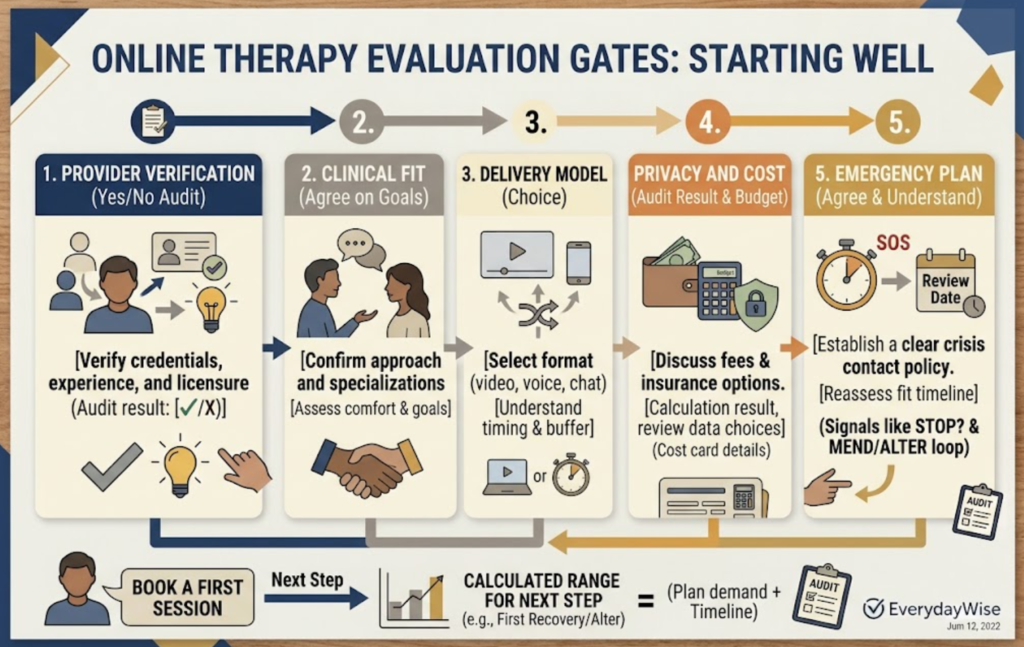
Quick decision: Before paying, obtain the provider’s full name and credential, verify current authorization with the appropriate official regulator, and confirm that the provider may serve you where you will physically be during sessions. Identify whether you are buying live therapy, asynchronous messaging, coaching, or a self-guided program. Read the privacy, data-sharing, billing, cancellation, and emergency policies. If the company will not clearly identify the provider, explain the service, or state what happens in a crisis, choose another route.
First Identify What the Service Actually Provides
The term online therapy is used for services that may operate very differently.
Live teletherapy
A licensed or otherwise locally regulated professional meets with you by video or phone at an appointed time. This most closely resembles an in-person session, although the technology, privacy, and emergency arrangements differ.
Asynchronous therapy
You and a professional exchange written, audio, or video messages. The provider may respond within a stated window rather than in real time. Ask how often messages are reviewed, what counts as a session, whether the same provider remains assigned, and what the service does with an urgent message.
Coaching or peer support
A coach or peer supporter may help with goals, routines, accountability, or shared experience. Their training and legal scope may differ from those of a regulated mental-health professional. The service should not present coaching as a substitute for clinical assessment or treatment when that is not what it provides.
Self-guided tools or automated support
An app may offer educational lessons, mood tracking, exercises, journaling, or chatbot conversations. These tools may supplement care for some people, but an automated response is not evidence that a qualified professional has assessed your situation.
One platform may offer several of these options. Read the description of the exact plan you are considering, including who responds, how quickly, and whether live appointments are included.
Verify the Human Provider
A platform’s brand is not the provider’s professional credential. Before a clinical session, ask for:
- the provider’s full name;
- professional title and credential;
- licensing or registration jurisdiction and number, when publicly available;
- the regulator that accepts complaints;
- experience with your concern, age group, language, culture, or accessibility needs; and
- the organization responsible for the clinical record.
Use the official regulator’s public register when one exists. Search the name, confirm that the credential is active, and review any public restrictions or disciplinary information. A profile badge or statement that someone is “verified” should not replace an official check.
Professional titles do not mean the same thing everywhere. Some are legally protected; others can be used more broadly. The earlier cluster article, Therapist, Psychologist, Psychiatrist, and Counselor Compared, explains why the full credential and local scope matter more than the shortest title on a profile.
Your Physical Location Can Change the Answer
Remote care crosses distance, but professional authorization still follows geography. Rules vary by country, province, state, territory, profession, and service. In the United States, for example, cross-state practice may require a full license, compact privilege, temporary authority, reciprocity, or telehealth registration. HHS advises providers to verify the patient’s location before an appointment.
Tell the service where you will physically be during sessions and ask whether the assigned provider is authorized to serve you there. This deserves another check if you:
- attend a session while traveling;
- divide time between two homes;
- study or work in another jurisdiction;
- move after treatment begins; or
- live near a border and selected the service by language rather than location.
A provider who can see you at home may be unable to continue while you are elsewhere. Ask what happens to scheduled care, prescriptions, records, and fees if your location changes.
Decide Whether the Format Fits the Need
Virtual mental-health services can include evaluation, therapy, medication support, and general support. NIMH notes that telehealth may be effective for some people and conditions, while acknowledging that a provider can help determine whether virtual care is appropriate.
Consider the whole situation:
- Do you need a formal diagnosis, document, prescription, or specialized assessment?
- Is the concern suitable for individual, family, couples, or group care?
- Would you communicate more clearly by video, phone, or writing?
- Do you have enough privacy to discuss sensitive subjects?
- Can you use the platform with your hearing, vision, mobility, language, or cognitive needs?
- Is a reliable device and connection available?
- Could symptoms, substance use, medical needs, or safety risks require in-person or more intensive care?
Convenience can improve access, especially when travel, disability, caregiving, work schedules, stigma, or a shortage of local providers creates barriers. It cannot establish that a particular provider, treatment method, or level of care is suitable.
Examine How the Relationship Will Work
Two services charging similar fees may provide very different amounts of professional contact. Ask:
- Are appointments live, and how long are they?
- Does the price include video, phone, messaging, or a combination?
- Who reads messages: the therapist, support staff, or an automated system?
- What response time is promised on working days, weekends, and holidays?
- Will you keep the same provider?
- Can you request a change, and does changing affect records or cost?
- Is communication between sessions clinical care, scheduling support, or neither?
- How are goals set and progress reviewed?
- What happens when the provider is away?
- Can the service coordinate with a family doctor, psychiatrist, school, or other professional with your permission?
If messaging is central, ask how lengthy exchanges are counted and whether old messages remain available. A subscription described as “unlimited” may still have response windows, length limits, or clinical boundaries.
Privacy Begins Before the First Session
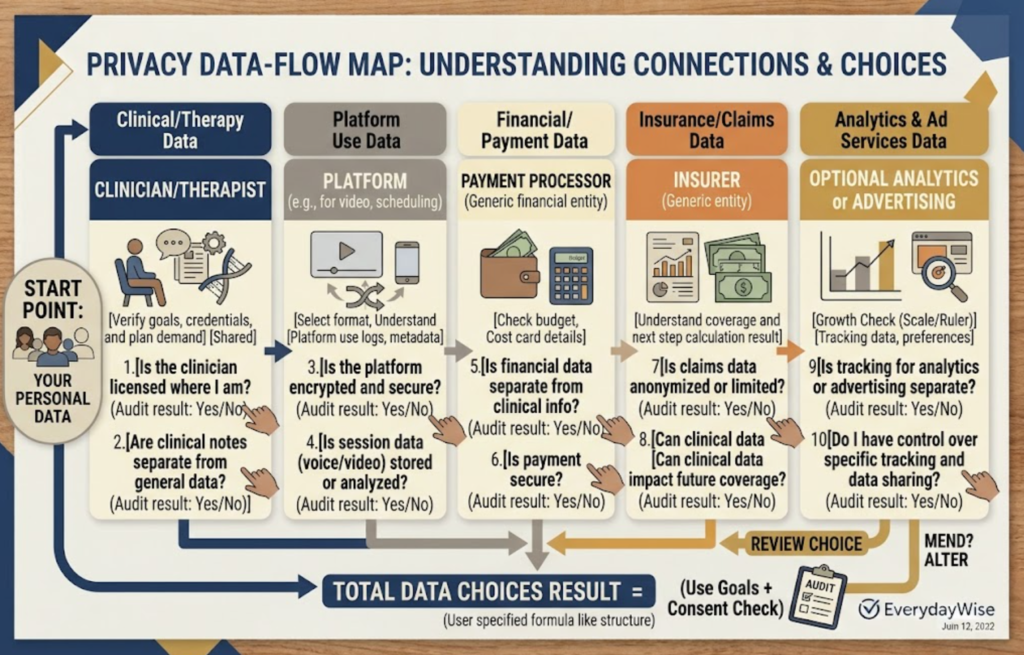
Sensitive information may be collected before you meet a therapist. A matching questionnaire can ask about symptoms, medications, relationships, substance use, trauma, or thoughts of self-harm. The website may also collect an email address, device identifiers, IP address, approximate location, referral source, and browsing activity.
Find out which organization receives each category of information and why. The clinical provider, platform operator, payment processor, analytics vendor, insurer, and advertising partner may have different access and legal obligations.
In the United States, HIPAA protects health information handled by covered entities and their business associates. HHS cautions that HIPAA generally does not protect personal search history, voluntarily shared online information, location data, or information entered into many consumer apps for personal use unless the app is acting for a covered entity or business associate. Other countries have different health and privacy laws, and coverage can depend on how a service is structured.
This makes “HIPAA compliant” or “secure” an opening question, not the end of the review.
Questions for the privacy policy
- What information is collected before registration, during matching, and during treatment?
- Which data becomes part of the clinical record?
- Is information used or shared for advertising, analytics, product development, research, or artificial-intelligence training?
- Can you refuse nonessential tracking without losing clinical care?
- Are sessions recorded, transcribed, summarized, or analyzed? If so, who consents and who receives the result?
- How are messages and attachments stored?
- How long is information retained after cancellation?
- Can you access, correct, export, or request deletion of eligible information?
- What information is sent to an insurer or employer-sponsored benefit program?
- How will the company notify users of a breach or major policy change?
The FTC has taken action against mental-health and wellness companies over allegations that sensitive health information was shared for advertising despite privacy promises. Those cases do not show that every online therapy company follows the same practices. They show why a reader should inspect the actual policy, consent screens, and settings rather than rely on reassuring marketing language.
Protect the Session on Your Side
The platform controls only part of the privacy environment. HHS recommends practical steps such as using a private location, headphones, an updated personal device, strong unique passwords, multi-factor authentication, and a protected internet connection. It also advises avoiding workplace or public devices and unsecured public networks when possible.
Before the first appointment:
- test the official link without entering unnecessary health details;
- confirm the invitation through a known provider contact if it looks unusual;
- turn off smart speakers or other devices that may listen or record;
- position the screen away from other people;
- close unrelated apps and notifications;
- ask whether a text, phone, or rescheduling option exists if the connection fails; and
- request captions, an interpreter, screen-reader support, or another accommodation in advance.
Privacy limitations do not automatically make virtual care unusable. A parked car, reserved room, community-health location, or audio session may provide a workable alternative, but discuss the plan with the provider rather than assuming every location is safe or permitted.
Read the Price as a Contract
The visible weekly or monthly price may not describe the total cost. Determine:
- whether payment is per appointment or subscription period;
- what professional contact is included;
- whether unused weeks are still billed;
- whether prices change after an introductory period;
- whether the company bills insurance or only supplies a receipt;
- what your insurer requires for reimbursement;
- whether missed sessions, late cancellations, provider changes, or technical failures are charged;
- how to pause or cancel;
- when cancellation takes effect; and
- whether refunds are available when no suitable provider is assigned.
Take a screenshot or save the version of the offer and cancellation terms you accepted. Use the official payment route. Requests for gift cards, cryptocurrency, wire transfers to an individual, or payment outside the service’s documented system are warning signs.
Insurance coverage, deductibles, network status, diagnostic coding, employer benefits, and record disclosure deserve a separate review. Article”Mental Health Privacy and Insurance Questions to Ask” will address privacy and insurance questions in detail.
Require an Emergency Plan Before You Need It
Routine online therapy is not an emergency service unless the provider explicitly operates one. Ask the platform:
- Does it verify my current location at each session?
- What emergency contact information does it request?
- What happens if I report immediate danger in a live session?
- When are messages reviewed, and are urgent messages monitored?
- Which local crisis or emergency services would be contacted?
- What should I do outside appointment hours?
- Can the service continue if I need a higher level of care?
An emergency plan should be understandable before treatment begins. A generic footer that tells users to contact emergency services may be necessary, but it does not explain whether the assigned provider can recognize, respond to, and coordinate an urgent situation in your location.
If you or someone else may be in immediate danger, do not wait for a routine platform reply. Contact the appropriate local emergency or crisis service, or go to the nearest appropriate emergency facility. The next cluster article provides a fuller mental-health crisis decision pathway.
Recognize Red Flags
Pause before paying or sharing more information when a service:
- hides the assigned provider’s identity or credential;
- cannot explain whether the provider may practice where you are located;
- calls coaching, automated conversation, or peer support “therapy” without explaining the difference;
- guarantees a diagnosis, cure, medication, document, or rapid result;
- makes privacy claims that conflict with its policy or consent screens;
- requires broad data permissions unrelated to care without explanation;
- records or analyzes sessions without clear notice and consent;
- has no usable emergency procedure;
- pressures you into a long prepaid term;
- makes cancellation much harder than enrollment;
- discourages questions, second opinions, or coordination with other care; or
- asks for payment or personal information through an unofficial contact.
One unclear answer may be a customer-service problem rather than proof of misconduct. The decision turns on whether the company can resolve it before you accept clinical, financial, or privacy risk.
Use the First Sessions as a Fit Check
Credentials and policies establish a minimum threshold. The therapeutic relationship still has to work.
After an initial session or early trial period, ask yourself:
- Did the provider explain their role, privacy limits, communication rules, and emergency process?
- Did I have enough time and privacy to speak?
- Did the provider listen, ask relevant questions, and avoid premature certainty?
- Do I understand the proposed goals or next step?
- Is the format helping or obstructing communication?
- Can the cost and schedule continue without creating a new crisis?
- Do I know how progress will be reviewed?
Feeling nervous or emotionally tired after a first session does not by itself mean the service is unsuitable. Serious boundary violations, discriminatory treatment, false credentials, unexplained data practices, unsafe advice, or pressure to continue deserve prompt attention.
You may ask for clarification, request another provider, obtain a second opinion, use a different modality, or leave the service. If a concern involves professional conduct, the relevant regulator or complaint body can explain available reporting routes.
Decision Summary
Evaluate online therapy in this order:
- Name the exact service: live therapy, messaging, coaching, peer support, or self-guided tool.
- Verify the provider’s identity, credential, official standing, and authority where you will receive care.
- Confirm that the modality and level of care fit the concern.
- Understand contact time, response expectations, continuity, records, and coordination.
- Trace what information is collected and how clinical, platform, payment, insurance, analytics, and advertising uses differ.
- Calculate the real cost and test the cancellation path before committing.
- Obtain a location-specific emergency and technical backup plan.
- Review fit after care begins and change routes when the service cannot meet the need safely.
The most useful online service is not necessarily the one with the fastest signup. It is the one whose provider, scope, privacy practices, terms, and limits you can identify before depending on it.
This article provides general educational information and does not diagnose a condition, recommend a specific provider or platform, or replace individualized medical or mental-health care. Credentials, telehealth authorization, privacy rights, insurance, consent, prescribing, and emergency procedures vary by location and service. If there is immediate danger or an urgent risk of harm, contact the appropriate local emergency or crisis service now.
FAQ
Is online therapy as effective as in-person therapy?
It can be effective for some people and conditions, but the answer depends on the concern, treatment method, provider, format, privacy, technology, and need for in-person assessment or intensive support. Ask a qualified provider why the proposed modality fits your situation and how progress will be reviewed.
How can I verify an online therapist?
Obtain the person’s full name, credential, licensing or registration jurisdiction, and number when available. Search the official regulator’s public register and confirm active standing. Also verify that the provider may serve you where you will physically be during appointments.
Does HIPAA protect every online therapy app?
No. In the United States, HIPAA applies to covered entities and business associates, not automatically to every consumer health or wellness app. Search history, location information, voluntarily shared data, and information entered into many personal-use apps may fall outside HIPAA. Other laws may apply, and other countries use different frameworks.
Is text therapy the same as a video appointment?
No. Asynchronous messages differ from a scheduled real-time clinical conversation. Ask who reads messages, how often, what response is included, whether urgent messages are monitored, and whether the format is appropriate for the concern.
Should I use insurance or pay privately?
Compare total cost, provider network status, reimbursement requirements, information sent to the insurer, record implications, and continuity. Neither route is universally better. Confirm the details with the service and insurer before relying on coverage.
What if I am traveling during an appointment?
Tell the provider before the session. Authorization often depends on the location where you are physically receiving care, and the provider may be unable to serve you in another state, province, territory, or country. Ask about rescheduling, temporary authority, and continuity before traveling.
Can an online therapy platform handle a crisis?
Some services have clinical emergency procedures, while others are designed only for routine scheduled care. Read the policy and ask what happens in your location. If immediate danger is present, use the appropriate local crisis or emergency service rather than waiting for a routine message response.
References
U.S. Department of Health and Human Services, Telehealth.HHS.gov — Licensing Across State Lines
National Institute of Mental Health — Getting Mental Health Support Virtually
U.S. Department of Health and Human Services — Telehealth Privacy and Security Tips for Patients
More in This Cluster: Mental Health Navigation
- Therapist, Psychologist, Psychiatrist, and Counselor Compared
- How to Prepare for a First Therapy Appointment
- How to Evaluate Online Therapy (you are here)
- What to Do During a Mental Health Crisis
- How to Talk to a Doctor About Mental Health
- Mental Health Privacy and Insurance Questions to Ask
- How to Support a Family Member Without Taking Over