The question “Is this confidential?” sounds simple until several systems are involved. A clinician may protect the content of a conversation, while the appointment still creates a medical record, an insurance claim, a patient-portal entry, or a payment notice. A parent, spouse, employer, school, or policyholder may have access to one part of that trail without receiving the therapist’s full account of the session.
That does not make privacy meaningless. It means you need to ask which information is protected, which information must be recorded or billed, who can receive it, and what exceptions apply.
Insurance raises a parallel set of questions. “Mental health is covered” does not tell you whether a particular clinician is in network, whether a diagnosis or referral is required, how many visits are authorized, what happens before the deductible is met, or whether virtual care is treated differently.
Quick decision: Before the first substantive session, ask two groups of questions. For privacy: what enters the record, who can see it, how family involvement works, and what safety or legal exceptions apply. For cost: whether both provider and service are covered, what authorization is required, what you will owe, and how to appeal a denial.
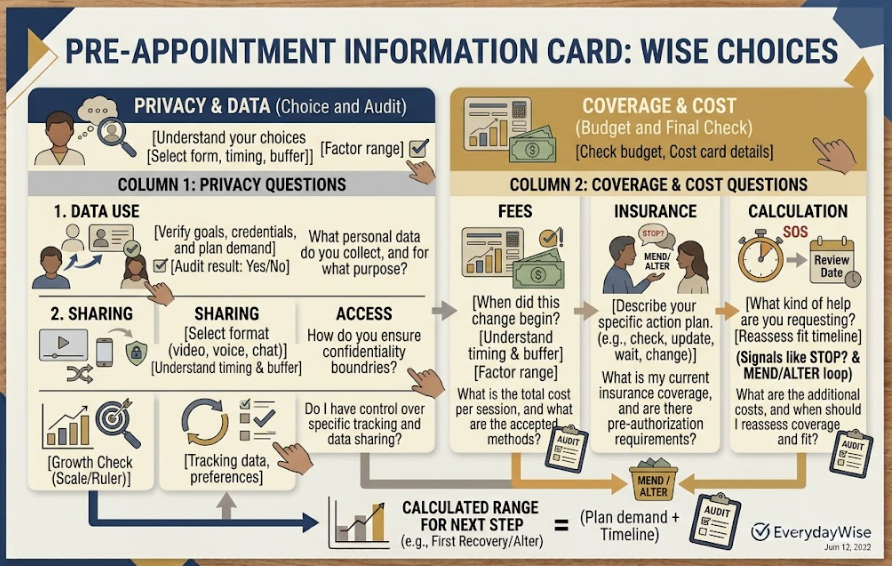
Start With the Correct Privacy Question
“Is this confidential?” often produces a broad yes followed by a long consent form. A more useful opening is:
“Before we begin, can you explain what you keep private, what goes into my health record or claim, who may access it, and the situations in which you must or may share information?”
Listen for distinctions among:
- what the clinician remembers or writes for personal use;
- the formal clinical record;
- information shared with other treating professionals;
- billing and insurance information;
- patient-portal messages and appointment notices;
- information released to a person you authorize; and
- disclosures required or permitted for safety, abuse reporting, court processes, public health, or other law.
Do not assume that every mental health provider, app, coach, peer group, employer program, or school service operates under the same health-privacy law. Ask what law, professional rule, contract, or privacy policy applies to that particular service.
Confidentiality Has Boundaries
Health professionals generally have duties to protect patient information, but the exact rules depend on jurisdiction, profession, setting, age, and circumstance. Common exceptions may involve an immediate or serious threat, suspected abuse or neglect, a legal order, required reporting, or care coordination. The wording and threshold are not universal.
Ask the clinician to explain the boundary in ordinary language:
- “What safety concerns could lead you to contact someone without my permission?”
- “Would you tell me before making that disclosure when circumstances allow?”
- “Who might you contact?”
- “How much information would you share?”
- “What mandatory-reporting rules apply to you here?”
In the United States, the Department of Health and Human Services explains that HIPAA may permit a covered provider to disclose protected information when the provider believes disclosure is necessary to reduce a serious and imminent threat, consistent with applicable law and professional standards. State law can add or change obligations. Other countries use different legal tests.
A safety exception should not be described as “anything concerning can be reported.” Nor should confidentiality be presented as absolute. Ask for the actual local rule before deciding what a general statement means for your care.
Ask What Goes Into the Record
Many people imagine therapy notes as a transcript. Ordinary health records are more likely to include selected information needed for care, administration, or billing: presenting concerns, symptoms, diagnosis when used, functional status, treatment plan, medications, risk assessment, progress, referrals, and service dates. Documentation practices vary.
Questions worth asking include:
- “What information do you normally document after a session?”
- “Do you record a diagnosis, and when is one required?”
- “Are your private process notes separate from the clinical record?”
- “Will notes or summaries appear in my patient portal?”
- “Can other clinicians in this health system see this record?”
- “How long are records retained?”
- “How can I request access or correction?”
- “Who should I contact about a privacy concern?”
US HIPAA gives special treatment to narrowly defined, separately maintained psychotherapy notes. Those notes are not the same as the broader medical record. HHS explains that diagnosis, treatment plans, symptoms, medication information, test results, and progress summaries generally fall outside that special category. Patients should therefore avoid assuming that everything discussed in therapy is excluded from ordinary health records or care coordination. HHS also describes US rights to access many medical and billing records and request correction, while psychotherapy notes are treated differently.
That distinction is US-specific. In Canada, for example, the applicable rule may be federal, provincial, or territorial. The Office of the Privacy Commissioner of Canada advises beginning with the organization handling the data and identifies different oversight bodies depending on the institution and location.
Map the Digital Trail
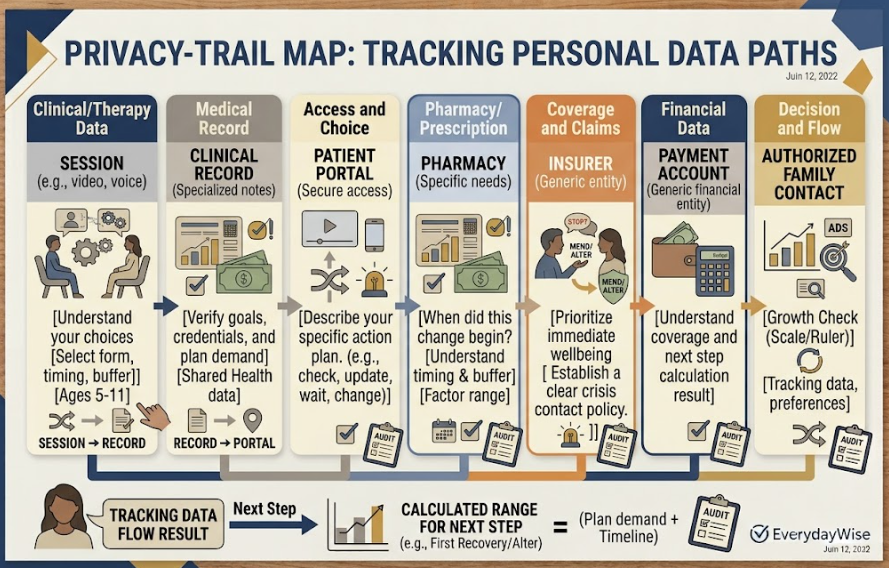
Privacy decisions also occur outside the session. Appointment reminders may appear on a shared phone. A family email address may receive portal alerts. A pharmacy account may list prescriptions. A video platform may collect technical data. A benefits portal may show a claim.
Before using a service, check:
- which email address and phone number receive reminders;
- whether voicemail may include the clinic or service name;
- whether mailed statements are sent and to which address;
- whether a shared patient or insurance portal displays appointments, diagnoses, claims, or prescriptions;
- what appears on bank or credit-card statements;
- whether telehealth sessions can be conducted from a private place;
- whether messages are part of the formal record;
- whether sessions are recorded, and if so, why, where, for how long, and with whose consent; and
- which outside technology companies process the information.
Changing a notification setting may reduce household visibility, but it does not erase the clinical or billing record. Incognito browsing and deleted cookies do not control what a provider or insurer is legally required to retain.
Decide How Family or Other Support People Are Involved
A trusted person can help with scheduling, transportation, payment, remembering instructions, or noticing changes. Their involvement does not have to be all or nothing.
Ask:
- “Can I authorize this person for scheduling but not clinical details?”
- “Can they join only part of an appointment?”
- “What information can you share if I agree verbally, and what requires a written authorization?”
- “How do I change or revoke that permission?”
- “What happens if I am temporarily unable to make decisions?”
- “Will the person who pays receive clinical information or only billing information?”
Under US HIPAA, a covered provider may in some circumstances share information relevant to care or payment with a family member or other involved person when the patient agrees or does not object. Other laws or professional rules may be stricter. A patient can ask the provider to document a clear preference, but the applicable process varies.
Avoid signing an authorization without reading its scope. Check which records it covers, who may receive them, the purpose, the expiration date, and how revocation works. Revocation usually cannot undo a disclosure that already occurred lawfully.
Ask Different Questions for a Child or Teen
Privacy becomes more complicated when a parent or guardian arranges or pays for care. The answer may depend on the young person’s age, capacity, type of service, consent law, custody arrangements, school setting, insurance, and safety concerns.
Before treatment begins, ask both the provider and payer:
- who consents to care;
- what the parent or guardian may access;
- what private conversation the young person may have;
- what the clinician normally summarizes for the family;
- what information is shared if safety becomes a concern;
- whether portal access changes at a particular age;
- where appointment and claim notices are sent; and
- how custody or guardianship documents affect access.
Parents may need enough information to support treatment and safety, while a young person may need room to speak honestly. The provider should explain how those needs are handled under local law rather than promising complete secrecy or complete parental access.
In the United States, even a parent who is generally the child’s personal representative does not automatically have a HIPAA right to access separately maintained psychotherapy notes. The broader mental health record is treated differently, and state law matters. This is one reason to ask what kind of record is being discussed instead of using “the notes” as a single category.
Separate the Provider From the Service
For insurance, confirming the clinician’s name is only the beginning. Coverage can depend on the professional’s credentials, billing entity, location, service code, diagnosis, referral, delivery method, and plan rules.
Ask the provider:
- “Are you currently contracted with my exact plan, not only this insurance company?”
- “Which individual or organization will appear as the billing provider?”
- “What type of appointment or service will be billed?”
- “Will you submit claims, or must I seek reimbursement?”
- “What is your fee if the claim is denied or applied to my deductible?”
- “Do you charge for missed visits, forms, letters, phone calls, or record copies?”
- “Do you use an outside laboratory, prescriber, facility, or platform that bills separately?”
Then ask the insurer or benefit administrator the same coverage questions. Provider directories can be out of date, and a clinic’s statement that it “accepts” an insurer may mean it will submit a claim—not that it is in network or that the service is covered.
Record the date, representative’s name or reference number, and the exact plan language you were given. A benefits quote is valuable evidence, though it may not guarantee payment.
Translate “Covered” Into a Real Cost
The amount you owe may involve several moving parts:
- Premium: the regular amount paid to maintain coverage.
- Deductible: the amount you may have to pay before the plan starts paying for certain care.
- Copayment: a fixed amount for a covered service.
- Coinsurance: a percentage of the plan’s allowed cost.
- Allowed amount: the amount the plan recognizes for a service.
- Out-of-network balance: the difference a provider may charge beyond what the plan recognizes, where permitted.
- Out-of-pocket maximum: a plan-defined limit that may exclude premiums, uncovered care, out-of-network costs, or amounts above the allowed charge.
Ask for an estimate using your current deductible status:
“If I see this provider for this service today, what would I owe before and after the deductible, and does that spending count toward my out-of-pocket maximum?”
In the United States, HealthCare.gov states that Marketplace plans cover mental health and substance-use services as essential health benefits, but the specific benefits depend on the state and plan. Coverage of a category does not promise that every clinician, method, or number of visits is paid without restrictions.
Public systems may cover primary care or specialist services while leaving counselling, private psychology, medication, or supporting documents partly or entirely outside public coverage. Employer and private benefits may add another layer. Verify each service rather than assuming that a country’s “universal” or public health system covers every mental health professional.
Ask About Authorization, Referrals, and Visit Limits
Some plans require action before treatment or before additional sessions. Ask:
- Is a referral required?
- Is prior authorization required before the first visit or after an initial allowance?
- Who submits the request?
- What clinical information must be sent?
- Is there a visit limit, dollar limit, or review point?
- Does telehealth use the same benefit?
- Is a diagnosis required for reimbursement?
- Are psychological tests, group therapy, family sessions, intensive outpatient care, or inpatient care handled differently?
- What happens if authorization expires while care continues?
US federal mental health parity rules apply to certain plans and generally restrict plans from imposing less favorable financial requirements or treatment limitations on mental health and substance-use benefits than on medical and surgical benefits. They do not require every plan to cover every service. The US Department of Labor directs consumers to examine copayments, visit limits, prior authorization, and medical-necessity rules. Because plan type and enforcement jurisdiction matter, ask which regulator or appeal process applies to your coverage.
Understand What an Insurance Claim Reveals
An insurer usually needs enough information to process and review a claim. That may include the patient’s identity, provider, service date, service code, diagnosis code, charge, and sometimes additional records for authorization or medical-necessity review.
Ask:
- “What information will be submitted with a routine claim?”
- “Will a diagnosis code be used?”
- “When might the insurer request additional clinical records?”
- “Will the policyholder receive an explanation of benefits or claim alert?”
- “Can communications be sent directly to me?”
- “If I pay privately and do not submit a claim, what records will the provider still retain?”
Paying privately may reduce insurance-related disclosure, but it does not make the visit anonymous or remove the provider’s documentation duties. It can also mean the spending will not count toward insurance deductibles or limits. Ask before choosing that route.
Employment-sponsored coverage does not ordinarily mean a supervisor receives therapy notes. Still, an employer may receive limited plan-administration or aggregated information, and separate workplace processes—such as disability leave, accommodation, occupational health, or an employee assistance program—may have different documentation and privacy rules. Ask each program who operates it and what reaches the employer.
Know the Denial and Appeal Path Before You Need It
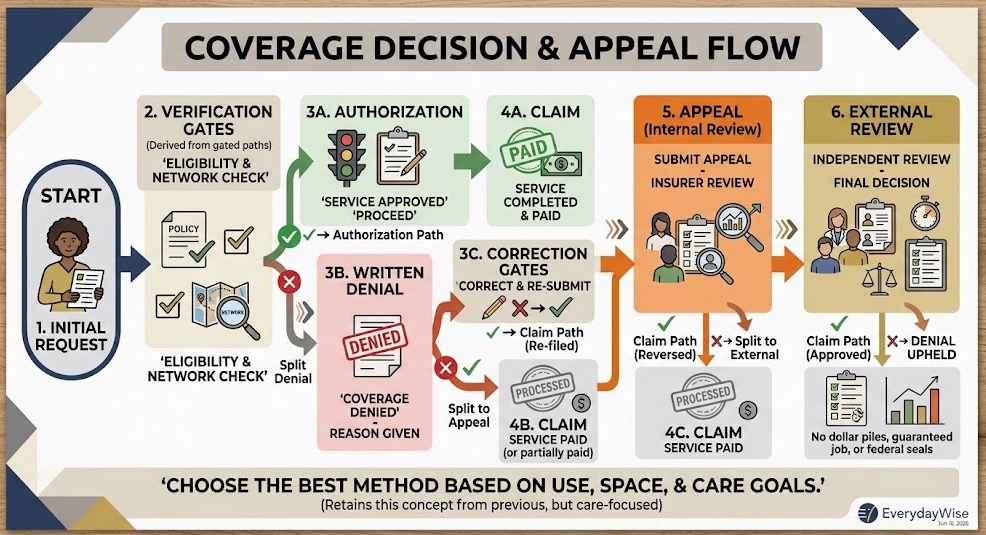
A denial is not always the final answer. It may result from missing authorization, coding, network status, a benefit exclusion, a visit limit, or a medical-necessity decision.
If a claim or request is denied:
- obtain the written reason and the plan provision used;
- compare it with the provider’s submission and your benefits documents;
- ask whether the issue can be corrected or resubmitted;
- note the internal appeal deadline and required evidence;
- ask whether an independent or external review is available;
- request continuity or expedited review if delay could seriously affect health, when that process exists; and
- identify the regulator, ombudsman, employer-benefit office, union, public authority, or consumer-assistance service that oversees the plan.
Do not rely solely on a telephone refusal. Ask for the decision in writing and keep copies of claims, authorizations, receipts, clinical letters, and messages. A clinician may be able to provide documentation, but ask whether preparing it has a fee.
Use a Pre-Appointment Verification Sheet
Before committing to ongoing care, record these answers in one place:
Privacy
- Applicable privacy rule and contact person
- What enters the clinical record
- Portal and notification visibility
- Family or guardian access
- Safety and legal exceptions
- Record access and correction process
- Technology vendors and recording policy
Coverage
- Exact plan and member identifier
- Provider and service network status
- Referral and authorization requirements
- Deductible, copayment, coinsurance, and allowed amount
- Visit or dollar limits
- Telehealth and out-of-network rules
- Claim information and policyholder notices
- Denial and appeal contacts and deadlines
Recheck coverage when the calendar or plan year changes, the provider moves, the clinician’s billing arrangement changes, treatment format changes, or an authorization period ends.
Decision Summary
Privacy and insurance are related but separate. A provider’s duty of confidentiality does not prevent every record, claim, portal alert, or authorized disclosure. Insurance coverage does not establish the privacy rules, and a private payment does not eliminate the medical record.
Ask for specific pathways: what is documented, who can access it, what exceptions apply, what a claim contains, whether provider and service are covered, what you will owe, and how a denial is reviewed. The best time to clarify those rules is before sensitive information or recurring charges begin moving through the system.
This article provides general educational information and is not legal, insurance, or medical advice. Privacy rights, consent rules, coverage, billing protections, and appeals vary by country, jurisdiction, plan, provider, age, and circumstance. Confirm the current rules with the provider, payer, and appropriate regulator. In an immediate safety emergency, seek local urgent help rather than delaying care to resolve payment or privacy questions.
FAQ
Does confidentiality mean nothing is written down?
No. A provider may create clinical and billing records while still having a duty to protect them. Ask what is documented, where it is stored, who can access it, and what exceptions apply.
Are psychotherapy notes the same as my medical record?
Under US HIPAA, separately maintained psychotherapy notes are a narrow category with special treatment. Diagnosis, symptoms, treatment plans, medication information, and progress summaries generally belong to the broader record. Other countries use different definitions.
Can the person who holds my insurance policy see my claim?
Possibly. Claim statements, explanations of benefits, and portal alerts may reveal the provider, date, service, or cost. Ask the plan what the policyholder can see and whether confidential communications are available.
Does “in network” mean the visit will be free?
No. A deductible, copayment, coinsurance, authorization rule, or uncovered service may still apply. Confirm both the provider and the specific service, then request an estimate based on your current benefits.
Will my employer know that I received mental health care?
An employer-sponsored plan does not ordinarily give a supervisor access to therapy notes, but workplace benefits, disability, accommodation, occupational-health, and employee-assistance processes may have different information flows. Ask each program directly.
Can I prevent a parent from seeing a teenager’s mental health information?
There is no universal answer. It depends on age, capacity, consent law, service type, custody, insurance, portal design, and safety circumstances. Ask the provider and payer to explain the local rules before care begins.
What should I do if insurance denies treatment?
Request the written reason and plan provision, check for coding or authorization errors, obtain the appeal instructions and deadline, and ask whether external review or an expedited process is available.
Sources
- US Department of Health and Human Services — HIPAA and Mental Health Information
- US Department of Health and Human Services — Your Medical Records
- US Department of Labor — Mental Health and Substance Use Disorder Parity
- HealthCare.gov — Mental Health and Substance Abuse Coverage
- Office of the Privacy Commissioner of Canada — Protecting Personal Health Information
More in This Cluster: Mental Health Navigation
- Therapist, Psychologist, Psychiatrist, and Counselor Compared
- How to Prepare for a First Therapy Appointment
- How to Evaluate Online Therapy
- What to Do During a Mental Health Crisis
- How to Talk to a Doctor About Mental Health
- Mental Health Privacy and Insurance Questions to Ask (you are here)
- How to Support a Family Member Without Taking Over