The appointment is booked, but the hardest part may still seem unfinished: deciding how to explain what brought you there.
You may have months of experiences that do not fit into a neat story. You may worry that the concern is too small, too private, or too difficult to say aloud. If the appointment is for a child, you may also wonder whether raising the concern will frighten, embarrass, or label them.
A first therapy appointment does not require a polished explanation. Its purpose is to begin understanding what has been happening, what affects daily life, what help you are seeking, and whether this provider and service are appropriate. A short preparation page can make that conversation easier without turning it into a performance.
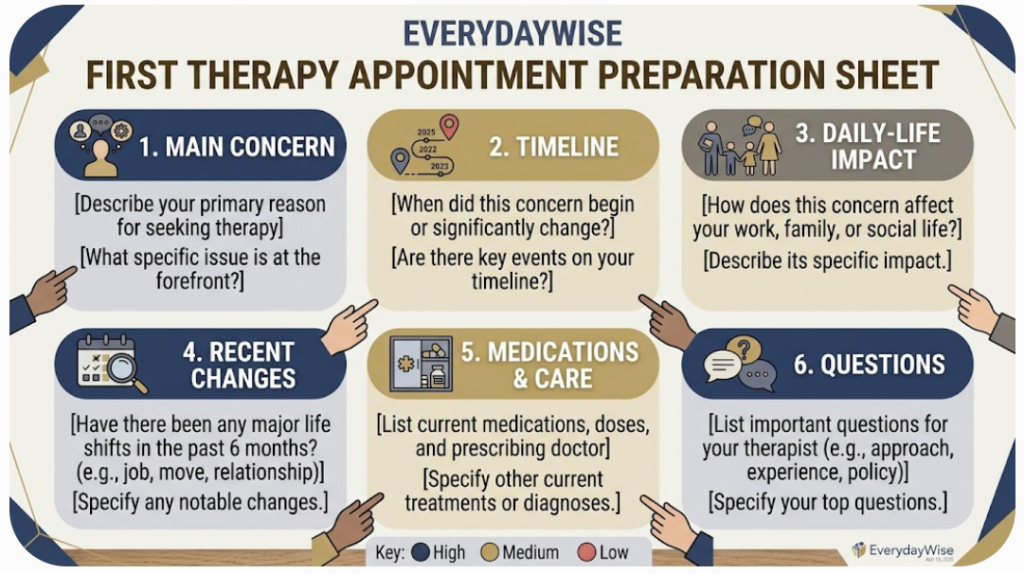
Quick decision: Before the appointment, write down the main concern, when you first noticed it, how it affects daily life, what has changed recently, any medications or other care, and two or three questions. Confirm cost, format, cancellation terms, privacy limits, and what the first session is intended to accomplish. Bring useful records only when relevant. In the session, correct misunderstandings, ask for plain-language explanations, and leave with a clear next step.
Preparation Should Reduce Pressure, Not Create More
People sometimes approach a first appointment as though they must prove that their distress is serious enough. Others try to reconstruct every event in chronological order or research possible diagnoses until the preparation itself becomes overwhelming.
The provider needs useful starting information, not a perfect case presentation. A few concrete observations are usually more informative than a long attempt to explain everything at once.
Write in fragments if that is easier:
- “Waking at 3 a.m. most nights for six weeks.”
- “Avoiding work calls and then feeling worse when they accumulate.”
- “Panic on the train twice this month.”
- “Child speaks freely at home but rarely at school.”
- “Arguments have become more frequent since the move.”
- “Drinking more often to switch off after work.”
These notes do not establish a diagnosis. They give the provider a place to begin asking better questions.
Start With the One-Sentence Reason for Booking
Complete this sentence:
“I made this appointment because…”
The answer can be broad:
- “…I have not felt like myself since my job changed.”
- “…my anxiety is starting to affect sleep and work.”
- “…I am worried about how my child is communicating and coping.”
- “…grief is still making ordinary tasks difficult.”
- “…I want help changing a pattern in my relationships.”
- “…my doctor recommended therapy, but I am not sure what to expect.”
You are allowed to say that you do not know exactly what is wrong. Uncertainty is information. The provider can ask what you notice, when it occurs, and what you hope might become different.
Build a Short Timeline
Mental-health concerns rarely begin on a perfectly remembered date. Approximate timing is still useful.
Record:
- when you first noticed the concern;
- whether it appeared suddenly or gradually;
- whether it is constant or comes and goes;
- what was happening around that time;
- whether it has improved, worsened, or changed form;
- any earlier episodes; and
- what you have already tried.
Include major life changes that may matter, such as a move, new job, separation, bereavement, childbirth, caregiving, illness, injury, school transition, financial pressure, discrimination, or a change in sleep or substance use. You do not need to decide whether the event “caused” the problem.
For symptoms or episodes, frequency is often clearer than words such as “sometimes.” “Three mornings this week” or “most evenings for about a month” gives the provider more usable context. If exact dates are unavailable, say so.
Describe the Effect on Daily Life
The same feeling can have very different consequences for different people. Note what has become harder in the areas that matter to you:
- sleep and waking;
- eating and appetite;
- concentration and memory;
- work, school, or caregiving;
- relationships and communication;
- hygiene and household tasks;
- leaving home, driving, or using transit;
- alcohol or other substance use;
- enjoyment and social contact; and
- personal or others’ safety.
Also note what remains possible. A balanced account helps the provider understand both impairment and existing supports. “I still go to work, but I spend every evening recovering and have stopped seeing friends” communicates more than either “I am functioning” or “everything is terrible.”
Bring Medication and Health Information
Mental and physical health can interact. Prepare a current list of:
- prescription medications;
- nonprescription medicines;
- vitamins, supplements, and herbal products;
- recent changes in dose or use;
- relevant medical conditions or recent tests;
- previous mental-health treatment; and
- medication allergies or serious past reactions.
Include alcohol, cannabis, nicotine, and other substances when they may affect symptoms, sleep, safety, or treatment. The purpose is accurate care, not moral judgment. NIMH recommends preparing medication information and discussing symptoms, timing, severity, frequency, stressors, and recent life changes with a healthcare provider.
Do not change a prescribed medication merely to prepare for therapy. If you are concerned about side effects, withdrawal, interactions, or safety, contact the prescriber, pharmacist, or an appropriate urgent service.
Decide What You Want Help With
You do not need a lifetime goal. Choose one early decision or change that would make therapy useful.
Examples include:
- understand why a pattern keeps occurring;
- sleep through more of the night;
- manage panic well enough to travel to work;
- respond differently during conflict;
- function after a loss;
- reduce avoidance;
- support a child without increasing fear or shame;
- decide whether another assessment or medical appointment is needed; or
- establish whether this therapist is a suitable fit.
Goals can change as the provider learns more. A first appointment may clarify that another service, a medical evaluation, a different therapy approach, or more urgent support is needed. That redirection is useful work rather than a failed appointment.
Prepare Questions for the Therapist
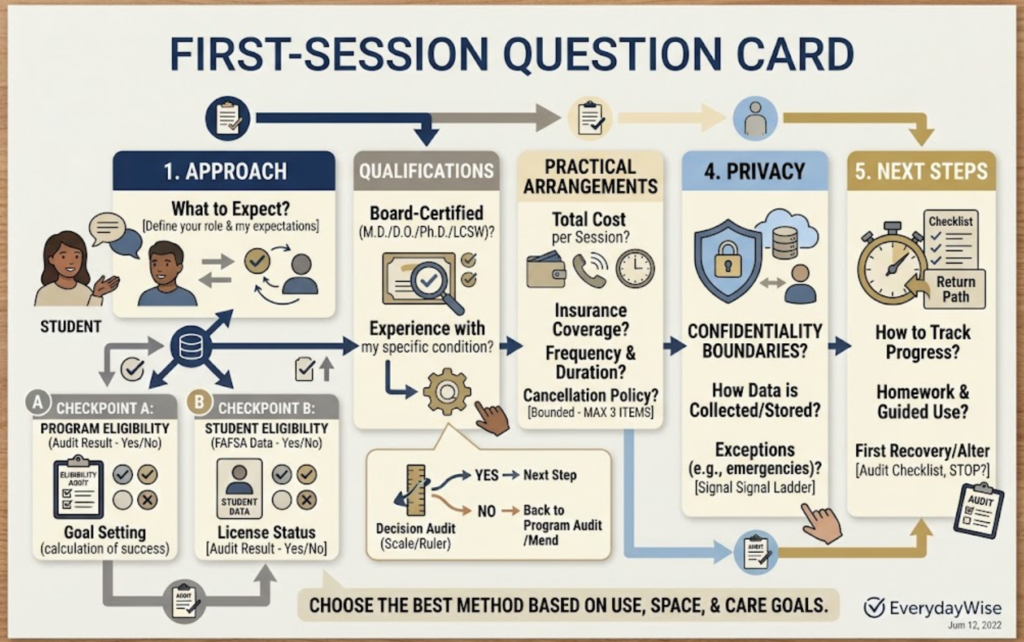
Choose the questions most relevant to your decision. You do not have to ask every question in one session.
About the approach
- How do you usually work with concerns like mine?
- What would the first few sessions focus on?
- How will we decide what goals to work toward?
- How do we review whether therapy is helping?
- What happens if your approach does not feel useful?
About qualifications and scope
- What is your professional credential and current registration?
- Do you regularly work with this concern, age group, culture, language, or family situation?
- Can you provide the documentation or assessment I need, or is that a different service?
- How do you coordinate with a doctor or another provider if needed?
About practical arrangements
- How long and how frequent are appointments?
- What are the fees, cancellation rules, and insurance receipts?
- Are appointments in person, virtual, or both?
- How do I contact you between sessions, and what response should I expect?
- What should I do if the situation becomes urgent when you are unavailable?
The preceding article, Therapist, Psychologist, Psychiatrist, and Counselor Compared, explains why the full credential and local scope matter.
Understand Privacy Before Sharing Details
Therapy is generally private, but confidentiality is not absolute. Exact rules depend on the provider, jurisdiction, setting, age, consent arrangement, and the nature of the risk.
Ask the provider to explain:
- who can access the record;
- what information may be sent to an insurer or referring clinician;
- how virtual sessions and messages are protected;
- whether the provider consults with supervisors or a care team;
- the circumstances in which information may be disclosed without permission;
- how privacy works for a child or adolescent; and
- how requests from parents, schools, employers, courts, or other organizations are handled.
Common legal or ethical exceptions can involve immediate danger, suspected abuse or neglect, court requirements, or other mandatory reporting duties, but the details vary. Ask for a plain-language explanation before assuming that either complete secrecy or unrestricted family access applies.
If you use insurance, the insurer may receive billing information and sometimes additional clinical information. The dedicated cluster article on privacy and insurance will cover those questions in depth.
From Jerome, EverydayWise Contributor
Jerome and his family moved from Korea to Canada when his son was still a baby. His son learned Korean and English from the beginning and seemed slow in language development. Jerome and his wife worried for years before raising the concern with a family doctor after their son was older than ten.
The hesitation was not indifference. Jerome worried that bringing up the concern might hurt his son or place a label on him. The school had not reported a problem, so he also questioned whether he and his wife were turning a private parental worry into something larger than it was.
The passage above comes from the lived experience of Jerome, an EverydayWise contributor. It illustrates why a first conversation may be delayed even when a parent is paying close attention. A consultation can begin with uncertainty; parents do not have to diagnose a child before asking what kind of observation, assessment, or support may be appropriate.
Jerome’s later conversation with the family doctor and the direction the family received are reserved for the cluster article on talking to a doctor about mental health. Here, his experience serves one preparation decision: write down what you have observed, what others have or have not noticed, and what you are afraid the conversation might mean.
Preparing for a Child’s First Appointment
Parents may feel caught between two risks: waiting too long and making a child feel that something is wrong with them. Preparation can protect the child’s dignity while still taking concerns seriously.
Separate observations from conclusions
Write what you see or hear:
- “He avoids school on presentation days.”
- “She has stopped sleeping alone since the move.”
- “The teacher has not reported a concern, but conversations at home often break down.”
- “Outbursts occur after noisy activities and last about 20 minutes.”
Avoid turning the note into a character judgment such as lazy, manipulative, dramatic, or defiant. Also avoid deciding on a diagnosis before evaluation.
Gather information from more than one setting when available
Depending on the concern, useful records may include teacher observations, report cards, prior assessments, medical information, developmental history, or examples of schoolwork. APA notes that referral information, relevant school records, and prior treatment or testing records can help a psychologist understand the concern; obtaining information from others normally requires appropriate permission.
The absence of teacher concern does not prove that nothing is happening at home. Conversely, parental worry does not establish a disorder. Differences between settings are themselves worth describing.
Explain the appointment without assigning a label
Use language suited to the child’s age and understanding. For example: “We are meeting someone who helps families understand what has been difficult and what might help.” Do not promise that every detail will remain secret from everyone, and do not threaten that the provider will “fix” or discipline the child.
Ask the provider beforehand:
- who attends the first session;
- whether the child and parent will speak separately;
- what privacy the child can expect;
- what information parents will receive;
- whether school contact may be recommended; and
- how consent or assent works locally.
AACAP advises families to ask about a professional’s training and experience and emphasizes the importance of a comfortable match among the child, family, and mental-health professional.
Plan the Day of the Appointment
Reduce avoidable friction:
- confirm the address, parking, transit, accessibility, or video link;
- complete forms before the session if possible;
- bring identification, payment information, referral documents, and relevant records;
- test the camera, microphone, internet, and private space for virtual care;
- arrange childcare or transportation if needed;
- avoid alcohol or other nonprescribed intoxicants before the session; and
- allow a short period afterward rather than scheduling an immediate high-pressure task.
For virtual therapy, confirm where you must physically be during the appointment and what emergency contact or location information the provider requires. Cross-border and interjurisdictional practice rules vary.
If speaking is difficult, bring the preparation page and ask the therapist to read it. You can also say at the beginning, “I am worried I will leave out the important part.” That helps the provider pace the conversation.
What the First Session May Include
The provider may ask about the current concern, history, daily functioning, relationships, health, medications, substance use, previous care, strengths, goals, and safety. They may explain their approach, confidentiality, recordkeeping, fees, communication rules, and what happens next.
Some questions may feel broad or unexpected. You can ask why a question is relevant. You can correct information, request a pause, or say that you are not ready to discuss a detail. The therapist may also need enough information to determine whether the service is safe and appropriate.
The first session may feel relieving, tiring, awkward, neutral, or incomplete. None of those reactions alone establishes whether therapy will work. Trust can take time, but serious concerns about boundaries, credentials, pressure, discrimination, privacy, or safety deserve attention immediately.
Leave With a Next Step
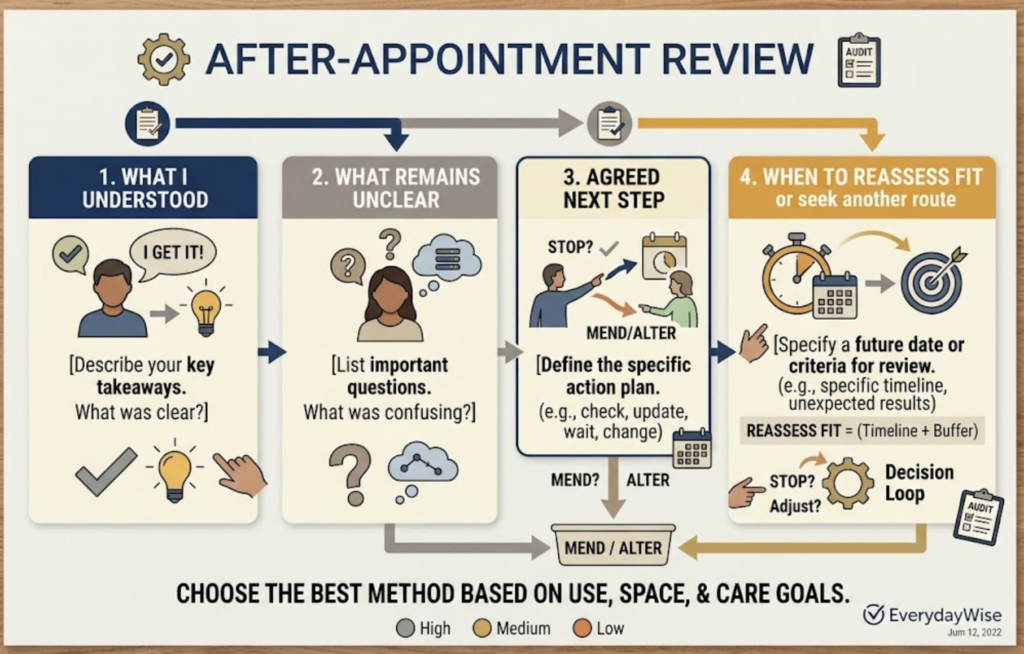
Before the appointment ends, ask:
- What is your initial understanding of the concern?
- Is this within your scope and experience?
- What do you suggest as the next step?
- How often would we meet, and for how long before reviewing progress?
- Is another medical, psychological, school, or community assessment advisable?
- What should I do if symptoms worsen before the next appointment?
- How will I schedule, pay, cancel, or obtain documentation?
Write down the plan in your own words. If the explanation is unclear, ask the provider to repeat it. You do not need to agree to a long course of treatment before understanding the recommendation, alternatives, likely benefits, possible burdens, cost, and consent terms.
Review Fit Without Demanding Instant Certainty
Afterward, consider:
- Did I feel listened to without being rushed into a conclusion?
- Could the provider explain their role and approach?
- Were privacy and practical terms understandable?
- Did they respond respectfully to culture, language, identity, disability, family structure, and financial limits?
- Was there a clear next step?
- Can I reasonably attend and afford the proposed care?
- Did anything feel unsafe, coercive, discriminatory, or outside professional boundaries?
A session can be emotionally uncomfortable while still being respectful and clinically useful. Likewise, a warm conversation is not enough if the provider lacks the required qualification or ignores safety. Fit includes human connection, competence, ethics, access, and an appropriate plan.
When Not to Wait for the Scheduled Appointment
A routine first appointment is not the right waiting point when someone may act on suicidal or violent thoughts, cannot remain safe, is severely confused or detached from reality, has dangerous intoxication or possible withdrawal, or faces another immediate medical emergency.
Contact qualified local crisis or emergency services. If uncertain, seek real-time guidance from an appropriate local service. Crisis response will be covered fully in Article”What to Do During a Mental Health Crisis“.
Decision Summary
- Write one sentence explaining why you booked.
- Note timing, frequency, recent changes, and daily-life impact.
- Prepare a complete medication and relevant health list.
- Choose one or two early goals and two or three questions.
- Confirm qualifications, cost, format, privacy limits, and emergency arrangements.
- For a child, record observations across settings without assigning a diagnosis or character judgment.
- Bring relevant records when they serve the appointment; you do not need to assemble your entire life history.
- Leave with a clear next step and a plan for what to do if the situation worsens.
This article provides general educational information and does not replace individualized medical or mental-health care. Privacy, consent, reporting duties, and professional scope vary by jurisdiction and setting. Seek qualified local advice. If there is immediate danger or an inability to remain safe, contact local emergency or crisis services now.
FAQ
What should I say at the beginning of my first therapy appointment?
Start with the main reason you booked and one or two examples of how it affects daily life. It is acceptable to say that you are unsure how to explain it or what kind of help you need.
Do I need to know my diagnosis before starting therapy?
No. Describe what you have noticed, when it began, and what has become difficult. A qualified provider can assess whether diagnosis is relevant and whether another professional or service is needed.
Should I bring notes to therapy?
Yes, if they help. A short timeline, medication list, questions, and examples of daily-life impact can reduce the pressure to remember everything. You may read from the notes or hand them to the provider.
Will I have to discuss trauma in the first session?
You may be asked about relevant history and safety, but you can tell the provider that you are not ready to describe details. Ask what information is needed now and how difficult material will be approached safely.
Can I bring someone with me?
Often, but ask first. Consider what support you want, whether you also need private time with the provider, and how the other person’s presence may affect disclosure and confidentiality.
What should a parent bring to a child’s first appointment?
Bring a concise developmental and concern timeline, medication and health information, relevant school or prior assessment records, and examples from home or other settings. Ask who should attend and how the child’s privacy will work.
What if I decide the therapist is not a good fit?
You can discuss the concern, ask whether the approach can change, or seek another qualified provider. If the problem involves unsafe conduct, credential concerns, discrimination, or a serious boundary violation, document it and consult the appropriate regulator or service.
References
Additional practical appointment-access guidance: Substance Abuse and Mental Health Services Administration, How to Set Up an Appointment for Mental Health and Substance Use Care.
American Psychological Association — Understanding Psychotherapy and How It Works
More in This Cluster: Mental Health Navigation
- Therapist, Psychologist, Psychiatrist, and Counselor Compared
- How to Prepare for a First Therapy Appointment (you are here)
- How to Evaluate Online Therapy
- What to Do During a Mental Health Crisis
- How to Talk to a Doctor About Mental Health
- Mental Health Privacy and Insurance Questions to Ask
- How to Support a Family Member Without Taking Over