A relative planning a short visit to the United States may clear the visa interview and still face one more condition: placing thousands of dollars with the U.S. government before the visa can be issued. That possibility is now part of a permanent visa-bond program—but it does not apply to every visitor or every B-1/B-2 applicant.
The first question is whether the applicant travels on a passport from a country on the State Department’s current visa-bond list. The second is whether a consular officer determines that the applicant is otherwise eligible and sends an official bond instruction. No applicant, family member, employer, or host should send money in anticipation of that instruction.
What to do now: Check the applicant’s passport country against the live State Department list. Attend the normal visa interview and wait for the consular officer’s written or electronic notice. If a bond is required, verify the amount, payer name, official payment link, permitted travel route, and authorized departure date before paying or booking nonrefundable travel.

Why It Matters
On August 3, 2026, a State Department final rule made the Visa Bond Program permanent. It covers certain applicants for temporary business or pleasure visas—B-1, B-2, or combined B-1/B-2—who are nationals of countries selected by the department. The rule took effect immediately and continued coverage for countries already subject to the pilot program.
Under the new rule, the bond amount is $10,000, $15,000, or $20,000. The consular officer selects the amount after considering the applicant’s circumstances. The rule says officers are generally expected to use $15,000, with $10,000 or $20,000 used when the circumstances support a lower or higher amount.
This money is separate from the ordinary visa application fee. It is intended to be returned when the bond conditions are satisfied, but it can remain unavailable for the duration of the trip and processing period. Exchange-rate changes and payment-provider costs can also affect the person who supplies the money.
Key Verified Facts
- The program is permanent as of August 3, 2026.
- It is limited to covered B-1/B-2 visitor-visa applicants; it is not a general charge on every U.S. visa applicant.
- The current rule sets three bond amounts: $10,000, $15,000, and $20,000.
- The requirement is imposed during visa adjudication. The applicant must wait for a consular officer’s notice and official payment link.
- Another person or organization may post the bond. That payer becomes the obligor—the person to whom a compliant bond is returned—and the obligor’s name must match the payment record and bond form.
- Posting a bond does not guarantee that a visa will be issued. A visa also does not guarantee admission; U.S. Customs and Border Protection makes the admission decision at the port of entry.
- Bond holders must enter and depart by commercial air through a U.S. air port of entry or a CBP Preclearance location. Charter flights, general aviation, land crossings, and sea ports do not meet the current route condition.
- New countries may be added with at least 15 days’ notice. A country may be removed immediately, so the live list matters more than a saved copy.
Is Your Passport Country on the Current List?
As checked on August 14, the State Department page identifies 50 countries. The page was last marked updated on May 13, 2026.
Effective in 2025: The Gambia, Malawi, Mauritania, Sao Tome and Principe, Tanzania, and Zambia.
Effective January 1, 2026: Bhutan, Botswana, Central African Republic, Guinea, Guinea-Bissau, Namibia, Turkmenistan.
Effective January 21, 2026: Algeria, Angola, Antigua and Barbuda, Bangladesh, Benin, Burundi, Cabo Verde, Cote d’Ivoire, Cuba, Djibouti, Dominica, Fiji, Gabon, Kyrgyz Republic, Nepal, Nigeria, Senegal, Tajikistan, Togo, Tonga, Tuvalu, Uganda, Vanuatu, Venezuela, and Zimbabwe.
Effective April 2, 2026: Cambodia, Ethiopia, Georgia, Grenada, Lesotho, Mauritius, Mongolia, Mozambique, Nicaragua, Papua New Guinea, Seychelles, and Tunisia.
The rule applies based on nationality and the passport used, regardless of where the person submits the visa application. Because the list can change, use the official page again on the interview date rather than relying only on this snapshot.
What Happens at the Visa Interview?
The applicant follows the ordinary nonimmigrant-visa process first, including the application, appointment, interview, and standard fee. If the consular officer finds the applicant otherwise eligible and within the program, the officer states the required bond amount and provides instructions.
The case may be refused temporarily under Immigration and Nationality Act section 221(g) while the bond is being posted. That procedural refusal can be overcome after the required bond is properly posted, but payment still does not compel the officer to issue a visa.
The final rule permits limited waivers for a significant national or humanitarian interest. Applicants cannot submit a separate application demanding a waiver; a consular officer may recommend one through the department’s process.
Pay Only After an Official Instruction
The safest payment rule is simple: wait for the consular officer’s notice.
The applicant should receive a written or electronic message through the contact information supplied in the visa application. It provides the official Visa Bond Program payment link and the required bond form. The final rule describes payment through the Treasury platform in U.S. dollars. The State Department’s current operating page specifically directs applicants to Pay.gov and warns against third-party websites.
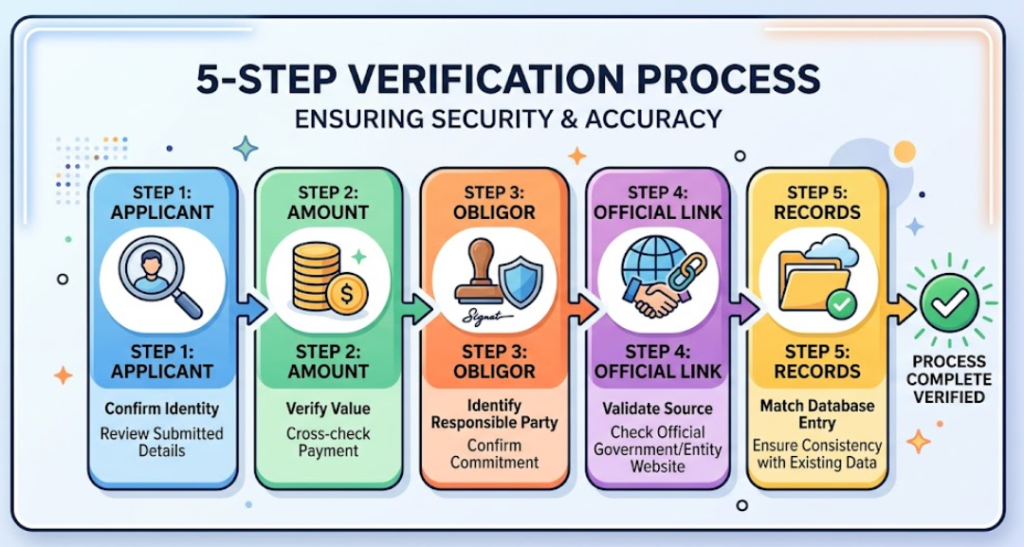
Before anyone pays, compare these details:
- Applicant: Full name, passport country, and visa case information.
- Amount: The exact amount stated by the consular officer.
- Obligor: The person or organization supplying the money. This name must match the payer and bond form.
- Destination: The link delivered through the official process, leading to the U.S. government payment platform.
- Record: A saved copy of the notice, signed bond form, payment confirmation, case number, and payer contact information.
A family member or employer can pay, including from another country, but that choice has consequences. The government returns the money to the obligor, not automatically to the traveler or host. Families should agree in writing who will supply the funds, who bears exchange-rate or payment costs, and how a returned amount will be handled.
Protect the Refund Before the Trip Begins
The bond conditions affect the itinerary. Current guidance requires both entry and departure by commercial air through an eligible U.S. air port or CBP Preclearance location. A traveler who enters by air and later leaves by car, cruise ship, private aircraft, or another nonpermitted route may create a serious compliance and departure-record problem.
Keep the visa annotation, bond form, payment confirmation, boarding passes, itinerary, and evidence of timely departure. At entry, CBP—not the visa expiration date—determines how long the traveler may remain. Check the admission record and authorized-until date after arrival, and resolve any error promptly through the appropriate official channel.
The State Department says the money is returned automatically when DHS records show one of these outcomes:
- the traveler departs on or before the authorized date;
- the visa expires without the traveler using it; or
- the traveler seeks entry and is denied admission.
Possible breach cases are referred for a USCIS determination. Current guidance identifies late departure, remaining after the authorized stay, and applying to adjust out of nonimmigrant status—including an asylum claim—as examples that may lead to a breach review. Anyone considering a change or extension of status should obtain qualified immigration advice before assuming how it will affect the bond.
A Published-Amount Conflict Requires Care
There is a material mismatch between the two official sources as of August 14. The August 3 final rule—the newer legal source—sets amounts at $10,000, $15,000, or $20,000. The State Department’s country page is still dated May 13 and displays the pilot-era amounts of $5,000, $10,000, or $15,000.
Applicants should not choose between those figures themselves. The consular officer’s notice for the individual case should identify the operative amount, and the official payment request should match it. If a notice or payment link shows inconsistent figures, pause and contact the embassy or consulate through its official website before sending funds.
This discrepancy also makes screenshots, social posts, and older advice particularly unreliable. The current country list remains useful, while the amount language on that same page has not yet been conformed to the newer final rule.
Warning Signs of a Visa-Bond Scam
Treat a payment request as unsafe when it arrives before the interview, promises to guarantee approval, asks for gift cards or cryptocurrency, directs payment to a personal account, uses a third-party payment website, or pressures a U.S. host to send money immediately.
An official bond instruction should connect to the visa case and identify the amount and procedure. Type the embassy or consulate’s official address into the browser independently when checking a message. Do not rely on a phone number or link supplied only by the person requesting money.
What Remains Uncertain
The State Department can add or remove countries, issue implementation updates, change its operational page, or grant category-level waivers. The published conflict over bond amounts may be corrected without notice. Individual bond decisions also depend on facts reviewed at the interview.
For that reason, this newsletter is a preparation guide rather than a prediction that a particular applicant will pay a bond. The live country page, the final rule, the embassy or consulate handling the case, and the case-specific consular notice are the controlling checkpoints.
The Bottom Line
Being from a listed country does not create a bill that should be paid in advance. It identifies a visitor-visa applicant who may enter the bond process. The actual sequence is live country check → normal B-1/B-2 interview → consular decision and amount → official payment link → compliant commercial-air travel → documented timely departure.
If a relative, friend, or employer will provide the money, decide who will be the obligor before payment and preserve every record. Most importantly, never let urgency or a promise of visa approval replace an official instruction tied to the applicant’s case.
Important Note
This newsletter provides general information about a changing U.S. visa process, not legal advice or a prediction about any application. Applicants should follow their case-specific consular instructions and seek advice from a qualified U.S. immigration professional when a planned status change, extension, humanitarian claim, or other individual circumstance could affect the bond.
Primary Sources
- Federal Register — Visas: Visa Bond Program, Final Rule (effective August 3, 2026)
- U.S. Department of State — Countries Subject to Visa Bonds