When Jerome worked for a construction company in Korea, the schedule often meant working 12 days and then having 2 days off. At first, the pace was engaging. The site kept moving, the construction was visibly progressing, and supervising work that carried large responsibilities produced a real sense of accomplishment.
The same schedule did not continue to feel the same. Major decisions brought more strain. Vacations became difficult to take, and time for family or for himself narrowed. Repeated work began to feel less like progress and more like an unbroken cycle. He started postponing tasks even though he could already picture every step, hour, and stressful decision they would require. The backlog grew, rest did not feel like rest, irritation spilled toward employees and family, and he drank more while pushing himself harder.
That account cannot establish a diagnosis, and it does not prove that one moment marked a switch from stress to burnout. It shows why the difference matters. A demanding period can still contain energy, meaning, and recovery. A longer pattern may change not only how tired a person feels, but also how they relate to the work and how capable they feel of doing it.
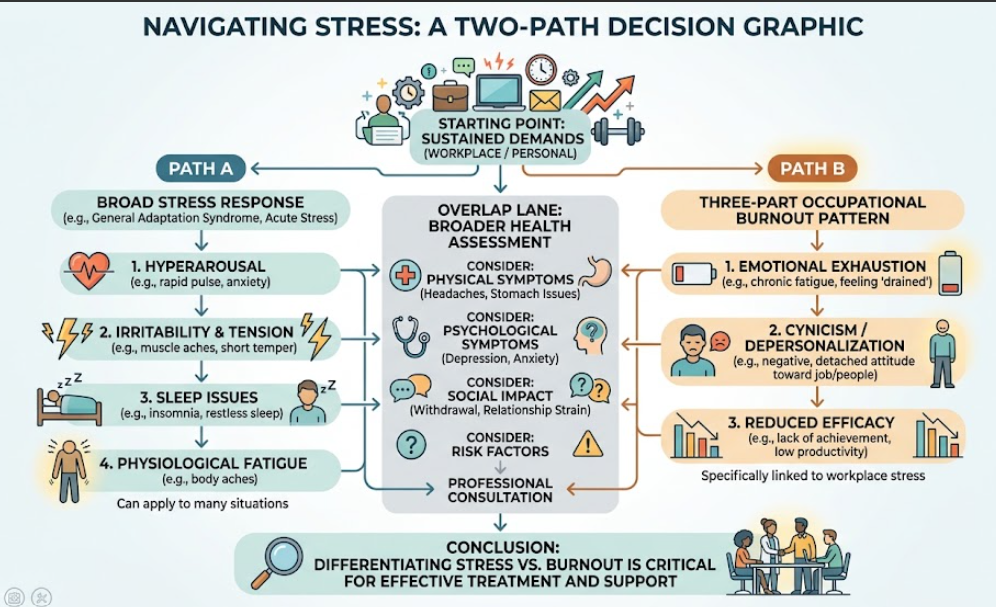
Quick decision: Stress can arise from work, caregiving, finances, conflict, illness, or many other demands and may be short-lived or chronic. WHO uses burnout more narrowly for an occupational pattern resulting from chronic workplace stress that has not been successfully managed, characterized by exhaustion, increased mental distance or cynicism toward the job, and reduced professional efficacy. If the change is persistent, affects life beyond work, increases alcohol or other substance use, or impairs safe functioning, do not rely on the label alone—consider a broader health assessment and appropriate workplace support.
Stress Is a Response, Not a Verdict
WHO describes stress as a state of worry or mental tension caused by a difficult situation. It is a natural response that can help people address challenges and threats, but the way stress affects well-being depends partly on how intense and prolonged it becomes.
Stress is not limited to employment. It may follow a deadline, caregiving load, financial uncertainty, conflict, illness, a move, study, discrimination, unsafe conditions, or several demands arriving together. It can involve difficulty relaxing or concentrating, irritability, anxiety, headaches or other pain, stomach problems, sleep disruption, and changes in appetite. Chronic stress can worsen existing health problems and may be accompanied by increased use of alcohol, tobacco, or other substances.
A stressful response can be proportionate to a genuinely difficult situation. A person may still care about the task, believe the effort matters, and work effectively while feeling tense or tired. When the demand ends or resources improve, the response may ease.
This does not make chronic stress harmless. It means that “stress” describes a broad response and does not by itself identify the source, duration, severity, or appropriate action.
Burnout Has a More Specific Occupational Meaning
In ICD-11, WHO classifies burnout as an occupational phenomenon, not a medical condition. It is conceptualized as resulting from chronic workplace stress that has not been successfully managed and has three dimensions:
- feelings of energy depletion or exhaustion;
- increased mental distance from one’s job, or negativism or cynicism related to the job; and
- reduced professional efficacy.
All three dimensions matter to the concept. Exhaustion alone can have many causes. Disliking one task is not the same as sustained mental distance from the job. A temporary mistake or difficult week does not establish reduced professional efficacy.
WHO also states that this formal burnout concept applies specifically to the occupational context. People commonly use phrases such as “caregiver burnout,” “parental burnout,” or “school burnout,” and those experiences may involve serious exhaustion and distress. But they should not be presented as if WHO’s ICD-11 occupational definition automatically covers every area of life. In non-work settings, it is usually clearer to describe the actual demands, exhaustion, detachment, and functional effects without forcing a label.
Compare the Pattern, Not One Symptom
Stress and burnout overlap. The distinction becomes more useful when several features are considered together.
| Question | Stress | Occupational burnout pattern |
|---|---|---|
| Where does it arise? | Any area of life; one source or several | Formally tied to chronic workplace stress |
| How long can it last? | Brief, recurring, or chronic | Develops in relation to chronic work stress that has not been successfully managed |
| What stands out? | Tension, worry, activation, irritability, concentration or physical symptoms | Exhaustion plus greater distance, negativism, or cynicism toward work plus reduced professional efficacy |
| What happens when the demand changes? | May ease when the event ends or resources improve | May persist when the work conditions and demand-resource imbalance remain |
| Does the label diagnose a medical condition? | No; stress may accompany many conditions | No; WHO does not classify burnout itself as a medical condition |
| What should guide action? | Source, duration, severity, function, safety, and available resources | The three-part work pattern, workplace conditions, functional impact, and possible overlapping health concerns |
This table is an orientation tool, not a test. A person can experience chronic stress without meeting the occupational burnout description. A person whose work experience resembles burnout can also have depression, anxiety, a sleep problem, a medical condition, substance-related concerns, or several issues at once.
The Change in Relationship to Work Matters
One practical distinction is whether the person is only under pressure or whether their relationship to the work is changing.
During a demanding but bounded period, someone may say:
- “There is too much to do this week, but I still know why it matters.”
- “I am tense before the deadline, but I can disengage after it.”
- “I need more time or help, and the pressure eases when I get it.”
A possible burnout pattern may sound more like:
- “Even after the immediate deadline, I feel depleted by the idea of returning.”
- “I have become detached, cynical, or numb toward work I once cared about.”
- “I am doing familiar work but increasingly experience myself as ineffective.”
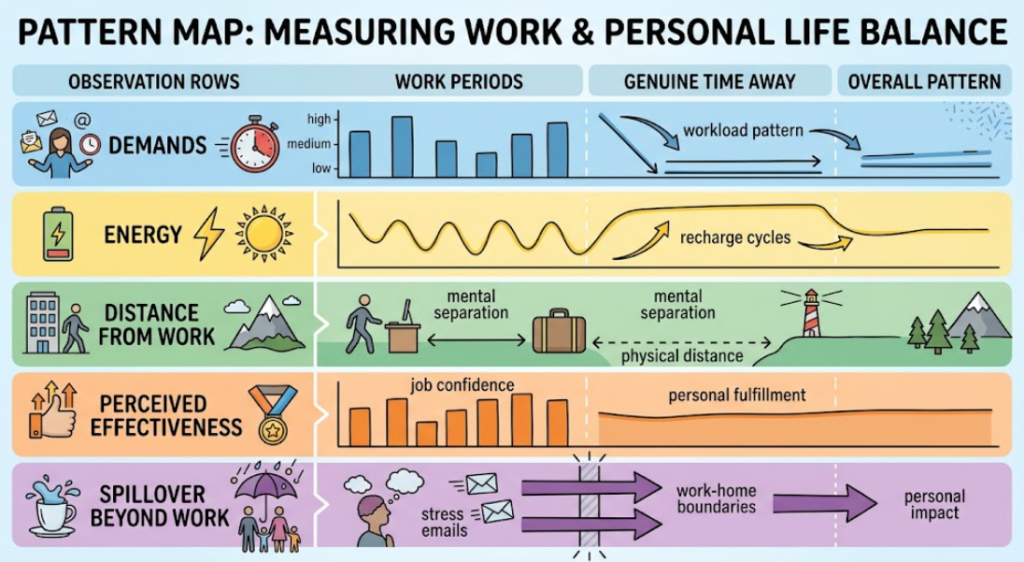
These statements still do not diagnose burnout. They identify changes worth examining. In Jerome’s experience, the work initially provided visible progress and meaning. Later, he noticed repetition without a sense of development, growing resistance to tasks he understood well, and a backlog that reinforced his belief that he was no longer working effectively. The important observation is not that enjoyment disappeared on a particular day. It is that energy, distance from work, and perceived effectiveness changed together under sustained conditions.
Recovery Can Provide Information, but Not a Diagnosis
People sometimes use a simple rule: stress improves after a weekend; burnout does not. That may be a useful observation, but it is not a reliable diagnostic boundary.
A weekend may be too short, may contain caregiving or household demands, or may be spent anticipating unfinished work. Someone may feel better during leave and still return to unchanged conditions. Another person may remain exhausted because of depression, sleep loss, pain, infection, medication effects, or another health issue unrelated to burnout.
Instead of asking whether one break “fixed” the problem, observe:
- whether work thoughts and physiological tension recede when work actually stops;
- whether energy returns during adequate sleep and genuine time away;
- whether interest and connection return outside the work setting;
- whether the same pattern resumes immediately under the same demands; and
- whether symptoms have spread across relationships, self-care, leisure, or basic daily functioning.
The recovery pattern helps show what needs investigation. It does not determine the answer by itself.
Do Not Use Burnout to Explain Everything
Burnout, depression, and anxiety can share features such as exhaustion, concentration difficulty, irritability, sleep disturbance, and reduced functioning. A systematic review and meta-analysis found meaningful relationships among burnout, depression, and anxiety while concluding that the constructs were not identical.
The difference cannot be settled safely with a short online checklist. A work-linked pattern may point toward burnout, but symptoms that extend through most areas of life deserve broader attention. Examples include persistent low or irritable mood, loss of interest or pleasure outside work, intense or uncontrollable worry, panic, major sleep or appetite change, increasing reliance on alcohol or other substances, or difficulty carrying out ordinary responsibilities.
Physical causes also matter. Fatigue, concentration problems, sleep disruption, or reduced capacity can accompany medical conditions and medication effects. The fact that work is difficult does not prove that work is the only cause.
The goal is not to choose the most acceptable label. It is to avoid letting a familiar label delay an assessment that could identify a different or additional problem.
Look at the Work, Not Only the Worker
WHO identifies excessive workloads or work pace, long or inflexible hours, understaffing, low control over job design or workload, limited support, unclear roles, job insecurity, discrimination, harassment, and conflicting home and work demands among psychosocial risks to mental health at work.
That matters because burnout is often framed as a personal recovery failure. If the workload continually exceeds available time, staffing, authority, information, or recovery, asking the worker to become more resilient leaves the underlying condition in place.
Personal actions may still help. A worker can document demands, identify priority conflicts, protect specific recovery periods, request clarification or support, and seek clinical care. But WHO’s mental-health-at-work guidance also recommends organizational interventions that assess and modify workplace risks.
A useful review therefore asks both sets of questions.
Questions about the person’s current functioning
- What has changed in energy, concentration, sleep, mood, patience, or substance use?
- Is the change mainly tied to work, or has it spread through the rest of life?
- Can the person work, drive, make high-consequence decisions, and care for themselves safely?
- What happens during genuine time away?
Questions about the work system
- Which demands increased, and which resources decreased?
- Are priorities possible within the available time and staffing?
- Does responsibility exceed decision authority?
- Can work stop, be handed over, or be covered during leave?
- Are long hours temporary and bounded, or treated as the normal operating model?
- What can a manager, team, occupational-health service, union, regulator, or other workplace channel change?
Neither side should erase the other. Workplace change does not replace healthcare when health is affected. Individual care does not make unsafe or chronically excessive working conditions acceptable.
Choose the Next Step by Function and Risk
You do not need certainty about the label before acting.
The pattern appears temporary and recovery is returning
If the demand is identifiable, time-limited, and easing—and sleep, concentration, mood, and ordinary function are recovering—a focused stress response may be enough for now. Reduce avoidable demands, clarify the end point, protect recovery, and watch whether the pattern actually resolves.
Work-specific exhaustion, distance, and reduced efficacy are persisting
When the three dimensions are appearing together, record the work conditions rather than only recording feelings. Note hours, workload, priority conflicts, decision responsibility, interruptions, staffing, leave, recovery opportunities, and changes in performance or relationships. That record can support a conversation with a manager, occupational-health service, worker representative, or clinician.
Do not wait for perfect proof before raising a workload or health concern. The purpose of the conversation is to examine the pattern and options, not to win an argument over terminology.
The effects are broader, worsening, or unsafe
Arrange professional help when distress or impairment persists, spreads beyond work, interferes with ordinary functioning, or is accompanied by increasing alcohol or other substance use. A primary-care clinician or qualified mental-health professional can help assess overlapping health conditions; available entry points vary by country.
Use urgent local help if there are thoughts of self-harm or suicide, inability to stay safe, severe intoxication or withdrawal concerns, a medical emergency, or behaviour that presents an immediate danger. Stop safety-critical work or driving when concentration, fatigue, substance use, or distress makes it unsafe.
Harm toward employees or family should not be treated as an unavoidable feature of burnout. Strain may help explain why behaviour changed, but it does not remove responsibility to stop harmful conduct, repair what can be repaired, and seek appropriate support.

A Seven-Day Orientation Record
Before making a major conclusion, collect a small amount of usable information. For seven days, note:
- the main demands and whether they were work-related or outside work;
- working and commuting hours;
- sleep opportunity and whether rest felt restorative;
- energy before work, during work, after work, and during time away;
- distance, cynicism, or numbness specifically toward the job;
- tasks delayed, errors, or work that felt harder than usual;
- effects on family, coworkers, self-care, and activities outside work;
- alcohol or other substance use that increased or became harder to control; and
- any moment when functioning became unsafe.
Do not turn the record into another performance requirement. Approximate notes are enough. Its purpose is to show whether the pattern is brief or persistent, work-specific or broad, recovering or worsening.
Decision Summary
Stress and burnout are related, but they are not synonyms.
- Stress is a broad response to difficult demands in any area of life.
- WHO’s formal burnout concept is occupational and results from chronic workplace stress that has not been successfully managed.
- Burnout involves three dimensions: exhaustion, increased distance or cynicism toward work, and reduced professional efficacy.
- One symptom, one hard week, or one online score cannot establish the pattern.
- Improvement during time away is useful information, not a diagnostic test.
- Symptoms that spread beyond work may indicate burnout plus another concern—or a different concern entirely.
- Review workload, control, staffing, hours, support, and recovery opportunities as well as personal coping.
- Seek broader help for persistent impairment, worsening mood or anxiety, increased substance use, or safety concerns.
The useful question is not simply, “Am I stressed or burned out?” It is, “What has changed—in the demands, my energy, my relationship to the work, my effectiveness, and the rest of my life—and what level of response does that change require?”
This article provides general health information and does not diagnose burnout, depression, anxiety, a substance-use disorder, or another medical or mental-health condition. Seek qualified professional assessment for persistent or worsening distress or impairment. Use local emergency or crisis services when there is immediate danger or inability to stay safe.
FAQ
Is burnout just severe stress?
Not exactly. Stress is a broad response to difficult demands. WHO defines burnout more specifically as an occupational phenomenon associated with chronic workplace stress that has not been successfully managed and characterized by exhaustion, mental distance or cynicism toward work, and reduced professional efficacy.
Is burnout a medical diagnosis?
WHO includes burnout in ICD-11 as an occupational phenomenon, not as a medical condition. Similar symptoms can occur with diagnosable mental or physical health conditions, so significant impairment may still warrant clinical assessment.
Can caregiving or parenting cause burnout?
People commonly use burnout language for caregiving and parenting exhaustion. WHO’s formal ICD-11 definition, however, is specific to employment. In other contexts, describe the demands, exhaustion, detachment, and functional effects clearly rather than assuming the occupational definition applies.
If I feel better on vacation, does that mean it was only stress?
No. Improvement during genuine time away is useful evidence about the role of work, but it does not rule burnout, depression, anxiety, sleep problems, medical causes, or other concerns in or out.
Can I be burned out and still perform well?
Performance may remain outwardly strong for a time. Look beyond output alone at energy, distance or cynicism toward work, perceived effectiveness, recovery, errors, relationships, and what it costs to maintain the performance.
Should I take an online burnout test?
A questionnaire may help organize observations, but it should not be treated as a clinical diagnosis. Use the results to identify patterns and questions for a workplace or healthcare discussion.
When should I seek professional help instead of managing stress myself?
Seek help when distress or impairment persists or worsens, affects life beyond work, increases reliance on alcohol or other substances, or interferes with safe functioning. Use urgent local help for thoughts of self-harm or suicide, inability to stay safe, or another immediate emergency.
Sources
- Stress — World Health Organization
- Burn-out an Occupational Phenomenon — World Health Organization
- The Relationship Between Burnout, Depression, and Anxiety: A Systematic Review and Meta-Analysis — Frontiers in Psychology
- Mental Health at Work — World Health Organization
- WHO Guidelines on Mental Health at Work — World Health Organization