Two days off can look adequate on a calendar and still arrive already committed. Sleep debt, errands, household work, family needs, and thoughts about the next shift may consume the same hours that appear to be “free.” By the time the person begins to settle, work is about to resume.
When Jerome worked for a construction company in Korea, his schedule often meant 12 days of work followed by 2 days off. Vacations were difficult to take, and time with family or for himself narrowed. The schedule contained days off, yet it did not reliably create enough distance from an operation that kept moving. His experience cannot determine what every worker needs. It shows why recovery must be judged by what the time permits, not by its label on a schedule.
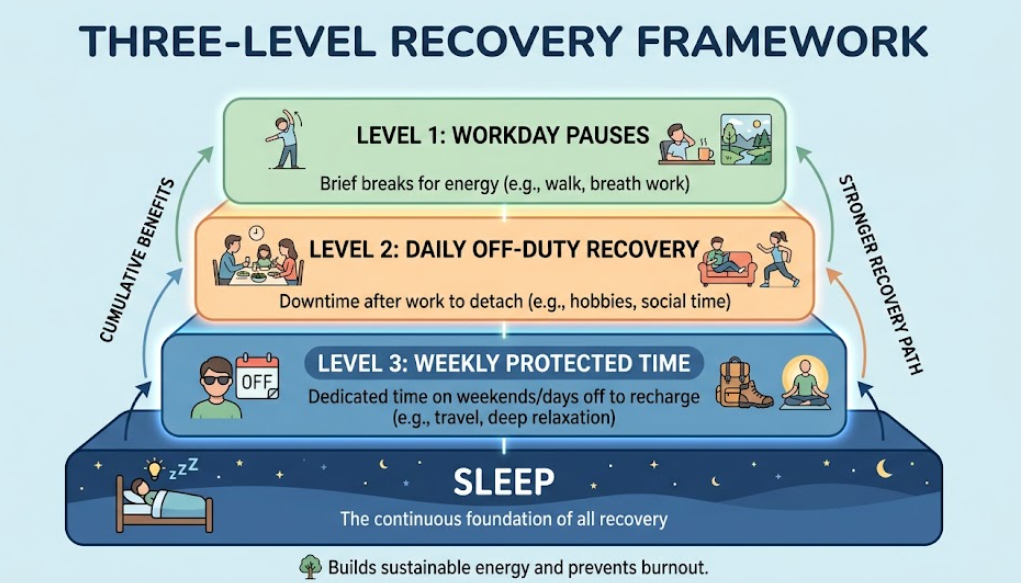
Quick decision: Build recovery at three levels: brief protected pauses during demanding work, a daily off-duty period that preserves sleep and mental distance, and recurring weekly time that is not merely postponed work or maintenance. If these periods cannot occur without unsafe backlog, lost pay, retaliation, or uncovered essential duties, the problem requires a workload, staffing, scheduling, or support response as well as personal planning.
Recovery Is a Function, Not an Activity List
Recovery is often reduced to a list of approved activities: exercise, meditation, hobbies, social time, or a bath. Any of these may help one person and burden another. The more useful test is what changes after the activity.
A period is functioning as recovery when it supports some combination of:
- lower physical or mental activation after work;
- adequate opportunity for sleep;
- temporary distance from work demands;
- restored ability to concentrate or regulate emotion;
- connection with people or activities that matter outside work; and
- renewed capacity that does not depend on alcohol, another substance, or further self-neglect.
Quiet time is not automatically restorative. A person may sit still while answering work messages, rehearsing tomorrow’s problems, or blaming themselves for unfinished tasks. Conversely, active time with family, a walk, a religious practice, cooking, or a practical hobby may create genuine distance from work.
Judge the result rather than copying someone else’s routine.
Protect Sleep Before Optimizing Leisure
Sleep opportunity is the foundation that smaller recovery practices cannot replace. NIOSH associates workplace fatigue with nonstandard schedules, extended hours, and schedules that disrupt or shorten sleep. Its work-hour guidance notes that longer time awake, shorter or poorer sleep, and longer time on task can combine to increase fatigue risk.
Start with the interval between required activities. Include the commute, meals, hygiene, caregiving, and the time needed to settle—not only the hours between one shift ending and the next beginning.
If the available interval does not permit adequate sleep, a better evening routine cannot manufacture the missing hours. The response may need a later start, shorter shift, reduced commute burden, coverage, fewer consecutive shifts, or another schedule change. Specific work-hour rules and protections vary by occupation and jurisdiction.
Protecting sleep also means avoiding the assumption that every off-duty hour is available for chores or extra work. Some maintenance must happen, but a schedule that repeatedly trades sleep for basic household functioning is showing a capacity problem.
Level 1: Use Brief Pauses During Demanding Work
Short breaks do not cure burnout or erase an excessive shift. They can interrupt long periods of continuous physical, cognitive, or emotional demand.
NIOSH guidance for nurses reports that rest breaks during shifts can reduce injury and error risk and recommends that managers schedule breaks and arrange coverage rather than leaving workers to find an unguarded moment. The exact timing and frequency must fit the task, workplace, and safety requirements.
A usable pause has a clear boundary:
- stop or hand over the task safely;
- leave the immediate demand when possible;
- meet a basic need such as hydration, food, movement, restroom use, or quiet;
- avoid replacing the pause with routine work messages; and
- return through a defined next step or handoff.
Coverage is part of the break. A nurse, operator, caregiver, driver, supervisor, or sole worker may be unable to disengage safely without someone else assuming responsibility. In those settings, “take more breaks” is incomplete advice. The organization must provide a workable relief system.
Level 2: Create a Daily Off-Duty Boundary
Daily recovery begins when work stops making new demands. That boundary may be weakened by alerts, late calls, unresolved responsibility, unpredictable scheduling, or the belief that being reachable is always required.
Choose a shutdown action that fits the work:
- record unresolved items and the next step;
- identify what is genuinely urgent and how it will be escalated;
- hand over responsibility explicitly;
- silence nonessential work channels;
- place work materials outside the main living or sleeping space; and
- tell affected people when availability resumes.
The shutdown action reduces the need to keep rehearsing unfinished work in memory. It does not guarantee mental detachment, especially during a crisis or after a difficult event. It provides a visible boundary that the mind and other people can recognize.
For workers without control over after-hours contact, document the frequency, duration, and consequence of interruptions. That record can support a conversation about on-call rotation, response standards, staffing, or compensation. Article”Workload Boundaries Without Perfect Control” addresses workload boundaries in greater detail.

Level 3: Reserve Weekly Time That Changes the Pattern
Weekly recovery needs enough continuity for the person to move beyond immediate decompression. It may be a full day, two half-days, or another arrangement suited to the schedule and household. The calendar block should be specific enough that work and maintenance do not automatically claim it.
Divide nonwork demands before the week begins:
- Essential maintenance: food, medication, laundry, caregiving, transportation, and necessary administration;
- Flexible maintenance: tasks that can be simplified, shared, delayed, or done less often;
- Recovery and connection: sleep, unstructured time, relationships, movement, spiritual practice, creativity, nature, or other genuinely restorative use;
- Contingency: some space for delays and unexpected needs.
If every available hour belongs to essential maintenance, the planning exercise has revealed a support deficit. Possible responses include redistributing household tasks, reducing standards temporarily, combining errands, arranging paid or community help where available, or changing the work schedule. None of these options is equally accessible to every household, and the absence of resources should not be described as a personal planning failure.
Jerome’s two-day break carried needs that had accumulated across 12 working days. Family time and personal time competed with recovery and unfinished obligations. A calendar can conceal that compression. Looking at the functions assigned to the two days makes it visible.
Build a Minimum Viable Recovery Plan
An ideal week may be unavailable. A minimum viable plan identifies the smallest set of protected conditions that keep the current week from consuming all future capacity.
Write one item in each row:
| Recovery layer | Minimum condition this week | What could block it? | Who or what can protect it? |
|---|---|---|---|
| During work | One covered pause during the most demanding period | No relief coverage | Shift lead assigns coverage |
| Daily | A defined off-duty interval with work alerts limited | Unclear on-call expectations | Written escalation rule |
| Sleep | Enough protected opportunity, including commute and care | Late shift plus early start | Schedule adjustment or handoff |
| Weekly | One block reserved for recovery or connection | Accumulated errands | Share, simplify, or defer flexible tasks |
| Contingency | Space for one unexpected demand | Calendar filled to capacity | Leave one block unassigned |
This is not a productivity score. Missing a block provides information about the schedule, support system, or current health. Revise the plan rather than compensating by removing more sleep.
Check Whether the Time Actually Restores Capacity
At the end of the week, review the result without demanding that every break produce energy.
Ask:
- Did I have adequate opportunity to sleep?
- Could I stop monitoring work for any meaningful period?
- Did the break reduce tension or make concentration easier afterward?
- Did family or personal time feel chosen, rushed, or simply added to the workload?
- What repeatedly entered the protected time?
- Did I rely more on alcohol or another substance to switch off?
- Did I return somewhat restored, unchanged, or more depleted?
Recovery can be incomplete during illness, caregiving crises, grief, financial strain, unsafe housing, or severe workplace stress. A disappointing result does not prove that the activity was wrong. It may show that the interval was too short, the demands continued, sleep was inadequate, or a broader health concern is present.
Do Not Use Small Breaks to Legitimize Chronic Overload
WHO identifies excessive workloads, understaffing, long or inflexible hours, low control, limited support, and conflicting home and work demands as psychosocial risks. It recommends organizational interventions that assess and change working conditions.
A five-minute pause cannot correct a schedule that chronically prevents sleep. A protected evening cannot compensate for an on-call system that repeatedly interrupts it. A weekend cannot restore capacity if the accumulated household and work burden fills every hour.
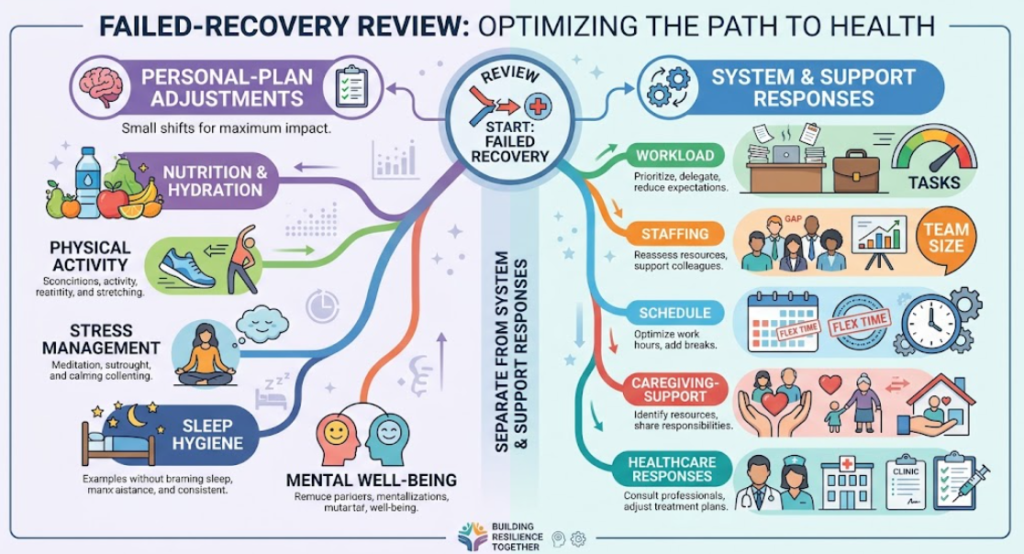
When recovery repeatedly fails, make the operating conditions visible:
- consecutive days and total hours worked;
- shift timing and notice;
- after-hours interruptions;
- missed or interrupted breaks;
- commute and required recovery interval;
- workload or staffing gaps;
- safety errors, near misses, or impaired driving concerns; and
- the specific coverage or schedule change needed.
WHO guidance for health workers includes workload reduction, schedule changes, communication, teamwork, safe staffing, regular breaks, and flexible schedules among preventive measures. The principle extends beyond one worker trying harder to recover: work should be organized so recovery is possible.
When Recovery Planning Is Not Enough
Seek professional assessment when exhaustion, sleep disruption, concentration difficulty, mood or anxiety symptoms, or reduced functioning persist despite a realistic opportunity for rest—or when no realistic opportunity can be created. Increasing reliance on alcohol or other substances also warrants timely support.
Stop driving or safety-critical work when fatigue makes it unsafe. Use urgent local help for thoughts of self-harm or suicide, inability to remain safe, severe intoxication or withdrawal concerns, violence, or another immediate emergency.
Decision Summary
- Evaluate time off by what it permits, not by the calendar label.
- Protect adequate sleep opportunity before optimizing leisure activities.
- Build recovery at workday, daily, and weekly levels.
- Include coverage and handoff; a break without transferred responsibility may not be usable.
- Preserve some weekly time for recovery or connection after essential maintenance.
- Review whether protected time restored capacity and what repeatedly invaded it.
- Treat repeated recovery failure as evidence about workload, staffing, scheduling, support, or health.
- Do not use small personal practices to normalize chronically excessive or unsafe work.
- Move to workplace, healthcare, or urgent support when function or safety requires it.
A workable recovery plan gives time a protected purpose and then checks whether the person can actually use it.
This article provides general health and workplace information. It does not diagnose burnout, a sleep disorder, or another condition and does not replace workplace safety rules, employment requirements, or professional care.
FAQ
How much recovery time do I need each week?
There is no single universal weekly amount. Sleep needs, shift timing, workload, health, caregiving, commute, and task risk differ. Protect adequate daily sleep opportunity and recurring time away from work, then assess whether capacity returns.
Do short breaks really help?
They can interrupt time-on-task fatigue and may reduce errors or injuries in demanding work, particularly when managers provide coverage. They do not compensate for inadequate sleep or chronic overload.
What if I cannot stop thinking about work?
Capture unfinished items, define the next step, complete a handoff, and limit nonessential alerts. Persistent intrusive work thoughts, distress, or impaired sleep may require workplace changes or professional support.
Is family time always recovery time?
No. Family time may be meaningful and restorative, demanding, or both. Caregiving and household responsibilities require capacity. Preserve personal recovery as well as connection where possible.
Should I use my day off to catch up on chores?
Some maintenance is necessary. Separate essential tasks from flexible ones and reserve part of the available time for sleep, recovery, or connection. If essentials consume everything, examine support and workload rather than blaming the schedule plan.
Can a vacation fix burnout?
Time away may help, but benefits can fade when unchanged chronic conditions resume. Vacation should not substitute for workload, staffing, control, schedule, or health interventions.
When should persistent fatigue be medically assessed?
Seek assessment when fatigue persists despite adequate rest opportunity, worsens, affects daily function, or accompanies significant sleep, mood, anxiety, substance-use, or safety concerns. Use urgent help for immediate danger.
Sources
- NIOSH — Center for Work and Fatigue Research
- NIOSH — Key Factors that Promote Fatigue
- NIOSH — Rest Breaks
- WHO — Mental health at work
- WHO — Psycho-social risks and mental health
More in This Cluster: Stress and Burnout
- Stress vs Burnout
- Early Signs of Burnout
- How to Reduce Decision Fatigue
- Building Recovery Time into a Busy Week (you are here)
- Workload Boundaries Without Perfect Control
- When Self-Help Is Not Enough
- How to Support Someone Experiencing Burnout