A familiar task does not become technically harder, yet it stays untouched. A reply waits. A routine decision is postponed. By the end of the day, the unfinished work has become another demand to carry into tomorrow.
That change can look like poor time management in isolation. It becomes more informative when it arrives with other changes: energy no longer returns as expected, work feels increasingly distant or pointless, ordinary tasks require unusual effort, patience shortens, and the effects follow the person home.
This was part of Jerome’s experience while working for a construction company in Korea. Work that had once felt engaging became repetitive. He began delaying tasks he knew how to do, watched the backlog grow, and then felt even less able to begin. Irritation reached employees and family, and he drank more. His experience cannot identify a universal first sign or establish a diagnosis. It shows why early recognition depends on a pattern of change, not one dramatic event.
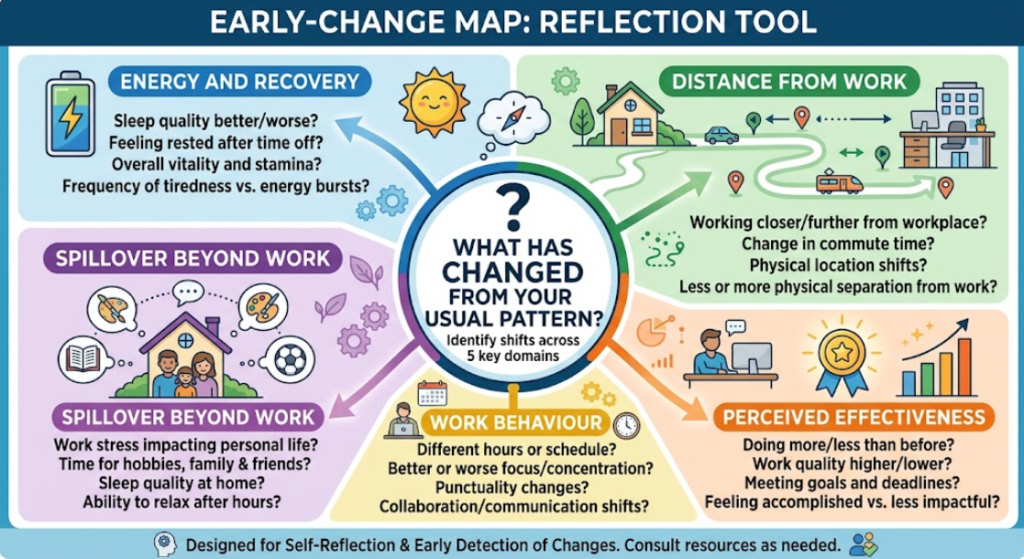
Quick decision: Look for a sustained change from your own usual functioning across several areas—energy and recovery, distance from work, perceived effectiveness, work behaviour, and spillover into life outside work. One difficult week or one symptom does not establish burnout. A clustered or worsening work-linked pattern deserves an early response; broader impairment, increasing substance use, or unsafe functioning deserves professional assessment without waiting for certainty.
Early Does Not Mean Trivial
The word early can suggest a mild condition that should be watched until it becomes serious. That is not the useful interpretation here. Early recognition means noticing a meaningful change before lost capacity, accumulated work, damaged relationships, or unsafe decisions make the situation harder to correct.
WHO defines burnout as an occupational phenomenon resulting from chronic workplace stress that has not been successfully managed. It is characterized by three dimensions: energy depletion or exhaustion, increased mental distance or cynicism toward the job, and reduced professional efficacy. WHO does not classify burnout itself as a medical condition, and the definition applies specifically to work.
Those dimensions provide an orientation, not a home diagnostic test. They also explain why tiredness alone is insufficient. Someone may be exhausted after an emergency deadline and recover when it ends. Another person may remain productive while becoming increasingly detached and paying for that output with sleep, relationships, or alcohol. Work-related changes carry more weight when they cluster, persist, and begin to affect function.
Start With Your Own Baseline
Comparing yourself with the busiest coworker or an idealized productive person can hide useful information. A more practical comparison is with your own ordinary pattern under reasonably similar conditions.
Consider what has changed in the last several weeks or months:
- Does energy recover after adequate sleep or genuine time away as it normally would?
- Has your emotional relationship to work shifted from interest or ordinary frustration toward numbness, cynicism, dread, or detachment?
- Do familiar tasks feel unusually difficult to start, organize, or complete?
- Are delays, errors, unfinished work, or avoidance increasing?
- Are patience, sleep, self-care, relationships, or substance use changing alongside work?
No single answer proves burnout. A change may reflect a temporary surge, sleep loss, illness, medication effects, grief, depression, anxiety, caregiving demands, conflict, or several causes together. Baseline comparison simply helps identify that something worth examining is happening.
Five Areas Where Change May Appear
1. Energy and recovery
Ordinary fatigue usually carries information about recent effort and often improves with sufficient rest. A developing burnout pattern is more concerning when depletion recurs or remains present and is closely tied to work, especially when normal recovery opportunities stop restoring usable energy.
Possible changes include beginning the workday already depleted, needing progressively more effort for routine duties, losing the ability to settle after work, or spending time off anticipating the return. Sleep can be disrupted, but sleep difficulty is not specific to burnout and deserves broader attention when it persists.
Track the direction of change: “My energy and recovery have shifted, the change is continuing, and work appears to be part of the pattern.” That observation contains more usable information than tiredness alone.
2. Distance, cynicism, or loss of connection
People do not need to enjoy every task. Boredom with repetitive work, frustration with a poor process, or disagreement with a decision can be proportionate responses. Concern grows when distance becomes more general and persistent: caring less about work that previously mattered, treating people as interruptions, moving through duties mechanically, or relying on cynicism to get through the day.
NIOSH notes that burnout is distinct from boredom, which is linked to understimulation, although the experiences can look similar. It also notes that highly engaged workers are not protected from burnout; commitment can coexist with serious risk when demands repeatedly exceed resources.
Boredom becomes more informative when placed beside the rest of the person’s experience. Repetition plus adequate capacity may call for variety or development. Repetition alongside exhaustion, detachment, reduced effectiveness, and chronic overload points to a broader work-health problem.
3. Reduced sense of effectiveness
Reduced professional efficacy is not the same as objectively poor performance. A person may still meet deadlines or protect others from errors while feeling increasingly unable to do the job well. That output may require longer hours, repeated checking, skipped breaks, or recovery borrowed from home life.
Changes can also become visible: more errors, slower decisions, difficulty concentrating, unfinished administrative work, or a growing belief that effort no longer produces meaningful progress. These signs require context. A new system, inadequate staffing, unclear priorities, insufficient training, or impossible workload can make capable people less effective.
Avoid turning a structural problem into a character judgment. Record what the work requires, what resources are available, and what has changed in performance or perceived capacity.
4. Avoidance and accumulating work
Procrastination is not a burnout diagnosis. People delay tasks for many reasons, including uncertainty, low priority, distraction, perfectionism, conflict, unclear authority, and simple dislike.
It becomes more relevant when it is a change from usual functioning and forms a reinforcing cycle. A familiar task is delayed. The unfinished task adds pressure. Starting now would require confronting both the original work and the backlog, so resistance increases. The person remains mentally occupied by the work without completing it or resting from it.
Jerome recognized this cycle. He knew the work had to be done and became angry with himself for not doing it, yet watching it accumulate did not create momentum. It created more resistance. In that context, procrastination mattered because it had become part of a wider pattern of avoidance, backlog, self-criticism, and lost recovery. That pattern deserved attention before the cycle expanded.
5. Spillover into behaviour and life outside work
Work strain may first become visible somewhere else. Patience shortens with coworkers or family. Meals, movement, hygiene, social contact, or activities that normally restore a person begin to disappear. Alcohol or another substance shifts from occasional use toward a regular way to come down, sleep, numb work thoughts, or tolerate the next day.
WHO’s general stress guidance includes irritability, difficulty concentrating or relaxing, sleep and appetite changes, physical symptoms, and increased use of alcohol, tobacco, or other substances among possible effects of stress. These experiences are not unique to burnout. Their value is as evidence that the effect is widening and may need a broader health response.
Strain can help explain changed behaviour, but it does not excuse mistreatment. If irritation is reaching other people, reduce immediate opportunities for harm, acknowledge what happened, and seek support for both the workload and the behaviour.
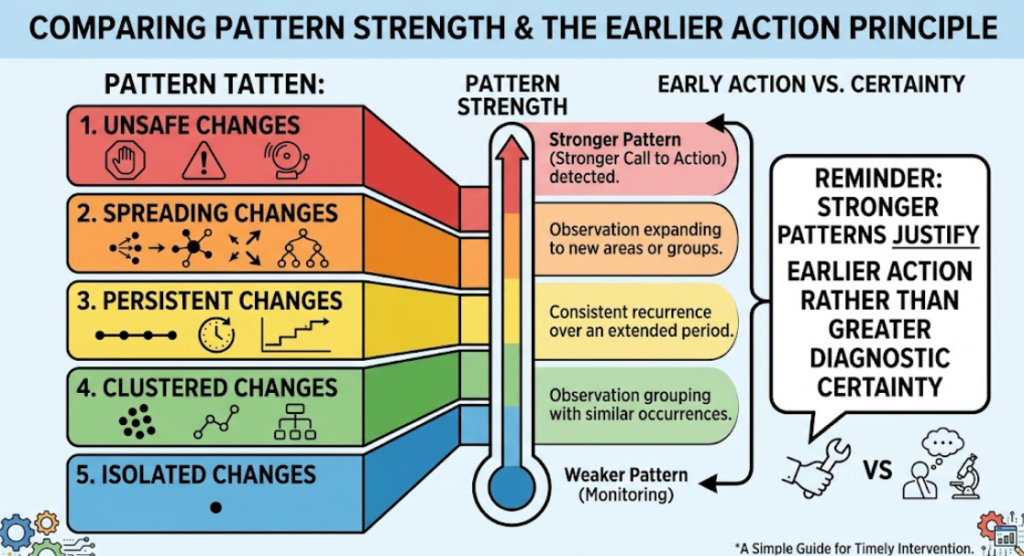
A Pattern Is Stronger When It Clusters and Persists
Five questions make observations more useful than a symptom count.
Is it a change?
A trait or long-standing preference may matter, but a noticeable departure from ordinary functioning often provides clearer information. Note when the change began and what changed around the same time.
Is it clustered?
Exhaustion together with work distance and reduced effectiveness is more consistent with WHO’s burnout concept than any one feature alone. Behavioural and life spillover may show that the cost is increasing.
Is it persistent or recurring?
One severe week can deserve action without proving burnout. Persistence means the pattern does not reliably resolve as the immediate demand changes, or it returns because the same chronic conditions remain.
Is it work-linked or broad?
A pattern concentrated around employment supports examining work demands and resources. Symptoms present across nearly every area of life may indicate burnout plus another concern—or a different health concern that should not be dismissed as “just work.” NIOSH cautions that burnout can overlap with depression and anxiety and that serious symptoms should not be minimized by assuming burnout.
Is function or safety changing?
Missed duties, impaired concentration, unsafe driving, errors in safety-critical work, escalating conflict, inability to care for basic needs, or loss of control over substance use should accelerate the response. Action does not require a completed label.
Do Not Wait for a Perfect Burnout Test
Questionnaires can organize observations, but an online score cannot establish what is causing fatigue, detachment, concentration difficulty, or reduced functioning. NIOSH describes multiple burnout models and emphasizes that burnout must be distinguished from fatigue, boredom, loneliness, depression, anxiety, moral distress, and other concerns.
A clinician may need to consider sleep disorders, anemia, thyroid problems, infection, pain, medication effects, depression, anxiety, trauma-related conditions, alcohol or other substance use, and other possibilities according to the person’s symptoms and history. Workplace review may need to consider excessive workload or pace, long or inflexible hours, understaffing, low control, poor support, unclear roles, harassment, insecurity, and conflict between work and home demands.
These are not competing explanations that must be settled before anything changes. Health assessment and workplace action can proceed together.
Make a Short Observation Record
A short record can turn a vague sense that “something is wrong” into usable information. Seven to fourteen days is a practical observation window, not a diagnostic threshold. If the situation is already severe or unsafe, skip the observation period and seek help.
Once a day, write a few factual notes:
- hours worked and the main demands;
- sleep opportunity and whether rest restored energy;
- energy before, during, and after work;
- connection, distance, or cynicism specifically toward the job;
- one task that was easier or harder than usual to start or finish;
- errors, delays, or decisions that felt less safe;
- effects on coworkers, family, self-care, or ordinary activities;
- alcohol or other substance use that increased or felt harder to control; and
- what improved during genuine time away.
Do not score every feeling or make the record another daily test to pass. Its purpose is to reveal direction: stable or worsening, isolated or clustered, work-specific or broad, recovering or not recovering.
Respond Before the Label Is Certain
An early response should address both demands and resources. NIOSH emphasizes that burnout risk is influenced at the individual, group, leadership, organizational, and wider-context levels; it is not only an individual problem to fix.
Choose one immediate demand to make visible. That might be conflicting priorities, recurring after-hours work, a high-consequence decision with inadequate information, an uncovered responsibility, or a backlog that cannot fit within available time. Pair it with one resource request: priority clarification, coverage, a deadline trade-off, decision support, protected recovery time, or occupational-health input.
At the same time, protect basic capacity where possible. Avoid safety-critical work or driving when fatigue, distress, or substance use makes it unsafe. Create a defined stopping point instead of remaining mentally on duty without productive work. Tell one appropriate person what has changed rather than waiting until performance fails.
Small actions do not compensate for chronically excessive or unsafe conditions. They create information, reduce immediate risk, and open a route toward a larger change. Later articles in this cluster address decision fatigue, recovery time, and workload boundaries in detail.

Know When Observation Is No Longer Enough
Arrange professional support when distress or impairment persists, spreads through life outside work, or becomes difficult to manage. A primary-care clinician, qualified mental-health professional, occupational-health service, or substance-use service may provide an appropriate entry point, depending on the need and local system.
Do not wait for a burnout determination when alcohol or other substance use is increasing, sleep or mood is seriously disrupted, ordinary responsibilities are becoming unmanageable, or concentration and fatigue are making work or driving unsafe.
Use urgent local emergency or crisis help for thoughts of self-harm or suicide, inability to stay safe, severe intoxication or withdrawal concerns, a medical emergency, violence, or another immediate danger. Stop safety-critical activity when you cannot perform it safely.
Decision Summary
Early recognition begins when a meaningful pattern is noticed soon enough to support a response; diagnosing burnout from one symptom is neither necessary nor reliable.
- Compare current functioning with your own usual pattern.
- Look across energy, work distance, perceived effectiveness, work behaviour, and spillover beyond work.
- Give more weight to changes that cluster, persist, spread, impair function, or affect safety.
- Treat new procrastination and backlog as information to examine, not proof of laziness or burnout.
- Do not assume that engagement, competence, or continued output rules burnout out.
- Consider physical and mental-health explanations as well as workplace conditions.
- Address at least one demand and one missing resource before waiting for perfect certainty.
- Move promptly to professional or urgent support when impairment, substance use, or safety concerns escalate.
Begin with three questions: What has changed? What is sustaining the change? What response is justified now? They remain useful even when the label is uncertain.
This article provides general health information and does not diagnose burnout or any medical, mental-health, sleep, or substance-use condition. Seek qualified professional assessment for persistent, worsening, broad, or functionally impairing symptoms. Use local emergency or crisis services for immediate danger or inability to stay safe.
FAQ
What is usually the first sign of burnout?
There is no universal first sign. For one person, the earliest noticeable change may be recovery that no longer works; for another, it may be growing distance from work, reduced effectiveness, avoidance, or irritability. Look for change from baseline across several areas rather than one required sequence.
Is procrastination an early sign of burnout?
It can be part of a developing pattern, but it is not specific to burnout. It becomes more informative when it is new, work-linked, persistent, and accompanied by exhaustion, detachment, reduced effectiveness, accumulating work, or spillover beyond work.
Can I be burned out if I still care about my job?
Yes. NIOSH notes that strong engagement does not make a worker immune to burnout. A person can remain committed while chronic demands deplete energy and reduce sustainable capacity.
How long should early signs last before I act?
You do not need to wait for a fixed duration. Respond to a meaningful change as soon as it affects recovery, work, relationships, substance use, or safety. A 7- to 14-day record may clarify a mild uncertain pattern, but it is not a required waiting period.
Can burnout cause irritability at home?
Work strain can spill into relationships, but irritability is not unique to burnout. Treat the spillover as a reason to examine the broader pattern and to prevent harm; it does not excuse mistreatment.
Should I talk to my manager or a healthcare professional first?
The routes can occur together. A workplace conversation may address demands, priorities, staffing, control, or recovery, while a healthcare professional can assess persistent symptoms and overlapping conditions. Choose the safest available entry point; use urgent help for immediate danger.
When is increased drinking more than an early warning sign?
Seek professional support when alcohol is increasingly used to sleep, numb work thoughts, manage distress, or get through the next day; when use is hard to control; or when it affects safety, work, health, or relationships. Severe intoxication, withdrawal concerns, or immediate danger require urgent local help.
Sources
- World Health Organization — Burn-out an occupational phenomenon
- NIOSH — What burnout is and is not
- World Health Organization — Stress
- World Health Organization — Mental health at work
- NIOSH — Series Overview: Burnout and Public Health Workers