An unfinished task can occupy the same hours that were supposed to provide rest. The person does not complete the work, yet cannot disengage from it. The backlog remains visible, anger turns inward, and the next attempt begins with less capacity than the last.
Jerome reached a period like this while working for a construction company in Korea. Work accumulated as his resistance to it grew. He became angry at himself for knowing what had to be done and still not doing it. Irritation affected employees and family, and he drank more while continuing to push himself. This account does not establish burnout, depression, an alcohol use disorder, or another diagnosis. It shows a point at which productivity advice alone would have been too narrow.
Quick decision: Move beyond self-help when distress or changed behaviour persists, worsens, spreads beyond work, interferes with ordinary functioning, increases reliance on alcohol or other substances, or creates safety concerns. Use immediate local emergency or crisis help for danger, thoughts of suicide or self-harm, inability to stay safe, severe intoxication or possible withdrawal, violence, or a medical emergency. Workplace changes and health assessment can proceed at the same time.
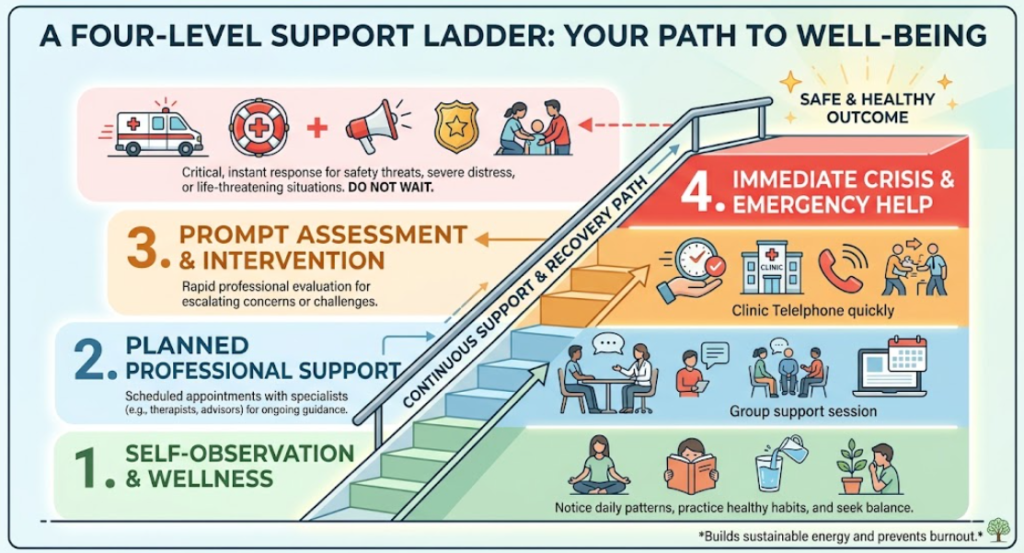
Self-Help Has a Proper Role—and a Limit
Sleep protection, brief recovery periods, reduced decision load, workload documentation, and support from trusted people may reduce strain. They can also reveal the shape of the problem. If a person improves when demands change and recovery becomes possible, that information is useful.
Self-help becomes insufficient when the person must keep adding techniques merely to remain inside unchanged harmful conditions. A breathing exercise cannot supply missing staff. A planner cannot create hours that do not exist. A weekend routine cannot assess persistent low mood, panic, a sleep disorder, medication effects, or increasing alcohol use.
Professional support does not have to wait until a crisis or a confirmed diagnosis. SAMHSA advises considering help when changes in thoughts, mood, body, or behaviour make work, home, school, or relationships difficult; examples include concentration problems, sleep or eating changes, withdrawal from others, reduced self-care, irritability, and alcohol or drug-related consequences. The exact timing and appropriate service depend on the person and local system.
Earlier contact may also make it easier to compare options, arrange appointments, and involve trusted support before immediate risk narrows the available choices.
Use Function and Direction to Decide
A symptom count can miss the most important change. Review four dimensions.
Persistence
Has the problem continued despite a realistic chance to recover or adjust the demand? One hard week may still deserve support, while a longer pattern strengthens the case for assessment.
Direction
Is the situation stable, improving, or worsening? More avoidance, less sleep, stronger dread, growing conflict, and increasing substance use show a direction that calls for earlier action.
Spread
Does the problem remain tied to one task or workplace, or has it reached relationships, self-care, finances, driving, parenting, caregiving, and activities that previously mattered? Broader effects deserve broader assessment.
Function and safety
Can the person carry out ordinary responsibilities, make consequential decisions, drive, operate equipment, and care for themselves safely? Function may decline before the person can name a condition.
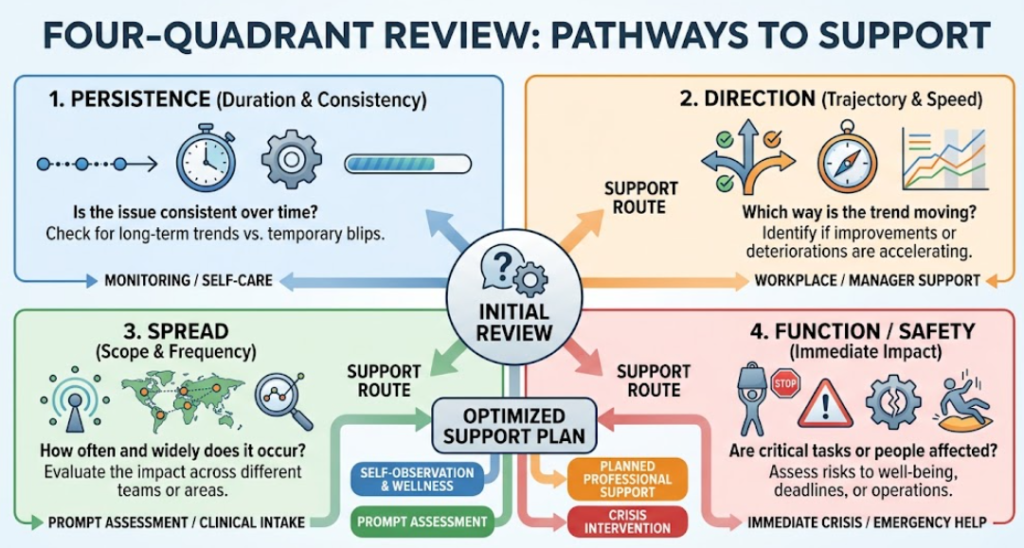
Choose a Support Route by the Problem
There is no single global front door. Several routes may be used together.
Primary care or general healthcare
A primary-care clinician can assess fatigue, concentration difficulty, sleep disruption, mood or anxiety symptoms, pain, medication effects, and possible physical causes. Bring a concise timeline rather than trying to select the diagnosis yourself.
Mental-health care
A qualified mental-health professional may help assess depression, anxiety, trauma-related symptoms, work-related distress, relationship effects, and coping patterns. Care may include psychotherapy, medication assessment through an authorized prescriber, or another locally appropriate approach.
Occupational health or workplace support
Occupational-health services, an employee assistance program, a union or worker representative, a health and safety office, or a manager may help address workload, schedule, leave, accommodation, coverage, or return-to-work questions. Access and confidentiality rules vary; ask what information will be shared before disclosing details.
Alcohol or other substance-use support
Increasing use deserves direct attention when alcohol or another substance is used to sleep, numb work thoughts, manage distress, or get through the next day. SAMHSA identifies drinking more or longer than intended, unsuccessful efforts to cut down, continued use despite harm, preoccupation, interference with work or relationships, and withdrawal symptoms as reasons for concern.
Do not abruptly stop heavy or dependent alcohol use without medical guidance; withdrawal can be dangerous. Seek urgent medical advice for possible withdrawal, severe intoxication, confusion, seizure, breathing difficulty, or another acute concern.
Crisis or emergency services
Use local crisis, emergency, or emergency-medical services when help cannot safely wait. Crisis systems differ by country. If possible, identify the local number and nearest emergency setting before a worsening situation becomes urgent.
Workplace Action and Healthcare Are Not Alternatives
People sometimes receive two incomplete messages: fix the job, or fix yourself. Both the conditions and their health effects may need attention.
WHO identifies excessive workload, understaffing, long or inflexible hours, low control, limited support, harassment, unclear roles, and home-work conflict as psychosocial risks. It recommends organizational interventions that assess and modify workplace conditions.
A clinician cannot assign more staff or change an unsafe schedule. A manager cannot rule out anemia, a sleep disorder, depression, anxiety, or substance-related risk. Parallel action may include:
- a health appointment for persistent symptoms;
- immediate removal from unsafe duties;
- a workload and schedule review;
- documented priority trade-offs;
- temporary or longer-term accommodation where available;
- leave or reduced duties under applicable policy; and
- support for alcohol or other substance use.
Local employment law and benefits determine what can be requested or protected. Obtain jurisdiction-specific advice when rights, deadlines, confidentiality, or retaliation are concerns.

Prepare for the First Conversation
Needing help does not automatically make it easy to explain what is happening. A one-page note can reduce the burden.
Include:
- when the changes began;
- the main work and nonwork demands;
- sleep opportunity and sleep quality;
- changes in energy, concentration, mood, anxiety, motivation, appetite, or physical symptoms;
- effects on work, relationships, self-care, and safety;
- alcohol, medication, or other substance use, including recent change;
- actions already tried and what happened;
- current medications and relevant health history; and
- the help needed today.
The final item might be “assess why I cannot recover,” “help me address drinking,” “document work restrictions,” or “help me stay safe tonight.” A concrete request gives the conversation a starting point without requiring the person to know the solution.
Reduce Barriers One at a Time
Cost, availability, language, culture, stigma, transportation, childcare, privacy, and fear of workplace consequences can all obstruct care. SAMHSA suggests checking whether a service accepts the person’s coverage, offers low-cost care, has available appointments, and fits important preferences. Equivalent resources vary globally.
Choose the next workable step:
- ask a trusted clinician or person for one referral;
- contact an insurer, public health service, community clinic, or employee program;
- request interpretation or culturally relevant care;
- ask a trusted person to sit with you while you call;
- prepare two providers rather than searching indefinitely for the perfect one; or
- use a crisis or urgent service when routine access is too slow for the risk.
An unsuccessful first contact does not settle whether help is warranted. Try another route if the service is unavailable, inappropriate, or dismissive.
Make an Immediate Safety Plan When Risk Is Rising
Do not leave a person alone when there is immediate danger and it is safe for you to remain. Contact local emergency or crisis support, reduce access to lethal means when this can be done safely and lawfully, and involve a trusted person. Follow the instructions of qualified responders.
Stop driving, operating equipment, supervising safety-critical work, or making high-consequence decisions when fatigue, intoxication, withdrawal, confusion, or severe distress makes performance unsafe.
If violence or coercion is present, prioritize the safety of the person at risk. Strain or burnout language does not excuse threats or harm. Emergency, domestic-violence, workplace-safety, or legal routes may be appropriate according to the situation.
Decision Summary
- Use persistence, direction, spread, function, and safety to judge when self-help is insufficient.
- Seek assessment before a crisis when ordinary responsibilities or relationships are being affected.
- Match the route to the problem: healthcare, mental health, occupational health, substance-use support, or crisis care.
- Address workplace conditions and health effects in parallel.
- Bring a short timeline, functional effects, substance changes, and the help needed today.
- Do not abruptly stop potentially dependent alcohol use without medical guidance.
- Escalate immediately for suicide or self-harm risk, inability to stay safe, severe intoxication or withdrawal, violence, or a medical emergency.
The threshold for asking for help is not proof that a person has failed. It is enough that the current response no longer matches the level of risk or impairment.
This article provides general health information and cannot diagnose or select treatment. Local healthcare, crisis, emergency, substance-use, occupational-health, and employment systems vary.
FAQ
Do I need a burnout diagnosis before seeking help?
No. WHO does not classify burnout as a medical condition, and overlapping symptoms may need broader assessment. Persistent distress, impaired function, substance changes, or safety concerns are sufficient reasons to ask for help.
Should I see a doctor or a therapist first?
Either may be a useful entry point. Primary care can assess physical and mental-health contributors; a qualified mental-health professional can assess emotional, behavioural, and functional patterns. Urgency and local access should guide the choice.
Is an employee assistance program confidential?
Rules vary. Ask what is confidential, what may be reported to the employer, who provides the service, and how records are handled before disclosing sensitive information.
When does increased drinking require help?
Seek help when use is increasing, difficult to control, used to sleep or cope, or causing health, work, safety, or relationship effects. Possible dependence or withdrawal requires medical guidance.
Can I ask for workplace changes without a diagnosis?
Often you can raise workload, safety, schedule, staffing, or priority concerns without sharing a diagnosis. Formal accommodations or leave may require documentation under local rules.
What if the first provider does not help?
Clarify what you need, request another referral or opinion, and try another route. Use urgent services if risk increases while routine care is unavailable.
What requires immediate help?
Thoughts of suicide or self-harm, inability to stay safe, severe intoxication or possible withdrawal, violence, confusion, a medical emergency, or unsafe functioning requires immediate local crisis or emergency support.
Sources
- SAMHSA — Signs You Need to Seek Help
- SAMHSA — Alcohol
- WHO — Mental health at work
- SAMHSA — Health Care and Support