When I chose civil engineering after university, I did not spend much time asking people what the field was actually like. The salary after graduation looked attractive, and television dramas gave construction-company employees a certain image. By the time I started working, the choice no longer felt like selecting a job. It felt like entering a field—one with construction sites, dust, and a working environment I would have to adapt to. Looking back, I may have started sensing the mismatch while preparing for interviews, when company videos and other materials showed more of the reality. But I was preparing to be hired, not yet evaluating whether I wanted the life around the work.
That distinction matters. A job title is a label. A role is a repeated pattern of tasks, surroundings, relationships, rewards, pressures, and future options. If you choose mainly from salary, status, a course title, or a polished employer image, you may be deciding with only the most visible part of the role.
Quick answer: To identify what you want from your next role, describe the work experience before naming the occupation. Define what you must have, prefer, can tolerate, will not accept, and still need to verify across five areas: the work itself, the setting, the people and operating style, the rewards, and the direction the role creates. Then compare opportunities against those priorities. The goal is not to predict a perfect career. It is to make the next decision with fewer hidden assumptions.

Start With the Role, Not the Dream Job
“What do I want to be?” sounds like a career question, but it often asks too much. It implies that one occupation should express your identity, use your abilities, provide meaning, pay enough, fit your life, and remain satisfying for years.
A more useful question is narrower:
What do I need my next career role to be like?
“Next” keeps the decision realistic. You are not signing a lifetime contract. You are choosing a role that should fit the person, responsibilities, and options you have now while keeping an eye on what it may make easier—or harder—later.
This also separates three things that job seekers commonly blend together:
- Occupation: the broad kind of work, such as civil engineer, nurse, editor, or sales manager.
- Field or industry: the system around the work, such as construction, health care, publishing, or technology.
- Role: the actual combination of duties, employer, team, authority, schedule, location, conditions, and expectations.
Two people with the same occupation can have very different working lives. One civil engineer may spend substantial time in an office; another may regularly move between an office and construction sites. The U.S. Bureau of Labor Statistics describes that office-and-site split as common in civil engineering, but a broad occupational profile still cannot tell you how a particular employer organizes a particular job.
That is why identifying what you want must happen before evaluating titles. Otherwise, the title quietly becomes a substitute for the missing details.
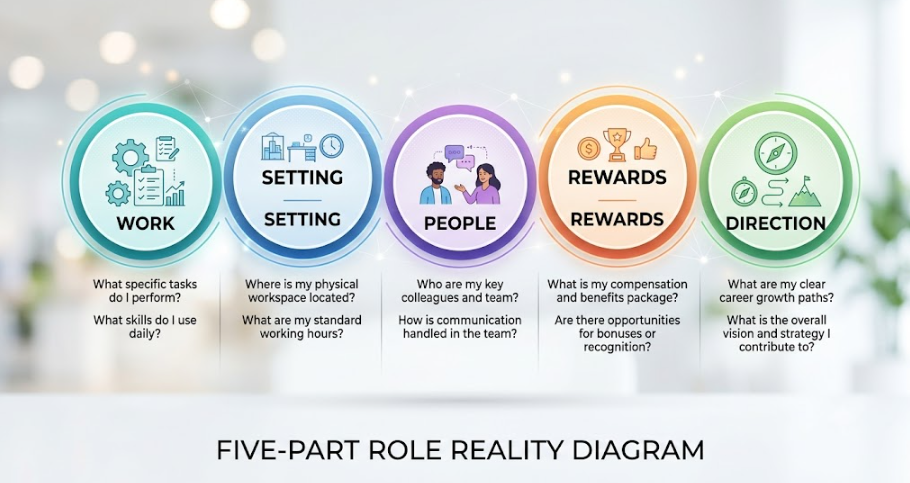
Use Five Dimensions of Role Reality
Official career resources do not describe occupations by title alone. O*NET includes tasks, work activities, work context, interests, values, skills, and worker requirements. The Bureau of Labor Statistics’ Occupational Outlook Handbook separates what workers do, work environment, education, pay, and outlook. NIOSH’s worker well-being framework also looks beyond the task itself to workplace culture, physical environment, health, and life outside work.
For a personal decision, these ideas can be translated into five practical dimensions.
1. Work: What will you repeatedly do?
Do not ask only whether the subject interests you. Ask what fills an ordinary week.
- Will you analyze, build, write, sell, teach, coordinate, repair, negotiate, or care for others?
- How much time is spent in deep work, meetings, documentation, travel, customer contact, or urgent response?
- Are the outputs concrete and visible, or long-term and ambiguous?
- Do you want to make decisions, advise someone else, execute a plan, or supervise delivery?
People often like the purpose of a field but dislike its recurring tasks. Someone may care deeply about health without wanting clinical work, or enjoy buildings without wanting construction-site operations. The mission and the daily activity are related, but they are not the same choice.
2. Setting: Where and under what conditions will you work?
The setting is not background scenery. It is part of the role.
Consider:
- office, home, field, shop floor, classroom, vehicle, laboratory, or mixed locations;
- fixed location versus frequent travel;
- predictable hours versus shifts, overtime, seasonal peaks, or on-call responsibility;
- noise, weather, protective equipment, crowds, isolation, or physical demands;
- commute and relocation requirements; and
- how much control you have over pace and schedule.
Salary and prestige can be easy to compare because they are visible. Repeated exposure to a setting is harder to imagine before you have lived it. Yet a tolerable task in the wrong environment can become an unsustainable role.
3. People: How will the work be organized around you?
“Good culture” is too vague to guide a decision. Translate it into observable conditions.
- Do you want close supervision or wide autonomy?
- Do you prefer stable teams or changing clients and project partners?
- How much conflict, persuasion, emotional labor, or public accountability can you accept?
- Do you need regular feedback, mentoring, clear procedures, or room to improvise?
- Is success mostly individual, collaborative, competitive, or dependent on other teams?
CareerOneStop’s Work Values Matcher groups common work values into achievement, independence, recognition, relationships, support, and working conditions. That is a useful reminder that people do not all want the same form of a “good job.” One person may value autonomy more than recognition; another may accept less autonomy in exchange for dependable support.
4. Rewards: What must the role give back?
Compensation matters. Treating it as superficial does not help someone who has rent, debt, dependents, or retirement goals. But compensation is one reward among several.
Your list may include:
- minimum acceptable pay and benefits;
- income stability or upside;
- schedule control and paid time away;
- learning, mastery, or professional credibility;
- recognition, status, or decision authority;
- connection to people or a useful outcome; and
- enough energy left for family, health, community, or another important pursuit.
Be specific about the trade-off. “I want flexibility” is not yet a criterion. “I need to be able to leave by 5:30 p.m. three days a week” is. “I want good pay” is not yet a threshold. A minimum total compensation range, adjusted for hours, commute, benefits, and risk, can be compared.
5. Direction: What will this role make more likely next?
Every role creates options and constraints. It builds some experience, relationships, and credibility while leaving other capabilities unused.
Ask:
- What will I know how to do after two years?
- Which future roles will this experience qualify me for?
- Will I become more dependent on one employer, credential, location, or industry?
- If I dislike the role, which parts of the experience can travel elsewhere?
- Does advancement move toward work I actually want, or simply more responsibility for work I already dislike?
This does not mean predicting an entire career path. It means noticing that choosing a role also chooses a direction of travel.
Build a Role Reality Brief
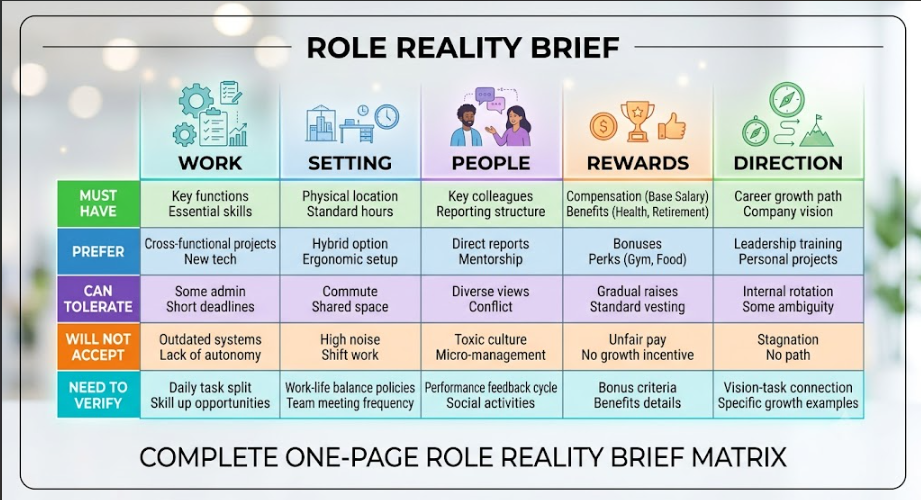
Now turn reflection into a one-page decision tool. Create five columns or sections—Work, Setting, People, Rewards, and Direction—and sort your criteria into these five levels:
| Priority | Meaning | Example |
|---|---|---|
| Must Have | The role is not workable without it | Predictable weekday schedule because of caregiving |
| Prefer | Meaningful advantage, but negotiable | Mostly independent work with a weekly team meeting |
| Can Tolerate | A cost you will accept for a clear benefit | Occasional travel during major projects |
| Will Not Accept | A condition that makes the role unsuitable | Routine overnight shifts or required relocation |
| Need to Verify | Important, but currently based on an assumption | How often “hybrid” employees are expected onsite |
Limit the first draft. Choose no more than three Must Haves and three Will Not Accepts. If everything is essential, the brief cannot help you make trade-offs.
Then write one sentence explaining each priority. For example:
- Must Have — Work: I need at least half my week to involve analysis or problem-solving, because constant coordination drains me.
- Prefer — People: I prefer a manager who reviews priorities weekly but does not monitor every task.
- Can Tolerate — Setting: I can accept up to two overnight trips per month for stronger learning and pay.
- Will Not Accept — Rewards: I will not take a role whose base pay cannot cover my essential monthly obligations.
- Need to Verify — Direction: I need evidence that this role leads to technical specialist positions, not only people management.
The explanation exposes whether the criterion comes from evidence, fear, habit, or someone else’s definition of success.
Look Back for Evidence, Not Just Feelings
Your current and past experiences already contain clues. Review two or three periods when work, school, volunteering, caregiving, or a major project felt unusually energizing or draining.
For each period, ask:
- What was I actually doing?
- What was the physical and social setting?
- How much control, clarity, and support did I have?
- What reward or cost mattered most?
- Was the problem the work itself, the organization, the manager, the schedule, or my life circumstances at the time?
Avoid conclusions that are too broad. “I hate engineering” may really mean “I do not want frequent site work.” “I am bad with people” may mean “I dislike high-conflict customer interactions.” “I need a new career” may mean “I need a different team, schedule, or level of authority.”
The opposite mistake is also possible: blaming one employer for a feature that is common across the field. Keep uncertain conclusions in Need to Verify until you can test them.
Separate Attraction From Evidence
When a role attracts you, write down why before researching it. The answer often reveals the assumption doing the most work.
| Attractive signal | What it may hide | Better question |
| High salary | Long hours, location costs, volatility, difficult entry, or a wide pay range | What do typical workers earn here, and under what conditions? |
| Impressive title | Limited authority or work you do not enjoy | What decisions would I actually own? |
| Meaningful mission | Repetitive tasks, emotional demands, or weak support | What does an ordinary week require? |
| Remote label | Travel, time-zone coverage, or informal office pressure | Where did the team actually work last month? |
| Fast advancement | Turnover, narrow training, or management as the only path | What happened to the last three people in this role? |
| Familiar field | Staying because of sunk time rather than current fit | Which parts still serve me, and which no longer do? |
This is not cynicism. Attractive signals can be real benefits. The point is to stop one visible advantage from answering questions it cannot answer.
Do Not Turn the Brief Into a Personality Verdict
A career assessment can provide language and ideas. CareerOneStop offers a Work Values Matcher, and My Next Move offers the O*NET Interest Profiler. These tools may help you notice patterns, but they should not decide that you “are” one career type.
Preferences also change with life stage and exposure. A new graduate, a parent with limited schedule flexibility, and a mid-career worker recovering from burnout may rank the same role differently. A constraint is not a character defect, and a preference is not proof of ability.
This first brief is therefore a working hypothesis. The next articles in this cluster will examine skills, interests, and constraints; distinguish a job change from a career change; and show how to research, test, and discuss a direction before committing. For now, the task is simply to make your criteria visible.
Make the Next Decision, Not the Final Decision
Use the brief when reading job descriptions, talking with people, or comparing opportunities. Scorekeeping can help, but do not let a total erase a non-negotiable. A role with many appealing features still fails if it violates a genuine Must Have or includes a Will Not Accept condition.
Before moving forward, ask:
- Can I describe the ordinary week, not just the title?
- Have I considered the setting and operating model as seriously as pay and mission?
- Which trade-offs am I knowingly accepting?
- Which important claims are still assumptions?
- What evidence would change my mind?
You do not need perfect self-knowledge before taking a career step. You need a clearer specification for the next role and enough humility to revise it when reality teaches you something new.
A strong career direction is not a dramatic declaration of who you will be forever. It is a better-informed choice about what kind of work, environment, relationships, rewards, and future options you are willing to build around next.
FAQ
What if I do not know what kind of work I enjoy?
Start with evidence from tasks you have already done, including school, unpaid responsibilities, projects, and temporary work. Identify which activities held your attention, which conditions helped, and which costs were hard to sustain. Put uncertain preferences in “Need to Verify” rather than forcing an answer.
Should salary be a Must Have?
It can be. Define the minimum from real obligations and goals, then compare total compensation, hours, commute, stability, and benefits—not salary alone. A threshold is more useful than “as much as possible.”
How many non-negotiables should I have?
Keep the list short enough to guide a real search. Three Must Haves and three Will Not Accepts are a practical starting limit. If the list is longer, separate genuine requirements from strong preferences.
What if my ideal criteria do not fit the available jobs?
The brief should expose trade-offs, not deny them. Decide which criteria protect health, obligations, or core goals and which can be relaxed temporarily for income, access, or experience. Record the compromise and when you will review it.
Can one bad job tell me that the whole career is wrong?
Usually not by itself. Separate occupation, industry, employer, manager, team, schedule, and life circumstances. A later article in this cluster addresses how to decide whether the needed change is a job change or a broader career change.
Are career assessments reliable enough to choose a role?
Treat them as prompts, not verdicts. They can help name interests or values and generate options, but a decision still requires evidence about actual tasks, conditions, entry requirements, and trade-offs.
Should I apply before I have verified every unknown?
Often, yes. Applying can preserve an option while you investigate. Keep important uncertainties visible and resolve them before accepting a commitment, especially when they concern safety, schedule, location, compensation, or family obligations.
Sources
- CareerOneStop – Work Values Matcher
- O*NET OnLine
- Occupational Outlook Handbook
- BLS – Civil Engineers
- NIOSH Worker Well-Being Questionnaire
- My Next Move – O*NET Interest Profiler
More in This Cluster: Career Direction
- How to Identify What You Want from Your Next Role (you are here)
- Skills, Interests, and Constraints
- Career Change vs Job Change
- How to Research a Career Before Committing
- Testing a Career Direction with Small Experiments
- How to Use Informational Interviews
- Creating a 12-Month Career Plan