Leaving your employer and leaving your career can begin with the same sentence: “I cannot keep doing this.” But they are not the same decision.
One person may still value the occupation but need a different manager, schedule, or workplace. Another may like the employer yet no longer want the occupation’s core work. A third may be comfortable with the work itself but unable to accept the conditions common across the wider field. Treating all three situations as a full career crisis can create unnecessary cost. Treating a deeper mismatch as a bad-job problem can reproduce the same dissatisfaction somewhere else.
The useful question is not simply, “Should I quit?” It is: What level of the current situation needs to change?
Quick answer: Separate dissatisfaction into four levels: your current role, your employer, your occupation, and your broader field. Look for repeated evidence, compare good and bad periods, and identify which conditions would remain after a move. Then choose the smallest change that is likely to solve the actual problem. A role or employer change usually preserves more experience and carries fewer transition costs; an occupation or field change may be justified when the core work or structural conditions are the mismatch. Do not use this diagnostic to delay action when safety, health, harassment, discrimination, illegal conduct, or imminent job loss requires more immediate support.
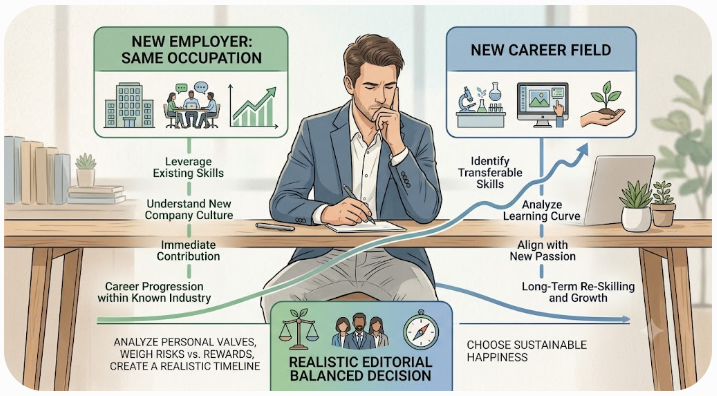
Why the Label Matters
“Job change” and “career change” are everyday phrases, not precise legal categories. For this decision, it helps to define four layers.
| Level | What changes | What may stay |
|---|---|---|
| Role | Assignment mix, seniority, team, schedule, location, or level of responsibility | Employer, occupation, and field |
| Employer | Organization, manager, culture, policies, resources, or compensation system | Much of the occupation and field knowledge |
| Occupation | The recurring work activities and occupational identity | Some transferable skills and possibly the same field |
| Field | The industry or professional ecosystem in which the work occurs | Occupation or transferable skills may continue elsewhere |
These layers can overlap. Moving from site engineer to estimating within the same construction company may alter the role and some occupational tasks. Moving from accounting at a hospital to accounting at a manufacturer changes the employer and field while preserving much of the occupation. Moving from nursing to health-care operations may change the occupation while retaining field knowledge.
The purpose of the labels is not to force a perfect classification. It is to reveal what you are preserving, what you are giving up, and what the proposed move can realistically fix.
Start With the Pattern, Not the Worst Day
A difficult week can contain real information without defining the whole career. Before choosing the size of the change, collect examples from a meaningful period: several weeks for a new problem, or several months when the dissatisfaction has been persistent.
For each example, record five things:
- Trigger: What happened?
- Level: Did it arise from the role, employer, occupation, or field?
- Frequency: Was it isolated, periodic, or routine?
- Control: Could it change through a conversation, reassignment, accommodation, or different employer?
- Persistence: Would the problem probably follow you into another role or organization?
Include positive evidence too. When did the work feel useful, absorbing, tolerable, or sustainable? What was different? If you dislike client escalation but enjoy analysis, the distinction matters. If you enjoy the occupation only when workload is unusually low, that also matters. Diagnosis improves when it explains both the better and worse periods.
Avoid using mood as the only evidence. Fatigue, grief, financial stress, caregiving pressure, illness, and burnout can change how every option appears. That does not make the dissatisfaction unreal. It means the decision should distinguish a work problem from a problem affecting your capacity across work and life. When symptoms are severe or persistent, appropriate medical or mental-health support may belong alongside—not after—the career decision.
Level 1: Is the Current Role the Problem?
A role-level problem is specific to how your current job has been designed or assigned. Common signs include:
- too much or too little responsibility;
- an assignment mix that underuses your strongest capabilities;
- a schedule, location, travel pattern, or workload that no longer fits;
- unclear authority or conflicting priorities;
- limited access to the work you want to develop; or
- a mismatch between your level and the work you are actually doing.
Test the role hypothesis by asking: Would I want to do this occupation here if the assignment, level, schedule, or team changed?
If the answer is plausibly yes, a transfer, redesigned workload, promotion, reduced responsibility, accommodation, or different team may be the smallest sufficient change. That does not mean the change will be available. It means you should not confuse lack of access to a better role with proof that the whole occupation is wrong.
Level 2: Is the Employer the Problem?
Employer-level problems arise from the organization rather than the occupation’s essential work. They may include:
- weak management or persistent conflict;
- culture that rewards behavior you do not want to adopt;
- compensation, benefits, staffing, or advancement practices;
- inadequate tools, training, or decision authority;
- instability, repeated restructuring, or an unsustainable business model; or
- policies on flexibility, travel, location, or performance that do not fit your needs.
Ask: Have I seen credible versions of this occupation performed under materially better conditions elsewhere?
Former colleagues, occupational sources, job postings, and people at other organizations can provide clues, although each has limits. A single attractive posting does not prove that the employer operates as advertised. A single bad workplace does not prove that all employers are alike.
If the occupation’s core activities still fit, changing employers may preserve your domain knowledge, professional network, credentials, and market identity. But do not assume a new logo will solve a field-wide condition. If staffing shortages, seasonal travel, commission dependence, physical exposure, or irregular hours are common across the occupation or industry, the issue may sit deeper.
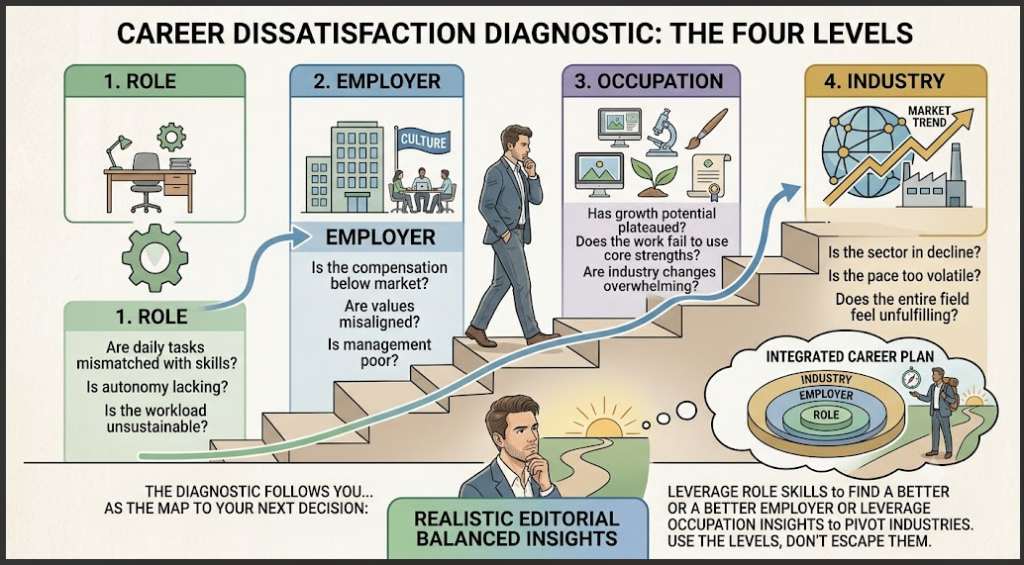
Level 3: Is the Occupation the Problem?
An occupation-level mismatch concerns the recurring work itself, not merely its current setting. O*NET distinguishes work activities from work context: what workers do is different from the physical and social conditions in which they do it. That distinction is useful here.
Possible signs of an occupation-level problem include:
- the central tasks are consistently draining or uninteresting;
- the outputs or responsibilities do not feel worth the trade-offs;
- the amount of public contact, detail, persuasion, supervision, analysis, or physical work inherent in the occupation does not fit;
- progression leads toward work you want even less; or
- acceptable versions of the occupation are too rare to form a realistic plan.
Ask: If I could perform this occupation for a well-run employer, with fair pay and reasonable colleagues, would I still want to leave the core work?
A persistent no is stronger evidence for occupational change. So is a pattern across more than one employer or role. Before concluding, separate disliked central activities from removable peripheral tasks. Almost every occupation contains administration, difficult conversations, deadlines, or repetition. The question is not whether every task is enjoyable; it is whether an acceptable version of the recurring work exists for you.
An occupational change need not discard everything. Transferable skills, field knowledge, relationships, and credentials may support an adjacent move. The Career Evidence Inventory from the previous article can show which capabilities travel and which gaps require verification.
Level 4: Is the Field the Problem?
A field-level mismatch concerns conditions shared across an industry or professional ecosystem. Examples may include:
- where the work is concentrated geographically;
- project cycles, seasonality, funding patterns, or economic sensitivity;
- common physical environments or travel demands;
- regulation, licensing, or liability structures;
- typical customer, stakeholder, or public pressures;
- industry norms around schedules, advancement, or mobility; and
- whether the field’s output conflicts with values you need your work to respect.
Ask: Would keeping my occupation but applying it in another field remove the main problem?
The answer can expose a field change that is smaller than a full occupational reinvention. A project manager, analyst, salesperson, writer, technician, or accountant may be able to carry the same occupation into a different industry. Conversely, someone may want to remain in a valued field but move into a different occupation within it.
Do not declare a condition “industry-wide” from one employer or from reputation alone. Occupational profiles can describe work environment, education, pay, and outlook; job postings can reveal current requirements; and conversations can reveal variation. That verification belongs to the next stages of the cluster. For now, label the assumption and identify what evidence would change your view.
Build a Change-Level Diagnosis
Create a one-page table using the strongest recurring problems—not every annoyance.
| Evidence | Likely level | Would it follow to another employer? | Could a smaller change solve it? | Confidence |
| Rotating schedule conflicts with caregiving | Role, employer, or occupation | Unknown | Possibly | Medium |
| Core work requires constant sales conversations I do not want | Occupation | Probably | Unlikely | Medium-high |
| Manager changes priorities without authority or resources | Employer or team | Not necessarily | Possibly | High |
| Field commonly requires long remote-site assignments | Field | Often | Only in some segments | Medium; verify |
Then complete four sentences:
- I would stay in this role if…
- I would stay in this occupation if…
- I would stay in this field if…
- I need to leave regardless if…
Compare the answers with your Role Reality Brief and Career Evidence Inventory. The first records what your next role needs to provide. The second records what you can bring, what interests you, what constraints apply, and which gaps are real or assumed. This article adds the missing question: how much of the current path must change to improve the fit?
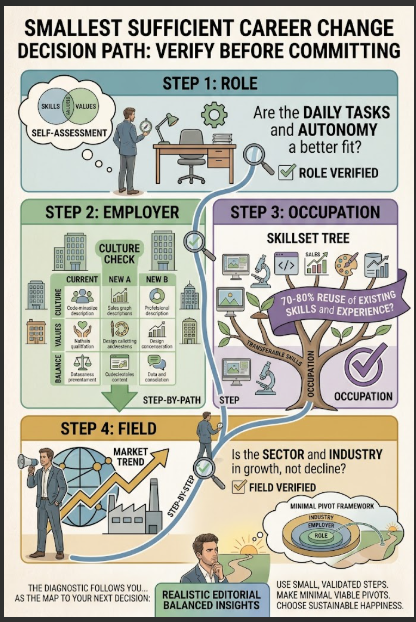
Choose the Smallest Sufficient Change
Use the diagnosis to select a provisional change level.
Adjust the role when:
- the occupation and field remain acceptable;
- the problem is tied to assignments, level, team, location, or schedule; and
- a realistic internal change could address the main mismatch.
Change employers when:
- the core occupation still fits;
- the main problems arise from management, culture, resources, policies, or rewards; and
- credible employer variation exists.
Change occupations when:
- the recurring work itself is the mismatch;
- the conclusion remains after imagining a competent, fair employer; and
- an adjacent or new occupation offers a better use of your evidence and constraints.
Change fields when:
- the structural environment is the main problem;
- similar conditions recur across employers in the field; and
- your occupation or transferable capabilities could be used in a different ecosystem—or both occupation and field genuinely need to change.
“Smallest” does not mean timid. It means no larger than necessary to solve the diagnosed problem. A full field change may be the smallest sufficient response to a field-level mismatch. A promotion may be too small if it intensifies the same unwanted work.
Account for Cost, Reversibility, and Urgency
Two options that could solve the problem may carry different consequences. Compare them across:
- income interruption and benefits;
- training or credential requirements;
- time to become employable;
- portability of existing experience;
- geographic or schedule effects;
- effect on health and responsibilities outside work;
- ability to test or reverse the move; and
- cost of staying while you investigate.
Do not assume staying is cost-free. Continued exposure to an unsafe, unhealthy, discriminatory, or severely damaging situation can carry substantial cost. Seek appropriate workplace, legal, health, union, employee-assistance, or emergency support when relevant; a career framework cannot determine those rights or protections across jurisdictions.
Likewise, do not interpret uncertainty as a reason to resign immediately. When the situation permits, the next step is to verify the diagnosis. Research the occupation and field, test promising directions in small ways, and speak with people who can describe different versions of the work. Those steps are covered in the next three articles. A later 12-month plan can sequence the transition after the direction has enough support.
Make a Provisional Decision
Finish with one sentence:
My current evidence points to a [role / employer / occupation / field] change because ____. A smaller change would not be sufficient because ____. Before committing, I need to verify ____.
If you cannot complete the sentence, do not invent certainty. Name the two most plausible levels and the evidence that would distinguish them. For example: “This may be an employer problem or an occupation problem. I need to learn whether analysts at better-resourced organizations spend materially less time on emergency reporting.”
A good decision at this stage is not a final resignation date or a new career title. It is a defensible diagnosis of the change you are actually considering. That keeps a bad month from becoming an unnecessary reinvention—and keeps a deeper mismatch from following you into a different version of the same job.
FAQ
How do I know whether I need a career change or just a new job?
Ask what would remain if you moved to a well-run employer. If the core work would become acceptable, an employer or role change may be sufficient. If the recurring activities would still be wrong for you, investigate an occupation change. If the structural conditions of the industry are the problem, examine a field change.
Does disliking my manager mean I should change careers?
Not by itself. A manager problem is usually team- or employer-level evidence. Check whether the occupation has been acceptable under other leaders or conditions before treating it as a career verdict. Harassment, discrimination, retaliation, or safety issues may require prompt specialist support regardless of the longer-term career diagnosis.
What if I have disliked the same occupation at several employers?
That pattern strengthens the occupation-level hypothesis, especially when the same central tasks cause the problem. Still compare the employers and roles carefully: the repeated factor might be a common schedule, customer group, specialty, or field condition rather than the entire occupation.
Can I change fields without changing occupations?
Often, yes. Many occupations exist across multiple industries. The transfer may still require new domain knowledge, terminology, networks, or evidence, so verify actual postings and entry expectations before assuming the move is direct.
Is a promotion a career change?
Usually it is a role change within the same occupation or occupational family, though the work can shift substantially. Evaluate the future activities rather than the title. A promotion that replaces technical work with supervision may improve fit for one person and worsen it for another.
Should I quit before I know which level is wrong?
There is no universal answer. Consider safety, health, finances, benefits, legal or immigration consequences, caregiving, and the availability of alternatives. When immediate departure is not necessary, clearer diagnosis and evidence can reduce the risk of reproducing the same problem.
What should I do after choosing a provisional change level?
Verify it. Research the occupation and field, compare real employers and roles, test uncertain assumptions through small experiments where possible, and use informational interviews carefully. Only then turn the direction into a time-bound transition plan.
Sources
- CareerOneStop – Career Changers
- CareerOneStop – How-to Guide: Switch Careers
- O*NET OnLine
- O*NET – Browse by Work Activities
- BLS – Occupational Outlook Handbook
- BLS – Occupation Finder