A small career experiment can save you from making a large decision with weak evidence. Its purpose is not to prove that you have found the right career. It is to give you a relatively low-cost way to discover that an assumption is incomplete, a task feels different in practice, or a direction deserves deeper investigation.
Reading can tell you what a role usually involves. It cannot fully tell you what it will feel like to perform a recurring task, learn the required tools, work within the environment, or fit the work around your real constraints. That gap matters most when the next step would require a degree, an expensive credential, a major pay cut, or leaving a stable job.
You do not need to recreate an entire occupation to reduce that uncertainty. You need a small test that is close enough to the real work to produce useful evidence—and limited enough that you can recover if the direction is wrong.
Reader decision: Choose one uncertain career assumption, design a proportionate real-world test, and decide whether to continue, revise, stop, or gather better evidence.
Start with the uncertainty, not the activity
It is easy to collect career activities without learning much. You can finish a course, attend a webinar, watch someone work, or volunteer for a project and still be unclear about whether the direction fits.
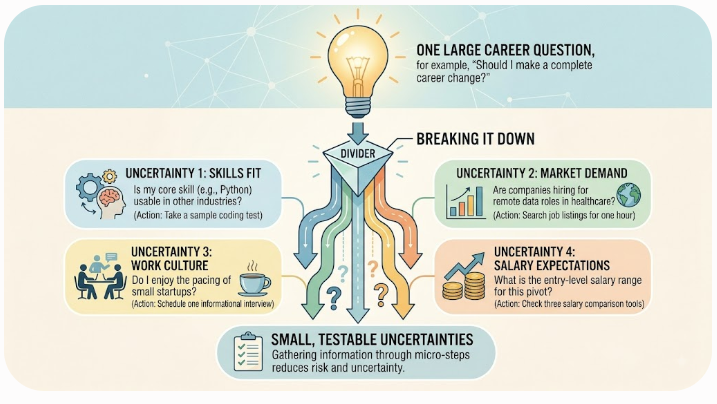
The experiment becomes useful only when it is tied to a specific uncertainty.
Suppose you are considering project management. “Take a project-management course” is an activity. It becomes an experiment when you state what it is intended to test:
- Do I like turning ambiguous requests into a plan?
- Can I tolerate following up when other people miss deadlines?
- Do I want work that involves frequent coordination and documentation?
- Can I learn the basic tools without displacing responsibilities I must protect?
These are different questions. A course may test your interest in concepts and your willingness to learn, but it may reveal very little about conflict, interruptions, accountability, or organizational pressure. The activity and the uncertainty must match.
Use the research from your Career Research Dossier to find claims marked Unverified, Variable, or Contradicted. Then choose the uncertainty that could most change your decision. Do not test what you already know merely because it is convenient.
What counts as a career experiment?
A career experiment is a bounded experience that lets you perform, observe, or learn something meaningfully related to a possible direction. The U.S. Department of Labor recognizes several forms of work-based learning, including job shadowing, internships, pre-apprenticeships, apprenticeships, and summer work experiences. CareerOneStop also describes shadowing as following someone in their job for a short period and volunteering as another way to gain work experience.
Your experiment can be much smaller than an internship or apprenticeship. Depending on the field and your access, it might include:
- taking responsibility for an adjacent assignment in your current job;
- completing a short, realistic project with a defined user and deadline;
- shadowing a worker with the employer’s permission;
- using a simulation, lab, or supervised workshop;
- volunteering in a role that contains a relevant task;
- taking one introductory module before enrolling in a full program;
- completing a paid freelance or temporary assignment within your competence;
- joining an official pre-apprenticeship or work-based learning program.
The format is not the important part. The question is whether the experience produces evidence that resembles the part of the career you need to understand.
An exposure is not always a test
A webinar may improve orientation but provide no task evidence. A polished portfolio project may test technical execution but hide the meetings, revisions, constraints, and routine maintenance that shape the actual job. Shadowing one unusually enthusiastic professional may reveal a workplace, but not the range of employers or schedules in the occupation.
Treat each result according to what the experiment could genuinely show. A narrow test can be valuable without being decisive.
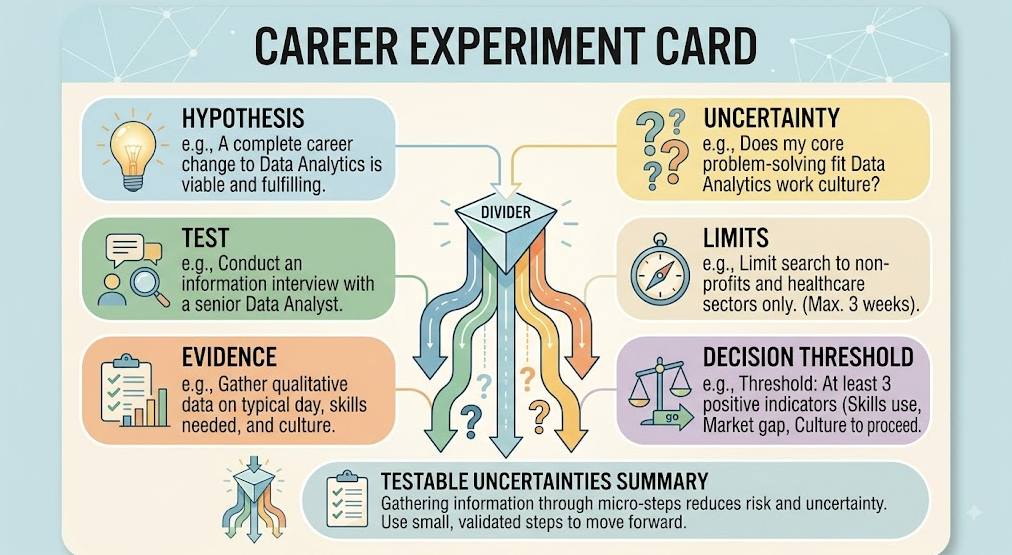
Build a Career Experiment Card
Write the experiment down before you begin. This reduces the temptation to reinterpret every pleasant or difficult moment as proof of a conclusion.
1. Career hypothesis
State a provisional claim, not a life prediction.
“A role involving regular data analysis may fit me because I enjoy finding patterns, can sustain focused computer work, and am willing to develop the required spreadsheet and querying skills.”
This is testable. “Data science is my calling” is not.
2. Critical uncertainty
Choose one question whose answer could change your next step. Examples include:
- Do I like the core task, not only the topic?
- Can I learn the entry-level tool at a reasonable pace?
- Does the normal physical or social environment work for me?
- Can I perform the task while respecting my health, care, location, or schedule constraints?
- Am I interested enough to continue when the work becomes repetitive or difficult?
3. Closest safe test
Choose the smallest activity that resembles the uncertainty. If you need to test client interaction, a solitary online course is weak. If you need to test whether you can learn basic code, an approved beginner project may be more informative than watching a software engineer for an hour.
Aim for realism, but do not impersonate a licensed professional, handle protected data, enter a restricted worksite, or perform hazardous tasks. Observation or simulation is often the appropriate boundary.
4. Limits
Set the time, money, access, and risk boundaries in advance. For example:
- two weekends, not an open-ended commitment;
- a fixed learning budget, not a full certificate;
- public or synthetic data, not employer or client information;
- observation only around equipment or regulated work;
- no unpaid productive work that should legally or ethically be paid.
Check applicable employment rules, licensing requirements, confidentiality obligations, insurance conditions, and employer policies. Rules differ by country, jurisdiction, workplace, and type of arrangement.
5. Evidence to collect
Decide what you will record. Useful evidence may include:
- tasks completed and conditions encountered;
- time needed and where you became stuck;
- feedback on the work from an authorized reviewer;
- energy before, during, and after the task;
- willingness to repeat the ordinary parts;
- conflicts with non-negotiable constraints;
- differences between the experiment and real employment.
Avoid a single mood score. A stressful first attempt does not prove poor fit, and an exciting first day does not prove durable fit.
6. Decision threshold
Define what would justify the next step. A threshold might be:
“I will investigate this direction further if I can complete the basic task with support, remain willing to repeat it after the novelty fades, and find no direct conflict with my fixed schedule constraint.”
The threshold should not require mastery. Early experiments are designed to test direction, not job readiness.
Choose the right-sized experiment
Not every uncertainty requires the same level of commitment. Use an evidence ladder.
Level 1: Simulate or sample
Try a short exercise, introductory lab, realistic case, or small personal project. This is useful for testing initial task interest and learning friction. It is weak evidence about workplace culture, workload, or employer expectations.
Level 2: Observe with permission
Shadow a professional, tour an approved workplace, or observe a process. Focus on the proportion of time spent on routine work, interruptions, documentation, and coordination—not only the most visible task.
Observation has limits: people may behave differently while being observed, and one day may be atypical. Record what you could not see. Detailed questions for professionals belong in the next article on informational interviews; this experiment is about structured exposure.
Level 3: Perform an adjacent task
Seek a small assignment in your current organization, community group, class, or volunteer setting. The task should have a real constraint, recipient, or quality standard. This can reveal how you respond to revisions, deadlines, ambiguity, and accountability.
Get authorization first. Do not use proprietary material for a portfolio, and do not represent a trial assignment as professional experience beyond what it was.
Level 4: Enter a structured experience
An internship, pre-apprenticeship, apprenticeship, practicum, temporary assignment, or formal returnship can produce stronger evidence because it combines tasks with a work setting. It also carries greater time, eligibility, and opportunity costs. Confirm whether it is paid, what supervision is provided, what credential or credit it offers, and what protections apply.
Move up the ladder only when the next level is needed to answer an important remaining question. More commitment is not automatically better evidence.
Evaluate the experiment across five dimensions
After the test, separate what you learned into five categories.
| Dimension | What to ask | Common misreading |
|---|---|---|
| Task Fit | Would I willingly repeat the central activity after the novelty wears off? | “I like the industry, so I will like the work.” |
| Learning Fit | Can I tolerate the way competence is built, including practice and feedback? | “The first attempt was hard, so I lack ability.” |
| Environment Fit | How did pace, noise, interruption, physical demands, autonomy, and interaction affect me? | “One workplace represents the whole occupation.” |
| Constraint Fit | Can this direction work with my income floor, health, care duties, location, and time? | “A temporary conflict can never change.” |
| Evidence Quality | How closely did the test resemble real work, and what remained artificial? | “Completing any project proves job fit.” |
Use concrete observations. “I hated it” is important but incomplete. “I enjoyed analyzing the information but disliked presenting recommendations in real time, and the role appears to require that weekly” is more useful because it identifies what needs confirmation or redesign.
Distinguish discomfort from a negative result
Experiments often feel awkward because you are new, being observed, or working without fluency. That discomfort is not automatically evidence against the career. Ask what produced it.
- Beginner friction: The task was slow because the tools were unfamiliar.
- Skill gap: Performance improved with instruction, but more training is needed.
- Preference mismatch: You understood the task and still did not want to repeat it.
- Environment mismatch: The work was acceptable, but the pace, setting, schedule, or interaction was not.
- Constraint conflict: The path requires resources or conditions you cannot currently provide.
- Poor experiment design: The activity did not resemble the question you meant to test.
This separation prevents two opposite errors: abandoning a viable direction because learning was uncomfortable, or excusing a persistent mismatch because you want the direction to work.
When possible, repeat the test under a slightly different condition. One project, supervisor, or workplace can be unrepresentative. Repetition is most useful when the first result was surprising, mixed, or heavily shaped by circumstances.
Decide: Continue, Revise, Stop, or Still Unclear
At the end of the experiment, make a limited decision.
Continue
The test produced relevant evidence in favor of the direction, no protected constraint was violated, and a proportionate next test is available. Continue does not mean resign or enroll immediately. It means the hypothesis has earned more investigation.
Revise
Part of the direction fits, but the role, employer type, work setting, specialization, or training route needs adjustment. You may like analysis but not client-facing delivery, or the occupation but not a travel-heavy version of it.
Stop
The experiment revealed a persistent task mismatch, unacceptable condition, or disproportionate cost. Stopping is a useful result when the test was relevant and the evidence is clear. You have avoided a larger commitment.
Still Unclear
The experiment was too artificial, too short, poorly supported, or confounded by an unusual circumstance. Do not force a yes-or-no answer. Identify what better evidence would be needed.

Avoid experiments that transfer risk to someone else
Career exploration should not create hidden harm. Be cautious when an experiment involves patients, children, vulnerable people, financial decisions, legal matters, heavy equipment, food safety, cybersecurity, or confidential information. In these settings, observation, simulation, or supervised training may be the only responsible option.
Do not ask a small business or nonprofit to absorb extensive supervision simply so you can “try out” a career. Define the arrangement honestly, respect the organization’s ability to decline, and clarify whether work is paid, voluntary, educational, or observational. Never assume that calling something an internship or trial makes unpaid work lawful.
If you are employed, also consider conflicts of interest, outside-work policies, intellectual-property terms, confidentiality, and fatigue. A career experiment should reduce decision risk, not create disciplinary, legal, financial, or health risk.
Turn the result into better evidence
Complete your Career Experiment Card within a day or two, while details remain clear. Record:
- what you expected;
- what actually happened;
- which evidence was strong or weak;
- what changed in your career hypothesis;
- the smallest justified next step.
Then update the relevant claim in your Career Research Dossier. An Unverified claim may become Confirmed for this setting, not universally confirmed. A contradiction may reveal that employers implement the same occupation differently.
If the experiment raises questions about how experienced people entered the field, what varies across employers, or what beginners routinely misunderstand, prepare those questions for an informational interview. Do not treat one person’s answer as a substitute for your own experience; use conversation and experimentation as different kinds of evidence.
The goal is not certainty. Career decisions rarely offer it. The goal is to replace an expensive leap based on imagination with a sequence of bounded decisions supported by increasingly relevant evidence.
A practical final check
Before committing to your experiment, confirm that you can answer each question:
- What exact uncertainty am I testing?
- Does the activity resemble the task or condition I need to understand?
- What can this experiment not tell me?
- Do I have permission, supervision, and appropriate safety boundaries?
- Are the time and financial limits explicit?
- What evidence will I record?
- What result would justify continuing, revising, stopping, or trying again?
If those answers are clear, the experiment is ready. If they are not, make the test smaller or more specific before investing further.
FAQ
How long should a career experiment last?
Long enough to encounter the relevant task more than superficially, but no longer than needed to answer the defined question. A software exercise may take a weekend; supervised shadowing may take a day; an adjacent assignment may require several weeks. Set the end date before starting.
Is taking an online course a good career experiment?
It can test interest in the subject, willingness to practice, and early learning friction. It usually cannot test the full work environment, workload, stakeholder demands, or employer expectations. Use it for the uncertainty it can actually address.
What if I cannot get job-shadowing access?
Use a safer substitute: an authorized workplace tour, public demonstration, simulation, realistic case, supervised workshop, adjacent task, or short structured program. Some fields appropriately restrict observation because of privacy, safety, or licensing.
Should I build a portfolio during the experiment?
Only if the project is relevant and you have the right to share it. Use public, synthetic, or personally created material. Do not publish employer, client, patient, student, or proprietary information. Describe the project and your role accurately.
What if I enjoy the experiment but perform poorly?
Separate early skill from learning potential. Look at whether feedback helped, whether performance improved, and whether you are willing to continue practicing. One beginner attempt cannot establish your eventual competence.
What if I dislike the experiment?
Identify whether you disliked the core task, being a beginner, the specific environment, poor supervision, or a constraint around the activity. A negative reaction is evidence, but its cause determines whether to stop, redesign, or repeat the test.
How many experiments should I run before changing careers?
There is no universal number. Use enough varied evidence to address the uncertainties that make the decision consequential. A costly or irreversible move generally warrants stronger and more realistic tests than a reversible internal assignment.
Sources
- CareerOneStop – Get Work Experience
- U.S. DOL, Office of Disability Employment Policy – Career Preparation
- Apprenticeship.gov – Apprenticeship for Young People
- ONET Resource Center – The ONET Content Model
More in This Cluster: Career Direction
- How to Identify What You Want from Your Next Role
- Skills, Interests, and Constraints
- Career Change vs Job Change
- How to Research a Career Before Committing
- Testing a Career Direction with Small Experiments (you are here)
- How to Use Informational Interviews
- Creating a 12-Month Career Plan