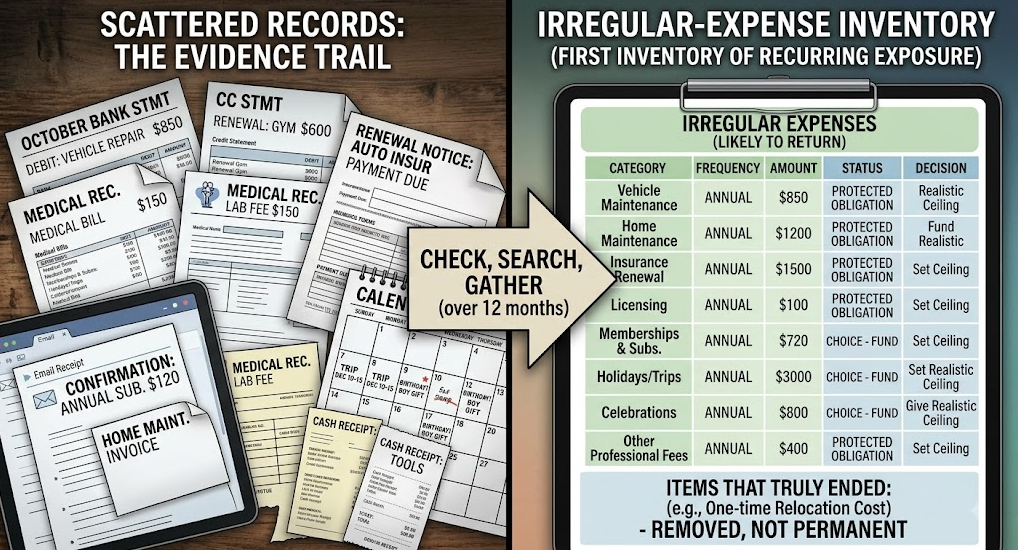
An annual insurance notice in February. A school receipt in August. A furnace-service invoice in October. A vehicle registration charge that appears once and then disappears from view for another year.
Individually, each document looks like an exception. Laid across twelve months, they form an evidence trail. The amounts may change and the dates may shift, but the category often returns. A cost does not become unpredictable merely because it is absent from this month’s bank statement.
That distinction changes the job. You do not need to forecast every future expense perfectly. You need to identify which large, uneven costs are visible far enough ahead to fund gradually—and which genuinely uncertain shocks still belong outside the plan.
Reader decision: Decide which irregular expenses to pre-fund, how much to assign each month, and what to revise when the amount, deadline, or available cash changes.
Irregular does not always mean unexpected
Monthly budgets naturally emphasize what happens every month. Rent, utilities, groceries, subscriptions, and required payments are easy to see because they keep returning. An annual premium, seasonal purchase, professional renewal, or expected maintenance visit can vanish between due dates even though it is part of the household’s real cost of living.
The Consumer Financial Protection Bureau’s annual planning tool recommends looking across a year when income or expenses vary by month. That wider view helps reveal periodic costs that a single-month budget misses. The Federal Deposit Insurance Corporation likewise notes that expenses paid on a schedule other than monthly may need to be converted into monthly amounts when building a spending and saving plan.
Use three practical classifications:
- Scheduled and known: the due date and amount are reasonably firm, such as a membership renewal or annual registration notice.
- Expected but variable: the category and approximate timing are visible, but the amount is an estimate, such as routine vehicle maintenance or seasonal utility changes.
- Unplanned: whether the event will happen, when it will happen, or what it will cost cannot be reasonably assigned to a planning window.
The first two can often be included in an irregular-expense plan. The third is generally an emergency-reserve issue. Some categories can sit in both places: scheduled maintenance is planned, while a sudden major breakdown may be an emergency. Label the purpose of each dollar so the same balance is not counted twice.
This article uses a dedicated planned-expense reserve as an operating mechanism. It does not require a particular number of accounts, apps, or digital envelopes. Those design choices belong to the broader sinking-fund and household-system decisions.
Find the expenses your monthly view hides
Do not begin with an idealized list from memory. Review evidence from the previous 12 months, and use 24 months where costs are seasonal, lumpy, or easy to miss.
Check:
- bank and credit-card statements;
- insurance and licensing renewals;
- tax, school, medical, and professional records;
- vehicle and home-maintenance invoices;
- membership and subscription renewal notices;
- calendars, email receipts, and household messages; and
- expenses paid in cash or reimbursed later.
Search for categories that were large enough to disrupt an ordinary month, required borrowing, displaced another bill, or caused a rushed decision. Also note costs that were paid comfortably; they still belong in the evidence set if they are likely to return.
Remove items that truly ended. A one-time relocation cost should not become a permanent annual target. Separate purchases made by choice from obligations that must be protected, but do not pretend optional events are free. If a holiday, trip, celebration, or activity is likely to remain in the household plan, give it a realistic ceiling or explicitly decide not to fund it.
The result is not a prediction of next year. It is a first inventory of recurring exposure.
Build an Irregular Expense Funding Map
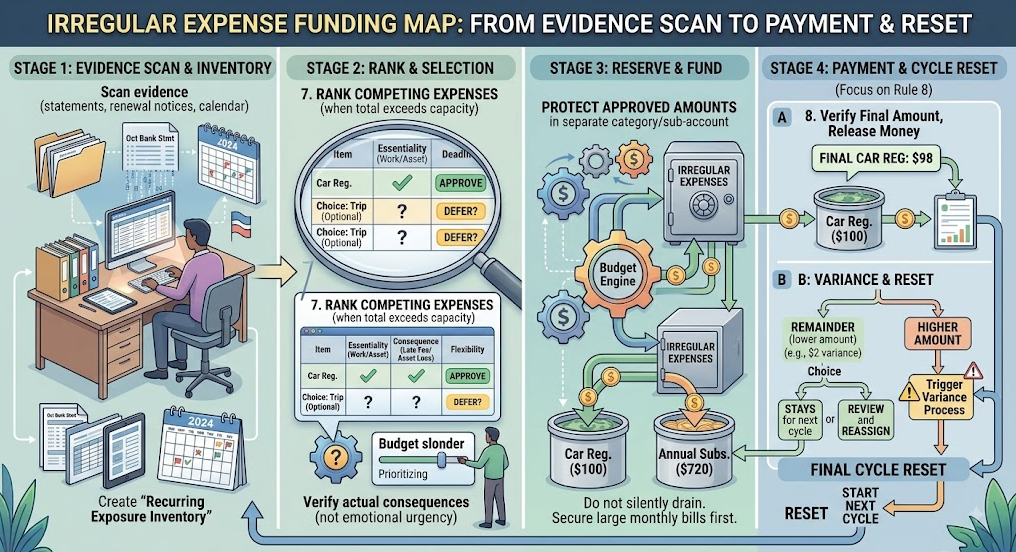
Use one line per expense. The goal is to turn a distant cost into a present funding decision without manufacturing certainty.
1. Name the expense precisely
“Car” is too broad. “Annual registration,” “winter tires,” and “scheduled service” have different dates, estimates, and consequences. Precise names reduce the chance that one reserve is expected to cover several incompatible purposes.
2. Set the due date or due window
Use the contractual due date when one exists. For a variable event, use a planning window: “before the school year begins,” “before winter,” or “during the next scheduled service interval.”
If the payment date is flexible, choose a target date early enough to preserve options. Do not assume a provider will permit installments, a date change, or a grace period unless the current terms confirm it.
3. Create a working estimate
Use the most relevant evidence available:
- a current renewal notice or quote;
- the last invoice adjusted for known changes;
- a recent provider estimate;
- a contractual fee schedule; or
- a range based on several past years.
When the amount is uncertain, record low, working, and high estimates rather than presenting one guess as a fact. The working estimate drives the contribution; the high estimate shows the exposure if the cost rises.
Do not automatically add a universal percentage for inflation or contingencies. A stale invoice plus an arbitrary markup can look precise while remaining poorly grounded. Update the estimate when better evidence arrives.
4. Subtract money already assigned
Count only money that is currently available and reserved for this expense. Do not count a tax refund that has not arrived, an unused credit limit, expected overtime, or the same savings balance already assigned to another goal.
Funding gap = working estimate − current dedicated reserve
If the gap is zero or negative, the working target is funded. Keep the excess assigned only if it has a stated purpose, such as covering the high estimate or beginning the next cycle.
5. Divide by the actual time remaining
For a known deadline:
Monthly funding need = funding gap ÷ remaining contribution periods
If a $1,200 premium is due in eight months and nothing is reserved, the current funding need is $150 per month—not $100 based on a full twelve-month cycle that has already partly passed.
For a cost that repeats without a firm next bill, an annualized starting estimate can be useful:
Expected annual amount ÷ 12 = preliminary monthly amount
Treat that result as a planning amount, not a guarantee. When the timing becomes clearer, switch to the remaining-gap calculation.
6. Test the total against real cash flow
Add all proposed monthly funding amounts to the existing monthly plan. If dependable income cannot cover ordinary obligations, required payments, safe current-month cash flow, and the new contributions, the map is not feasible yet.
Do not fund next winter by missing this month’s utility payment. Do not create a planned-expense reserve with a credit-card cash advance. A target can be mathematically correct and still be unsafe for the household’s present cash position.
7. Rank competing expenses
When the full total does not fit, evaluate each line by:
- essentiality: does it protect housing, health, work, legal compliance, or a necessary asset?
- deadline: how soon must a decision or payment occur?
- consequence: what happens if it is underfunded or delayed?
- estimate confidence: how reliable are the date and amount?
- flexibility: can the scope, timing, or provider be changed safely?
This is not a universal priority list. A professional licence may be essential to one reader’s income and irrelevant to another. Verify actual consequences instead of ranking by which reminder is most emotionally vivid.
8. Define the payment and reset rule
Before the expense arrives, decide how you will verify the final amount, release the money, record any difference, and start the next cycle.
If the bill is lower than expected, choose whether the remainder stays for the next cycle, covers a related approved cost, or is reassigned after review. If it is higher, use the variance process below rather than silently draining another protected category.
A worked example with competing deadlines
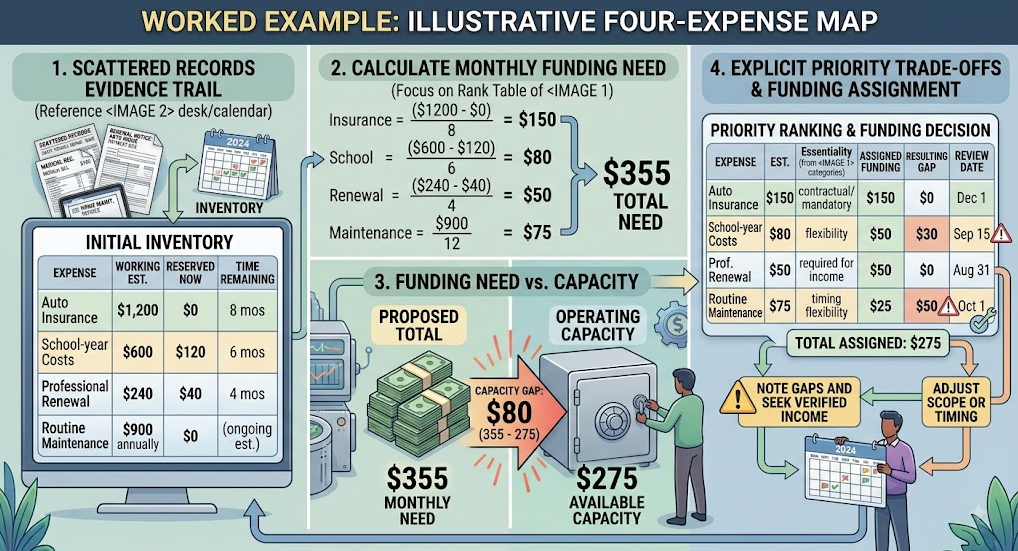
Suppose a household identifies four costs:
| Expense | Working estimate | Reserved now | Time remaining | Monthly need |
|---|---|---|---|---|
| Auto insurance premium | $1,200 | $0 | 8 months | $150 |
| School-year costs | $600 | $120 | 6 months | $80 |
| Professional renewal | $240 | $40 | 4 months | $50 |
| Routine vehicle maintenance | $900 annually | $0 | Ongoing estimate | $75 |
The proposed total is $355 per month. The arithmetic is:
- insurance: $1,200 ÷ 8 = $150;
- school: ($600 − $120) ÷ 6 = $80;
- renewal: ($240 − $40) ÷ 4 = $50; and
- maintenance: $900 ÷ 12 = $75.
Now assume the household can safely assign only $275 per month without lowering its bill holdbacks or operating floor. The map has revealed an $80 monthly capacity gap. That is useful information; it is not permission to label the plan complete.
The household verifies that the professional renewal is required to keep earning income, the insurance deadline is contractual, school costs have some scope flexibility, and vehicle maintenance timing depends on the service schedule. It might protect the $50 renewal amount and $150 insurance amount first, assign $50 to school costs, and assign $25 to maintenance while seeking a current service estimate. That totals $275.
This creates consequences: the school target will be short unless the scope changes or extra verified income is assigned, and the maintenance line may need to rise after inspection. The household records those gaps and sets review dates. It does not claim that smaller contributions make the original targets funded.
The example is illustrative. Your priorities depend on actual obligations, safety, household needs, and the consequences of delay.
Manage estimates without pretending they are exact
Irregular expenses often contain two kinds of error: the amount changes, or the timing changes. Build a response for both.
Review the map when a renewal notice, quote, inspection, schedule, or policy update supplies better evidence. Recalculate the remaining gap using the new amount and the contribution periods still available. Do not rewrite prior months as though the new information was always known.
If the estimate rises, choose deliberately among four responses:
- increase future contributions within available cash flow;
- reduce the scope of a flexible expense;
- move the date only when doing so is permitted and safe; or
- identify a remaining shortfall and plan the least harmful response.
If the expense arrives earlier, recalculate from the new deadline immediately. If it arrives later, do not automatically spend the accumulated balance; keeping it assigned may reduce the next cycle’s monthly burden.
For highly uncertain amounts, fund a defensible working estimate and display the high estimate separately. That makes the risk visible without forcing every worst-case number into the current budget. If a high-cost event is genuinely unplanned, coordinate with the emergency-reserve decision rather than relabeling it after it occurs.
Keep the reserve usable and distinct
The money should be safe, accessible by the due window, and easy enough to identify that it is not mistaken for ordinary spending. The right storage arrangement depends on account access, fees, minimum balances, deposit insurance or equivalent protections, benefit-program asset rules, and household behavior.
One account can hold several planned amounts if records clearly show what each portion is for. Separate accounts can make boundaries visible but may add fees, transfer work, or minimum-balance requirements. The number of accounts is not the measure of whether the plan works.
Avoid investing money needed on a short or firm timeline in an asset whose value can fall when payment is due. Do not treat available credit as a reserve. And before automating contributions, verify that the transfer date and amount will not push the operating account below its protected floor.
Review at the moments that change the decision
The map does not need constant attention. Review it:
- when new price or date evidence arrives;
- after a contribution is missed;
- when income or essential expenses change materially;
- before committing the reserve to payment;
- immediately after the expense is paid; and
- at least once across a complete annual cycle.
After payment, compare estimated and actual amounts. Record whether the difference came from price, scope, timing, or a poor initial estimate. Then decide whether the next target should use the actual bill, a multi-year average, a new quote, or a different planning range.
Also remove goals that no longer belong. A reserve list that only grows eventually overstates what the household can fund and hides the priorities that matter now.
Turn irregular costs into visible choices
An irregular expense becomes dangerous to cash flow when it remains invisible until its payment month. Looking across twelve months does not make every amount certain, but it reveals which costs deserve a place in today’s plan.
Use evidence to identify them. Separate scheduled, estimated, and genuinely unplanned costs. Calculate the remaining gap over the time actually available. Test the combined total against current cash flow, rank conflicts openly, and reset the plan after payment.
The goal is not a future with no surprises. It is fewer costs being called surprises merely because the monthly view forgot them.
FAQ
What counts as an irregular large expense?
It is a material cost that does not occur in an even monthly pattern. Examples may include annual premiums, registrations, school-year costs, professional renewals, seasonal purchases, or planned maintenance. “Large” depends on whether the cost can disrupt your ordinary cash flow.
Should I divide every annual bill by 12?
Only when you have a full cycle to prepare. If the bill is due sooner, subtract the amount already reserved and divide the remaining gap by the actual contribution periods left.
What if I do not know the exact amount?
Use current evidence to record low, working, and high estimates. Fund from a defensible working estimate, show the high exposure separately, and recalculate when a notice, quote, or inspection improves the information.
Is a planned-expense reserve the same as an emergency fund?
No. A planned-expense reserve covers costs whose category and approximate timing can be anticipated. An emergency fund is intended for unplanned financial shocks. Some broad categories, such as car costs, can require both planned maintenance money and separate emergency protection.
What if all my monthly funding needs do not fit?
Do not hide the gap. Protect current essentials first, then rank irregular expenses by essentiality, deadline, consequence, estimate confidence, and flexibility. Reduce scope or change timing only where it is genuinely safe and permitted.
Do I need a separate account for every expense?
No. One account can support several goals if the internal records remain clear. Separate accounts may improve boundaries but can add fees and management work. Choose the simplest arrangement that preserves each assignment.
What should I do with money left after the bill is paid?
Apply the written reset rule. The remainder might stay for the next cycle, cover an approved related variance, or be reassigned after review. Do not count it toward another purpose until the first assignment has been formally released.
Sources
- CFPB – Annual Planner
- CFPB – Planning for the Year
- FDIC – Money Smart for Adults, Module 4: Your Spending and Saving Plan
- CFPB – An Essential Guide to Building an Emergency Fund
- Consumer.gov / FTC – Making a Budget