Laundry advice often sounds as if every home needs a row of perfectly labelled hampers: whites, lights, darks, towels, delicates, heavily soiled clothes, and perhaps several more. That system can protect clothing, but it can also leave a family with six undersized piles and nothing large enough to wash efficiently.
The opposite shortcut—put everything together on cold and hope for the best—creates a different risk. One unstable red garment can tint pale clothes. A lint-producing towel can cover dark athletic wear. Heavy jeans and exposed hardware can rub against a lightweight top. A care-label exception can be damaged even when every other item survives.
The useful question is not, “How many colour piles should laundry have?” It is: “Which differences in this basket are likely to change the safe wash method or cause an avoidable transfer, abrasion, or cleaning problem?”
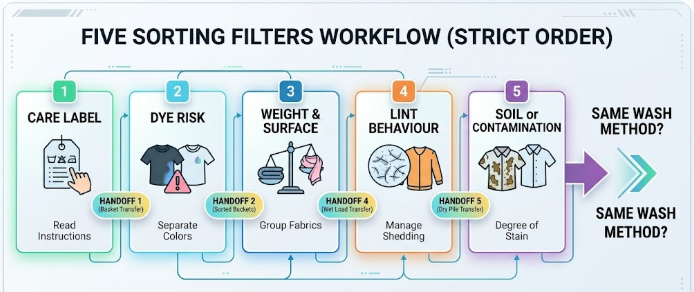
For most ordinary household laundry, five filters are enough:
- care instructions;
- colour-transfer risk;
- fabric weight and surface;
- lint production or attraction; and
- soil level or special contamination.
You do not need to create a separate load for every difference. Separate when the risk is meaningful, and combine when the items can safely share the same cycle, temperature, products, and handling.
Practical rule: Sort for the most restrictive item in the load. If one garment cannot safely share the planned cycle, temperature, or companions, remove it rather than lowering your standards by accident.
Start With the Care Label, Not the Colour
Colour is visible, so it attracts attention first. But the care label can reveal a more important incompatibility: hand wash, gentle cycle, wash separately, non-chlorine bleach only, or a temperature limit.
In the United States, the FTC Care Labeling Rule requires covered clothing and certain textile goods to carry instructions for at least one safe method of regular care. A label can specify hand or machine washing, water temperature, drying method, bleach warnings, and other steps needed to prevent harm.[1] The rule is American, but the practical principle travels well: the instructions supplied with the item should control the decision for that item.
Before dividing a basket by colour, pull out anything that:
- says hand wash, wash separately, or dry clean;
- requires a cycle or temperature unlike the routine load;
- contains trims, coatings, padding, or embellishments that need special handling;
- has a known history of shedding or releasing dye; or
- is too valuable or difficult to replace for a first-wash experiment.
Do not assume matching colours make two garments compatible. A black lace top and black work jeans may share a colour but not a safe level of agitation. A white performance shirt and white cotton towel may need different companions because one attracts lint.
If the label is missing or unreadable, use a conservative method based on the fibre, construction, trim, and replacement risk. When the item is valuable, unfamiliar, or structurally complex, professional advice may be cheaper than testing it in a routine load.
Sort for Colour Transfer Where the Consequence Matters
Dye transfer occurs when loose or unstable dye moves from one item to another during washing. The risk is not identical for every coloured garment or every wash. New, saturated, dark, or historically unstable items deserve more caution than familiar garments that have completed many washes without bleeding.
Whirlpool’s general sorting guidance recommends separating by colour, fabric type, soil level, and care label, and specifically notes that dye transfer can affect other items in the load.[2] Manufacturer guidance is not a guarantee for every textile, but it supports a sensible risk-based approach.
Separate these first
- New saturated colours: especially red, burgundy, deep blue, dark green, purple, and black.
- Items labelled “wash separately” or “wash before wearing”: the label is already identifying a transfer or finish concern.
- Pale or white items whose appearance matters: a small tint may be noticeable even if the fabric remains usable.
- A known bleeder: if an item has transferred colour before, treat that history as stronger evidence than a generic shortcut.
- High-consequence items: school uniforms, work shirts, special-event clothing, or anything hard to replace before it is needed.
Combining may be reasonable when
- the garments have been washed repeatedly without dye transfer;
- the colours are similar in depth;
- every item can use the same temperature and cycle;
- no item carries a separate-wash warning; and
- a small appearance change would not create a serious loss.
Cold water can reduce some colour-management risk and may suit many routine loads, but it does not make unstable dye impossible. A colour-catcher sheet may provide an additional layer of protection, but it should not be treated as permission to ignore a label or mix a known bleeder with irreplaceable pale clothing.
The first few washes are the time to be cautious. Once an item has a reliable history, your household can make a more informed decision about combining it.
Separate by Weight and Surface, Not Just Fabric Name
“Cottons together” is too broad to be a complete sorting rule. Cotton can mean a thin T-shirt, a looped towel, rigid denim, or a delicate knit. What matters in the washer is how the items interact.
Heavy, rough, or hardware-heavy garments can create more friction against lightweight or loosely constructed fabrics. Zippers, hooks, buckles, hook-and-loop fasteners, and decorative hardware can catch or scrape other items. Whirlpool advises sorting heavier fabrics away from lighter ones to reduce damage and pilling risk.[3]
Create separate loads when the basket contains a meaningful mismatch such as:
- heavy jeans with fine knits or lingerie;
- bath towels with lightweight office clothing;
- rough workwear with soft children’s sleepwear;
- items with exposed hooks or hook-and-loop closures alongside snag-prone fabrics; or
- a gentle-cycle garment mixed into a load that needs stronger mechanical action.
Preparation can reduce risk but does not erase every mismatch. Close zippers and fasteners according to the garment guidance, secure hook-and-loop closures, turn abrasion-prone garments inside out, and use a mesh bag for small delicate items when appropriate. If the planned cycle is still wrong for one item, separate it.
At the same time, avoid creating tiny loads based on fibre labels alone. Similar-weight everyday shirts, underwear, socks, and sleepwear can often share a routine load if their labels, colours, and soil levels are compatible.
Keep Lint Producers Away From Lint Collectors
Some combinations come out clean but look worse because fibres move between items.
Common lint producers include:
- new towels and washcloths;
- terry cloth;
- chenille;
- fleece or fluffy blankets; and
- items already shedding visible fibres.
Common lint collectors include:
- dark smooth clothing;
- corduroy;
- some synthetic or permanent-press fabrics; and
- garments with surfaces that visibly hold pale fibres.
Whirlpool’s product guidance specifically recommends separating lint-producing fabrics such as towels and chenille from lint takers such as corduroy, synthetics, and permanent press.[4] The exact behaviour varies by item, especially when new, so use what you observe after washing.
This does not mean every towel needs its own colour-and-size micro-load. It means a new pale towel should not be buried among black leggings if lint would make those leggings inconvenient to wear. Towels of compatible colours and care needs can form a practical load, especially during their early washes when shedding may be greater.
If lint appears once, do not immediately redesign the entire household system. Identify the likely producer, clean the appliance filter or areas specified in its manual, and test a better pairing next time.
Sort by Soil Level When the Wash Job Is Different
Colour-compatible items may still require different treatment because “dirty” is not one condition.
Routine body soil on everyday clothing is different from heavy mud, grease, food residue, pet mess, or a stain that needs attention before washing. The American Cleaning Institute has long recommended sorting by both colour and soil level as part of laundry preparation.[5]
Separate heavily soiled items when they:
- need pretreatment or a longer, stronger cycle;
- could redeposit visible soil onto lightly worn clothing;
- contain grit or debris that should be removed first;
- carry odour or residue you do not want transferred; or
- require a product or temperature that routine garments cannot tolerate.
Do not use sorting as a substitute for stain treatment. A sauce stain does not necessarily require an entire separate load; it may require prompt pretreatment and a check before drying. The full response to blood, grease, sauce, ink, and mud belongs in Article “How to Treat Common Laundry Stains Before They Set”.
Also avoid washing items carrying excessive solids as if they were ordinary clothing. Remove material safely according to the situation and follow incident-specific guidance where bodily fluids, chemicals, floodwater, sewage, pesticides, or hazardous workplace substances are involved.
Do Not Turn Every Illness Into a Separate-Load Rule
Fear can make household sorting more complicated than public-health guidance requires. For general home cleaning, the CDC says it is safe to wash dirty laundry from a person who is sick with other people’s items, using detergent and the recommended water temperature, drying items completely, and washing hands after handling dirty laundry.[6]
That general advice has important exceptions. Specific hazards can require isolation or a different process. Current CDC guidance says laundry used by a person with mpox should not be mixed with other laundry and should be handled without shaking.[7] CDC/NIOSH also advises that work clothes potentially carrying hazardous take-home exposures be kept separate and washed separately from family clothes.[8]
The decision is therefore not “sick person equals separate” or “all family laundry is always safe together.” Ask what the actual exposure is.
- Ordinary household illness: follow current public-health guidance, product labels, care labels, and thorough drying; automatic separation may not be necessary.
- Vomit or feces, a diagnosed infectious condition with specific instructions, bedbugs, or another defined biological hazard: use the current condition-specific guidance.
- Chemical, pesticide, asbestos, lead, industrial dust, sewage, or floodwater exposure: keep the items out of routine family laundry until authoritative workplace, public-health, disaster, or professional guidance confirms the correct process.
When a clinician, public-health authority, employer, product label, or incident-response instruction gives a specific laundering method, that instruction overrides a general household article.
Build the Smallest Sorting System That Catches Real Risk
A sorting system works only if the household uses it. Seven permanent hampers are not automatically safer than two hampers and one review basket.
For many families, a workable setup is:
- Routine lights: stable pale and white everyday items with compatible care needs.
- Routine darks/colours: stable medium and dark everyday items with compatible care needs.
- Review basket: new saturated garments, delicates, known bleeders, stain-treatment items, unusual labels, and anything with special contamination.
Towels, bedding, or heavy workwear can wait in their normal collection place and be pulled into a separate load only when their weight, lint, soil, or wash method makes that useful. You do not need a permanent container for every occasional category.
Use a “one red flag is enough” check
Before starting a mixed load, ask:
- Can every item use the same cycle and water temperature?
- Is there a new, saturated, or known colour bleeder?
- Is there a major weight, roughness, or hardware mismatch?
- Is a lint producer sharing the load with a visible lint collector?
- Does one item need pretreatment, stronger washing, or special handling?
- Is there a defined health, workplace, chemical, pest, sewage, or flood exception?
If the first answer is yes and the other five are no, combining is often a reasonable household choice. If one meaningful red flag appears, remove that item or create a compatible load around it.
What to Do When a Category Is Too Small for a Load
Small piles create the practical tension in sorting. Do not solve it by automatically running an inefficient tiny load or by taking a needless risk.
You have four options:
- Wait: hold the category until there is enough for a safe load, provided no dampness, odour, stain, or shortage makes delay unwise.
- Hand wash: use this only when the label permits it and the item can be dried properly.
- Combine conservatively: add items that match the same care method, colour risk, weight, lint behaviour, and soil level.
- Use an appropriate small-load setting: follow the washer manual, understanding that a machine setting cannot make incompatible garments compatible.
Plan around high-consequence needs. If a child has one clean uniform left, waiting for a perfectly full pale-clothing load may not be sensible. If the only item waiting is a new red scarf beside white shirts, waiting is probably safer.
Decision Summary
- Read care labels before sorting by appearance.
- Separate new saturated colours, known bleeders, and items labelled to wash separately.
- Treat a garment’s wash history as useful evidence, not a guarantee.
- Keep heavy, rough, or hardware-heavy pieces away from lightweight and snag-prone items.
- Separate lint producers from items that visibly collect lint.
- Split heavily soiled items when they need a different wash job.
- Do not assume every household illness requires a separate load; follow current condition-specific guidance.
- Keep hazardous work, chemical, sewage, flood, and other exceptional contamination out of routine family laundry until the correct method is known.
- Use the fewest permanent categories that reliably catch these risks.
- Combine only when the items can share the same care method and no meaningful red flag remains.
Good sorting is not a ritual and it is not a test of how many hampers you own. It is a short risk check. Protect the item that needs the gentlest treatment, isolate the source most likely to transfer dye, lint, soil, or contamination, and let compatible everyday clothes share the work.
FAQ
Do I really need to separate lights and darks?
It is prudent for new saturated colours, known bleeders, and pale items whose appearance matters. Familiar, colourfast garments of similar depth may be combined when their labels, fabric behaviour, soil, and wash method are compatible. Cold water can help manage risk but cannot guarantee that unstable dye will not transfer.
Can I wash towels with clothes?
Sometimes, but check more than colour. Towels can be heavy and lint-producing, while some clothing attracts lint or needs gentler action. Combining is more reasonable when the items have compatible colours, care labels, weights, soil levels, and lint behaviour.
Should children’s clothes be washed separately from adults’ clothes?
Not automatically. Separate according to care instructions, dye risk, fabric behaviour, soil, and any specific health guidance—not simply the wearer’s age. A baby’s or child’s product label or clinician may give a more specific instruction.
Should sick people’s laundry always be washed separately?
No. CDC general household guidance says laundry from a sick person can be washed with other people’s items. However, specific infections and exposures can require separation, so follow current condition-specific public-health or clinical advice.
What should I do with one new dark garment?
Check its label first. If it says wash separately, do so. Otherwise, waiting for similar dark items or washing it conservatively is safer than testing it beside pale, valuable, or urgently needed clothing.
Are colour-catcher sheets a replacement for sorting?
No. They may add protection, but they do not override care labels or make a known bleeder risk-free. Use them as a backup within an already reasonable load, not as the only control.
How many laundry categories does a family need?
Only enough to catch recurring risks. Many households can use routine lights, routine darks/colours, and one review basket, then create occasional towel, bedding, heavy-soil, or special-care loads when needed.
This article provides general household garment-care information. Follow each item’s care label and the current instructions for your washer, dryer, detergent, and laundry products. Infectious illness, bedbugs, bodily fluids, hazardous chemicals, occupational exposure, sewage, and floodwater may require incident-specific public-health, workplace, pest-control, disaster-response, or professional-cleaning guidance.
Sources
- FTC – Clothes Captioning: Complying with the Care Labeling Rule
- Whirlpool – How to Separate & Sort Laundry for Washing
- Whirlpool – What Is Fabric Pilling & How to Prevent It
- Whirlpool Product Help – Preventing Excessive Lint on a Washer Load
- CDC – When and How to Clean and Disinfect Your Home
- CDC / NIOSH – About Take-Home Exposures
More in This Cluster: Laundry Systems
- How to Build a Laundry Routine That Actually Gets Finished
- Sorting Laundry: What Still Matters and What Can Be Combined (you are here)
- How Much Laundry Detergent Should You Actually Use?
- How to Prevent Musty Towel Odours From Coming Back
- Air Drying vs Machine Drying: Which Is Better for Your Clothes?
- How to Treat Common Laundry Stains Before They Set
- Laundry Mistakes That Damage Clothes and Washers Too