Using laundry detergent should be simple: measure it, add it, and start the machine. In practice, the package may show several lines, the washer drawer may have unfamiliar symbols, and a pod removes the measuring step without answering whether one pod suits the load.
Jerome learned this through ordinary mistakes. When he first became responsible for a family’s laundry, he did not always know which compartment held detergent and which held fabric softener. He sometimes added products wherever they seemed to fit, then found product that had not fully dissolved after the cycle. The problem was not laziness. It was that several separate decisions—product, amount, compartment, cycle, and load—had been compressed into one vague instruction: “add detergent.”
The right amount is not one universal number. Products have different concentrations, washers use different amounts of water, and loads differ in size and soil. The most reliable starting point is the dose on the detergent label for your actual load, checked against the washer manual. Then adjust only when a specific factor justifies it.
Practical rule: Start with the product label, not a remembered capful. Use the washer manual to decide where the product goes. Adjust for load size, soil, and water hardness—one variable at a time.

Why More Detergent Is Not Automatically More Cleaning
Detergent helps water wet fabric, lift and suspend soil, and keep removed material from settling back onto clothing. But cleaning is a system: product chemistry, water, mechanical action, temperature, cycle time, and rinsing all matter.
Adding more product cannot repair every mismatch. An overloaded drum may prevent clothes from moving properly. A cycle that is too gentle may not suit a heavily soiled load. A stain may need prompt pretreatment rather than a larger whole-load dose. A clogged or incorrectly configured dispenser may fail to deliver the product as intended.
Excess detergent can also become part of the problem. Appliance guidance identifies oversudsing and product residue as possible consequences of using too much detergent or using conventional high-sudsing detergent in a high-efficiency washer. The American Cleaning Institute also lists detergent amount, water hardness, load size, and water level among factors to check when laundry develops residue or poor results.
This does not mean “less is always better.” Too little detergent may not provide enough cleaning capacity for a large, heavily soiled load or hard water. The goal is an appropriate dose, not the smallest possible dose.
First, Identify the Washer and the Product
Before measuring anything, answer two questions.
Is the washer high efficiency?
High-efficiency washers use less water than many traditional machines and are designed for low-sudsing HE detergent. ENERGY STAR notes that certified full-size washers use substantially less water per load than standard models, although designs and capacities vary. In a lower-water system, uncontrolled suds can interfere with operation and rinsing.
Look for the HE symbol on the detergent and confirm the machine requirements in its manual. Do not assume that a front-loader is the only kind of HE machine; many top-load impeller washers are also high efficiency. If a shared laundry room provides no manual, record the model number and find the manufacturer’s instructions rather than inferring from the lid or door.
What exactly are you dosing?
Two bottles of liquid detergent may require different amounts because one is more concentrated. The cap size is not a reliable comparison between brands or formulas. Powder scoops and pod sizes also vary.
Read the current package every time you change product. Find:
- the normal-load dose;
- the larger- or heavily-soiled-load dose;
- whether the product is HE-compatible;
- any water-hardness instruction;
- whether the product goes in the drum or dispenser; and
- any warnings about fabrics, temperature, storage, or pretreatment.
Never pour a new concentrated formula to the line you used for the previous bottle merely because both caps look similar.
Use a Five-Factor Dose Check
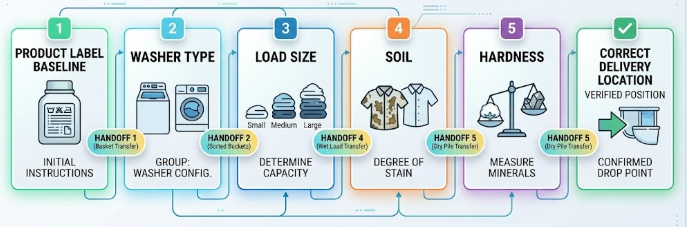
The label provides the baseline. Five factors tell you whether that baseline category fits.
1. Load size
Judge the amount of dry laundry, not just how full the hamper looked. A few bulky items may occupy the drum without weighing or soiling it like a dense load of clothing. Follow the washer’s loading instructions; detergent cannot compensate for a drum packed too tightly for items to circulate.
Use the label’s small, medium, or large-load definition when provided. Do not automatically call every full-looking drum “extra large.”
2. Soil level
Routine shirts worn indoors do not create the same cleaning demand as muddy play clothes, oily workwear, or heavily soiled sports gear. Use the product’s higher-soil direction when the whole load genuinely needs it.
If only one item has a local stain, increasing detergent for every garment may be wasteful and ineffective. Set the item aside for label-safe pretreatment; detailed blood, sauce, grease, ink, and mud decisions belong in the stain guide, Article “How to Treat Common Laundry Stains Before They Set”.
3. Water hardness
Hard water contains minerals that can reduce cleaning efficiency or contribute to deposits with some products. Your water utility, building manager, well test, or local authority may provide a hardness result. Product labels may recommend a different dose or compatible treatment for hard water.
Do not diagnose hard water from stiff fabric or white residue alone. Those signs can also reflect excess product, an overloaded washer, a dispenser problem, or incomplete rinsing. Confirm the water information before changing several parts of the routine.
4. Product concentration and form
Concentration changes the amount needed. Form changes how much control you have.
- Liquid is easy to measure in small increments and may be convenient for some pretreatment instructions, but it is easy to overpour.
- Powder is also adjustable and stores without the spill risk of liquid, but it must be used where and as the machine and product direct. Moisture or a blocked dispenser can cause clumping.
- Single-dose packs or pods reduce measuring and spills during dosing, but they offer limited adjustment for a very small or unusually large load. They must go in the location specified on the package and washer instructions—often the empty drum before clothes, not the drawer.
No form is universally best. Choose based on machine compatibility, the need to adjust dose, storage safety, cost per correctly dosed load, and the kinds of loads your household actually washes.
5. Machine delivery system
Some washers use a single-load drawer. Others have an agitator-mounted softener dispenser, direct-to-drum instructions, or an automatic bulk-dosing reservoir. A compartment that accepts liquid detergent may need an insert moved or removed for powder. Symbols and numbering are not identical across brands.
Whirlpool’s current support guidance, for example, describes separate dispenser areas for HE detergent, liquid chlorine bleach, and liquid fabric softener so the washer releases them at the intended stage. That example explains why separation matters; it is not a map for every machine.
Machine-specific rule: If the package and washer seem to disagree about placement, pause and consult both manufacturers’ instructions. Do not improvise by mixing products in one compartment.
Know What Goes Where
The dispenser controls timing as well as location.
Main-wash detergent
Put liquid or powder detergent in the main-wash compartment only when the manual permits that form there. A compartment marked “I” may be for prewash and “II” for the main wash on some machines, but symbols vary. Check rather than guess.
Fabric softener
Fabric softener is not detergent. Where the machine has a compatible dispenser, it is normally released during the rinse rather than the main wash. Manufacturer guidance says to measure according to the softener label, use the designated dispenser, dilute only if directed, and follow the washer’s use-and-care guide.
Softener is optional, not a required step for clean laundry. It may be unsuitable for some textiles or performance properties, so check the garment and product instructions. This article does not assume every family needs it.
Bleach and other additives
Use only products permitted by the garment label, washer manual, and additive label. Never treat an unmarked compartment as a general-purpose additive cup, and never mix household cleaning chemicals. If you cannot identify the compartment, leave the additive out until you can verify it.
Single-dose packs
Follow the pack label exactly. Do not cut, puncture, or squeeze a pod to create a partial dose. Keep packs in their original closed container, out of children’s sight and reach. Poison Control warns that concentrated laundry packets can cause serious injury when children bite or burst them, including eye and airway exposure.
This safety trade-off matters in a family system. A product that simplifies measuring is not convenient if it cannot be stored securely.
A Controlled Way to Correct Poor Results
When clothes look dull, smell unclean, feel coated, or emerge with visible product, avoid changing the dose, cycle, temperature, additive, and load size all at once. You will not know which change worked.
Use this sequence:
- Check the garment labels and washer manual. Confirm that the cycle, temperature, load, product form, and compartment were permitted.
- Check the detergent label. Verify that you used the correct line for that load and did not carry over a dose from another concentration.
- Inspect the load. Consider overloading, one unusually dirty item, or incompatible fabrics before adding more detergent.
- Confirm water hardness if it is relevant. Use an actual local result where possible.
- Inspect and clean the dispenser as the manual directs. Residue in a drawer may reflect buildup, the wrong insert position, or a maintenance issue. Whirlpool advises cleaning removable dispenser parts according to the machine instructions when residue accumulates.
- Run the next comparable load with one justified adjustment. Record the product, dose, load type, and result.
If the machine repeatedly leaves undissolved product, fails to dispense, overflows with suds, or shows an error after correct use, stop treating dosage as the only explanation. The dispenser, water supply, cycle selection, or machine may need model-specific troubleshooting or service.
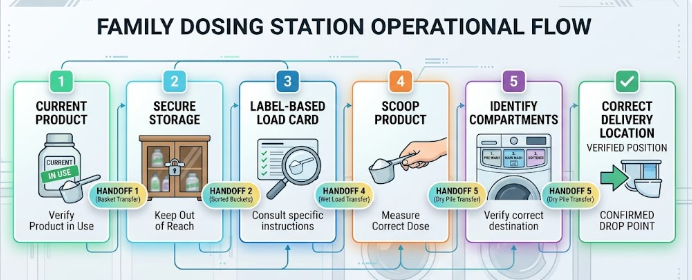
Create a Household Dosing Standard
A routine becomes easier when family members do not have to reinterpret the bottle for every ordinary load.
Create a small reference after you have checked the current label and washer manual:
| Load type | Starting instruction | Adjustment trigger |
|---|---|---|
| Routine family clothes | Product’s normal-load label dose | Change only for a different load size, soil level, hardness instruction, or product concentration |
| Small load | Product’s small-load direction, if provided | Do not split a pod unless the product explicitly supports it; choose an adjustable form if small loads are common |
| Large or heavily soiled load | Product’s applicable labelled dose | Also confirm the drum is not overloaded and the cycle suits the soil |
| Special item or stain | Set aside for item-specific instructions | Do not increase the entire load merely for one spot |
Write the product name and date on the reference. Replace it when the formula, package directions, washer, or household water source changes. A line drawn on an old cup is useful only while it still corresponds to the product in use.
What Not to Use as a Dose Test
Several familiar shortcuts are unreliable:
- “The cap should be full.” Caps often contain multiple dose lines, and concentrations differ.
- “More suds means cleaner.” HE products are designed to control suds; foam is not a cleaning score.
- “The clothes smell strongly clean.” Fragrance intensity does not measure soil removal or rinsing.
- “One pod is always one load.” Pack directions may distinguish load sizes, and a fixed unit may be awkward for small loads.
- “White marks prove the powder is bad.” Residue can have several causes, including dose, hardness, load, delivery, and rinsing.
- “An extra rinse makes overdosing harmless.” It uses more water and time and does not make deliberate excess a sound default.
Decision Summary
- Use the current detergent label as the dose baseline.
- Confirm whether the washer requires HE detergent.
- Adjust for the actual load size, whole-load soil, verified hardness guidance, and product concentration.
- Use the washer manual—not drawer appearance—to identify the correct compartment.
- Keep detergent, softener, bleach, and other additives in their designated systems and never mix chemicals.
- Choose liquid, powder, or packs based on compatibility, adjustability, secure storage, and cost per correct dose.
- Treat persistent residue, suds, or dispensing failure as a troubleshooting problem, not automatic proof that more or less detergent is the only answer.
- Change one factor at a time and keep a simple household reference for routine loads.
The best detergent dose is not a universal capful. It is a repeatable starting point that matches one product, one machine, and one kind of load. Once those pieces are clear, laundry becomes easier to teach, easier to share, and much less dependent on guesswork.
FAQ
How much laundry detergent should I use for a normal load?
Use the normal-load amount on the current detergent label, then confirm that the product and placement match your washer manual. There is no reliable universal volume because concentration, machine design, load definition, soil, and water hardness differ.
Is one laundry pod enough?
Follow the pack directions for the load size and soil level. A fixed single-dose pack may suit many routine loads but may be a poor fit for very small loads or may require a different labelled quantity for large or heavily soiled loads. Do not cut or puncture a pod to adjust it.
Can too much detergent make clothes smell or feel dirty?
Too much product can contribute to oversudsing or residue, but odour and poor feel can also result from overloading, incomplete drying, trapped moisture, machine buildup, water conditions, or an unsuitable cycle. Check the whole process before blaming one factor.
Where do I put detergent in a washing machine?
Use the location specified by both the product and washer instructions. Depending on the machine and product, that may be a main-wash drawer, the drum, or an automatic dosing reservoir. Do not infer placement from compartment size or copy another machine’s layout.
Can I put fabric softener in the detergent compartment?
No. Use fabric softener only as its label and the washer manual direct, normally through a designated softener dispenser that releases it during the rinse. If the machine has no compatible dispenser, follow the manual or omit it rather than improvising.
Should I use more detergent in hard water?
Some products direct a higher dose or a particular treatment for hard water, but follow the product label and use verified local hardness information. Do not increase detergent based on residue alone, because excess product, loading, dispensing, and rinsing can create similar signs.
Sources
- Whirlpool – What Is HE Detergent?
- American Cleaning Institute – Laundering Problems & Solutions
- Whirlpool Product Help – Using the Single Load Dispenser Drawer, Front Load Washer
- Whirlpool – What Is Fabric Softener and What Does It Do?
- Poison Control – What Happens If a Child Eats a Tide Pod?
- Whirlpool Product Help – Detergent Remains in Dispenser
More in This Cluster: Laundry Systems
- How to Build a Laundry Routine That Actually Gets Finished
- Sorting Laundry: What Still Matters and What Can Be Combined
- How Much Laundry Detergent Should You Actually Use? (you are here)
- How to Prevent Musty Towel Odours From Coming Back
- Air Drying vs Machine Drying: Which Is Better for Your Clothes?
- How to Treat Common Laundry Stains Before They Set
- Laundry Mistakes That Damage Clothes and Washers Too