A towel can smell clean when it leaves the dryer and musty again after one shower. Another may carry an odour straight from the washer. A third smells fine until it is folded into a cupboard. These are not necessarily the same problem, even though the result is similar.
Towels repeatedly absorb water, body soil, skin-care products, and laundry products. Their thick loops can hold moisture longer than a lightweight shirt. If a damp towel stays folded, piled, crowded, or sealed away, the conditions that support odour return. Washing may remove the current smell without fixing the point where moisture keeps getting trapped.
The most useful question is therefore not, “What should I add to the next wash?” It is: “At what stage does this towel stop drying fully?”
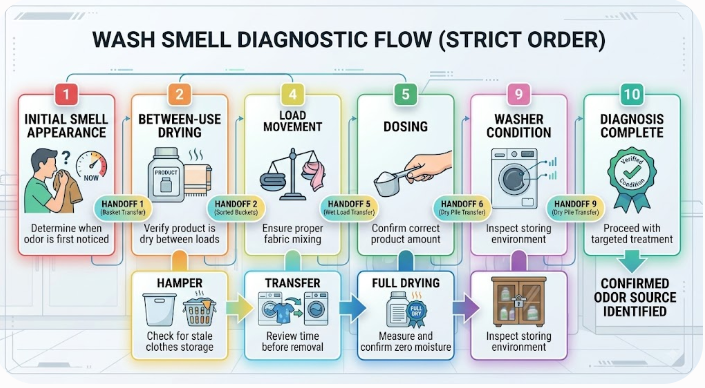
Check the complete path:
- drying between uses;
- waiting before wash day;
- space and movement in the washer;
- detergent and additive use;
- transfer after the cycle;
- complete drying before storage; and
- the washer itself.
Practical rule: Follow the moisture. Find the first point where towels stay damp, compressed, or enclosed, and correct that point before adding products or repeating the entire routine.
First, Notice When the Smell Appears
The timing of the odour is evidence. It will not prove one cause by itself, but it tells you where to begin.
| When the towel smells | Start by checking |
|---|---|
| Before wash day | How it dries after use; whether damp towels are piled in a hamper |
| When the washer opens | Load density; detergent and additive amount; cycle choice; whether the washer already smells |
| After sitting in the washer | How long the wet load waited before transfer |
| After drying | Whether thick areas are still damp; whether the dryer or rack was crowded |
| After storage | Whether towels were fully dry before folding; cupboard airflow or dampness |
| Only after the next use | Whether the towel dries between uses and whether residue is affecting absorbency or rinsing |
Do not change every variable at once. If you add a new product, increase the temperature, reduce the load, clean the machine, and change the drying method in one day, you may get a better result without learning what prevented recurrence. Correct the clearest moisture trap first, then test the same routine over several uses.
Give a Used Towel Air, Not Just a Hook
A towel needs exposed surface area and moving air to release moisture. A thick towel doubled over a small hook may remain damp where the layers touch. Several towels pressed together on one rail can create the same problem. A wet towel placed on a bed, floor, chair, or in a closed hamper has even less opportunity to dry.
After use:
- spread the towel over the available rail rather than bunching it;
- give each person’s towel its own space where possible;
- run the bathroom exhaust fan or use safe ventilation after bathing;
- move a towel to a better drying location if the bathroom stays humid; and
- do not add a visibly damp towel to a closed basket.
The US Environmental Protection Agency describes moisture control as the key to controlling mould and advises drying damp materials promptly. Its 24–48-hour guidance concerns wet building materials after leaks or spills, not a promise that every towel is safe for a fixed number of hours. For household towels, the practical lesson is simpler: do not deliberately hold them damp until wash day.
If wall space is limited, the answer may be a longer rail, spaced hooks, an over-door rack, or a rotation in which used towels dry before entering the hamper. Buy equipment only after identifying the real constraint. A larger hamper does not solve poor airflow.
Do Not Let the Hamper Become a Damp Holding Tank
A hamper is a collection point, not a drying appliance. Even a ventilated basket cannot reliably dry a wet towel buried beneath clothing.
Before putting a used towel into household laundry:
- let it air until it is no longer damp;
- keep it spread rather than rolled while it dries;
- remove any unusual contamination for situation-specific handling; and
- start the load before the basket becomes compressed and airless.
This does not require daily towel washing for every household. Wash frequency depends on use, household needs, climate, access to machines, and current health guidance. The system decision is to separate dry waiting from damp waiting. If wash day is not immediate, dry first and collect second.
If towels develop odour before they ever reach the washer, detergent is not the first variable to change. Improve the between-use and prewash drying step, then reassess.
Leave Enough Room for Washing and Rinsing
Towels absorb a great deal of water and become heavy. A drum that looks merely full when loaded with dry towels may leave too little room for the movement the washer is designed to provide. Crowding can limit contact with wash water and make rinsing less effective.
Use the appliance manual’s loading guidance rather than a universal “three-quarters full” rule. Capacity, drum design, cycle, and towel size differ. Large bath sheets may need a different load count from hand towels even in the same machine.
Keep the load reasonably compatible. A small number of lightweight items may wash safely with towels when their labels, colours, lint behaviour, and cycle needs agree, but stuffing additional clothing into a dense towel load merely to avoid another cycle can work against cleaning and rinsing. The detailed sorting decision belongs in Article “Sorting Laundry What Still Matters and What Can Be Combined”.
If the towels smell as soon as the wash ends, run one controlled test with a smaller compatible load and the correct cycle. A better result points toward loading or cycle selection. No improvement means you should continue down the chain instead of assuming more detergent is required.
Treat Detergent and Softener as Variables, Not Fragrance
Strong fragrance can cover an odour temporarily without showing that the cause has been removed. More detergent can also create a rinsing problem, especially when the load is dense or the machine uses relatively little water. Too little product may fail to handle the soil. The goal is the correct amount for the current product, washer, load, soil, and water conditions.
Start with the detergent label and washer manual. If you see persistent suds, a coated feel, visible residue, or a dispenser that does not empty properly, use the controlled dosing and placement check in Article “How Much Laundry Detergent Should You Actually Use”. Do not respond to every musty towel by pouring in an extra capful.
Fabric softener is optional. Some appliance guidance warns that softener can coat towel fibres and affect absorbency. That does not mean every softener caused every odour, but it makes repeated or excessive use a reasonable variable to review. Check the towel care label, product directions, and washer instructions. If you test omitting it, keep the detergent dose and other conditions stable so the result is interpretable.
Avoid improvised chemical combinations. Vinegar, bleach, ammonia, detergent, oxygen products, and other cleaners are not interchangeable, and some mixtures can release dangerous gases or damage textiles and machines. Use only a product that the towel label, product label, and appliance instructions permit, in the specified location and amount. Never mix household cleaning chemicals.
Transfer the Load Promptly
The washer finishes by leaving towels clean but wet. If they sit in the closed drum, the process has paused at its most moisture-intensive stage.
Use a reminder tied to the expected cycle end, or choose a delayed-start time that ends when someone can transfer the load. If the machine has a manufacturer-approved post-wash tumble or ventilation feature, it can help during a short delay, but it does not convert the washer into long-term storage.
Appliance guidance identifies wet laundry left in a washer as one possible source of musty smells and recommends prompt transfer. If a forgotten load already smells, do not simply dry it and hope heat or fragrance will conceal the problem. Rewash it according to the textile and machine instructions, then dry it completely.
The routine article, Article “How to Build a Laundry Routine That Actually Gets Finished”, treats this as a handoff problem: the person who starts a load must either own the transfer or explicitly pass it to someone who can. A phone alarm is useful only if someone has accepted the task.
Dry the Thickest Part Completely
Public-health guidance for ordinary household laundry says to use detergent, the recommended water temperature, and dry items completely. “Completely” matters more than whether the household uses a dryer or a rack.
Before folding, check the towel’s thickest and slowest-drying areas:
- hems and decorative bands;
- doubled corners;
- folds created on a crowded rack;
- the centre of a large bath sheet; and
- any section that was pressed against another item.
In a dryer, follow the towel and machine instructions, clean the lint filter as directed, and avoid a load so dense that items remain bundled. A sensor cycle may end before one unusually thick item is dry; check rather than assuming. On a rack or line, open the towel fully, leave space between items, and account for indoor humidity and airflow.
Do not use maximum heat as the automatic answer. High heat can be unsuitable for some fibres, trims, and finishes. Use the warmest wash and suitable drying method allowed by the care label and machine guidance. Article “Air Drying vs Machine Drying Which Is Better for Your Clothes” owns the full air-versus-machine drying decision, including energy, climate, space, and garment trade-offs.
Store Only What Is Fully Dry
Folding hides damp areas. A towel that feels cool may simply be cool, but it may also retain moisture in a thick hem. Pause before closing it into a stack.
Storage should be dry, clean, and not so compressed that a slightly damp item affects the entire pile. If clean towels smell only after time in one cupboard, inspect the storage environment rather than repeatedly rewashing every towel. Look for condensation, a plumbing leak, damp shelving, or an odour already present in the cabinet.
Do not treat this article as a mould-remediation guide. Visible growth, recurrent building dampness, water damage, sewage or flood exposure, or an unexplained health concern requires the appropriate property, public-health, insurance, or professional response. EPA guidance emphasizes correcting the water source when mould is present.
If the cupboard itself is dry and odour-free, test a smaller, fully dried stack with a little more space. That isolates storage from washing and drying variables.
Check Whether the Washer Is Returning the Smell
If different loads leave the machine with the same odour, or the empty drum smells, the towels may be carrying a machine problem rather than creating it.
Check the washer manual for its cleaning cycle and maintenance instructions. Depending on the model, relevant areas may include:
- the door gasket or lid area;
- detergent and softener dispensers;
- a removable filter or pump access point;
- the drum-clean cycle;
- drainage or installation requirements; and
- the manufacturer’s instruction about leaving the door or drawer open between uses.
Do not dismantle panels, mix cleaners, or copy another model’s cleaning method. Manufacturer guidance notes that water and laundry-product residue can accumulate in washers and that damp internal areas may develop odour; the model’s own cleaning directions should control.
If water remains where it should drain, the machine reports an error, the gasket is damaged, sewage-like odour appears, or cleaning does not correct the problem, stop treating towels as the cause. Building drainage, installation, or appliance service may need attention.

Run a One-Variable Towel Reset
When the cause is unclear, use one small batch of affected towels as a test.
- Read the labels. Confirm permitted wash temperature, drying method, detergent, and any additive restrictions.
- Check the machine. If the empty washer smells, complete its manual-directed maintenance first.
- Use a smaller compatible load. Give the towels room to move and rinse.
- Use the correct detergent dose. Do not add extra fragrance or combine chemicals.
- Transfer immediately. Set an alarm before starting the wash.
- Dry fully. Check hems and the centre before folding.
- Store separately for the test. Use a known-dry shelf or basket.
- Observe the next use. Hang the towel open with airflow and note when, if at all, the smell returns.
If the test batch stays fresh, reintroduce one ordinary condition at a time. If it smells only after returning to the usual bathroom, focus on between-use drying. If it smells only in the usual cupboard, inspect storage. If every load smells on opening the washer, focus on the appliance and its operation.
Replace a towel when it remains objectionable after label-safe washing and complete drying, has visible deterioration that cannot be safely corrected, or no longer performs adequately. Replacement should follow diagnosis, not substitute for fixing a damp rail, forgotten load, or wet cupboard that will affect the next towel too.
What Not to Assume
- “A stronger scent means the towel is cleaner.” Fragrance is not a cleaning or dryness test.
- “Musty means I need more detergent.” Dose is only one point in the moisture pathway.
- “Hotter is always better.” The care label and machine instructions set limits.
- “A hamper with holes can dry a soaked towel.” Air openings do not help much when wet textiles are compressed together.
- “The dryer finished, so every towel is dry.” Check thick areas before folding.
- “The towel is the problem.” A damp bathroom, cupboard, washer, or drainage issue may be returning the odour.
- “One homemade mixture is safe for every fabric and machine.” Use compatible, labelled products and never mix cleaning chemicals.
Decision Summary
- Identify when the odour first appears.
- Spread towels fully between uses and improve safe ventilation.
- Let damp towels dry before they enter a hamper.
- Follow the washer’s loading limit and give dense towels room to move.
- Use the label-based detergent dose and review optional softener if residue is suspected.
- Transfer wet towels promptly after washing.
- Confirm the thickest areas are fully dry before folding.
- Test the storage space if clean towels develop odour in the cupboard.
- Clean and maintain the washer only as its manual directs.
- Change one variable at a time so the household learns what actually prevents recurrence.
A lasting fix is rarely a secret ingredient. It is a continuous moisture-control system. When towels can dry after use, move through the washer without delay, finish drying before storage, and return to a dry place, the household has removed the conditions that allow mustiness to keep coming back.
FAQ
Why do my towels smell musty even after washing?
Possible causes include damp storage before washing, a crowded load, incorrect detergent or additive use, delayed transfer, incomplete drying, a damp cupboard, or odour inside the washer. Note when the smell first appears and check that stage before changing several products.
Should I wash musty towels in hot water?
Use the warmest water permitted by the towel’s care label and suitable for the washer and products. Hotter is not universally safe and does not correct a damp hamper, delayed transfer, or wet storage space.
Does fabric softener make towels smell?
It is not the only possible cause. Some softeners can coat fibres or affect towel absorbency, especially if overused or incompatible. Follow the towel, product, and washer instructions, and test omitting softener while keeping other variables stable.
Can I put vinegar and baking soda in the washer together?
Do not improvise mixtures. Use only products and placements permitted by the textile label, product label, and washer manual. Never mix cleaning chemicals, particularly bleach with acids or ammonia.
How can I keep wet towels from smelling before wash day?
Hang each towel open with airflow until dry, then place it in the hamper. Do not roll or bury a damp towel under other laundry. If the bathroom stays humid, use safe ventilation or move the towel to a better drying location.
How do I know whether the washer is causing the smell?
Smell the empty drum and notice whether different types of laundry leave with the same odour. Check for residue and standing water only in areas the manual identifies, then run the manufacturer-directed maintenance cycle. Persistent drainage or sewage-like odours may need service or building attention.
Sources
- EPA – A Brief Guide to Mold, Moisture and Your Home
- Whirlpool – How to Wash and Dry Towels to Keep Them Soft
- Whirlpool – How to Remove Smells in a Front Load Washer
- CDC – When and How to Clean and Disinfect Your Home
- Whirlpool – How to Clean a Front Loading Washer
More in This Cluster: Laundry Systems
- How to Build a Laundry Routine That Actually Gets Finished
- Sorting Laundry: What Still Matters and What Can Be Combined
- How Much Laundry Detergent Should You Actually Use?
- How to Prevent Musty Towel Odours From Coming Back (you are here)
- Air Drying vs Machine Drying: Which Is Better for Your Clothes?
- How to Treat Common Laundry Stains Before They Set
- Laundry Mistakes That Damage Clothes and Washers Too