Twenty years after opening his first credit card, Jerome still did not feel that he understood credit scores particularly well. He knew that card issuers, mortgage lenders, and auto dealers sometimes checked his credit. He also knew that missed payments could cause trouble. Yet the number itself remained something he rarely looked at, partly because he had heard that checking it could hurt it.
That combination is common: years of experience using credit without a clear picture of how the score is made. The system becomes easier to understand once three separate things are identified—the information in a credit report, the formula applied to that information, and the lender’s wider decision about whether and on what terms to offer credit.
Quick decision: Check your own credit reports before an important application. Doing so does not lower your score. Confirm that the accounts and payment information are accurate, note which score and scoring model you are viewing, and ask a prospective lender whether a rate inquiry can begin without a hard credit check. Treat the score as one input in a lending decision, not as a complete measurement of your finances or character.

A Credit Score Is a Model Output
A credit report is a record. It may show credit cards, loans, limits, balances, payment history, collection accounts, credit inquiries, and identifying information. Lenders and other companies supply much of that account data to credit bureaus, which assemble reports.
A credit score is a calculation made from information in one of those reports. A scoring company designs a model to estimate a particular kind of credit risk. The model converts selected report data into a number. A lender may then use that number alongside other information when deciding whether to approve an application, how much to lend, and what price or terms to offer.
The chain looks like this:
Creditor data → credit-bureau report → scoring model → score → lender decision
Each arrow matters. A creditor may not report to every bureau. Reports may update on different dates. Models may weigh information differently. A lender may use a score that differs from the one shown in a banking app and then consider income, existing obligations, collateral, down payment, and its own underwriting rules.
The score therefore has a narrower meaning than people often give it. It summarizes information available to a specific model at a specific time. It does not certify that someone is financially secure, responsible in every part of life, or able to afford a particular payment.
Why You Can Have More Than One Credit Score
There is no single permanent score stored in one universal file.
Several variables can change the result:
- Credit bureau: Different bureaus may hold different information about the same person.
- Scoring model: FICO, VantageScore, and other models use their own formulas and versions.
- Loan purpose: A lender may use a model designed or selected for mortgages, auto lending, credit cards, or another decision.
- Calculation date: A new reported balance, payment, account, or inquiry can change the inputs.
- Country: Credit-reporting systems, score ranges, laws, and bureau practices differ by jurisdiction.
In the United States, many consumer scores use a 300-to-850 range, although not every score does. Canada’s main consumer scores usually range from 300 to 900. A number from one country or model should not be compared mechanically with a number from another.
The Consumer Financial Protection Bureau notes that a score obtained by a consumer may differ from the score a lender uses. That does not automatically indicate an error. The useful comparison begins with four labels: bureau, model, version or score type, and date.
If a lender says your score was 718 while an app shows 742, ask what score the lender used and when it was calculated. Then compare the underlying reports. The difference may come from timing or model choice; it may also reveal that one report contains information the other does not.
What Information Usually Matters
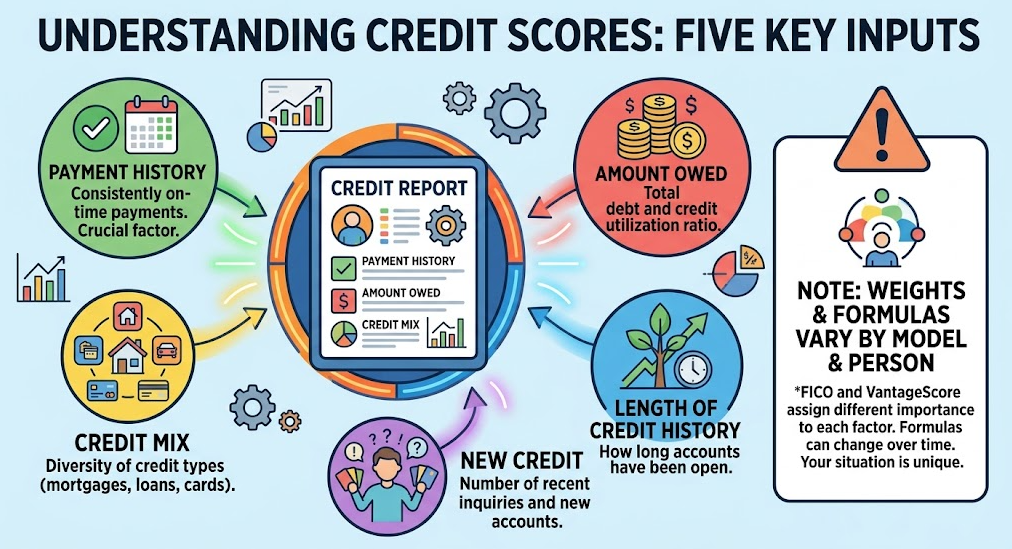
Exact formulas are proprietary and vary. Still, common scoring systems examine recognizable categories of credit-report information.
Payment history
Models generally consider whether reported credit obligations were paid as agreed. A late payment is not simply a moral label attached to a person. The model may consider how late it became, how recently it occurred, how often it happened, and what other information appears in the file.
Payment history is the largest stated category in a general FICO score—35% for the general population. That percentage is an educational guide, not a calculator for predicting the exact number of points a payment will add or remove.
Amounts owed and available revolving credit
Models may consider balances across accounts and how much revolving credit is being used relative to available limits. A credit card near its limit can convey different risk information from an installment loan that is being paid down on schedule, even when the dollar balances look similar.
FICO describes “amounts owed” as 30% of a general score. Credit utilization deserves its own treatment because statement dates, individual-card balances, and total limits can complicate the simple percentage. Article”Credit Utilization Explained admin” will explain that subject in detail.
Length of credit history
The age of accounts can provide a longer record of how credit has been managed. Models may consider the oldest account, newest account, average age, and how recently accounts have been used. A long history can help, but a person does not need twenty years of credit or an unnecessary old account to be worthy of credit.
New credit and inquiries
Applications can create hard inquiries, and opening several accounts in a short period may indicate increased risk to some models. The effect depends on the model and the rest of the file. Rate-shopping rules may group qualifying mortgage, auto, or student-loan inquiries made within a limited window, but the window varies by model.
Credit mix
Models may consider experience with revolving credit, such as cards or lines of credit, and installment credit, such as auto, student, or mortgage loans. Credit mix is not an instruction to borrow. FICO expressly notes that it is unnecessary to have one of every account type.
What a Credit Score Usually Does Not Measure
One of the most useful distinctions appears at an auto dealership. Jerome has seen dealers consider both a credit score and income when calculating financing terms. Those are related to the same loan decision, but they are not necessarily inside the same score.
For example, FICO says its scores are calculated only from information in the credit report. Salary, occupation, and employment history are not FICO score factors. A lender may still request them to decide whether the proposed payment is affordable and whether the application meets its policies.
Likewise, a credit score does not directly measure:
- the amount in a bank or investment account;
- whether the household has an emergency fund;
- the cost of rent, childcare, medicine, or other unreported obligations;
- the condition or value of collateral;
- the applicant’s current income under models that use report data only; or
- whether a particular loan is a good decision for the borrower.
This is why a high score does not guarantee approval or a low interest rate, and why a modest score does not prove that a person is incapable of managing money. The score estimates a defined risk from available data. Underwriting makes the broader transaction decision.
Checking Your Own Credit Does Not Hurt It
Jerome’s reluctance to look at his own score came from a familiar misunderstanding: he had heard that a credit check can lower the score, so avoiding checks seemed safer.
The missing distinction is who requests the information and why.
Soft inquiry
Checking your own credit report or score is generally a soft inquiry and does not affect your credit score. Existing-account reviews, prescreening, and some other non-application checks may also be soft inquiries.
Hard inquiry
A lender commonly makes a hard inquiry after a consumer applies for a new credit card, auto loan, mortgage, refinance, or other credit. Hard inquiries can affect scores because recent applications may be part of a scoring model.
Before giving personal information at a dealership or lender, ask:
- Are you quoting a general rate or taking a credit application?
- Will this step create a hard inquiry or a soft inquiry?
- Which lender or lenders will receive the application?
- If I compare offers, what rate-shopping period may apply to this loan type?
In the United States, CFPB says a person can ask about rates without authorizing a credit-report pull. When a formal application begins, read the consent rather than assuming that an early conversation is only informational.
A Score and a Report Answer Different Questions
A single number can show that something changed without explaining what changed. The report provides the account-level information needed to investigate.
Suppose a score falls after an otherwise ordinary month. Possible explanations include a newly reported card balance, a late payment, a new account, a hard inquiry, a closed account, or incorrect information. Staring at the number cannot identify which one occurred.
A useful review pairs the two:
- Score: What number, model, bureau, and date am I seeing?
- Report: Which accounts, balances, dates, payment statuses, and inquiries supplied the underlying data?
In the United States, consumers can obtain reports from Equifax, Experian, and TransUnion through AnnualCreditReport.com; CFPB says online reports are currently available weekly at no charge. In Canada, the Financial Consumer Agency of Canada directs consumers to free reports from Equifax and TransUnion. Availability of a free score varies by bureau, province, financial institution, and service.
Use an official government-recommended or bureau channel, and read subscription terms before accepting a “free” score. Some services provide an educational score rather than the version a lender will use. The educational score can still help track general movement, provided its identity and limits are understood.
Jerome’s Experience: Consistency Was Real, Even Before the Formula Was Clear
Jerome concentrated on paying cards, mortgages, and installment obligations on time. His reasoning was simple: credit begins with keeping agreements consistently. That principle does align with a major part of credit scoring, even though it does not explain the full calculation.
He also remembers a colleague in Korea who used several cards to cover one card bill with another. As the cash-flow problem deepened, the colleague turned to very high-cost credit that deducted interest in advance. Wage garnishment eventually reached the workplace.
That experience should not be used to infer the colleague’s exact score, diagnosis, motives, or later access to credit. It does show why a score cannot be separated entirely from cash flow. When incoming cash can no longer support recurring promises, moving balances between accounts may postpone a deadline while increasing cost and fragility. Missed payments, collections, judgments, or other events may then enter the relevant credit system according to local rules.
The lesson is broader than “always pay on time.” A promise can be kept sustainably only when the amount and schedule fit the borrower’s real income and essential expenses. Credit health begins before the reporting date, in the decision about whether the obligation is affordable.
Read a Lender’s Decision in Layers
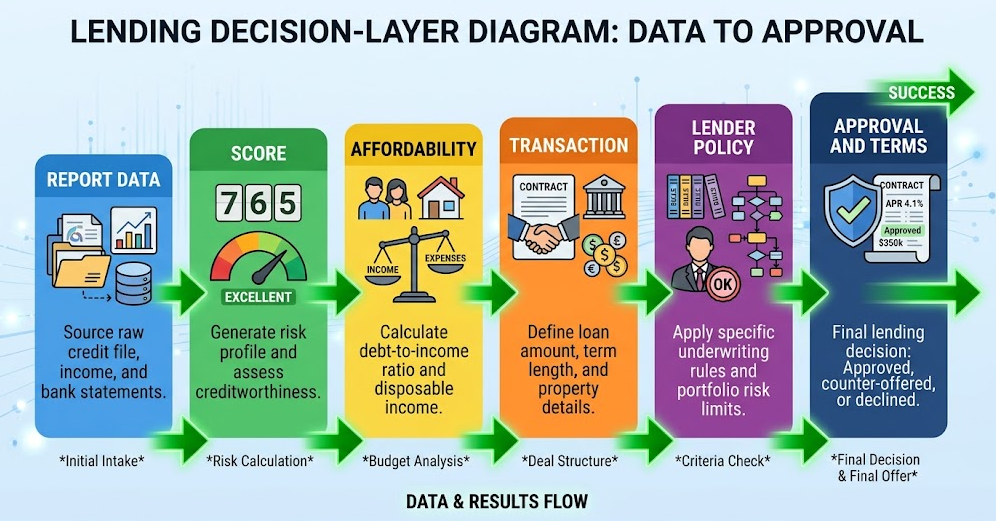
When an application is approved or denied, separate the result into layers:
- Report data: What did the bureau provide?
- Score: Which model, version, bureau, and date produced the number?
- Affordability: What income and existing obligations did the lender consider?
- Transaction: What amount, term, collateral, down payment, or credit limit was requested?
- Lender policy: What approval rules, pricing tiers, and documentation standards applied?
This prevents two common errors. The first is assuming that a strong score entitles someone to any requested loan. The second is treating an expensive offer as proof of personal failure when the product, term, collateral, or lender policy may also have affected the price.
If the offered interest rate is worse than expected, request the score disclosure or adverse-action information available under local law, compare another lender, and review the report used. Do not focus exclusively on changing the number when the immediate problem may be an error, insufficient income for the requested payment, a costly loan structure, or a thin credit file.
A Practical First Review
Set aside thirty minutes when no application is pending.
- Obtain your credit report through an official or government-recommended channel.
- Verify identity information and look for accounts you do not recognize.
- Compare reported balances, limits, payment status, and recent inquiries with your records.
- If a score is available, record its model or score type, bureau, date, and range.
- Save errors for formal dispute rather than trying to compensate for them with a new account.
- List the next major use of credit—first card, apartment application, auto loan, mortgage, or refinance—and the likely timing.
- Avoid opening credit solely to manipulate one category before understanding the cost and the lender’s actual requirements.
This review establishes a baseline. The rest of the cluster can then answer narrower questions: report versus score, actions that help build credit, common myths, late payments, utilization, and rebuilding time.
The Bottom Line
A credit score is generated, not discovered. It is the output of a particular model using information from a particular credit report at a particular time. Different bureaus, models, dates, and loan purposes can produce different numbers.
The number matters because it may influence access, rates, limits, deposits, or other terms. Still, the strongest first move is not chasing a few points. It is understanding the report beneath the score, checking it without fear, correcting inaccurate information, and accepting only obligations that the household’s cash flow can support.
Jerome was right that credit begins with consistency and keeping agreements. The fuller version adds one condition: the agreements themselves must remain manageable. A score records parts of that history. It cannot make the underlying promises affordable.
Important Note
This article provides general educational information, not individualized financial, credit, legal, or lending advice. Credit-reporting laws, scoring systems, access rights, and lender practices vary by country and jurisdiction. Confirm consequential decisions with the relevant credit bureau, lender, regulator, or a qualified nonprofit credit counsellor.
Frequently Asked Questions
Does checking my own credit score lower it?
No. Checking your own report or score is generally a soft inquiry and does not affect the score. A lender’s inquiry connected with a new credit application may be a hard inquiry.
Why is the score in my banking app different from the lender’s score?
The app and lender may use different bureaus, models, versions, purposes, or calculation dates. Record those labels before deciding that one number is wrong.
Is income included in a credit score?
It depends on the scoring system, but widely used FICO scores are based on credit-report information and do not include income. Lenders may consider income separately when making a loan decision.
Does a high score guarantee the lowest interest rate?
No. The lender may also consider income, debt obligations, loan term, collateral, down payment, product type, and its own pricing policy.
Should I open several accounts to create a credit mix?
Not solely for that purpose. New accounts can create inquiries, costs, and obligations. FICO says consumers do not need one of every credit type.
Is a credit report the same as a credit score?
No. The report contains account and credit-history information. A scoring model uses selected report information to calculate a score.
What should I do before applying for a car loan or mortgage?
Review your reports early enough to identify errors, learn which inquiries will occur, compare lenders within an appropriate shopping period, and evaluate the payment against your cash flow—not only against the amount a lender is willing to approve.
Sources
- Consumer Financial Protection Bureau — What Is a Credit Inquiry?
- Consumer Financial Protection Bureau — Where Can I Get My Credit Scores?
- Consumer Financial Protection Bureau — Does Requesting My Credit Report Hurt My Credit Score?
- Consumer Financial Protection Bureau — When Will My Lender Run a Credit Check?
- Financial Consumer Agency of Canada — Credit Report and Score Basics
- Financial Consumer Agency of Canada — Getting Your Credit Report and Credit Score
- FICO — What’s in My FICO Scores?
- AnnualCreditReport.com — Official U.S. Credit Report Access
More in This Cluster: Credit Fundamentals
- How Credit Scores Work (you are here)
- Credit Report vs. Credit Score: What Each One Tells You
- What Actually Helps Build Credit?
- Common Credit Score Myths That Can Cost You Money
- How Late Payments Affect Your Credit—and What to Do Next
- Credit Utilization Explained: Which Balance Actually Counts?
- How Long Does It Take to Rebuild Credit?