A credit problem can happen on one date. Recovery rarely has one completion date.
You might bring an overdue account current, pay down a heavily used card, or correct an error and then check your score a few days later. If the number has barely moved—or has not moved at all—it can seem as though the work accomplished nothing. More often, several systems are moving on different schedules.
The lender must update its records. The new information must reach a credit bureau. A score must be calculated from the report available at that moment. Then a future lender may assess that score alongside income, debt, the requested loan, and its own approval rules.
That sequence makes “How long will this take?” a useful question only after it is divided into smaller ones.
Quick Decision
If you have no immediate need to apply: stabilize every required payment, reduce fragile balances, correct report errors, and let accurate positive history accumulate before seeking new credit.
If an application is approaching: check the reports that may be used, confirm recent changes have been reported, compare the cost of applying now with the value of waiting, and use prequalification or rate-shopping tools that clearly state how the credit check will be handled.
If an account is already past due or unaffordable: contact the creditor or a reputable nonprofit credit counsellor promptly. Preventing another missed payment may matter more than monitoring the score.
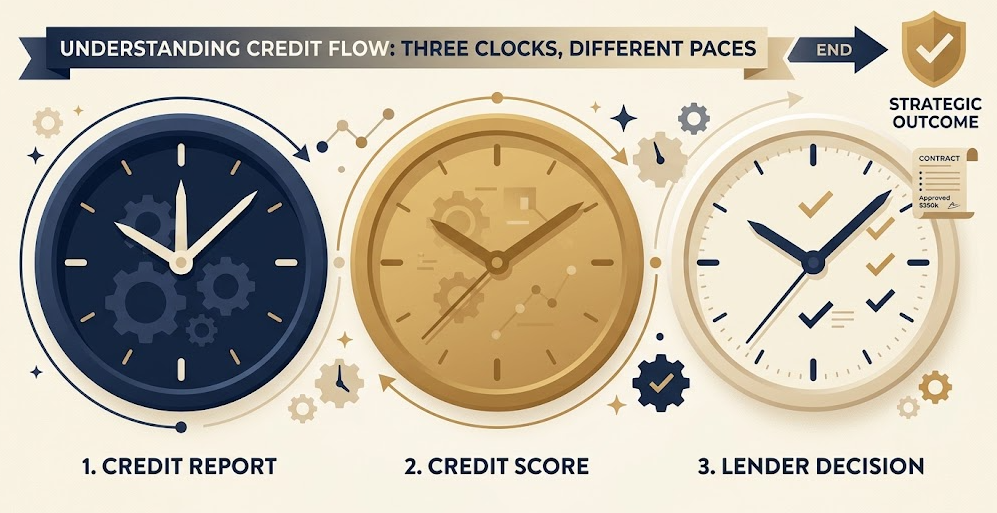
Credit Rebuilding Runs on Three Clocks
1. The credit-report clock
Your report changes when lenders and other information providers send updated account data and the bureau processes it. A payment made today may therefore appear on a later reporting cycle rather than immediately.
The change also has to be the right kind of change. Paying a card balance can lower the balance that is eventually reported. Bringing an account current can change its present status. Neither action automatically deletes accurate historical late payments.
Errors follow another process. In the United States, a credit reporting company generally must investigate a dispute within 30 days, with some circumstances allowing up to 45 days. In Canada, consumers can dispute inaccurate information with the credit bureaus for free, but the practical process and timing depend on the bureau, the information provider, and the supporting evidence.
These are processing rules, not promises about a score.
2. The credit-score clock
A score is calculated from a particular report using a particular scoring model at a particular time. There is no single score that continuously updates everywhere.
When newly reported information changes the underlying report, a later score calculation may respond. The size and direction of that response depend on the rest of the file, the model, and the information that changed. Someone with one recently high card balance may see a different pattern from someone rebuilding after several missed payments, a collection, or insolvency.
This is why a reliable recovery forecast cannot be created from the event alone. Two people can take the same action and receive different score results.
3. The lender-decision clock
An improved score does not establish that a borrower is ready for every loan. Lenders may also consider income, existing obligations, down payment, collateral, recent applications, account history, and the type and amount of credit requested. Their underwriting models and price tiers differ.
The practical milestone is therefore broader than “my score changed.” It is the point at which the report is accurate, recent obligations are stable, the requested payment is affordable, and available offers are acceptable.
First Stabilize the Record You Are Building From
Credit cannot develop a durable positive pattern while new damage is still being added. Before estimating a recovery period, identify what is happening now.
- Are all required payments current?
- Is another payment likely to be missed in the next month?
- Are card balances still rising because ordinary expenses exceed available cash?
- Does the report contain an error, fraud, or an account you do not recognize?
- Is the planned application urgent, or can it wait for a stronger file?
If cash flow cannot support every obligation, score optimization is not the first problem to solve. Contact creditors before a due date when possible, ask what hardship or payment options exist, and understand the cost and reporting consequences before agreeing. A legitimate credit counsellor may help organize choices when several accounts are involved.
Jerome’s own approach over roughly two decades of using credit has been simpler than trying to predict every scoring change: keep card, mortgage, and installment obligations paid as agreed. That principle does not reveal how quickly any score will change, but it protects the record on which future decisions will be based.
The Type of Problem Changes the Timeline
A high reported card balance
Credit utilization can change when a lower balance is reported. That may make it one of the more responsive parts of a file, but the calendar still depends on the issuer’s reporting and the date the score is calculated.
Do not borrow from another expensive source merely to create a temporary lower reported balance. A better-looking ratio is not useful if the transfer weakens cash flow or increases total cost.
For the full explanation of statement balances, reporting dates, and utilization, see Article”Credit Utilization Explained“.
A recent late payment
Becoming current stops the account from remaining presently overdue, but an accurate late-payment history can remain visible for the period allowed in the relevant jurisdiction. Its influence is not necessarily constant throughout that period, and scoring models do not publish a universal recovery schedule.
The immediate priorities are to prevent the delinquency from progressing, confirm the current status, and build a new series of on-time payments. Article”How Late Payments Affect Your Credit“, covers the event and response in detail.
An inaccurate item
An error is different from accurate negative information. Correcting it is a data-quality process, not a request for forgiveness. Keep copies of the report, the dispute, supporting records, delivery confirmations, and the result. After the investigation, obtain a fresh report and verify that the correction appears where expected.
If you are applying for important credit while a dispute is open, ask the lender how an active dispute may affect underwriting. Some lenders may pause or treat disputed information differently.
A collection, charge-off, consumer proposal, or bankruptcy
These events have different legal meanings and reporting periods. Country, province or state, bureau practices, account dates, and the type of proceeding can all matter. Paying or settling an account may resolve the debt obligation without erasing an accurate record or guaranteeing a particular score response.
Obtain advice appropriate to the specific event before relying on a generic timeline. A licensed insolvency professional, qualified attorney, or reputable credit counsellor may be appropriate depending on the issue and jurisdiction.
Retention Time Is Not the Same as Recovery Time
Official rules often describe how long information may remain on a credit report. Those rules are important, but they answer a records question—not the whole credit-rebuilding question.
In the United States, most negative information can generally be reported for seven years, while bankruptcies can remain for up to ten years. In Canada, retention periods vary by the type of information, province or territory, and bureau; many negative items remain for about six years, with important exceptions.
Those outer limits do not mean that every lender will react identically until the final day. They also do not mean a score will recover by a known amount before the information leaves. Recency, severity, frequency, the rest of the file, the scoring model, and the credit product all affect the outcome.
A useful progress measure is the distance between the old event and the most recent new problem. Each month without another missed obligation can extend a cleaner recent pattern, even while an older accurate item remains visible.
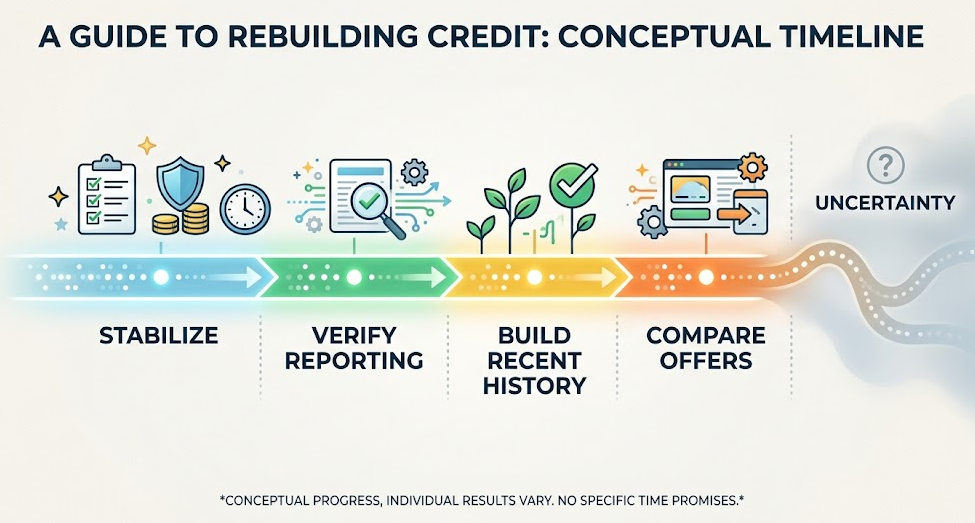
Use Review Windows, Not Score Deadlines
Setting a date by which a score “must” improve can turn normal reporting delays into panic. A review window creates a more useful task: check whether the expected information has changed and decide what to do next.
After the next expected reporting cycle
Check whether a paid-down balance, current status, or account correction appears. If it does not, confirm the lender’s records first. Then use the bureau’s dispute process if the report is inaccurate.
After several consecutive payment cycles
Review whether every required payment was made on time, balances are stable or falling, and new applications were limited to genuine needs. The objective is to see whether the plan is sustainable—not to search for a promised number.
Before an important application
Retrieve current reports early enough to correct errors. Compare debt payments with reliable income, estimate the new payment under more than one rate, and decide the maximum total borrowing cost you can accept.
Where a lender offers prequalification using a soft inquiry, read the terms carefully. Prequalification is not final approval, and not every quotation tool uses the same type of inquiry.
After a denial or costly offer
Do not submit repeated applications simply to see whether another lender says yes. Review the reasons provided, the report and score used when disclosed, and the price of the offer. The next action may be correcting an error, reducing debt, allowing more recent history to develop, or seeking a product that better fits the situation.
A Practical Rebuilding Plan
Step 1: Define the next decision
Name the credit event you are preparing for: an apartment, a vehicle, a mortgage, a lower-cost refinance, or simply a more resilient file. Add a realistic date and the maximum payment you can support.
This prevents a score from becoming an end in itself.
Step 2: Read the reports, not only the score
List every account, status, balance, credit limit, inquiry, public record, and unfamiliar item. Compare more than one bureau where appropriate because the contents may differ.
Step 3: Stop new negative information
Bring manageable accounts current, arrange reminders or automatic payments with sufficient account funds, and contact creditors about unaffordable obligations. Avoid a payment system so tight that one irregular expense causes another late payment.
Step 4: Correct factual errors
Dispute inaccurate information directly with the relevant bureau and information provider. Supply focused evidence and keep a complete record. Accurate negative information generally cannot be removed simply because it is damaging.
Step 5: Reduce fragile revolving balances
Paying down cards can improve both utilization and monthly flexibility. Choose a pace that leaves enough cash for housing, food, transportation, insurance, and the next required payments.
Step 6: Add no more credit than the plan requires
A new account can be useful when it is affordable and genuinely needed. Opening several products to “build faster” adds inquiries, new obligations, and administrative risk without a guaranteed benefit.
Step 7: Measure behavior and lender readiness
Keep a small dashboard:
- number of accounts currently paid as agreed;
- whether any new late status appeared;
- reported card balances and limits;
- unresolved report errors;
- total required monthly debt payments;
- months of cash-flow stability; and
- the estimated cost of the credit you may seek.
This dashboard shows progress even when different score providers display different numbers.
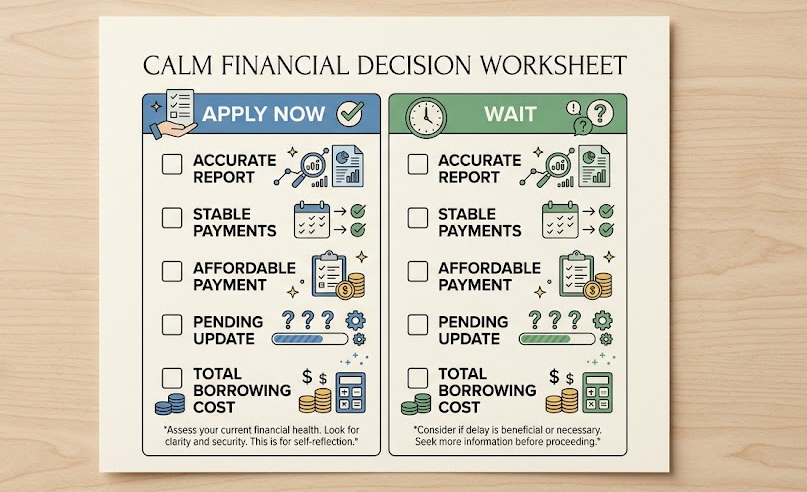
Decide Whether to Apply Now or Wait
Waiting can be valuable when a known balance reduction has not yet appeared, a material error is under investigation, recent payment stability is still fragile, or the available offer would strain the budget.
Applying now may still be reasonable when the need is urgent, the payment is affordable, the report is accurate, and the cost of delay exceeds the likely value of waiting. For example, reliable transportation needed for work may carry a different decision than replacing a functioning vehicle for convenience.
Compare both paths in dollars:
- What will the purchase or delay cost?
- What rate, fees, term, and total interest are actually available now?
- What specific report change are you waiting for?
- Has that change occurred, or is the plan based only on hope that a score will rise?
- Can you obtain updated quotes later without creating unnecessary applications?
The strongest decision uses a verified milestone. “The corrected account now appears on all relevant reports” is a milestone. “I waited three months, so my rate should be better” is an assumption.
Avoid Shortcuts That Can Make Recovery Harder
Be cautious when a company promises a new credit identity, a guaranteed score increase, instant deletion of accurate information, or a fixed recovery date. In the United States, federal consumer agencies warn that accurate negative information generally cannot legally be removed simply because it hurts. Consumers can dispute errors themselves for free.
Also avoid submitting disputes you know are false, misrepresenting information on an application, or paying to use a stranger’s credit history. These tactics can create legal, financial, and identity-theft risks.
Legitimate help should explain fees, services, limitations, and alternatives without demanding secrecy or guaranteeing results.
Decision Summary
Credit rebuilding has no universal finish line. The report must first contain accurate updated information; a scoring model must then evaluate that report; a lender must finally decide whether the full application meets its rules.
You can still make the process measurable:
- stabilize payments and cash flow;
- verify what each report actually shows;
- correct errors through official processes;
- lower costly or fragile balances at a sustainable pace;
- limit new applications to real needs;
- review progress after meaningful reporting and payment cycles; and
- compare actual loan terms instead of waiting for an imagined perfect score.
The most useful sign of recovery is a growing record of obligations handled as agreed, supported by a budget that can keep the pattern going.
Important note: This article provides general educational information, not individualized financial, legal, credit-repair, or insolvency advice. Credit reporting rules, retention periods, scoring models, and lender practices vary by jurisdiction and provider. Verify current requirements with official sources and seek qualified help for your circumstances.
Frequently Asked Questions
1. Can a credit score improve in one month?
It can change after updated information reaches a report and a new score is calculated, but no one can promise the timing, direction, or size of the change. Verify the underlying report change rather than treating one month as a deadline.
2. Does paying off debt remove negative information?
Paying debt can reduce what you owe and may resolve the account, but it does not automatically erase accurate payment history, collections, or other reportable events. Confirm how the account is reported afterward.
3. How long should I wait before applying for a loan?
Use a milestone instead of a fixed interval: accurate reports, expected updates posted, stable recent payments, an affordable new payment, and acceptable quotes. An urgent need may justify applying sooner than an optional purchase.
4. Will checking my own credit slow rebuilding?
Requesting your own report or score is generally treated differently from a lender’s hard inquiry and should not lower the score. Use official or clearly identified services, and review the terms before authorizing access.
5. Should I close old cards while rebuilding?
Closing an account can change available credit, utilization, fees, and account management. Decide based on cost, risk, and whether the account can be managed safely; closure is not a guaranteed score strategy.
6. Can a credit-repair company rebuild credit faster?
No company can guarantee a score increase or legally erase accurate negative information on demand. A legitimate service may help with organization or disputes, but consumers can challenge inaccuracies directly through the bureaus without paying a credit-repair company.
7. Why did one score improve while another did not?
The providers may have used different bureaus, report dates, or scoring models. Compare the underlying report information and ask a prospective lender which source it uses when that information is available.
Sources
- Consumer Financial Protection Bureau — How do I get and keep a good credit score?
- Consumer Financial Protection Bureau — How long does information stay on my credit report?
- Consumer Financial Protection Bureau — How long does it take to repair an error on a credit report?
- Federal Trade Commission — Fixing Your Credit FAQs
- Financial Consumer Agency of Canada — Credit report and score basics
- Financial Consumer Agency of Canada — How long information stays on your credit report
- Financial Consumer Agency of Canada — Checking your credit report for errors and fraud
More in This Cluster: Credit Fundamentals
- How Credit Scores Work
- Credit Report vs. Credit Score: What Each One Tells You
- What Actually Helps Build Credit?
- Common Credit Score Myths That Can Cost You Money
- How Late Payments Affect Your Credit—and What to Do Next
- Credit Utilization Explained: Which Balance Actually Counts?
- How Long Does It Take to Rebuild Credit? (you are here)