A small closet can hold a surprising amount of clothing and still fail at its main job. The problem appears on an ordinary morning: the shirt you want is hidden, the children cannot reach what they are expected to put away, and a bulky coat occupies the easiest section even though it is used only occasionally.
Adding another shelf or bin may increase capacity. It does not automatically improve access. A useful small closet keeps the clothing needed for current life visible and reachable, gives less-used items a deliberate secondary place, and preserves enough open space for garments to be returned without rebuilding the system each day.
From Jerome, EverydayWise Contributor
When my family moved from Korea to Canada, clothing became harder to organize than I expected. In Korea, the seasons made the exchange clearer: summer clothing could replace winter clothing, and winter removed the need for shorts. In Canada, a thick outer layer may still be useful outside the deepest winter, so it is difficult to decide how many bulky coats should stay near the door and how many can move farther away. Our children also need clothing at heights they can reach, while my wife and I share a walk-in closet by using different vertical areas.
The passage above comes from an EverydayWise contributor’s household experience. It illustrates the decision a small closet has to support: not simply how much can fit, but which person needs which clothing, how often, and at what height.
Quick decision: Organize the closet around access before capacity. Remove everything from only one bounded section, measure the usable rail, shelf, floor, and door space, and identify the clothing needed in the current two to four weeks. Give that clothing the easiest positions. Move occasional and clearly off-season items to secondary zones, keep children’s daily clothing within their reach, and leave enough open capacity for each item to return without force.
Begin With the Closet’s Actual Job
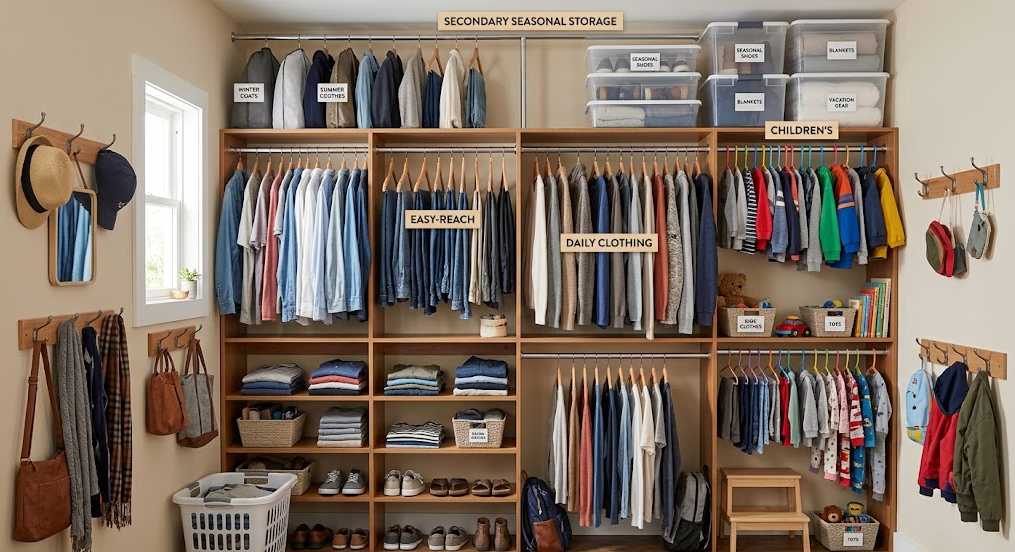
The same small closet can serve very different purposes. An entry closet may need to handle coats, school bags, umbrellas, and wet-weather transitions. A bedroom closet may support daily dressing, laundry return, workwear, and occasional clothing. A child’s closet also has to change as height, size, and preferences change.
Write one sentence describing the closet’s current job. For example:
- “This closet holds the outerwear and daily departure items used by four people.”
- “This closet supports my weekday clothing and a small amount of formal wear.”
- “This closet lets a child choose and return current-size clothing independently.”
That sentence becomes a boundary. If the entry closet’s job is daily departure, archived clothes and rarely used luggage should not occupy its easiest positions merely because they fit there. If a bedroom closet is the only available clothing storage, it may need both active and secondary zones—but the zones should not compete equally for access.
The goal is not a closet that looks empty. It is a closet that makes the next ordinary clothing decision easier.
Map What Happens Before Buying Organizers
Storage products are easiest to evaluate after the household knows what the space must hold. Begin with a short observation period or a review of the previous two weeks.
Notice:
- which garments are repeatedly removed and returned;
- which items are searched for but difficult to find;
- where clean laundry waits because its assigned place is inconvenient;
- which clothes remain visible but are rarely chosen;
- which items belong to another room or another person;
- where shoes, bags, or accessories interrupt clothing access; and
- which parts of the closet are unreachable, too deep, or awkward to use.
This produces a more useful inventory than counting every garment at the beginning. The immediate question is which items earn the most accessible space.
Avoid emptying the entire closet unless it can be restored in the same session. The bounded-session method in Article”How to Declutter Without Making a Bigger Mess” applies here: work on one metre or yard of rail, one shelf, one drawer, or one person’s section at a time. A small closet becomes less useful very quickly when its contents cover the bed and floor before destinations have been decided.
Measure Usable Space, Not Just Empty Dimensions
A closet’s nominal width and height do not equal usable storage. Doors need clearance. Garments hang below a rail. A shelf may be deep enough to hide a second row. A corner may technically hold a bin but make the adjacent clothes difficult to remove.
Record:
- internal width, depth, and height;
- rail length and height;
- shelf width, depth, and spacing;
- floor area left after hanging garments;
- door type and swing or sliding overlap;
- baseboards, vents, lights, access panels, and outlets;
- the longest and bulkiest garments; and
- comfortable reach ranges for each user.
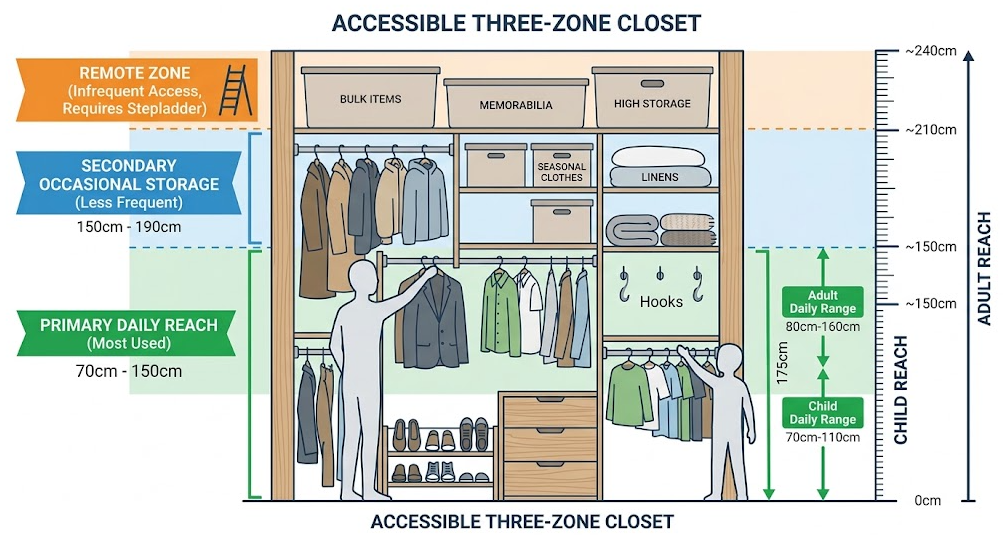
Then mark three access zones:
- Primary zone: comfortable daily reach with no stool, reshuffling, or second container to move.
- Secondary zone: reachable with a deliberate extra step; suitable for occasional or backup items.
- Archive or remote zone: difficult to reach or outside the closet; suitable only for genuinely infrequent and clearly labelled storage.
This map prevents a common mismatch: placing daily items in the largest available space even when that space is inconvenient. The most accessible area is usually more valuable than the biggest one.
Give Current Clothing the Primary Zone
Current clothing is not necessarily everything appropriate to the official season. It is the clothing the household may realistically need during the present weather, routines, work, school, and planned events.
Jerome’s experience in Canada shows why a strict seasonal swap may not fit every climate. A household may keep one or two warmer outer layers accessible during a mild period while moving the rest of the winter volume to a secondary location. The decision can be based on actual near-term use rather than the name of the season.
Within the primary zone, group clothing according to the decisions people make while dressing. Useful groupings may include:
- school or work clothing;
- frequently worn casual clothing;
- exercise or activity clothing;
- current outer layers; and
- one small group for near-term events.
Keep categories broad enough to maintain. Dividing shirts by colour, sleeve length, fabric, purpose, and formality may look precise but create too many rules for a small daily system. A category is useful when someone can return an item without pausing to interpret it.
The detailed seasonal-rotation process belongs to Article”Seasonal Clothing Rotation”. For this article, the small-closet rule is simpler: near-term clothing receives prime access; clothing with a credible but less frequent use moves outward or upward.
Use Vertical Space Without Turning It Into Hidden Space
The area above the main rail often appears to be unused capacity. It can help, but only when the stored items can be identified and retrieved safely.
Upper shelves work best for light, infrequently used items in containers that can be handled without losing balance. A label should be readable from the floor. If every retrieval requires opening several identical bins, the shelf has become hidden storage rather than useful storage.
Lower space may support short-hanging garments or a limited folded-clothing area. Before adding a second rail or freestanding unit, check the length of the garments above it and the clearance needed to use drawers, doors, and the floor.
Avoid filling every vertical gap. A small amount of working space allows hangers to move, folded clothing to be removed without disturbing a full stack, and clean laundry to return to its assigned place. When the final item fits only after compressing the others, the closet has lost operating capacity even if its physical capacity is not yet exceeded.
Detailed comparisons among hangers, drawers, and bins belong to Article”Hanger, Drawer, and Bin Storage Compared”. The principle here is to assign each vertical zone a clear access level and avoid products that solve one dimension by blocking another.
Decide What to Hang and What to Fold
The best method depends on the garment, the available space, and how the person uses it.
Hanging may be useful when a garment:
- wrinkles easily;
- is selected visually;
- is worn frequently enough to justify rail space; or
- keeps its shape well on an appropriate hanger.
Folding may be more suitable when a garment:
- can stretch or distort while hanging;
- is small enough to disappear among longer garments;
- stacks or stands securely in a drawer or on a shelf; or
- belongs to a category used together, such as sleepwear or exercise clothing.
Canadian Conservation Institute guidance is written for museum and collection textiles, not an ordinary family wardrobe. It nevertheless supports a useful care boundary: clean, dry textiles should be stored in a cool, dry, ventilated place, and some garments—particularly fragile, heavy, knitted, decorated, or bias-cut pieces—may need flat support rather than hanging. Everyday clothing does not require museum packaging, but the garment’s weight and construction still matter.
Do not force one method across the entire closet. Rail space is scarce, but folding every item can make clothing visually disappear. A mixed system can protect garments while preserving access.
Make the System Reachable for the Person Who Uses It
A shared family closet often fails when it is organized from the perspective of the tallest adult. A child may be told to choose clothes or put laundry away while the relevant rail, shelf, or bin remains beyond reach.
For children, place a limited set of current-size, frequently used clothing where they can see and return it. High shelves can hold adult-managed categories, next-size clothing, or infrequent items, but they should not contain the child’s ordinary daily choices.
Small items such as children’s socks can be difficult to fold into stable piles. A shallow, clearly bounded section may be easier to use than a deep stack. The exact container matters less than whether the child can identify the category, reach it safely, and return the item without reorganizing the drawer.
Adults sharing a closet may also use height deliberately. Jerome places his clothing higher and his shorter wife’s clothing lower in their shared walk-in closet. That arrangement works because reach is connected to the person using the section. The full negotiation of shared space, category ownership, and equal access belongs to Article”Closet Organization for Shared Spaces”; here, the immediate test is whether each person’s daily items are physically usable by that person.
Protect Airflow, Clothing Condition, and Safe Movement
A tightly packed closet can conceal damp clothing, stains, insect activity, or damaged seams. Before putting clothing into a less-visible zone, confirm that it is clean and dry. Do not seal damp outerwear or recently worn clothing into a closed container.
The Canadian Conservation Institute notes that textiles are vulnerable to moisture, mould, pests, light, dust, and unsuitable storage. Its collection-care standards are more protective than most everyday wardrobes require, but the general lesson remains relevant: storage should not trap moisture, distort a garment under its own weight, or make inspection impossible.
Keep floors and doorways clear enough for normal movement. Do not store clothing against heaters, cover ventilation equipment, block electrical panels, or interfere with a closet light or access point. Follow the closet-system and building manufacturer’s limits rather than assuming every shelf or rail can support additional weight.
Freestanding dressers and clothing-storage units require particular attention in homes with children. The U.S. Consumer Product Safety Commission recommends anchoring dressers and other clothing-storage furniture securely to the wall and following applicable instructions because unstable units can tip over. Product requirements and installation methods vary by country and model, so use the manufacturer’s hardware and local safety guidance. A high shelf is not a reason for a child to climb a drawer or freestanding unit.
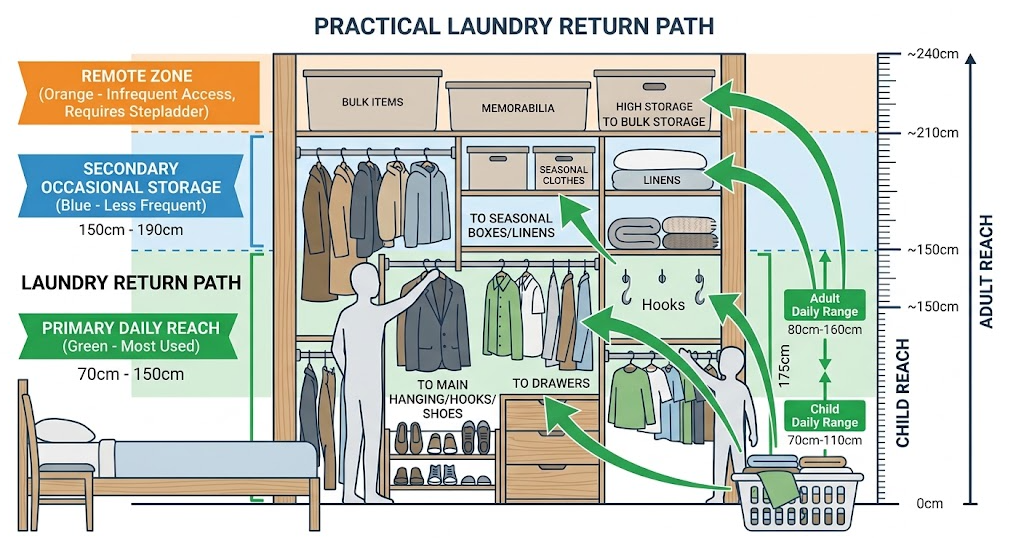
Create One Complete Return Path
An organization plan succeeds only when clean clothing can travel back into the closet.
Test the return path with one laundry load:
- Can each item be identified as hanging, folded, or stored elsewhere?
- Is its destination visible and reachable?
- Can it be returned without moving another category first?
- Is there room for normal variation between laundry days?
- Can every household member follow the system without a private explanation?
If clean clothing regularly stops on a chair, bed, or laundry basket, examine the assigned destination before concluding that the household lacks discipline. The category may be too full, too far away, divided too narrowly, or dependent on a folding method no one maintains.
Change one source of friction at a time. Widen a category, lower a child’s section, remove an unused organizer, or move an occasional garment out of the primary zone. A complete, simple return path is more valuable than a highly detailed system that works only immediately after a reset.
Finish One Small-Closet Reset
For a first session, choose one section that currently slows down a repeated task. It might be the coat rail near the entrance, one child’s current clothing, or the part of a bedroom closet used on workdays.
Use this order:
- State the section’s job.
- Set a physical boundary and finish time.
- Remove only that section’s contents.
- Identify current, occasional, misplaced, outgrown, and undecided items.
- Measure the available space and each user’s reach.
- Return current clothing to the primary zone.
- Assign occasional clothing to a labelled secondary zone.
- Route outgrown, damaged, or no-longer-used clothing to the next decision without leaving an indefinite floor pile.
- Test the result with the next laundry return or departure routine.
Donation can be one responsible route for usable clothing, but acceptance standards vary. The U.S. Environmental Protection Agency includes donation and reuse among ways to reduce waste; local organizations still decide what condition, season, and item types they accept.
The first reset does not need to resolve every garment in the household. It needs to make one small closet section easier to use today while showing what the next specialist decision should be: seasonal rotation, quantity, storage method, accessories, shared space, or maintenance.
FAQ
Should I remove everything from a small closet at once?
Only if the entire closet can be decided and restored in the same session. Otherwise, work on one rail section, shelf, drawer, category, or person’s area so the bed, floor, and remaining closet stay usable.
What should go in the easiest-to-reach part of the closet?
Clothing that is likely to be used during the current two to four weeks should receive the primary zone. Adjust for weather, work, school, planned events, mobility, and the person using the space rather than relying only on the calendar season.
Should I buy organizers before sorting my clothes?
Usually not. First identify the closet’s job, measure the usable space, observe what must remain accessible, and decide which categories belong there. Then a product can be evaluated against a known problem instead of becoming another object to fit.
How full should a small closet be?
There is no universal percentage. The practical limit arrives when items cannot be seen, removed, and returned without compressing or moving other categories. Preserve enough working capacity for ordinary laundry and seasonal variation.
How can children keep their closet organized?
Give them a limited set of current-size daily clothing at a safe, reachable height. Use broad, visible categories and avoid a return process that requires climbing, complex folding, or moving several containers.
What if the closet still cannot hold everything we use?
Confirm that the closet is serving its stated job and that secondary items have not occupied the primary zone. If all remaining clothing has a credible use, the next decision is whether to rotate it, reduce quantity, add appropriate storage elsewhere, or change the closet’s physical layout. Those decisions are addressed in the remaining articles in this cluster.
Sources
- Basic Care — Textiles — Canadian Conservation Institute
- CPSC Adopts Final Consumer Product Safety Standard to Prevent Tip-Overs of Dressers and Other Clothing Storage Units — U.S. Consumer Product Safety Commission
- What You Can Do — U.S. Environmental Protection Agency