A wardrobe can be crowded and still fail on an ordinary Tuesday. Five similar shirts may occupy the rail while the one layer needed for work is in the laundry. A much smaller wardrobe can fail for the opposite reason: every missed wash creates an immediate shortage.
That is why an ideal clothing number rarely transfers cleanly from one person to another. The useful target is a working range—enough clothing to cover real roles, laundry intervals, climate, fit, and a reasonable disruption buffer, while remaining visible and manageable in the available space.
From Jerome, EverydayWise Contributor
I have usually focused less on counting clothes than on whether they are actually used. During our larger summer or winter reviews, my wife and I look for clothes we have not touched for about a year and clothes that no longer fit after weight changes. Our children add another question because they grow quickly. My older child is a daughter and my younger child is a son, so only some outgrown clothes have a realistic path to the next child. That experience has taught me that keeping an item and having a credible future use for it are different decisions.
The passage above comes from an EverydayWise contributor’s household experience. It captures three reasons a fixed wardrobe total can mislead: different categories serve different routines, bodies change, and a possible future use may never become an actual one.
Quick decision: Build a clothing range by category. List the roles the category must cover, count the longest ordinary interval between washes, add a small buffer for delays or changes, and then test that range against fit, actual use, replacement difficulty, and available space. Treat one-year nonuse as a review prompt rather than an automatic discard rule.
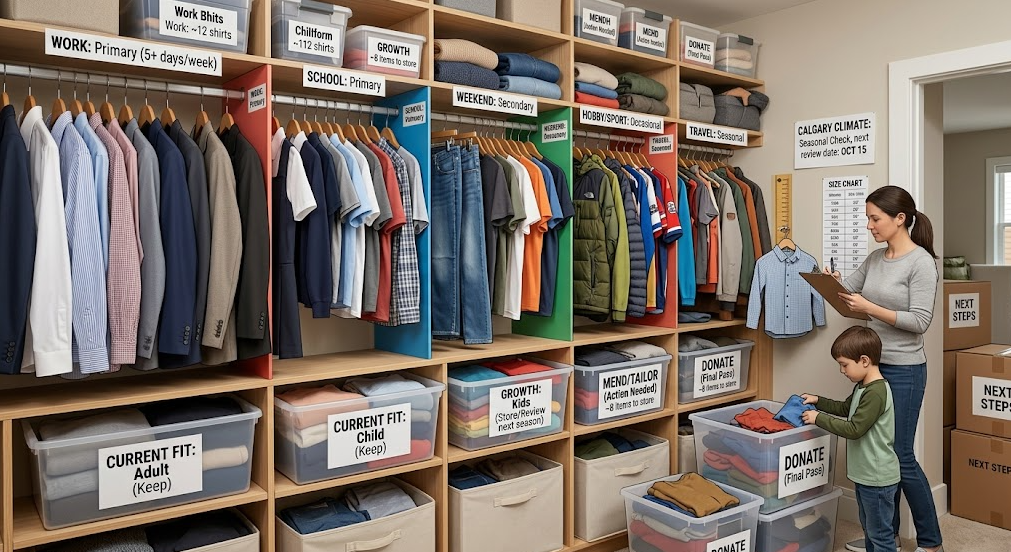
Begin With the Life the Clothes Must Serve
Before counting garments, identify the repeated situations that require them. Depending on the person, those may include:
- work, school, or uniforms;
- home and sleep;
- exercise, outdoor work, or sport;
- religious, cultural, or community clothing;
- formal or infrequent events;
- weather protection;
- travel;
- pregnancy, nursing, medical, sensory, mobility, or adaptive needs; and
- messy work, caregiving, or other activities that require changes.
One garment may cover several roles. A comfortable dark shirt might work for ordinary office days, travel, and dinner. Another item may have one narrow but important purpose, such as protective workwear or clothing required for a ceremony.
The list should describe present life rather than an imagined future identity. A large group of clothes for activities that no longer happen can make a wardrobe appear versatile while reducing access to what is needed now. Conversely, a rarely used garment may still earn its place when its purpose is specific, predictable, and difficult to replace quickly.
Start with categories rather than the entire wardrobe. Everyday tops, work trousers, undergarments, weather layers, and formal clothing operate on different cycles. A single total hides those differences.
Use the Laundry Interval as a Service Minimum
For frequently washed clothing, the longest ordinary interval between completed laundry cycles helps define the minimum working quantity.
Suppose someone wears one work shirt on each of five workdays and reliably completes that laundry once a week. Five usable shirts may cover the scheduled days, but the range is fragile. A spill, delayed wash, travel day, or unexpected shift can create a shortage. A small buffer may therefore be reasonable.
The same reasoning changes when:
- laundry is available only every two weeks;
- garments require air drying or special care;
- a shared laundry room is sometimes unavailable;
- a disability, illness, caregiving demand, or work schedule makes washing unpredictable;
- clothing must be changed more than once a day; or
- several household members compete for the same laundry time.
An EverydayWise working estimate is:
ordinary uses between completed washes + a small disruption buffer = starting range
This is a planning tool, not a universal formula. The buffer should reflect plausible interruptions rather than every imaginable emergency. Someone with easy in-home laundry may need less redundancy than a person who travels to a laundromat or depends on assistance.
Garments that are not washed after every use need a different calculation. Count how often the role occurs, how many items can be reworn safely and comfortably, and how long cleaning or repair takes. Follow garment-care instructions and any workplace or safety requirements.
Separate Active Quantity From Total Ownership
The number needed in immediate rotation may be smaller than the number reasonably owned. A useful wardrobe can contain several distinct groups:
- active: fits, supports current life, and is used during the present season;
- specific-purpose: used infrequently for a known role or event;
- backup: a limited substitute for laundry delays, damage, travel, or weather;
- transition: temporarily accessible during a seasonal change, as described in Article”Seasonal Clothing Rotation”;
- repair or alteration: waiting for a named action and deadline;
- bounded fit-change hold: retained temporarily because a body or health situation is changing; and
- stored for a credible future person or season: labelled with a recipient, size, and review point.
Without these distinctions, every retained garment can quietly claim to be “needed.” Separating the groups shows whether the active wardrobe works and whether the other groups have defined reasons and limits.
Audit Each Category With Five Tests
Once a category has a starting range, evaluate the actual garments.
1. Does it fit and function now?
Fit includes more than whether a zipper closes. The garment should support movement, comfort, weather, work rules, sensory needs, and the way the person currently dresses. An item can technically fit and still be unusable.
2. Does it have a distinct role?
Several similar garments may all be useful if they are worn. The problem appears when duplicates compete for the same narrow role while another recurring need remains uncovered.
3. Is it used within a relevant cycle?
Everyday clothing can be reviewed over weeks. Seasonal clothing needs a full relevant season. Formal, cultural, protective, or emergency garments require an event-based review rather than a short time test.
4. Could it be replaced if released?
Replacement difficulty matters. Unusual sizes, adaptive garments, uniforms, expensive protective layers, discontinued items, or clothing tailored for a specific purpose may deserve a larger reserve than inexpensive basics that are readily available.
5. Can it be stored without hiding the working wardrobe?
Capacity is a practical boundary. When a category is so compressed that garments disappear, wrinkle, become damaged, or cannot be returned after laundry, the quantity exceeds what that location can serve well. Article”How to Organize a Small Closet” explains how to measure and zone a small closet; Article”Hanger, Drawer, and Bin Storage Compared” will compare hangers, drawers, and bins in detail.
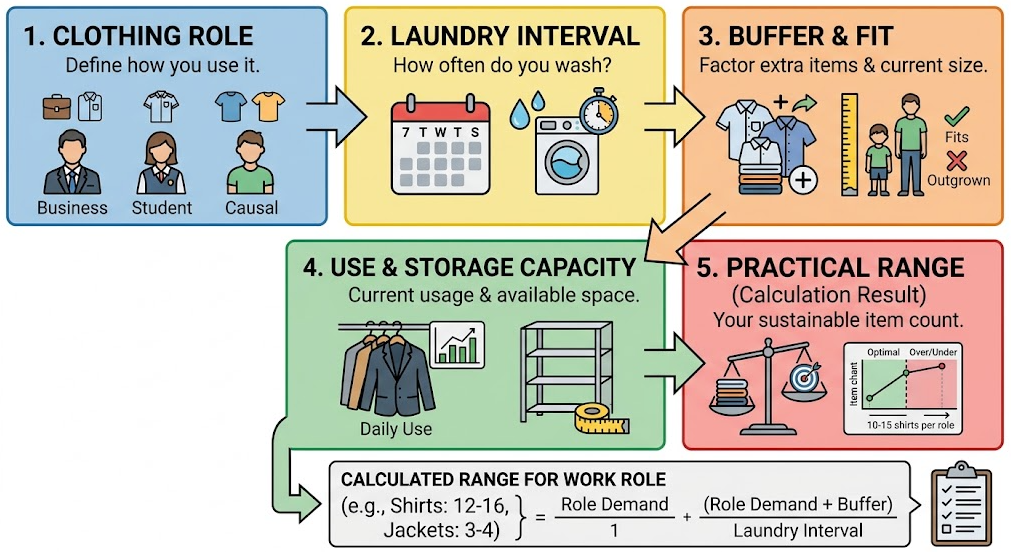
Let a Range Replace the Search for One Perfect Number
A category range creates two useful boundaries.
The lower boundary asks whether ordinary life can continue through the laundry cycle and likely disruptions. Falling below it produces repeated emergency washing, unsuitable substitutions, or purchases made under time pressure.
The upper boundary asks whether each retained item still has a credible role and whether the group remains accessible. Moving above it creates hidden clothing, duplicate decisions, and a return path that the available space cannot support.
For example, a person may conclude that seven to ten everyday tops serve current life. Seven covers the basic wash cycle; ten allows for a delayed load and different work or weather needs. That example is not a recommendation for everyone. Its value lies in showing how a range connects service and capacity.
Write the provisional range beside each high-volume category. Then live with it through at least one representative laundry cycle. If shortages or untouched surplus appear, revise the range using observed use rather than loyalty to the first calculation.
Use the One-Year Question Carefully
Jerome and his wife use about a year of nonuse as one signal during a larger clothing review. A year can reveal that a garment remained untouched through ordinary routines and all seasons. It should open a decision, not finish one.
Ask what explains the nonuse:
- The relevant season or event did not occur.
- The item was forgotten or inaccessible.
- It no longer fits comfortably.
- A repair was never completed.
- Another garment serves the same role better.
- Work, health, faith, culture, climate, or lifestyle changed.
- The garment is being held for a specific future need.
- The item has sentimental meaning that should be considered separately under Article”Sentimental Items: A Practical Decision Framework”.
An unused emergency layer, funeral outfit, uniform component, or culturally specific garment cannot be judged in the same way as an everyday shirt. Its retention case depends on consequence, replacement time, and likelihood of need.
If the only explanation is “I might use it someday,” make the future claim more concrete. For what activity? By whom? Within what period? What must happen before it becomes usable? A review date turns indefinite storage into a testable decision.
Give Body Changes a Bounded, Respectful Place
Bodies change for many reasons, including age, pregnancy, health, medication, disability, activity, and ordinary weight variation. A wardrobe review should not turn those changes into a character judgment.
First protect a sufficient group of clothes that fits and supports current life. Wearing only uncomfortable “temporary” clothing while waiting for a body to change can make daily dressing harder.
For clothes outside the current fit range, choose among:
- release now;
- alter or repair by a specific date;
- retain a small, clearly labelled fit-change group; or
- keep for a defined medical, pregnancy, postpartum, adaptive, or other known transition.
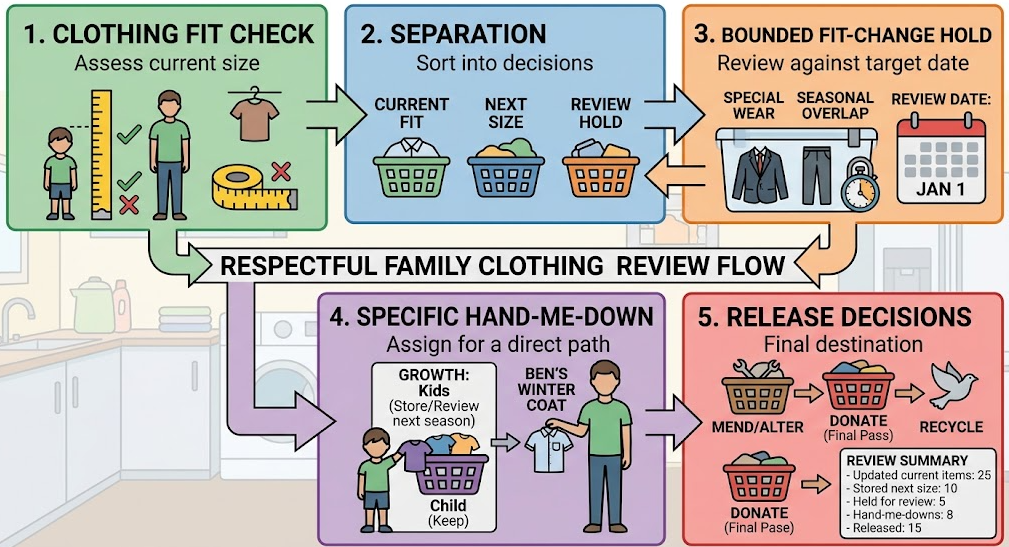
Set a physical limit and review date for the holding group. The boundary may be one rail section or one container, depending on the garments and storage available. This keeps an uncertain future from displacing the full current wardrobe while preserving reasonable flexibility.
Another person’s body and clothing choices remain theirs. Ask before removing, donating, or reassigning their garments.
Count Children’s Clothing Around Growth and Care Reality
Children’s categories may need a wider operating buffer because spills, school activities, weather, toilet learning, and rapid growth change demand. The useful quantity still depends on actual laundry access and routines.
Keep current-fit clothing separate from:
- the next size that has a likely near-term use;
- special-purpose or seasonal items;
- outgrown clothes awaiting a decision; and
- hand-me-down clothing assigned to a credible recipient.
Jerome’s older daughter and younger son can share some unisex clothing, but that does not create a future for every outgrown garment. A hand-me-down group becomes more reliable when it identifies the recipient, size, season, condition, and next review date.
Children’s preferences also become more important as they grow. Clothing that fits physically may still remain unworn because it feels uncomfortable or does not match how the child wants to dress. Age-appropriate participation helps distinguish a real shortage from a wardrobe filled with technically usable clothes the child will not choose.
Find the Gap Before Buying More
A crowded wardrobe can produce a vague sense that nothing works. Before shopping, identify the exact failure:
- Which role is uncovered?
- How often does it occur?
- Is the problem quantity, fit, comfort, condition, weather, or visibility?
- Could an existing garment serve after repair or alteration?
- Is laundry timing creating the shortage?
- Would one versatile item solve several gaps?
Record the gap in ordinary language, such as “one washable work layer for cold office days” or “two current-size school trousers that tolerate frequent washing.” A specific requirement makes comparison easier and reduces the chance of adding another duplicate.
When clothing can leave, use a route appropriate to its condition and local options. Reuse occurs before material enters the waste-management system, according to the U.S. Environmental Protection Agency, but the EPA also notes that it does not estimate how much textile reuse occurs through donation or resale. This article therefore makes no claim that every donated garment will be reused. Verify what a local recipient accepts; detailed donate, sell, recycle, and discard decisions belong to Article”What to Donate, Sell, Recycle, or Discard”.
Complete One Category Before Judging the Whole Wardrobe
Choose a category that repeatedly causes a problem, such as everyday tops, children’s school clothes, or weather layers. Then:
- Define its roles.
- Note the ordinary laundry or cleaning interval.
- Add a realistic disruption buffer.
- Gather the category without opening unrelated storage.
- Separate current fit, specific purpose, backup, repair, bounded hold, and future-recipient items.
- Test each garment for role, use, replacement difficulty, and capacity.
- Return the working range to accessible space.
- Give every unresolved group a limit, action, and review date.
- Record any proven purchase gap.
The result may be a reduction, an increase, or simply a clearer division between active and stored clothing. Success is visible when the category covers real life, returns easily after laundry, and no longer depends on vague future uses to justify every item.
FAQ
Is there an ideal number of clothes to own?
No single number fits different climates, jobs, laundry access, bodies, cultures, families, and storage conditions. Build a range by category using roles, laundry interval, a small disruption buffer, actual use, replacement difficulty, and available capacity.
How many days of clothes should I keep?
Cover the longest ordinary interval between completed laundry cycles, then add a modest buffer for plausible delays or extra changes. Someone with limited laundry access may reasonably need more than someone who can wash at home at any time.
Should I remove anything I have not worn in a year?
Use a year as a review prompt. Consider whether the garment serves an infrequent event, a full seasonal cycle, work or safety requirements, cultural use, body transition, or a credible future need before deciding.
How many clothes should I keep in another size?
There is no universal quantity. Protect enough current-fit clothing first, then give any fit-change group a defined physical limit and review date based on the reason for the transition and available space.
Should I keep children’s clothes for a younger sibling?
Keep items with a credible recipient, appropriate condition, useful size and season, and a review date. Do not assume every outgrown item will suit the next child physically or personally.
What if decluttering reveals that I need more clothes?
That can be a valid result. Name the precise gap, check whether laundry timing, repair, visibility, or fit caused it, and buy only after the requirement is clear enough to compare options.