A mental-health crisis can make ordinary decisions suddenly difficult. The person in distress may be frightened, confused, overwhelmed, agitated, disconnected from reality, or unable to explain what is happening. A family member or friend may feel pressure to say exactly the right thing while also deciding whether to call a crisis line, a healthcare service, or emergency responders.
The first goal is smaller and more urgent: establish whether anyone is in immediate danger, connect with the right level of help, and keep the situation as safe and calm as circumstances allow until that help takes over.
Quick decision: If there is an attempt in progress, a serious injury or overdose, immediate danger of suicide or violence, a weapon or other lethal hazard, loss of consciousness, severe medical symptoms, or an unsafe situation you cannot control, call the local emergency number now. Otherwise, contact a local crisis line, urgent mental-health service, healthcare provider, or emergency department for real-time assessment. Stay with the person when it is safe, ask directly about suicide and immediate danger, reduce access to obvious hazards only if you can do so safely, and do not promise secrecy. Follow the responder’s instructions and give a clear handoff.
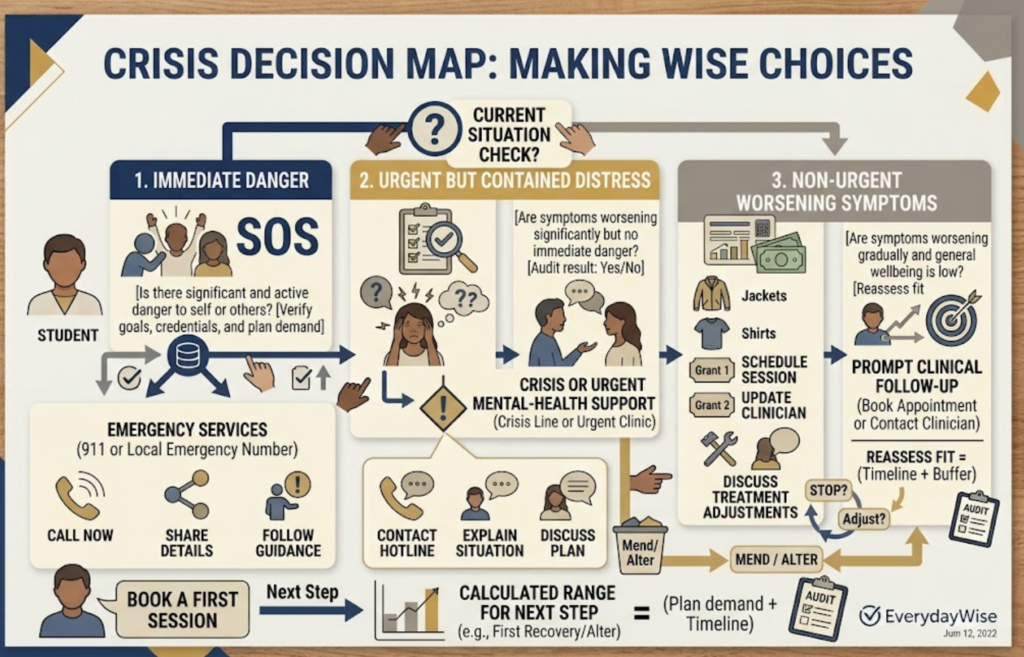
A Crisis Is Defined by the Need for Immediate Help
There is no single appearance of a mental-health crisis. Crying, silence, anger, panic, unusual beliefs, intoxication, withdrawal, or extreme energy can mean different things in different people. A diagnosis alone does not tell you how dangerous the present moment is.
Look at current safety and functioning. Urgent assessment may be needed when someone:
- says they intend to die, harm themselves, or harm another person;
- has made a plan, begun an attempt, or taken action to prepare;
- has recently injured themselves or may have overdosed;
- cannot stay safe without immediate support;
- is severely confused, disoriented, or unable to recognize familiar people or surroundings;
- appears to be responding to voices, beliefs, or perceptions that are directing dangerous action;
- is extremely agitated, reckless, aggressive, or unable to slow down;
- has gone for a prolonged period with very little sleep and is becoming increasingly impaired;
- cannot meet basic needs such as safe shelter, hydration, essential medication, or protection from weather;
- may have a medical emergency, drug reaction, intoxication, or withdrawal; or
- creates a situation in which a child, dependent adult, or another person is unsafe.
These observations do not establish a psychiatric diagnosis. Medical conditions, medication effects, substance use, head injury, infection, sleep deprivation, and other causes can produce behavioral or mental changes. When the cause is uncertain and the change is severe or sudden, urgent medical assessment may be the safer route.
Ask About Suicide Clearly
If you are concerned that someone may be thinking about suicide, ask directly and calmly:
“Are you thinking about suicide?”
You can follow with short safety questions:
- “Are you in danger of acting on those thoughts now?”
- “Have you already done anything to hurt yourself?”
- “Do you have a plan or access to what you would use?”
- “Can you stay with me while we call for help?”
The Government of Canada states that asking whether someone is thinking about suicide does not increase the risk and can open an important conversation. Avoid euphemisms that leave both people unsure what was asked.
Listen to the answer without debating whether the person “really means it.” A denial does not end the assessment if their actions, condition, or environment still suggest immediate danger. A disclosure of suicidal thoughts does not mean you must solve the crisis alone. It tells you to bring in qualified support.
Do not promise to keep suicidal intent or immediate danger secret. NIMH advises that a person who says they are going to kill themselves should not be left alone and that a trusted person or emergency support should be told.
Choose the Level of Response
The most useful distinction is between immediate danger, an urgent crisis that is currently contained, and a serious concern that can safely wait for prompt clinical follow-up.
Immediate danger or medical emergency
Call the local emergency number or go to the nearest appropriate emergency department when:
- an attempt, overdose, serious self-injury, assault, or dangerous act is occurring or has just occurred;
- the person has a weapon or immediate access to a lethal hazard;
- there is a specific and imminent threat to another person;
- the person is unconscious, having a seizure, struggling to breathe, severely injured, or medically unstable;
- severe agitation, confusion, or impaired judgment makes the location unsafe;
- you cannot safely remain with or transport the person; or
- a crisis professional tells you emergency intervention is required.
Tell the dispatcher that this is a mental-health or behavioral-health crisis and describe the immediate behavior, injury, substances, medical concerns, location, and known hazards. Ask whether a mental-health crisis team, ambulance, or other specialized response is available locally. Do not minimize danger to avoid embarrassment, and do not exaggerate behavior in an attempt to obtain a faster response.
Urgent distress without current immediate danger
Contact a crisis line, mobile crisis service, urgent mental-health team, healthcare line, same-day clinician, or emergency department when the person is highly distressed or losing function but the scene is currently safe enough to seek guided help.
A crisis counselor or clinician can ask more detailed questions, help decide whether an in-person assessment is needed, and identify local options. In the United States, SAMHSA directs people in crisis to call or text 988 and life-threatening emergencies to 911 or the nearest emergency room. In Canada, people thinking about suicide can call or text 9-8-8, while immediate danger goes to 9-1-1. Other countries use different numbers and systems.
Prompt follow-up when the person can remain safe
If there is no immediate danger and the person can participate in a plan, contact their family doctor, therapist, psychiatrist, community mental-health team, school service, employee assistance program, or another appropriate provider promptly. Ask what changes would require escalation before the appointment.
Long waits and limited services can make these categories imperfect. When uncertainty remains, call a crisis or health advice service and describe the facts rather than trying to assign the level alone.
Stay Present Without Taking Control of Everything
If it is safe for you to remain, use a steady voice and short sentences. Reduce the number of people speaking. Move away from noise, crowds, arguments, and unnecessary stimulation when the person is willing and the setting permits.
Helpful language can be simple:
- “I am here with you.”
- “We need help with this moment.”
- “Would you rather call together or have me make the call?”
- “What would help you feel safer while we wait?”
- “I am going to tell the responder what I have seen so they can help.”
Give manageable choices where choice remains safe: sit here or in the quieter room, call or text, use your phone or mine, have one support person present or two. Avoid offering choices that cannot be honored.
Do not lecture, shame, threaten, crowd, mock unusual beliefs, or demand a complete explanation. If someone is experiencing paranoia, hallucinations, or severe confusion, you do not need to agree with the belief. Acknowledge the distress and return to safety: “I can see this is frightening. I do not see it the same way, and I want us to get help.”
Your physical safety matters too. Keep a clear exit, avoid sudden touching, and step away if the person becomes threatening or the environment becomes unsafe. Do not attempt physical restraint unless you are trained, authorized, and required to respond within a professional role. Call emergency help when safe support is no longer possible.
Reduce Immediate Hazards Carefully
When it can be done without confrontation or additional danger:
- move other children or vulnerable people to a safer place;
- ask a trusted adult to remain nearby;
- create distance from obvious hazards;
- limit access to driving if impairment is severe;
- keep prescribed medication containers or relevant medical information available for responders; and
- follow instructions from the crisis counselor, poison service, dispatcher, or clinician.
Do not conduct a dramatic search, seize an object from someone’s hands, or place yourself between the person and an exit if doing so could escalate danger. Tell emergency responders about known hazards and let trained personnel manage an unsafe scene.
If an overdose or poisoning may have occurred, contact emergency services or the appropriate poison service immediately. Do not induce vomiting or give food, drink, medication, or home remedies unless a qualified responder instructs you to do so.
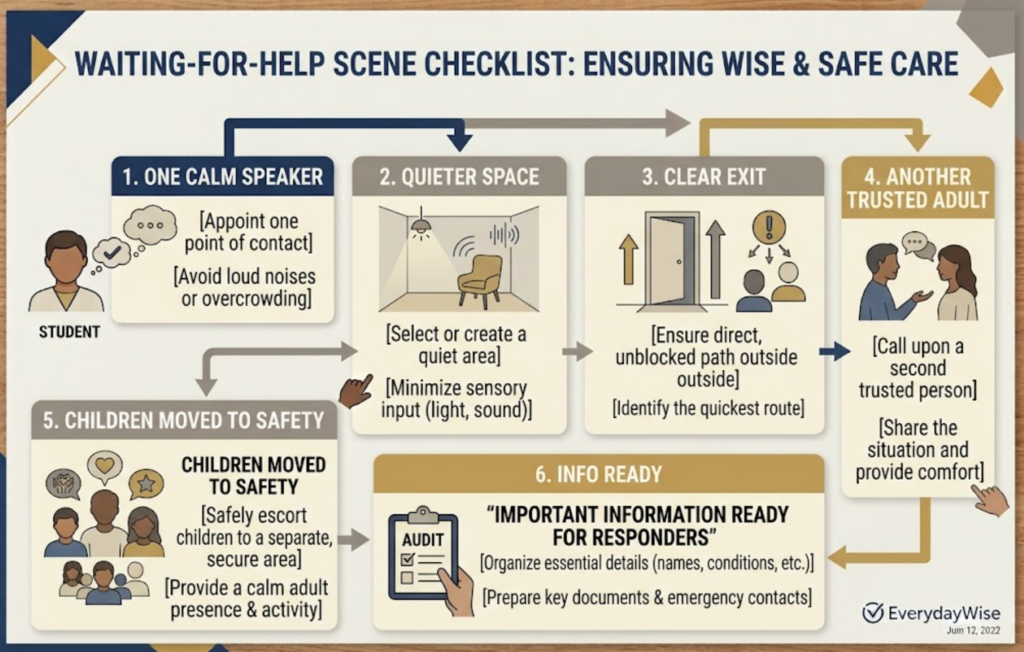
What to Tell a Crisis Responder
Stress can make a phone call feel disorganized. Start with location and immediate risk, then add relevant detail.
Prepare to say:
- the exact current location and callback number;
- whether anyone is injured, unconscious, missing, or in immediate danger;
- the person’s name, approximate age, and preferred language;
- what they said and did, using direct observations;
- whether suicide, self-harm, violence, weapons, overdose, intoxication, or withdrawal may be involved;
- major medical conditions, pregnancy, allergies, and current medications when known;
- recent medication changes or missed doses when known;
- whether the person has a crisis plan, treating team, or preferred hospital;
- communication, sensory, mobility, developmental, or cultural needs; and
- who is present and whether the scene is safe.
Separate observation from interpretation. “He has not slept for three nights, is pacing, and says the television is sending him commands” is more useful than “He has gone crazy.” “She sent a goodbye message and cannot be reached” communicates a concrete reason for urgency.
If you are calling about someone in another location, give their address, phone number, recent messages, known companions, and any access information you can lawfully provide. Stay available for follow-up rather than assuming the first call completes the handoff.
Do Not Drive When the Trip Is Unsafe
Transportation is a safety decision. A private car may be reasonable when the person agrees, remains calm, has no immediate means of harm, and a crisis professional or clinician supports that plan.
Use emergency transport when the person is medically unstable, severely impaired, threatening harm, likely to leave a moving vehicle, or cannot be transported without putting the driver or others at risk. Do not drive yourself if you are the person in crisis and your concentration, perception, substance use, medication effects, or impulses make driving unsafe.
Before leaving, confirm where you are going and whether the service can assess the person. Bring identification, a medication list, relevant contact information, and necessary accessibility or communication aids when they are readily available. Do not delay an emergency departure to assemble documents.
Respect Does Not Require Secrecy
A person in crisis still deserves dignity. Explain what you are doing when circumstances permit. Share information with those who need it for safety and care rather than broadcasting the situation to friends, coworkers, or social media.
At the same time, privacy has limits when someone faces immediate danger. You may need to contact emergency services, a caregiver, a parent or guardian, a treating professional, or another responsible person. Exact legal duties vary by role and jurisdiction. A family member does not need to determine every privacy rule before calling for urgent help.
If the person fears police, hospitalization, cost, discrimination, immigration consequences, family reaction, or loss of autonomy, listen and communicate those concerns to the responder. Ask about specialized crisis teams and the least restrictive safe option available. Do not promise that a specific outcome—no ambulance, no police, no hospital, no disclosure—can be guaranteed.
Special Considerations for Children and Teens
Take statements about suicide, self-harm, running away, violence, abuse, or inability to stay safe seriously. Ask direct, age-appropriate questions and involve an appropriate responsible adult unless doing so would create danger or conflict with professional safeguarding advice.
Contact emergency or crisis services immediately for imminent danger. Depending on the setting and urgency, a parent or guardian, pediatrician, school crisis team, child mental-health service, child-protection service, or emergency department may need to be involved.
Do not punish a child for disclosing frightening thoughts. Avoid making them repeatedly retell the event to every adult present. Record the essential facts and let the receiving professional lead the assessment.
If the child says home is unsafe or identifies a caregiver as the source of abuse or danger, do not automatically return them to that person. Contact the appropriate emergency or child-safeguarding service and follow professional direction.
Substance Use and Mental Crisis Can Overlap
Alcohol, cannabis, stimulants, sedatives, opioids, and other substances can intensify distress, impair judgment, or create medical danger. Withdrawal from some substances or medications can also become a medical emergency.
Tell responders what may have been used, approximately when, and what containers or prescriptions are present. Do not assume that unusual behavior is “only intoxication” or “only mental health.” Do not give another substance to calm the person or advise an abrupt medication change.
If opioid overdose is suspected, call emergency services and use naloxone if it is available and you know how to use it, following local instructions. Continue to follow dispatcher guidance; a temporary response to naloxone does not replace medical evaluation.
Make a Clear Handoff
When a crisis counselor, clinician, paramedic, mobile team, or emergency department takes over, summarize:
- what changed;
- what was said or done;
- what immediate risks you observed;
- any injury, substance, medication, or medical concern;
- what actions have already been taken; and
- what the person needs for communication or accessibility.
Ask what happens next and what you should do if the situation worsens, the person leaves, the call disconnects, or the proposed service cannot accept them. Record the service name and instructions when possible.
Your role may continue, but responsibility should no longer rest on one untrained person. If a responder dismisses concrete danger that is still present, state the facts again and ask what immediate alternative they recommend.

The Hours After the Immediate Crisis
Once immediate danger has passed, the person may feel exhausted, ashamed, angry, numb, relieved, or uncertain. Support should remain practical.
Before separation, clarify:
- where the person will stay and who will be present;
- which service or clinician will follow up and when;
- how essential medications will be managed by the appropriate prescriber or caregiver;
- what warning signs require another urgent call;
- how obvious hazards will remain reduced;
- whether work, school, driving, childcare, or other responsibilities need temporary adjustment; and
- who else needs to know for safety or care.
A written safety plan developed with a qualified professional can identify warning signs, internal coping steps, supportive people and places, professional contacts, crisis services, and ways to make the environment safer. It should support human and professional help, not replace it.
The supporter also needs recovery. After a frightening event, contact another trusted adult or professional, rest when safe, and seek support for your own distress. Caring about someone does not make you their sole crisis service.
Decision Summary
During a mental-health crisis:
- Check for immediate danger, serious injury, overdose, medical instability, and risk to others.
- Ask directly about suicide and whether the person may act now.
- Use emergency services for imminent or uncontrollable danger; use crisis or urgent mental-health services for a contained but urgent situation.
- Stay present when safe, reduce stimulation, and offer only manageable choices.
- Reduce obvious hazards without confronting, restraining, or endangering yourself.
- Give responders concrete observations, location, medical and substance information, and accessibility needs.
- Choose transport based on safety rather than convenience.
- Make a clear handoff and obtain an explicit next-step plan.
- Arrange follow-up and support for both the person and those who helped.
The task is not to determine the perfect diagnosis in the worst moment. It is to move from uncertainty to qualified help without leaving one person to carry the danger alone.
This article provides general educational information and is not a diagnosis, treatment plan, crisis assessment, or substitute for local professional advice. Crisis systems, emergency numbers, legal duties, consent rules, and available services vary by location. If you or another person is in immediate danger, has made an attempt, may have overdosed, is seriously injured, or cannot be kept safe, call the local emergency number or go to the nearest appropriate emergency facility now.
FAQ
Should I ask someone directly if they are thinking about suicide?
Yes. Ask calmly and clearly. Official Canadian guidance states that asking does not increase suicide risk and may open an important conversation. If the answer is yes, ask whether there is immediate danger, remain with the person when safe, and contact qualified crisis or emergency help.
What if the person says they are fine but I still think the situation is dangerous?
Use the full situation, not one answer. Recent actions, an attempt, a goodbye message, severe impairment, access to a lethal hazard, intoxication, or inability to remain safe can justify urgent help even when the person denies intent. Tell the responder exactly what you observed.
Should I call a crisis line or the emergency number?
Use the emergency number for immediate danger, a serious injury or overdose, medical instability, violence, or a scene you cannot keep safe. A crisis line or urgent mental-health service can help assess severe distress when immediate danger is not currently present. If unsure, call and describe the facts.
Should I take the person to an emergency department myself?
Only when the trip can be made safely and the destination can assess them. Use emergency transport if the person is medically unstable, severely impaired, threatening harm, likely to leave a moving vehicle, or unsafe to transport privately.
Can I leave after calling for help?
If suicide or immediate danger is suspected, do not leave the person alone when it is safe for you to stay. If staying puts you at risk, move to safety and remain in contact with responders. Make sure another responsible person or qualified service has actually taken over.
What if the person refuses help?
Keep communication calm and offer choices that remain safe. Refusal does not remove the need to call emergency services when there is imminent danger or severe incapacity. Outside immediate danger, a crisis professional can advise on local options, legal thresholds, and the least restrictive available response.
Is a safety plan enough after the crisis passes?
No. A safety plan can support follow-up, but it should be developed with appropriate professional and personal support and should not replace assessment or treatment. Confirm who will follow up, when, where the person will stay, and what change requires urgent escalation.
References
Public Health Agency of Canada — Preventing Suicide: When and How to Help
National Institute of Mental Health — Frequently Asked Questions About Suicide
National Institute of Mental Health — Warning Signs of Suicide
Healthdirect Australia — Mental Health Crisis Support
More in This Cluster: Mental Health Navigation
- Therapist, Psychologist, Psychiatrist, and Counselor Compared
- How to Prepare for a First Therapy Appointment
- How to Evaluate Online Therapy
- What to Do During a Mental Health Crisis (you are here)
- How to Talk to a Doctor About Mental Health
- Mental Health Privacy and Insurance Questions to Ask
- How to Support a Family Member Without Taking Over