A credit card’s annual percentage rate, or APR, describes the annualized price of borrowing. It is an important comparison number, but it does not tell you by itself how much interest will appear on your next statement.
The actual charge depends on several moving parts: which transaction created the balance, when interest began, the balance on each day, the number of days in the billing cycle, payments and credits, promotional terms, and the issuer’s calculation method. One account may also contain several balances at different APRs.
That is why two cardholders with the same advertised APR can pay very different amounts.
Quick Decision
If you pay eligible purchases in full by the due date and preserve the grace period, the purchase APR may not produce any interest charge. Focus first on paying the statement balance correctly and on time.
If you expect to carry a balance, compare the APR that applies to that specific transaction—not merely the card’s headline rate. Then check the grace-period rule, interest method, fees, payment allocation, and the amount you can repay each month.
Avoid treating cash advances, cash-like transactions, and balance transfers like ordinary purchases. They may have different APRs, separate fees, and no interest-free period.
APR Is an Annualized Rate, Not a Flat Annual Bill
An APR of 20% does not mean every $1,000 purchase automatically creates a $200 charge. If a qualifying purchase remains within an interest-free grace period and the required balance is paid by the due date, the interest may be $0.
When interest does apply, issuers commonly convert the annual rate into a periodic rate and apply it to balances over time. A simplified daily rate is:
Daily periodic rate = APR ÷ 365
At a 20% APR:
0.20 ÷ 365 = approximately 0.000548, or 0.0548% per day
If a $1,000 balance stayed unchanged for 30 days, a rough simple estimate would be:
$1,000 × 0.20 ÷ 365 × 30 = $16.44
This is an estimate, not a statement prediction. The issuer may use a different denominator or calculation convention, the daily balance may change, different transactions may carry different rates, and fees may be added separately. Your agreement and statement control.
Use APR to compare the price of borrowing under similar conditions. Use the account’s calculation method and your expected repayment pattern to estimate the actual cost.
The APR printed on a statement may also differ from the rate you remember at application. A promotional period may have ended, a variable benchmark may have moved, or an account event may have changed the applicable rate. Compare the current statement with the most recent notice and agreement instead of relying on an old screenshot or advertisement.
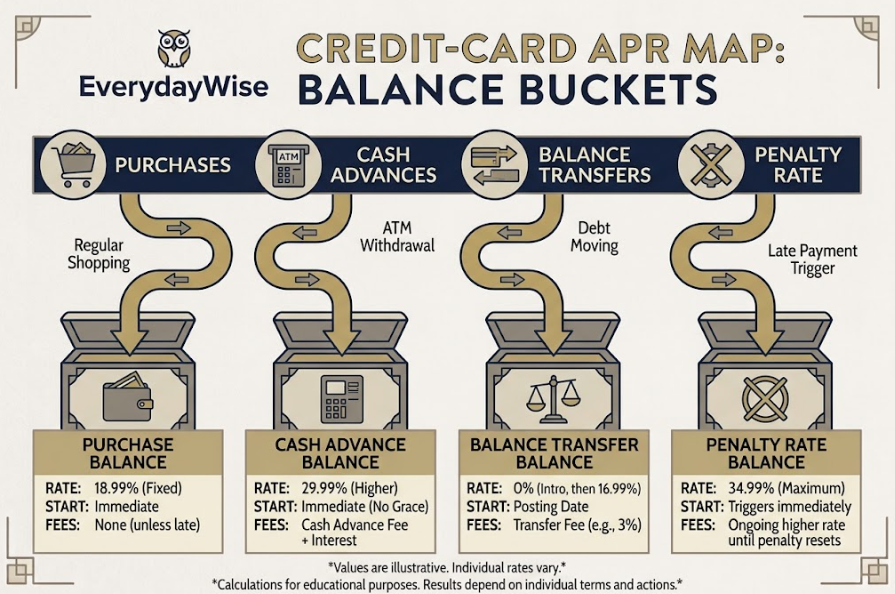
One Card Can Have Several APRs
The phrase “my card’s APR” can hide several separate rates.
Purchase APR
This generally applies to ordinary purchases when interest is charged. It may be fixed under the agreement or variable with a reference rate. A variable APR can change even when the cardholder has done nothing wrong.
Cash-advance APR
This may apply when you withdraw cash or perform another transaction classified as an advance. It is often higher than the purchase APR, and a transaction fee may also apply.
Cash-like transaction APR
An issuer may treat certain money orders, wire transfers, gaming transactions, credit-card cheques, or similar items as cash advances. The exact classification varies. A purchase that looks ordinary to the cardholder can therefore receive immediate interest and a fee if the agreement classifies it as cash-like.
Balance-transfer APR
A transferred balance may receive a promotional or standard transfer rate. A transfer fee can apply even when the promotional APR is 0%. The promotion usually lasts for a defined period and may be lost after particular defaults.
Penalty or increased APR
Late or missed minimum payments may cause an APR increase or end a promotional rate, depending on the agreement and applicable law. The trigger, affected balances, notice, duration, and route back to a lower rate are jurisdiction- and issuer-specific.
Before using a card for anything other than an ordinary purchase, identify the transaction category in the agreement. Do not assume that the lowest number in an advertisement applies to every balance.
The Grace Period May Matter More Than the Purchase APR
A grace period is the time during which qualifying purchases may be paid without interest. It is not a universal pause on every kind of credit-card debt.
In Canada, federally regulated institutions must provide a minimum 21-day grace period on purchases. Canadian federal guidance states that this period does not apply to cash advances, cash-like transactions, or balance transfers. U.S. rules and account terms differ, and an issuer is not generally required to offer a purchase grace period; when one is offered, the disclosure explains how to keep it.
Read three items together:
- the statement balance;
- the payment due date; and
- the agreement’s rule for avoiding interest on purchases.
Paying the minimum keeps an account from being immediately treated as unpaid, but it does not normally preserve interest-free treatment for the remaining purchase balance. Paying the current balance shown in an app may also produce a different result from paying the statement balance if new transactions, pending items, adjustments, or already-accruing balances are present.
If you have lost a grace period, ask the issuer exactly what must be paid and for how long before it is restored. Do not guess from a previous month or another card’s rules.
Cash Advances Usually Start Costing Money Immediately
Cash advances deserve their own decision because three costs can arrive together:
- a cash-advance fee;
- a higher APR; and
- interest beginning on the transaction date.
Assume a $500 cash advance carries a $10 fee and a 24% APR, with interest beginning immediately. A rough 20-day estimate is:
$500 × 0.24 ÷ 365 × 20 = $6.58 interest
The initial borrowing cost would already be about $16.58 before considering ATM charges, foreign-currency costs, compounding, or a different issuer method.
The same concern can apply to cash-like transactions and credit-card cheques. Verify classification before making the transaction, especially when using the card to obtain money, fund another financial account, gamble, or pay a debt.
Average Daily Balance Explains Why Timing Matters
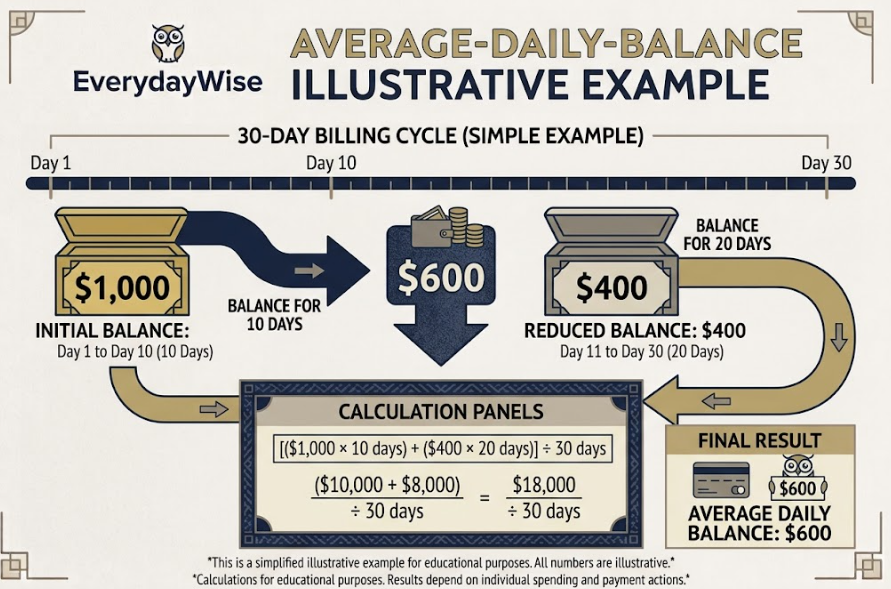
Many issuers use a daily-balance or average-daily-balance method. A simplified average daily balance is:
Sum of each day’s balance ÷ number of days in the billing cycle
Suppose a 30-day cycle begins with a $1,000 interest-bearing balance. You pay $600 after 10 days, leaving $400 for the remaining 20 days.
- first 10 days: $1,000 × 10 = $10,000;
- next 20 days: $400 × 20 = $8,000;
- sum of daily balances: $18,000;
- average daily balance: $18,000 ÷ 30 = $600.
At a 20% APR, a rough charge would be:
$600 × 0.20 ÷ 365 × 30 = $9.86
If the $600 payment arrived only after day 25, the average balance would be much higher. The payment amount is identical; the timing changes the interest-bearing balance.
This does not mean you should make random payments without protecting essentials such as housing, food, utilities, and insurance. It means that, once a safe payment amount is available, sending it earlier can reduce interest under a daily-balance method. Confirm processing time and how the issuer credits payments.
New Purchases Can Complicate an Existing Balance
When a cardholder is already carrying an interest-bearing purchase balance, placing new purchases on the same account may make the payoff harder to see. New charges increase daily balances, and the account may no longer provide interest-free treatment on those purchases.
A practical separation can help:
- stop adding discretionary purchases to the interest-bearing card;
- move normal spending to cash or debit while repaying, if that is manageable;
- keep necessary recurring payments visible; and
- use the statement’s interest-charge section to track whether the balance is actually shrinking.
This is cash-flow control, not punishment. A repayment plan is easier to evaluate when new spending is not continuously replacing the amount paid.
Promotional APR Does Not Mean Free Borrowing
A 0% or low promotional APR can reduce interest for a defined period, but it may still involve costs and deadlines.
Before relying on a promotion, record:
- the transactions covered;
- the transfer or transaction fee;
- the exact start and end dates;
- the standard APR after expiration;
- the minimum payment requirement;
- events that may end the offer; and
- how payments are allocated when other balances exist.
For a $5,000 balance transfer with a 3% fee, the upfront fee is $150 even if the promotional APR is 0%. To repay $5,150 over ten months, the simple target is at least $515 per month, assuming no other charges or complications.
Do not plan around the minimum payment when the objective is to finish before the promotion expires. Divide the full promotional balance and relevant fee by the number of safe payment months, leaving a buffer before the final date.
Payment Allocation Can Keep a Costly Balance Alive
When one account contains balances at different rates, your payment may not reduce each one in the order you expect.
In Canada, federal guidance says the minimum payment is typically applied to the lowest-rate portion. Amounts above the minimum may be applied to the highest-rate portion or proportionally across the balance, depending on the issuer. In the United States, federal rules generally direct amounts above the required minimum toward the balance carrying the highest APR, with specific exceptions; the issuer retains more discretion over the minimum portion.
The practical lesson is the same across jurisdictions: read the allocation term before mixing purchases, transfers, and advances on one account.
Ask the issuer:
- where the minimum payment goes;
- where amounts above the minimum go;
- how promotional balances are treated near expiration;
- whether a payment can be directed to a specific balance; and
- how credits and refunds affect the calculation.
Do not infer allocation from the total balance alone. Two accounts showing the same total can have very different interest costs when their balance composition differs.
Trailing Interest Can Appear After You Think You Paid in Full
Interest may continue accruing between the statement date and the date the issuer receives a payoff. The remaining amount that later appears is often called trailing or residual interest.
Imagine that an interest-bearing statement balance is paid on the 15th day after the statement closes. The payment may clear the displayed principal and prior interest, but interest may already have accrued for those 15 additional days. A later statement can contain that residual amount.
When paying off an interest-bearing account:
- ask for the current payoff amount and how long it remains accurate;
- confirm the processing date, not merely the date you initiate payment;
- stop new transactions on the account during payoff;
- check the next statement; and
- keep automatic payment active until the account truly reaches zero, if safe.
U.S. rules limit certain residual finance charges after a disclosed payoff balance is paid within the specified period, but the detailed protection is technical and should not be treated as a universal promise. Account terms and local law still matter.
Penalty APR Is Not Just a Late Fee
A late-payment fee is a one-time charge. A penalty or increased APR can raise the price of borrowing for a longer period.
The agreement should explain:
- what event triggers the increase;
- whether it affects existing balances, new transactions, or both;
- how long it may remain;
- whether timely payments can restore the previous rate; and
- what notice applies.
If a payment problem is likely, contact the issuer before the due date. Ask about the amount required, processing time, available hardship options, and whether any arrangement changes interest, fees, or credit reporting. A verbal conversation should be followed by written confirmation when it affects the account terms.
Compare APR With Dollars and a Repayment Plan
A lower APR helps, but repayment speed often has a larger effect than a small rate difference.
For a rough comparison, consider a stable $3,000 balance held for one year without reduction:
- at 20% APR: approximately $600 in simple annual interest;
- at 15% APR: approximately $450;
- rough difference: $150.
Real balances should decline, and actual calculations vary. Still, this test helps determine whether a lower-rate card’s annual fee or transfer fee has a plausible benefit.
Then stress-test the plan:
- What monthly payment can you sustain after essential expenses?
- What happens if repayment takes three months longer?
- Does the lower rate expire?
- Will a transfer fee erase much of the saving?
- Can new purchases remain off the account?
The best borrowing option is not necessarily the card with the lowest advertised APR. It is the arrangement with the lowest realistic total cost that you can repay without destabilizing the rest of the household budget.
For the separate annual-fee comparison method, see Article”How to Compare Credit Card Annual Fees“.
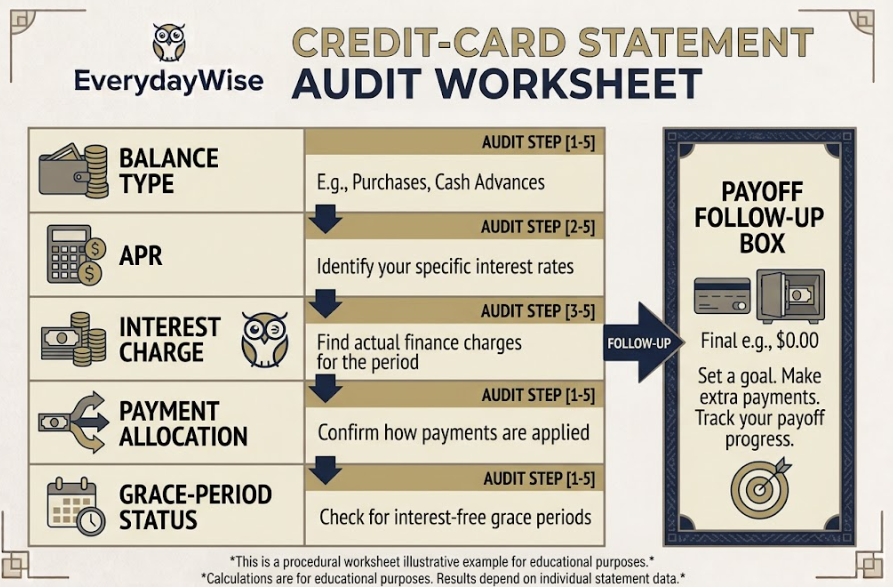
Use a Five-Line Statement Audit
Each month that interest appears, record:
- Balance types: purchases, advances, transfers, promotions.
- APR for each type: including any change from last month.
- Interest charged: by balance category when disclosed.
- Payments and allocation: minimum portion and excess portion.
- Grace-period status: whether new purchases are receiving interest-free treatment.
If the numbers do not make sense, compare the statement with the agreement and contact the issuer. Ask for an explanation of the balance subject to interest, periodic rate, number of days, and payment allocation. Keep the statement and response.
The Bottom Line
APR is a useful borrowing-price label, but the label becomes meaningful only when it is connected to a balance type, start date, daily balance, fee structure, and repayment schedule.
If you pay qualifying purchases in full and on time, protecting the grace period usually matters more than optimizing a purchase APR you never pay. If you carry debt, focus on the applicable rate, payment timing, allocation rules, and a repayment amount that reduces principal. Treat advances and transfers as separate financing decisions.
The most useful question is not “What is my card’s APR?” It is: Which APR applies to this balance, when did interest start, and what action will stop it?
This article provides general educational information, not individualized financial, legal, credit, or tax advice. Credit-card terms and consumer protections vary by issuer and jurisdiction. Review your agreement and current statement, and contact the issuer or an appropriate qualified professional before acting.
FAQ
1. Do I pay interest if I pay my credit card in full every month?
You may avoid interest on qualifying purchases when your card offers a grace period and you pay the required statement balance by the due date. Cash advances, cash-like transactions, and some transfers may begin accruing interest immediately. Check your agreement.
2. Is APR the same as the interest I will pay this year?
No. APR is an annualized rate. Your dollar charge depends on the balance subject to interest, how long it remains, daily changes, the calculation method, and applicable fees.
3. Why was I charged interest after paying the statement balance?
Possible reasons include an already-lost grace period, cash advances, a payment received after the due date, a remaining balance at another APR, or trailing interest accrued before payoff. Ask the issuer for the balance and dates used.
4. Does a 0% balance-transfer offer have no cost?
Not necessarily. A transfer fee may apply, the promotion covers only specified transactions and dates, and a standard APR may apply after expiration. Missing a required payment may also affect the offer.
5. Does paying earlier reduce credit-card interest?
It can when interest is based on daily balances. An earlier credited payment may reduce the balance used for more days. Confirm processing times and the issuer’s calculation method.
6. Which balance does my credit-card payment reduce first?
That depends on the agreement and jurisdiction. Minimum and above-minimum amounts may be allocated differently. Read the payment-allocation section or ask the issuer for a written explanation.
7. Is a lower-APR card always better?
No. Compare the applicable APR, annual and transaction fees, promotional period, repayment time, and whether you can avoid adding new debt. A slightly higher rate with no transfer fee may cost less in some scenarios.
References
- Financial Consumer Agency of Canada. “How credit cards work.” Updated October 15, 2025. https://www.canada.ca/en/financial-consumer-agency/services/credit-cards/credit-card-work.html
- Financial Consumer Agency of Canada. “Paying off your credit card.” Updated October 15, 2025. https://www.canada.ca/en/financial-consumer-agency/services/credit-cards/pay-off-credit-card.html
- Financial Consumer Agency of Canada. “Credit cards: know your rights and responsibilities.” Accessed August 25, 2026. https://www.canada.ca/en/financial-consumer-agency/services/rights-responsibilities/rights-credit-cards.html
- Consumer Financial Protection Bureau. “What is a credit card interest rate? What does APR mean?” Accessed August 25, 2026. https://www.consumerfinance.gov/ask-cfpb/what-is-a-credit-card-interest-rate-what-does-apr-mean-en-44/
- Consumer Financial Protection Bureau. “What is a grace period for a credit card?” Accessed August 25, 2026. https://www.consumerfinance.gov/ask-cfpb/what-is-a-grace-period-for-a-credit-card-en-47/
- Consumer Financial Protection Bureau. Regulation Z, § 1026.53, “Allocation of payments.” Accessed August 25, 2026. https://www.consumerfinance.gov/rules-policy/regulations/1026/53/
- Consumer Financial Protection Bureau. Regulation Z, § 1026.54 and Official Interpretations, “Limitations on the imposition of finance charges.” Accessed August 25, 2026. https://www.consumerfinance.gov/rules-policy/regulations/1026/54/
More in This Cluster: Credit Card Decision Basics
- Credit Card vs. Debit Card: Which Should You Use?
- Cash Back vs. Travel Rewards: Which Card Fits You?
- How to Compare Credit Card Annual Fees
- APR Explained: What Cardholders Often Miss (you are here)
- Should You Carry More Than One Credit Card?
- When a Secured Credit Card Makes Sense
- How to Close a Credit Card Without Unintended Consequences