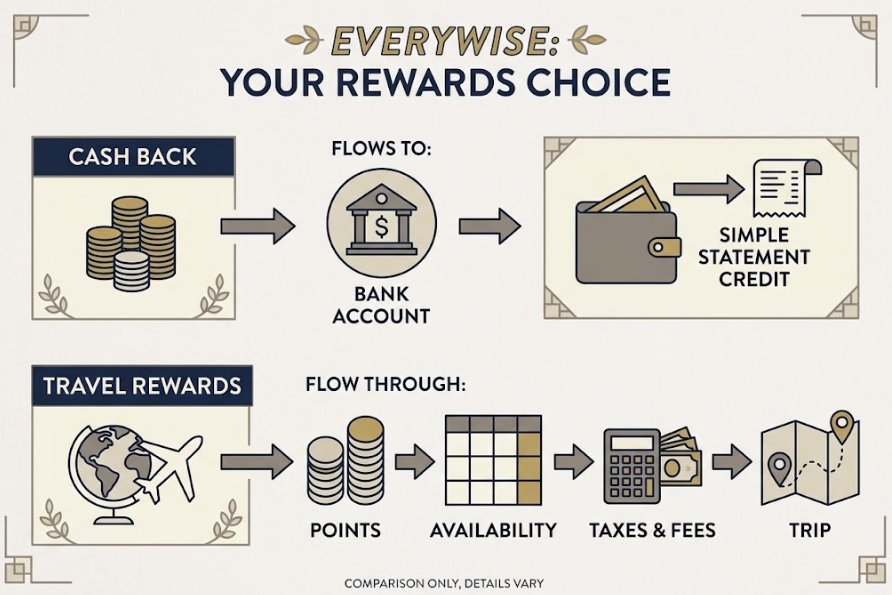
A cash-back card turns eligible spending into a relatively direct monetary benefit. A travel-rewards card may produce more apparent value when points are used well, but that value depends on where, when, and how you travel.
The better choice is the one that creates the most usable net value from spending you would make anyway. Compare the rewards you can realistically redeem, subtract the costs required to earn and use them, and account for the effort and restrictions involved.
Quick Decision
Choose cash back when you want simple value, flexible use, and little redemption planning.
Consider travel rewards when you travel with some regularity, can use the program’s routes or partners, have enough flexibility to find suitable redemptions, and will use included travel benefits.
If either card would cause you to carry a balance, prioritize a lower borrowing cost and reliable repayment over rewards. Interest can erase the value of cash back or points quickly.
From Jerome, EverydayWise Contributor
During my first seven years in Canada, I used a cash-back credit card. We used it at places such as Costco and grocery stores, and I received roughly CAD 300 to 400 in cash back each year. That was close to the cost of a large grocery trip for our family, so it felt as though the groceries were free.
I later changed to a card that earns airline miles. As my children grew, airfare for a family of four became a larger part of our travel cost. In simple dollar terms, the miles can appear more valuable than the cash back I used to receive. Still, I do not treat them exactly like cash. To use miles for a family trip, we may need to buy some seats or pay other costs. I think of the miles as a travel discount, and lately the balance has become one input into our travel planning.
The passage above comes from the experience of Jerome, an EverydayWise contributor. It shows how a household’s preferred reward can change with its spending and travel needs; it does not establish that either reward type is best for everyone.
Start With What the Reward Can Actually Buy
Rewards often appear in different units, which makes a direct comparison difficult.
A cash-back program may describe value as a percentage of eligible purchases. Depending on the program, the reward may arrive as a statement credit, a deposit, a cheque, or another redemption option. Its value is usually easier to recognize: CAD 100 or USD 100 of cash back is expressed in money, although redemption schedules and minimums may limit when it becomes available.
Travel programs may award miles or points according to spending categories, a fixed earn rate, or a relationship with an airline, hotel, or transferable-points system. The point balance alone does not reveal its purchasing power. A redemption might require different numbers of points depending on the route, date, cabin, cash price, program chart, or availability.
This produces two distinct questions:
- Cash back: How much money will I receive, and when can I use it?
- Travel rewards: What trip can these points help purchase under the rules that apply when I redeem them?
The second question can yield strong value, but it carries more uncertainty.
Use a Common Unit: Net Dollars per Year
Translate both options into an annual dollar estimate before comparing them.
Estimate cash back
List your realistic yearly card spending by category. Multiply each category by its applicable earn rate, respecting caps, merchant classifications, exclusions, and any base rate that applies after a cap is reached.
For example, suppose a household expects:
- $8,000 in a 3% category;
- $7,000 in a 2% category; and
- $10,000 at 1%.
The gross estimate would be:
- $8,000 × 3% = $240;
- $7,000 × 2% = $140; and
- $10,000 × 1% = $100.
That produces $480 before relevant card costs. It remains an estimate because merchants may code differently from what the shopper expects, and promotional rates may expire.
Estimate travel rewards
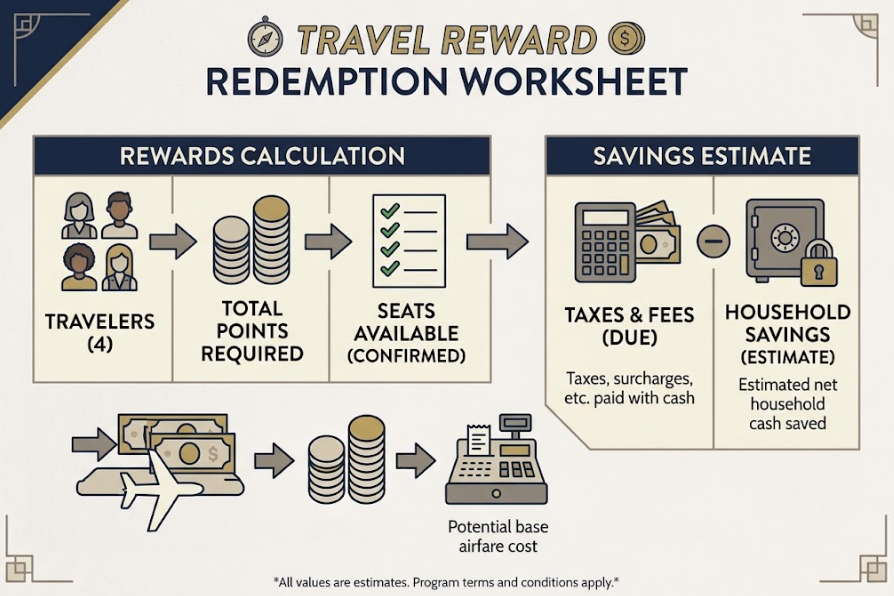
Begin with the same spending pattern, then estimate how many points it would generate. Next, identify a redemption you are reasonably likely to make. Divide the cash price you would otherwise pay—after adjusting for costs that remain—by the number of points required.
A useful calculation is:
Redemption value per point = (comparable cash price − taxes, fees, surcharges, and cash still required) ÷ points redeemed
If a ticket priced at $600 requires 40,000 points plus $100 in unavoidable charges, the points replace about $500 of the price:
($600 − $100) ÷ 40,000 = 1.25 cents per point
This 1.25-cent estimate applies only to that available redemption at that moment. A different flight, hotel, transfer partner, or date may produce a different result.
Subtract costs on both sides
Gross rewards are not net value. Account for:
- the annual fee and authorized-user fees;
- foreign-transaction charges relevant to your use;
- booking, transfer, redemption, or change fees;
- taxes and carrier-imposed charges not covered by points;
- extra spending required to reach a bonus;
- benefits you paid for elsewhere because the reward booking did not include them; and
- rewards lost through expiration, account closure, or program restrictions.
Annual-fee analysis receives its own treatment in Article”How to Compare Credit Card Annual Fees”. For this decision, subtract the fee rather than assuming the reward total is pure gain.
Cash Back Wins on Simplicity and Optionality
Cash back has a practical advantage that percentage tables can understate: it does not require a travel plan.
Once available under the program rules, money can help offset groceries, utilities, a statement balance, savings, or another household priority. A family that postpones travel does not need to find an alternative trip merely to protect the reward’s usefulness.
This flexibility matters when:
- travel is infrequent or unpredictable;
- work, school, caregiving, or health limits travel dates;
- the household prefers budget airlines, vacation rentals, road trips, or providers outside one loyalty system;
- the reward will be used for ordinary expenses; or
- no one wants to monitor transfer partners and award availability.
Cash back may also be easier for a household to value together. “We earned $350” communicates more clearly than “we earned 35,000 points” when the points could support several very different redemptions.
Simplicity does not remove all conditions. Some programs redeem only once a year, require a minimum balance, limit redemption methods, exclude certain transactions, or reduce the rate after a spending cap. Read the current terms.
Travel Rewards Need a Real Redemption Path
Travel points become valuable through use, not accumulation.
Before choosing a travel program, sketch one or two likely trips over the next 12 to 24 months. Do not begin with the advertised value of a premium cabin you would never buy. Begin with the trip your household would realistically take.
Check:
- whether the program or its partners serve the needed origin and destination;
- whether suitable seats or rooms are normally available during your travel window;
- whether the same redemption works for one traveler or an entire household;
- which taxes, surcharges, resort fees, or other cash amounts remain;
- whether points can cover only part of a booking;
- what happens if the trip changes or is cancelled; and
- whether points expire or the program can change redemption requirements.
Jerome’s family illustrates why the number of travelers matters. A redemption that is easy for one person may be difficult for four people on the same flight. If points cover two seats while two must be purchased, the points still have value—but the household must budget for the other seats and associated charges.
Flexibility Can Be Part of the Reward
Two households with identical spending may obtain different travel value because one can adjust dates, airports, routes, or destinations.
Flexibility may allow a traveler to:
- select an off-peak date requiring fewer points;
- use a nearby airport;
- transfer points to a partner offering better availability;
- book separate one-way itineraries; or
- wait for inventory that fits the trip.
Those options also create work and risk. Transfers may be irreversible. Partner space can disappear. A positioning flight or extra hotel night can consume savings. Separate tickets may create missed-connection exposure that one protected itinerary would not.
Assign value only to strategies you understand and would willingly use. A theoretical redemption that requires hours of research, an inconvenient itinerary, and a trip you did not intend to take is not equivalent to cash.
Benefits Count Only When They Replace a Real Cost
Travel cards may include benefits such as checked-bag allowances, airport lounge access, travel credits, insurance coverage, status-related features, or preferred booking terms. Cash-back cards may also include insurance or purchase protections.
Avoid adding every advertised benefit at face value. Use a replacement-cost test:
- Would you have purchased or used this benefit without the card?
- Does it apply to the people and trips you actually take?
- Must the trip be charged to the card for coverage to apply?
- Are there exclusions, limits, registration requirements, or claim procedures?
- Does another card, employer benefit, membership, or insurance policy already provide it?
If lounge access encourages spending at the airport but replaces nothing you would have bought, its personal financial value may be zero. If a checked-bag benefit reliably replaces fees your family would otherwise pay, the avoided cost may reasonably be included.
Insurance deserves particular caution. A benefit summary is not the policy. Eligibility, covered causes, age limits, trip length, payment requirements, exclusions, and claim documentation determine whether coverage applies. Verify the certificate before relying on it.
Welcome Bonuses Can Distort the Decision
A large introductory offer can make a card look far better in year one than it will later.
Separate the comparison into:
- first-year value, including a bonus you can earn without artificial spending; and
- ongoing value, based on normal spending and benefits after promotions end.
Never spend more than planned merely to reach a threshold. A $700 reward is not a $700 gain if obtaining it leads to $1,500 of unnecessary purchases, interest, or fees.
Also confirm when the bonus posts, what purchases qualify, whether previous cardholders are excluded, and how a return or refund affects eligibility. Promotional terms change and can be more restrictive than the headline suggests.
Rewards Are a Contractual Program, Not Stored Cash
Point and mile programs can change. Redemption rates, transfer ratios, eligible partners, availability, expiration rules, and program terms may be revised. The U.S. Consumer Financial Protection Bureau has documented consumer complaints involving disappearing rewards, devaluation, redemption problems, and differences between marketing and actual terms.
Cash-back programs also have rules and may change, but monetary presentation generally makes the current value easier to see. In either case, read notices and avoid accumulating rewards indefinitely without a purpose.
Closing a card can also affect unredeemed rewards, depending on the program. Before product changes or closure, confirm the reward balance, redemption deadline, transfer options, and any effect on linked loyalty accounts. The broader account-closing decision is reserved for Article”How to close a Credit Card”.
Interest Is the Fastest Way to Lose the Comparison
Rewards should be evaluated only after the repayment system works.
If a cardholder carries a purchase balance, interest may exceed the reward earned on the transaction. A person who earns 2% on a purchase does not come out ahead merely because the reward posted; the cost depends on the balance, APR, repayment time, and card terms.
The same principle applies to cash advances and cash-like transactions, which commonly do not earn rewards and may begin accruing interest immediately. Late payments can add fees, affect promotional terms, and damage credit history.
If carrying a balance is likely, compare borrowing costs and repayment options before reward type. Article”APR Explained”, will address those mechanics in detail.
Run a 12-Month Household Test
Use actual statements when possible rather than estimates built from memory.
Step 1: Measure normal spending
Review 12 months of card transactions. Group only purchases that could reasonably go on the new card. Exclude rent, taxes, tuition, or other payments if card use would add a processing fee larger than the reward.
Step 2: Calculate gross rewards
Apply the correct category rates, caps, merchant coding, and base rates. Do not assume every grocery-like purchase codes as grocery or every travel expense earns a travel multiplier.
Step 3: Choose realistic redemptions
For cash back, identify the timing and method. For travel, test actual routes, dates, party size, point requirements, and remaining cash costs.
Step 4: Value benefits conservatively
Count a benefit only when it replaces a cost or provides a service you would intentionally buy. Use the amount you would pay, not the issuer’s advertised retail value.
Step 5: Subtract costs and friction
Subtract fees and remaining travel charges. Note the time needed to search, transfer, book, track credits, and manage expiration. You do not need to assign an hourly wage, but the workload belongs in the decision.
Step 6: Stress-test a change in plans
Ask what happens if you do not travel next year, the preferred redemption disappears, your spending shifts categories, or the annual fee rises. Cash back usually handles uncertainty more easily; travel rewards may still win when the program continues to fit.

Decision Summary
Cash back is often the stronger fit when the household values clarity, flexible use, and low-maintenance redemption. Travel rewards may provide greater usable value when the traveler has a specific redemption path, suitable flexibility, enough availability for the travel party, and benefits that replace real costs.
Compare the options with the same annual framework:
- spending you would make anyway;
- rewards earned under actual category rules;
- redemption value you can realistically obtain;
- taxes, fees, and purchases that remain;
- benefits you will genuinely use;
- restrictions and planning effort; and
- the effect of changing travel plans.
Jerome’s move from cash back to airline miles did not make his earlier choice wrong. His household goal changed. Groceries once made direct cash value especially visible; later, airfare for four people made a travel discount more useful.
The reward should follow the household’s life, rather than asking the household to rearrange its life around the reward.
Important note: This article provides general educational information, not individualized financial, legal, tax, insurance, or travel advice. Credit-card terms, reward values, fees, benefits, merchant classifications, availability, transfer rules, taxes, and redemption conditions vary by issuer, program, country, and transaction. Verify current agreements and program rules before applying, transferring points, or booking travel.
FAQ
1. Are travel points always worth more than cash back?
No. Travel points may deliver higher value on some redemptions, but their value varies with availability, points required, cash charges, and the trip selected. Cash back is generally easier to value and use. Compare realistic net value rather than an advertised maximum.
2. How do I calculate the value of a travel point?
Subtract unavoidable taxes, fees, surcharges, and other cash required from the comparable cash price. Divide the remaining price avoided by the points used. The result applies to that redemption, not necessarily to every future use of the program.
3. Should I count a welcome bonus when comparing cards?
Count it separately as first-year value if normal planned spending can satisfy the terms. Also calculate ongoing value without the bonus. Do not make unnecessary purchases or carry debt to earn it.
4. Is a statement credit the same as receiving cash?
It reduces the amount owed on the account, but program treatment varies. A statement credit may not count as the required payment, and some programs offer deposits or cheques instead. Check the redemption and payment rules.
5. What if I cannot find four reward seats for my family?
Calculate the household trip as a whole. Points may cover some travelers while the remaining seats are purchased, but include all taxes, fees, and cash fares. If suitable availability is consistently limited, a flexible reward or cash back may be more useful.
6. Do rewards make a high-interest card worthwhile?
Usually not when you carry a balance. Interest and fees can exceed the rewards earned. Repayment ability and borrowing cost should come before reward value.
7. Should I save travel points for many years?
Holding points can support a larger trip, but programs may change redemption rates, partners, availability, or expiration rules. Save with a purpose, monitor program notices, and avoid treating points as guaranteed cash value.
Sources
- Financial Consumer Agency of Canada — Choosing a credit card
- Financial Consumer Agency of Canada — Credit Card Comparison Tool
- Financial Consumer Agency of Canada — How credit cards work
- Office of Consumer Affairs, Canada — Reward and customer loyalty programs
- Consumer Financial Protection Bureau — Consumer frustrations with credit-card rewards programs
- Consumer Financial Protection Bureau — Circular 2024-07 on credit-card rewards programs
- Consumer Financial Protection Bureau — The Consumer Credit Card Market Report, 2025
More in This Cluster: Credit Card Decision Basics
- Credit Card vs. Debit Card: Which Should You Use?
- Cash Back vs. Travel Rewards: Which Card Fits You? (you are here)
- How to Compare Credit Card Annual Fees
- APR Explained: What Cardholders Often Miss
- Should You Carry More Than One Credit Card?
- When a Secured Credit Card Makes Sense
- How to Close a Credit Card Without Unintended Consequences