A credit-card annual fee is the recurring price of keeping a particular account and its package of features. The right comparison is not simply fee versus no fee. You need to know whether the paid card creates enough additional usable value over a suitable lower-cost alternative.
That value may come from higher rewards, a lower interest rate, travel credits, insurance, checked-bag benefits, purchase protections, or another feature. Marketing totals are a poor substitute for household math: a benefit is valuable only when you qualify for it, use it, and avoid a cost you would otherwise pay.
Quick Decision
Start with a no-fee card that meets your basic needs. Treat it as the comparison baseline.
Consider paying an annual fee when the paid card’s extra rewards plus benefits you will actually use exceed its extra annual cost, using ordinary spending rather than a temporary bonus.
If you carry a balance, compare APR and repayment cost before rewards. A lower-rate card may justify a fee for a different reason, while an expensive rewards card can produce a net loss despite attractive benefits.
Start With the Alternative You Would Really Choose
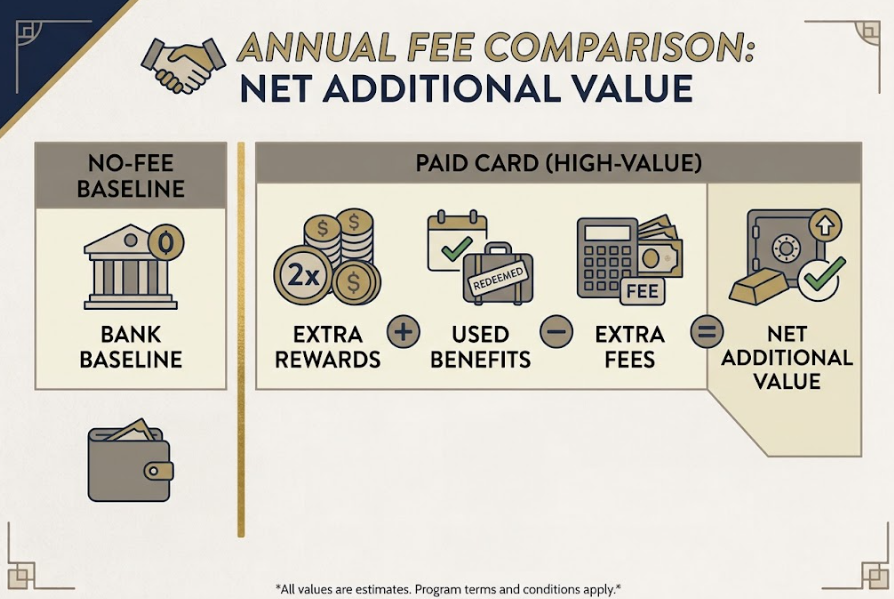
Suppose a paid card earns $600 in annual rewards and charges a $150 fee. Calling the result “$450 of value” is incomplete if a no-fee card would have earned $350 on the same purchases.
The paid card produced only $250 of extra rewards compared with that realistic alternative:
$600 paid-card rewards − $350 no-fee rewards = $250 extra rewards
After the $150 annual fee, the incremental advantage is $100:
$250 extra rewards − $150 extra fee = $100 additional net value
This comparison prevents a common mistake: giving the paid card credit for rewards you could have earned without paying its fee.
Use a baseline card that you could reasonably qualify for and would actually keep. It should fit the same broad purpose—everyday cash back, travel rewards, low-rate borrowing, or another need. Comparing a premium travel card with a bare card that cannot serve your trip may be as misleading as comparing it with no card at all.
Find Every Recurring Cost
The main annual fee usually appears once a year on the statement, but it may not be the only recurring cost.
Check the application disclosure, agreement, benefits guide, and current fee schedule for:
- the primary annual fee;
- additional-cardholder or authorized-user fees;
- a separate fee for a premium version of an additional card;
- taxes that may apply to a fee in the relevant jurisdiction;
- membership or program fees required to use a feature; and
- renewal pricing after an introductory first year.
Also note transaction-dependent costs, including foreign-transaction, cash-advance, balance-transfer, over-limit, late-payment, or returned-payment fees. Do not automatically add all of them to annual cost; include only those reasonably expected from your usage. Their presence still matters when comparing otherwise similar cards.
An annual fee waived in year one is not a permanently free card. Record the normal renewal fee and the exact anniversary or statement on which it is expected. A household that evaluates only the application year can miss the cost that controls the long-term decision.
Measure Rewards Using Your Own Spending
Take 12 months of actual transactions and sort them into the categories used by both cards. Remove spending that cannot be placed on a card or would incur a merchant fee larger than the reward.
For each card, calculate:
- eligible spending in each category;
- the applicable earn rate;
- spending caps and the rate after each cap;
- merchant-coding uncertainty;
- the base rate on all other eligible purchases; and
- the amount of rewards you are likely to redeem.
Then compare the two totals.
Example: higher grocery rewards
Assume a no-fee card earns 1% on $18,000 of relevant annual purchases, producing $180. A paid card earns 3% on $8,000 of groceries and 1% on the remaining $10,000:
- groceries: $8,000 × 3% = $240;
- other purchases: $10,000 × 1% = $100;
- paid-card gross rewards: $340.
The paid card earns $160 more than the no-fee baseline. If its annual fee is $120 and no other difference matters, the additional net value is $40.
The calculation changes if grocery spending falls, the bonus category has a cap, a frequent store is coded differently, or rewards expire unused. Use conservative assumptions near the break-even point.
For cash-back versus travel-reward valuation itself, see Article” Cash Back vs. Travel Rewards: Which Card Fits You?”.
Calculate the Reward-Only Break-Even Point
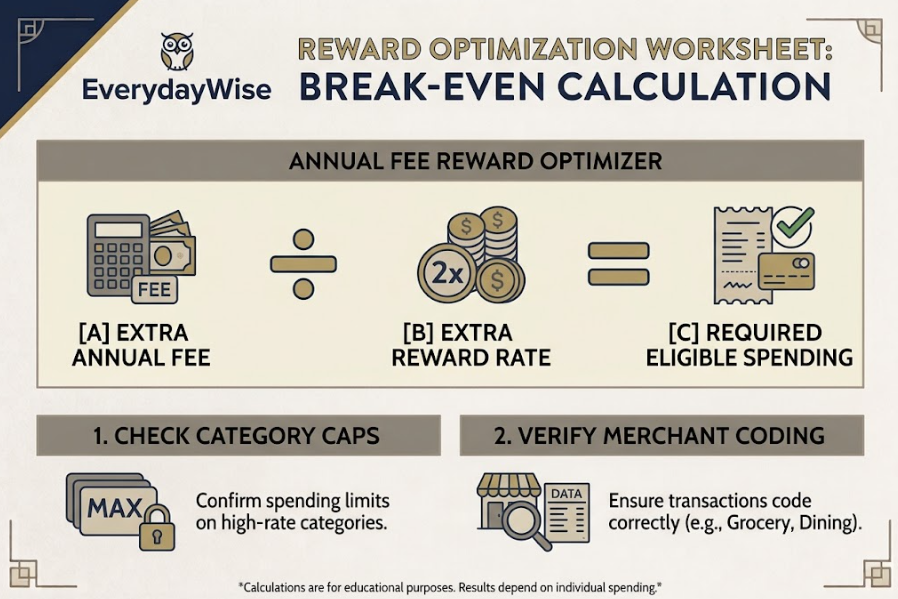
When two cards earn different rates on the same spending, the fee difference can be translated into a spending threshold.
Break-even spending = extra annual fee ÷ extra reward rate
If the paid card costs $120 more and earns 2 percentage points more on eligible purchases:
$120 ÷ 0.02 = $6,000
At $6,000 of spending that genuinely receives the higher rate, the extra rewards equal the extra fee. Below that amount, rewards alone do not recover the fee. Above it, the paid card begins to create an incremental reward advantage.
This simple formula works only when:
- the rate difference is stable;
- all included spending receives that difference;
- no cap changes the rate;
- both rewards are valued in the same dollar terms; and
- no other fee or benefit is being counted.
For tiered cards, calculate each spending category separately. A single advertised maximum rate should not be applied to the entire household budget.
Value Benefits by the Cost They Replace
Paid cards may advertise a long list of benefits. Adding their retail values can make almost any fee look worthwhile, even when the cardholder never uses them.
Use a four-part test for each benefit.
1. Would you have paid for it?
If you would not purchase airport lounge access, a food-delivery membership, or a particular subscription without the card, assigning the full retail price overstates its financial value. Enjoyment is real, but it is not necessarily savings.
2. Will you qualify and use it?
A travel credit may require booking through a specific portal. A checked-bag benefit may require the account to remain open, a loyalty number on the reservation, or payment with the card. Insurance may depend on age, trip length, covered cause, and how much of the purchase was charged.
3. Does it duplicate something else?
Employer coverage, another card, an airline status tier, a vehicle policy, or a separate membership may already provide the same benefit. Count only the portion that adds something useful.
4. What is the realistic replacement cost?
Use the amount you would otherwise pay for the same result. If a benefit replaces one $35 checked bag on two trips, a reasonable annual value might be $70—not the value of unlimited hypothetical uses.
Insurance should be valued especially carefully. The certificate of insurance controls, and a benefit is not equivalent to guaranteed claim payment. Confirm eligibility, exclusions, limits, deductibles, documentation, and whether separate coverage remains necessary.
Credits Are Often Conditional Coupons
A $200 annual credit may look like $200 of cash. Its household value may be lower when it is split monthly, tied to selected merchants, limited to a booking channel, activated only after registration, or lost if unused.
For each credit, record:
- the eligible purchase;
- the period in which it must be used;
- whether registration is required;
- whether the purchase costs more through the required channel;
- whether taxes or fees are excluded;
- whether unused amounts carry forward; and
- the amount you would naturally use without changing plans.
If you normally spend $8 per month with an eligible merchant and the card offers a $10 monthly credit, count at most the $8 that replaces normal spending. Do not manufacture a $2 purchase simply to make the spreadsheet show full value.
A conditional credit can still be useful. The point is to value it according to household behavior, not its headline maximum.
Separate First-Year Value From Renewal Value
The application year may include a welcome bonus, waived fee, introductory credits, or temporary earn rate. Renewal usually removes some of that value while keeping the annual fee.
Create two columns:
| Value category | First year | Typical renewal year |
|---|---|---|
| Ordinary rewards | Include | Include |
| Welcome bonus | Include only if safely earned | Exclude |
| Annual fee | Use actual first-year charge | Use normal renewal fee |
| Temporary credits | Include realistic use | Exclude unless renewed |
| Ongoing benefits | Include realistic use | Include realistic use |
A large first-year surplus may justify applying, but it does not prove the card deserves a permanent place in the wallet. Set a reminder before renewal and repeat the comparison using current terms and the prior year’s actual usage.
Do not overspend to reach a bonus. The relevant gain is the reward produced by planned purchases, less the fee and other costs. Purchases made only for the promotion are costs, not evidence that the card paid for itself.
A Lower Interest Rate Can Be the Main Benefit
Some annual-fee cards offer a lower purchase rate rather than premium rewards. For someone who expects to carry a balance, the potential interest difference may matter more than points.
Estimate the expected balance and repayment period under both cards. Compare the likely interest saved with the extra fee. Do not use the simple annual balance multiplied by APR difference when the balance changes substantially through the year; card interest is commonly calculated using daily balances and account-specific methods.
Because carrying debt is uncertain and expensive, use cautious scenarios. A lower-rate paid card should not become permission to increase spending. It may reduce financing cost while a balance is being repaid, but the underlying repayment plan remains essential.
Article”APR Explained: What Cardholders Often Miss”, owns the detailed interest mechanics.
Account for Household-Level Fees
A card may appear profitable for the primary cardholder and become less attractive after additional-cardholder fees are included.
Before paying for another card on the same account, ask:
- Does the additional card help earn rewards on normal household spending?
- Does the additional cardholder receive the same insurance or travel benefits?
- Are lounge visits, bags, credits, or status benefits shared or limited?
- Could the household achieve the same result with a free additional card?
- Does the added convenience justify its recurring cost?
Do not assume that a person holding an additional card has the same contractual rights or benefits as the primary account holder. Confirm the issuer’s terms.
The broader decision about whether a household should maintain more than one independent credit account is reserved for Article”Should you carry more than one Credit Card?”.
Include Switching Costs Without Letting Them Trap You
Changing cards can involve practical work: updating recurring payments, learning new benefits, preserving rewards, checking insurance continuity, and managing a new due date. Those are real frictions.
They should not force a household to pay an uneconomic fee forever. At renewal, possible options may include:
- keeping the card;
- asking whether another product is available within the same issuer;
- moving to a lower-fee or no-fee version when permitted;
- redeeming or transferring rewards before a change; or
- closing the account after reviewing credit, payment, and benefit consequences.
Product changes are not guaranteed and may affect rewards, bonuses, account features, card numbers, or credit reporting. Obtain the terms before acting. Account closure is covered separately in Article”How to close a Credit Card”.
Review the Card Before the Fee Appears
Do not wait for a surprising annual charge to begin the analysis. Record the account-opening month, expected renewal period, current fee, and the date by which you want the review completed. A reminder several weeks ahead creates time to gather information without assuming that a fee can be reversed after posting.
Use the previous 12 months of evidence:
- rewards earned and actually redeemed;
- credits used without extra spending;
- travel or insurance benefits that replaced a real cost;
- fees paid for the primary and additional cards;
- interest and transaction charges;
- expired or unused benefits; and
- changes expected in the next year.
Then obtain the current renewal terms directly from the issuer. Ask when the fee will post, whether a different product is available, how a change would affect rewards and benefits, and what deadlines apply. Document the answer when it affects the decision.
Cancellation, fee-refund, and product-change rules vary. A previous exception, another customer’s experience, or an online comment does not establish what the issuer must offer on your account. Make the keep-or-change decision from the current agreement and confirmed options.
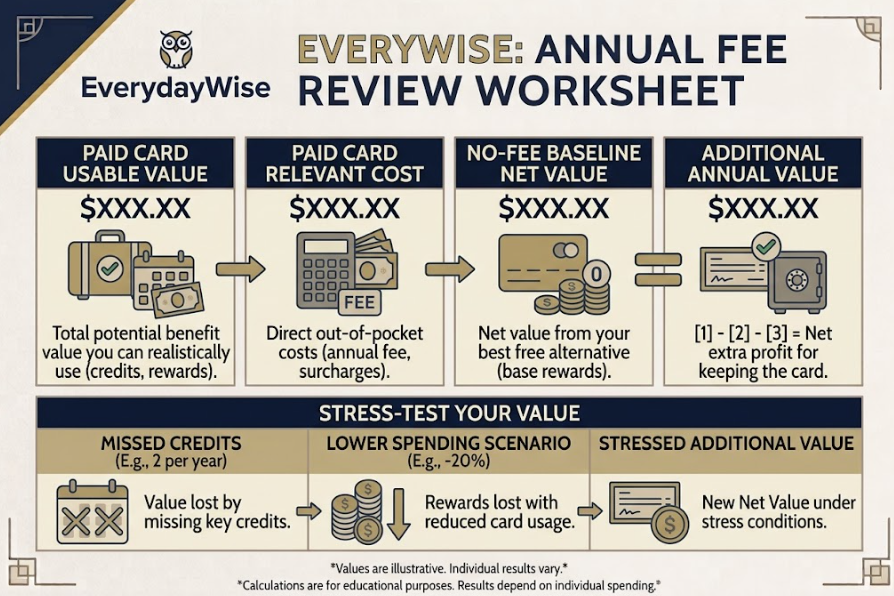
Build a One-Page Annual Fee Worksheet
Evaluate the paid card against one realistic baseline.
Paid-card value
- ordinary rewards redeemed: _____
- benefits that replaced real costs: _____
- credits naturally used: _____
- expected interest savings, if comparing low-rate cards: _____
- total usable value: _____
Paid-card cost
- primary annual fee: _____
- additional-cardholder fees: _____
- expected extra transaction or program fees: _____
- cost created by restricted booking or use: _____
- total relevant cost: _____
Baseline-card value
- ordinary rewards redeemed: _____
- benefits and credits naturally used: _____
- annual and additional-card fees: _____
- baseline net value: _____
Then calculate:
Paid-card net value − baseline-card net value = additional annual value
If the result is small, test lower spending, one missed credit, a reduced reward rate, or a year without travel. A card that wins only when every benefit is used perfectly may be a fragile fit.
Decision Summary
An annual fee is justified by comparison, not by the size of the card’s benefit list.
Use a suitable no-fee or lower-fee card as the baseline. Calculate ordinary rewards from actual spending, value benefits only when they replace real costs, discount conditional credits, and separate the welcome year from renewal years. Include every recurring household fee.
The strongest paid-card case usually has several qualities:
- the extra rewards come from normal spending;
- the household repeatedly uses the relevant benefits;
- credits fit existing purchases without prompting new ones;
- the result remains positive after fees and realistic imperfections; and
- the card’s borrowing terms fit the way the account will be managed.
A no-fee card can be the more valuable choice when use is light, benefits are duplicated, travel is uncertain, or the paid card requires constant effort to recover its cost. A paid card can be reasonable when its incremental value is clear and repeatable.
Recalculate before every renewal. The card, household, and program can all change.
Important note: This article provides general educational information, not individualized financial, legal, tax, insurance, or credit advice. Annual fees, APRs, rewards, benefits, credits, product-change options, and disclosure requirements vary by issuer, account, country, and current terms. Verify the application disclosure, cardholder agreement, fee schedule, and benefit certificates before applying, renewing, changing, or closing an account.
FAQ
1. Is a credit card with an annual fee automatically better?
No. Fee cards may offer additional rewards, benefits, or a lower interest rate, while some no-fee cards offer similar features. Compare the paid card’s additional usable value with a realistic lower-cost alternative.
2. How much should I spend to justify an annual fee?
It depends on the extra earn rate and usable benefits. For a simple rewards-only comparison, divide the extra fee by the extra reward rate. Adjust for caps, category rules, the baseline card’s rewards, and benefits you genuinely use.
3. Should I count the welcome bonus?
Count it in a separate first-year analysis when planned spending can earn it safely. Exclude it from the normal renewal-year calculation because it usually does not repeat.
4. Does a travel credit offset the annual fee dollar for dollar?
Only when you would naturally spend the full amount under the credit’s conditions. Monthly limits, selected merchants, required booking channels, registration, expiration, and higher portal prices can reduce personal value.
5. Can I ask to change to a no-fee card before renewal?
You can ask whether the issuer offers a product change, but approval and consequences vary. Confirm the new terms, reward treatment, card number, benefits, credit reporting, and any effect on future offers before accepting.
6. What if I carry a balance?
Prioritize APR and repayment cost over rewards. A fee may sometimes be worthwhile for a meaningfully lower rate, but detailed interest calculations and a repayment plan are necessary.
7. When should I review an annual-fee card?
Review it before each renewal and after major changes in fees, rewards, benefits, household spending, travel plans, or debt. Use actual prior-year rewards and benefits rather than the original marketing estimate.
Sources
- Financial Consumer Agency of Canada — Choosing a credit card
- Financial Consumer Agency of Canada — Credit Card Comparison Tool
- Financial Consumer Agency of Canada — How credit cards work
- Consumer Financial Protection Bureau — Know Before You Owe: Credit cards
- Consumer Financial Protection Bureau — How to find the best credit card for you
- Consumer Financial Protection Bureau — Credit cards consumer tools
- Consumer Financial Protection Bureau — Circular 2024-07 on credit-card rewards programs
More in This Cluster: Credit Card Decision Basics
- Credit Card vs. Debit Card: Which Should You Use?
- Cash Back vs. Travel Rewards: Which Card Fits You?
- How to Compare Credit Card Annual Fees (you are here)
- APR Explained: What Cardholders Often Miss
- Should You Carry More Than One Credit Card?
- When a Secured Credit Card Makes Sense
- How to Close a Credit Card Without Unintended Consequences