Credit and debit cards can look almost identical at checkout. The financial decision behind them is not identical.
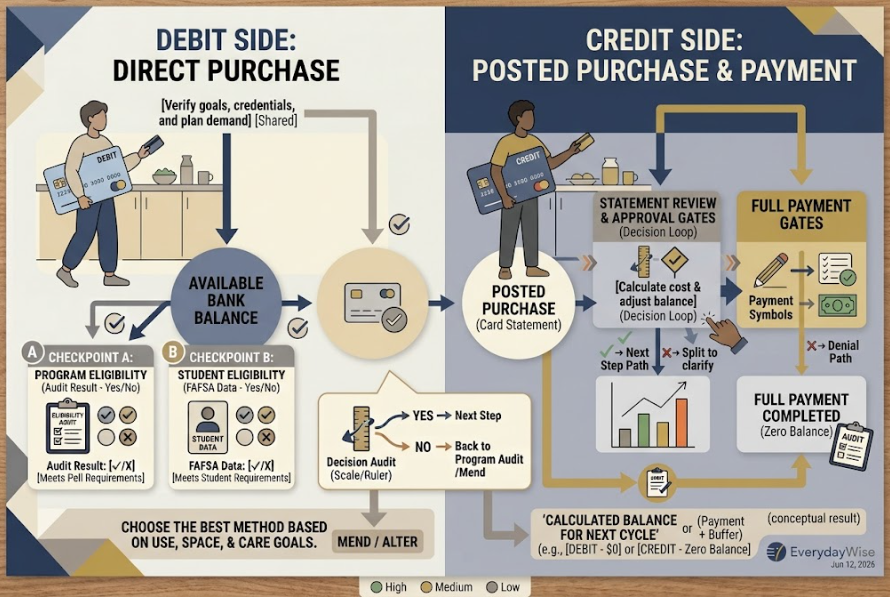
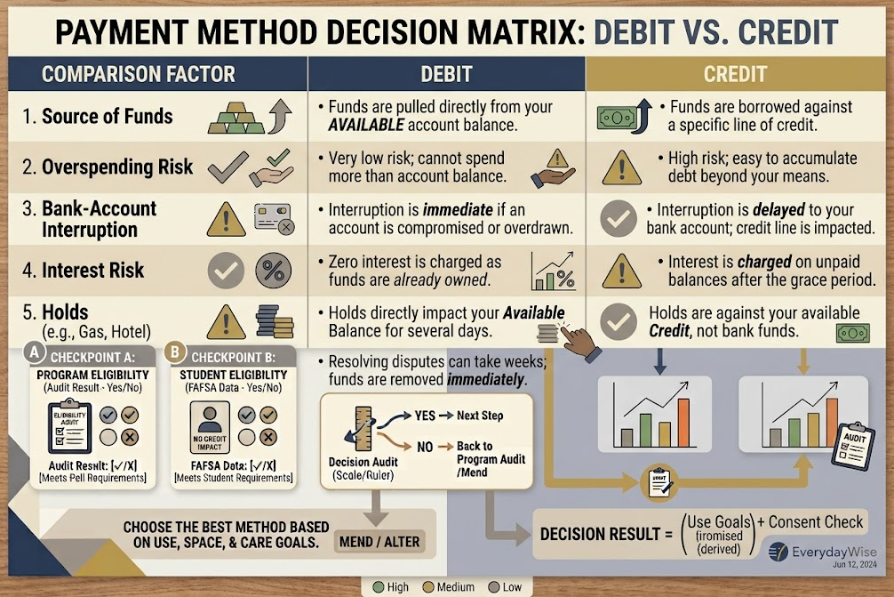
A debit purchase normally draws from money already held in your bank account. A credit-card purchase normally uses a revolving line of credit that you must repay. That difference affects when money leaves your account, whether interest can arise, how a disputed transaction interrupts cash flow, and what habits are needed to keep spending visible.
Neither card is automatically the responsible choice for every purchase. Debit can create a firm connection to available cash, yet an unexpected withdrawal may temporarily reduce money needed for bills. Credit can create time between a purchase and payment and may offer useful dispute processes, yet that distance can also make overspending and interest-bearing debt easier.
Quick Decision
Use debit when direct withdrawal helps you stay within available cash and the transaction will not expose essential bill money to a large hold or disruption.
Use credit when you can pay the statement balance in full, want to keep the purchase separate from your deposit account, or expect a deposit, delayed delivery, travel hold, or billing dispute—but confirm the merchant’s rules and your card agreement first.
If paying in full is uncertain, compare the potential interest and fees with the practical benefit before using credit. Rewards rarely compensate for carrying expensive debt.
From Jerome, EverydayWise Contributor
I have used credit cards for more than 20 years, and I believe I spend a little more easily when I use one. Unless I set alerts or check the account, I may not know exactly how much has accumulated. A card is simply more convenient than cash.
That does not make credit cards inherently bad. It means the payment method can change how visible spending feels. The purchase may take seconds, while the total becomes clear only when several transactions appear together. For me, the useful safeguard is to keep the running balance visible rather than assuming that I will remember every purchase.
The passage above comes from the experience of Jerome, an EverydayWise contributor. It illustrates a common decision problem; it does not establish how every person responds to card payments.
Start With the Source of the Money
The clearest difference appears before rewards, convenience, or card design enters the discussion.
Debit uses money in or connected to your account
When a debit transaction is authorized, the amount generally comes from the linked chequing or checking account. Depending on the transaction and institution, the amount may first appear as pending and then post later. If overdraft coverage or another linked source applies, spending beyond the available balance may still create fees or debt.
The practical advantage is immediate feedback. A lower bank balance can make the cost of a purchase difficult to ignore. The practical risk is that the same account may also hold rent, mortgage, utility, grocery, or automatic-payment money.
Credit uses borrowed capacity
A credit-card purchase adds to the account balance and reduces available credit. You later receive a statement showing transactions, the statement balance, the minimum payment, and a due date.
Paying only the minimum keeps the account from being treated the same as a completely missed payment, but it normally does not avoid interest or repay the balance quickly. The terms governing interest differ by country, issuer, transaction type, and account. Cash advances and balance transfers often follow different rules from ordinary purchases.
The meaningful comparison is available deposit money now versus a repayment obligation that becomes due later.
The Statement Balance Is the Key Credit-Card Number
Several balances can appear in a credit-card app:
- the current balance, which may include activity after the latest statement;
- the statement balance, fixed at the end of the billing cycle;
- the minimum payment, the smallest required amount shown for that statement; and
- the available credit, the unused portion of the limit.
For ordinary purchases, paying the statement balance in full by the due date is commonly the action that preserves the purchase grace period, subject to the agreement and account status. In Canada, federally regulated issuers must provide an interest-free grace period of at least 21 days on new purchases when the required conditions are met. U.S. rules and issuer terms also govern when a grace period applies; not every card or transaction must receive one.
The minimum payment is only a required installment toward a larger debt; it does not represent the price of the month’s purchases. If you repeatedly spend more than you repay, the balance can grow even though every minimum arrives on time.
Debit avoids a monthly revolving statement balance, but it does not eliminate financial risk. Overdraft fees, insufficient-funds consequences, subscription renewals, merchant errors, and fraudulent transactions can still affect the account.
Choose Based on the Failure You Can Best Absorb
Routine purchases work smoothly most of the time. The difference becomes more important when something goes wrong.
If the purchase is unauthorized
Credit and debit protections are not interchangeable, and the reporting deadline matters.
In the United States, federal rules generally limit liability for unauthorized credit-card use to no more than $50 when the legal conditions are met. Debit-card liability depends more heavily on how quickly a lost card or unauthorized electronic transfer is reported; delay can substantially increase potential loss. Account agreements or network policies may provide additional protection.
In Canada, major payment networks have made zero-liability commitments for eligible unauthorized credit and debit transactions. Cardholders still have responsibilities, including protecting the card and PIN, reviewing transactions, and reporting problems promptly. Canadian law also limits liability for unauthorized credit-card transactions, subject to exceptions such as gross negligence.
Legal liability is only one part of the experience. With debit, disputed money may already be missing from the bank account while the institution investigates. With credit, the disputed charge ordinarily appears against the credit account rather than directly removing the same dollars used for household bills. Investigation and temporary-credit practices vary, so neither route guarantees instant access or an effortless resolution.
If the merchant does not deliver as agreed
Credit cards may provide formal billing-error or dispute rights for qualifying transactions, particularly in the United States. Network chargeback processes may also apply to credit or debit purchases, but a chargeback is not a universal legal guarantee and does not replace the merchant’s return policy.
Keep the receipt, order confirmation, promised delivery date, cancellation request, correspondence, and photographs when condition is relevant. Contact the merchant promptly, then follow the issuer’s required dispute procedure and deadline.
If the card or account is unavailable
A fraud block, damaged card, expired card, merchant outage, or network problem can make either payment method temporarily unusable. A second payment route can provide resilience, but that does not necessarily mean opening several credit cards. A modest backup may be a card from another account or network, plus a small amount of emergency cash appropriate to the situation.
Some Transactions Deserve Extra Planning
Hotels, rental cars, and fuel pumps
Merchants may place an authorization hold above the final expected charge to cover incidentals or confirm available funds. On debit, that hold can reduce the bank balance available for other payments. On credit, it can reduce available credit. The hold may remain after checkout or return until the merchant and financial institution release it.
Before travel or a large purchase, ask:
- whether debit is accepted;
- the estimated hold amount;
- how long release usually takes;
- whether a physical card is required;
- whether the name on the card must match the reservation; and
- how much available cash or credit will remain afterward.
A debit card may be perfectly usable, but placing a large hold against essential cash can create a separate problem. A credit card may isolate the hold from the deposit account, but only if enough limit remains and the later statement can be paid safely.
Online orders and delayed services
When delivery, cancellation, or merchant reliability is uncertain, consider how long the money may be unavailable if a problem develops. Preserve transaction records and read the dispute rules before the deadline passes.
This does not justify spending more because credit is available. It identifies the account in which a temporary dispute would be less disruptive.
Recurring subscriptions
Either card can support recurring payments. Credit may prevent a subscription from drawing directly against a low bank balance, while debit can keep the charge connected to cash. Both require monitoring because replacing or locking a card does not always terminate the underlying contract, and some account-updater services may transmit new card details to participating merchants.
Cancel through the merchant’s documented process, save confirmation, and verify later statements.
Cash withdrawals
Debit is generally designed for access to money in a deposit account. Using a credit card at an ATM is commonly treated as a cash advance, which may trigger a fee and interest without the ordinary purchase grace period. Confirm the transaction type before proceeding.
Credit Cards Can Affect a Credit File; Debit Usually Does Not
A credit-card issuer may report the account, balance, payment history, and limit to credit bureaus. The account can therefore help or harm a credit record depending on how it is managed and reported.
Ordinary debit-card use generally does not create the same revolving credit history because the purchase is funded from a deposit account. That makes debit useful for payments, not a substitute for every credit-building function.
This distinction should not turn a routine purchase into a score exercise. Paying interest is not required to build credit. A small, manageable credit-card balance paid according to the agreement can create reported activity without carrying debt from month to month. For the mechanics of credit history and utilization, see Article”How Credit Scores Work”, and Article”Credit Utilization Explained”.
Build Visibility Into Whichever Card You Use
Jerome’s experience points to a broader issue: payment friction affects awareness. Cash creates a physical limit. Debit updates the bank account. Credit separates the purchase from the eventual outflow.
You can restore visibility without abandoning the card that fits the transaction.
Use one spending number
For credit, choose either the current balance or a manually tracked total as the number you check. Do not confuse remaining credit with money available to spend. A $10,000 limit does not create a $10,000 household budget.
For debit, check available balance after accounting for pending transactions and bills not yet withdrawn. The displayed balance may include money already committed elsewhere.
Set alerts that match the risk
Useful alerts may include:
- every transaction above a chosen amount;
- the running balance crossing a personal limit;
- statement availability;
- a payment approaching its due date;
- an unusually large or international transaction; and
- the bank balance falling below the amount reserved for upcoming bills.
Alerts are prompts, not controls. They work only if someone reviews and acts on them.
Reconcile weekly during uncertain periods
Compare receipts and pending transactions with the card or bank account. Identify subscriptions, duplicated charges, tips that posted differently, household purchases made by another authorized user, and refunds still outstanding.
A weekly review is especially useful during travel, holidays, a move, or a month with irregular expenses. It reduces the gap between “I think we spent” and “the account shows.”
Reserve the payment as you spend
Some households treat each credit purchase as though the cash has already left. They move the amount to a dedicated payment category or subtract it from the remaining spending plan. This preserves the convenience of credit while preventing the statement from becoming a future surprise.
Do not automate a full credit-card payment from an account that may lack sufficient funds. Automatic payment can reduce missed-payment risk, but it should be paired with balance alerts and enough cash on the withdrawal date.
A Purchase-by-Purchase Decision Test
Before choosing the card, ask five questions.
1. Is the money already available?
If not, credit converts the purchase into debt. Decide whether the purchase is essential, what repayment source exists, and what interest or fees could apply if the plan fails.
2. Would a hold or dispute interrupt essential bills?
If a large temporary withdrawal would endanger housing, utilities, food, insurance, or another automatic payment, using the primary bill account may be fragile.
3. Can the credit statement be paid in full?
If yes, credit may provide useful timing without interest on eligible purchases when the grace-period conditions are met. If no, calculate the likely financing cost rather than valuing the purchase only at the checkout price.
4. What evidence will you keep?
For travel, online orders, deposits, and delayed services, retain enough documentation to show what was promised, charged, delivered, cancelled, or returned.
5. Which method keeps spending most visible?
The technically stronger dispute route may still be the wrong everyday tool if it repeatedly leads to unaffordable balances. The method must work with your behavior as well as the transaction.
Decision Summary
Debit and credit cards solve different payment problems.
Debit keeps spending close to money already held in an account. It can make the budget more immediate and avoids revolving purchase debt, but holds, errors, or unauthorized withdrawals may affect cash reserved for daily life.
Credit separates the transaction from the deposit account and can provide useful billing and dispute structures. It also creates a repayment obligation. Convenience becomes expensive when the statement cannot be paid under the conditions needed to avoid interest.
Choose by examining the transaction and the household system:
- where the money will come from;
- whether the full statement can be paid;
- which account would absorb a hold or dispute;
- how quickly unauthorized activity must be reported;
- whether the transaction needs stronger documentation; and
- which method keeps spending visible enough to control.
The best default is the one that protects both sides of the decision: the purchase itself and the bills that still need to be paid afterward.
Important note: This article provides general educational information, not individualized financial or legal advice. Card protections, reporting deadlines, grace periods, overdraft treatment, holds, dispute rights, and network policies vary by country, institution, account, and transaction. Read your account agreements and verify current procedures with the card issuer or financial institution.
FAQ
1. Is a credit card always safer than a debit card online?
No universal rule fits every account or jurisdiction. Credit may keep a disputed charge away from deposit cash and may provide specific billing-dispute rights, but protection depends on the transaction, reporting deadline, issuer rules, and applicable law. Strong passwords, transaction alerts, merchant verification, and prompt reporting matter with either card.
2. Does using a debit card build credit?
Ordinary debit purchases generally do not build a revolving credit history because they use money from a deposit account. A debit account may still affect other financial relationships, but it is not normally reported like a credit-card account.
3. Do I pay interest every time I use a credit card?
Not necessarily. Eligible purchases may receive a grace period when the account terms and payment conditions are met. Cash advances and some other transaction types may begin accruing interest immediately. Check the agreement and statement.
4. Is paying the minimum enough?
It may satisfy the stated minimum-payment requirement, but it usually leaves debt outstanding and can result in interest. Paying only minimums can extend repayment for years, especially if new purchases continue.
5. Why did a hotel or gas station charge more than the final price?
The larger pending amount may be an authorization hold used to verify funds or cover incidentals. It reduces available bank funds or available credit until released. Ask the merchant and issuer about the amount and expected release time.
6. Should I use debit if credit cards make me spend more?
Debit may be a useful default when immediate balance feedback improves control. You can also make credit more visible through transaction alerts, a personal spending limit, weekly reconciliation, and reserving cash for each purchase. Choose the system that reliably prevents unaffordable balances.
7. What should I do after noticing an unauthorized charge?
Contact the issuer or financial institution immediately using a verified number, lock the card if the account offers that feature, document the report, and follow the required dispute process. Review related accounts and statements because legal and contractual protection can depend on prompt notice.
Sources
- Consumer Financial Protection Bureau — How prepaid, debit, and credit cards differ
- Federal Trade Commission — Comparing credit, charge, secured credit, debit, and prepaid cards
- Federal Trade Commission — Lost or stolen credit, ATM, and debit cards
- Federal Trade Commission — Using credit cards and disputing charges
- Financial Consumer Agency of Canada — How credit cards work
- Financial Consumer Agency of Canada — Unauthorized credit and debit transactions
- Financial Consumer Agency of Canada — Resolving an unauthorized transaction
More in This Cluster: Credit Card Decision Basics
- Credit Card vs. Debit Card: Which Should You Use? (you are here)
- Cash Back vs. Travel Rewards: Which Card Fits You?
- How to Compare Credit Card Annual Fees
- APR Explained: What Cardholders Often Miss
- Should You Carry More Than One Credit Card?
- When a Secured Credit Card Makes Sense
- How to Close a Credit Card Without Unintended Consequences