For years, my wife and I effectively relied on one credit-card account. I had the card, while she used a card saved in her phone and also used debit. That seemed simple—until we considered what would happen after a large purchase used much of the available limit, or if the card were lost, damaged, or temporarily unavailable.
We eventually decided to hold one credit card each. Both cards earn miles with the same airline because, as a family of four, we want our everyday spending to support the same travel goal. The point was not to collect cards. It was to give each adult an independent way to pay while keeping the household plan understandable.
— From Jerome, EverydayWise Contributor
The passage above comes from Jerome, an EverydayWise contributor. His experience raises the useful question: does a second card solve a real household problem, or merely create another account to manage?
The Quick Decision
A second credit card may make sense when it provides a specific benefit that your first card cannot provide—such as an independent account for another adult, a genuine payment backup, or a lower-cost card for a defined type of spending—and when you can pay and monitor both accounts reliably.
Keep one card if another account would mainly add temptation, annual fees, missed-payment risk, or administrative work. Do not open a card solely because more available credit might improve a score. Credit applications and new accounts can affect credit, and a higher total limit is not useful if it encourages higher balances.
Before applying, finish this sentence:
“The second card will solve ________, and we will manage it by ________.”
If the first blank is vague or the second has no practical answer, wait.
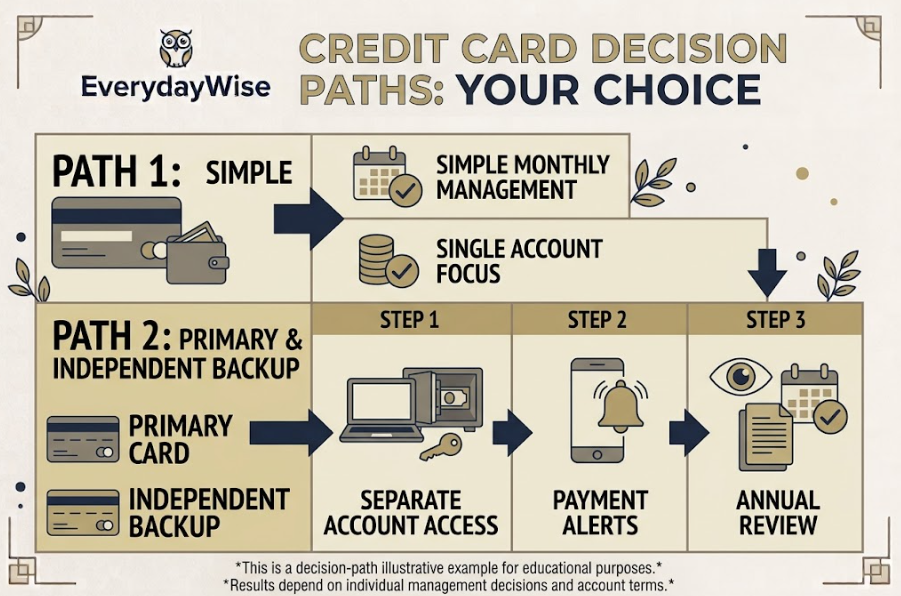
More Cards Do Not Automatically Create More Security
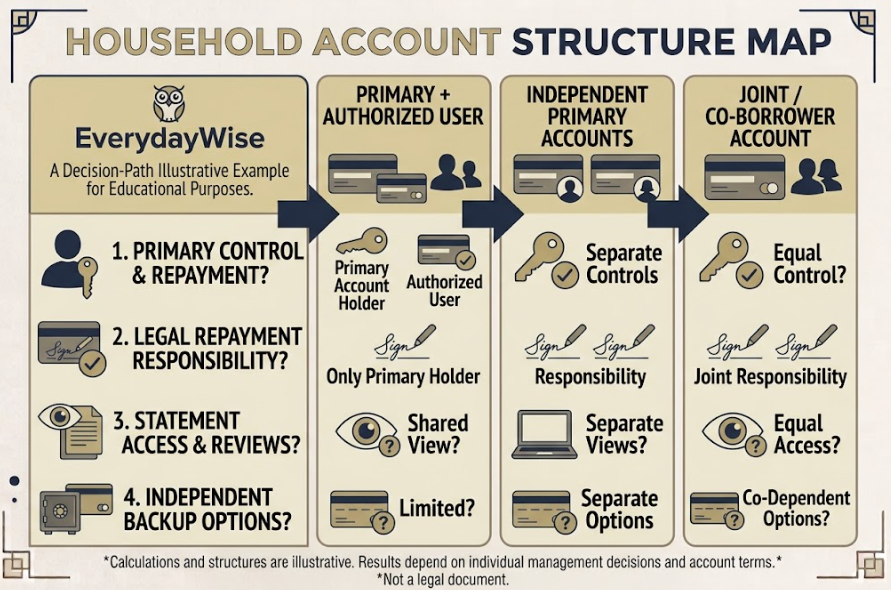
“Two cards” can describe very different arrangements:
- one primary account with an additional or authorized-user card;
- two independent accounts held by two adults;
- two accounts held by one person;
- a joint account, where available; or
- several cards opened mainly for rewards or promotions.
Those structures do not provide the same control, responsibility, credit history, or backup value.
In Canada, the Financial Consumer Agency of Canada explains that an additional cardholder uses a card connected to the primary cardholder’s account. The account belongs to the primary cardholder, the additional cardholder generally is not responsible for repaying the balance, and purchases made on that card do not build the additional cardholder’s Canadian credit history. A co-borrower arrangement is different: co-borrowers are jointly responsible for the balance.
In the United States, an authorized user is also different from a joint account owner. An authorized user generally is not obligated to repay the debt, while each owner of a joint account can be responsible for the full balance. Credit reporting practices for authorized users and account availability vary, so readers should confirm the issuer’s terms rather than assume that a card in someone’s wallet or phone is an independent account.
This distinction matters in Jerome’s household. A card connected to his account made spending convenient for his wife, but it did not create a separate account under her control. Two independent primary accounts can provide more separation—but also create two bills, two agreements, and two accounts requiring protection.
Four Reasons a Second Card May Be Useful
1. Another adult needs independent access
In a household with two adults, an independent account can reduce reliance on one person’s account. Each primary cardholder can receive statements, manage security settings, contact the issuer, and build an account history under the applicable reporting rules.
That does not mean every couple needs separate cards. Some households prefer one primary account because it simplifies budgeting. Others value the resilience of two independently controlled accounts. The correct arrangement depends on responsibility, trust, cash flow, account terms, and local law—not marital status alone.
Ask:
- If one person is unavailable, can the other review transactions and make payments?
- Is the second person a primary borrower, co-borrower, or authorized user?
- Who is legally responsible for the balance?
- Whose credit file may receive the account history?
- Can either person freeze, replace, or close the card?
Get the answers from the issuer before relying on the card as independent access.
2. Your only card could become temporarily unusable
A card can fail for ordinary reasons: loss, suspected fraud, damage, an expired replacement that did not arrive, a merchant acceptance issue, a security block, or an account that is too close to its limit for a planned purchase. A second account can help while the first problem is resolved.
But a true backup should not share every point of failure with the primary card. If both cards are stored in the same wallet, losing the wallet defeats the plan. If both are connected to the same compromised login or depend on the same primary account, the backup may be weaker than it appears.
A practical backup plan may include:
- a second, independently controlled account;
- a debit card and access to some cash;
- secure storage separate from the main wallet when appropriate;
- current contact information with both institutions; and
- enough available funds to pay either account on time.
A backup card is not an emergency fund. It is another borrowing tool. If income disappears or an essential expense rises, charging the cost simply postpones the cash-flow problem and may add interest.
3. Two cards have clearly different jobs
One card might be kept for predictable household purchases while another is used only for travel or recurring bills. Defined roles can improve visibility if the categories match the household budget.
Jerome and his wife chose cards connected to the same airline-mile goal. That can be coherent for their family, but it is not automatically the best strategy for everyone. Rewards can expire, change, require extra spending, or be difficult to use. A household carrying interest should generally prioritize borrowing cost and repayment over rewards.
The useful test is not “Which card earns more?” It is:
Does the second card produce value we will actually use after its fee, interest, complexity, and required spending?
If both cards do the same job, the second one may be unnecessary. If each card has a distinct role, write that role down. A card without a job often becomes an account that is forgotten until a fee, renewal, or suspicious transaction appears.
4. One account’s limit is too restrictive for normal planned spending
A second card can spread planned purchases across accounts, but that should not be confused with making the purchases more affordable. Total available credit is not income.
Before opening another card because the first limit feels tight, ask whether the problem is:
- an unusually large but fully funded purchase;
- normal monthly spending that will be paid from existing cash;
- a temporary authorization hold, such as for travel; or
- spending that the household cannot repay this month.
Only the first three may be payment-capacity problems. The fourth is a cash-flow or borrowing problem. Another card may hide it rather than solve it.
Five Costs That Are Easy to Underestimate
More due dates and more ways to miss one
Every additional account can create another statement date, payment due date, minimum payment, autopay instruction, and fraud-monitoring task. A missed payment can lead to interest, fees, loss of promotional terms, account restrictions, and credit consequences.
Autopay helps, but it does not eliminate responsibility. A payment can fail if the linked account has insufficient funds, account details changed, or the instruction was not active for the current cycle. Review each statement and verify that payment completed.
More spending can become less visible
Jerome noticed that credit cards made spending feel easier and that, without alerts, it was harder to know exactly how much he had spent. Adding another card can compound that problem because no single app shows the whole household picture unless you deliberately combine the balances.
Track the total current balance across all cards—not merely the balance on each card. A $700 balance on each of three cards is still $2,100 owed.
Fees can duplicate faster than benefits
Two annual fees may be reasonable if each card’s usable value exceeds its cost. But duplicate travel benefits, insurance, or credits do not necessarily double their value. Review the full fee test in Article”How to Compare Credit Card Annual Fees”.
Also examine foreign transaction fees, additional-card fees, late fees, and fees tied to specific transactions. Do not count a benefit merely because the issuer assigns it a dollar value. Count what your household would otherwise have purchased.
Rewards can fragment
Spending across several programs can leave small balances that never become useful. Two cards feeding one travel goal may reduce that fragmentation, as in Jerome’s household, but only if the program permits the intended use and the value outweighs fees and constraints.
For a full comparison, use Article”Cash Back vs. Travel Rewards Cards”. This article’s decision is the number and structure of accounts, not which reward currency wins.
Applications can affect credit
Applying for credit commonly creates a hard inquiry. The U.S. Consumer Financial Protection Bureau notes that hard inquiries can affect credit scores because scoring models consider how recently and frequently a person applies. Canadian scoring formulas also consider factors such as inquiries and new credit, though exact models differ.
Do not assume that the rate-shopping treatment used for certain mortgage, auto, or student-loan inquiries applies to a batch of credit-card applications. Space applications according to your actual need, and avoid opening several cards simply to test what you might receive.
What About Credit Utilization?
Credit utilization compares reported card balances with available credit limits. A second card may increase total available credit and therefore lower the ratio if spending stays unchanged. But that arithmetic is not a complete reason to open another account.
For example, $1,000 reported against a $2,000 limit is 50% utilization. If a second card adds another $2,000 limit and the balance remains $1,000, aggregate utilization becomes 25%. If the extra capacity leads to another $1,000 of spending, the ratio returns to 50% and the household owes twice as much.
Scoring models, reporting dates, account-level utilization, and lender decisions vary. No particular ratio guarantees a score or approval. Paying balances on time, keeping debt manageable, and applying only when needed are more durable principles than opening a card to chase a score change.
If utilization is your only reason, first consider whether ordinary payment timing, spending reduction, or a limit review on an existing account would address the issue. A limit increase can also involve issuer review and may affect spending behavior, so ask about the process and do not accept more credit than you can manage.
The Second-Card Test
Score each statement yes or no:
- The second card has one specific job.
- We can pay the full statement balance on both cards under our normal plan.
- We will see the combined balance at least weekly.
- Each responsible adult understands ownership and liability.
- The annual and transaction fees are justified by usable value.
- The card provides a genuinely separate payment option.
- We can monitor both accounts for fraud and recurring charges.
- We are not applying mainly because of a short-term bonus.
- We can keep the card secure even when it is not used often.
- We know what would cause us to stop using or reconsider it.
If you cannot answer yes to the payment, visibility, ownership, and monitoring questions, improve the system before adding the account.
A Simple Two-Card Operating System
If you decide that two cards make sense, keep the system boring.
Assign one role to each card
Examples:
- Card A: ordinary household purchases; Card B: independent backup.
- Card A: recurring bills; Card B: travel purchases.
- Adult A: independent account; Adult B: independent account; shared budget: one combined weekly review.
Do not create overlapping rules that require remembering which card earns a slightly better reward at every merchant. Complexity should earn its place.
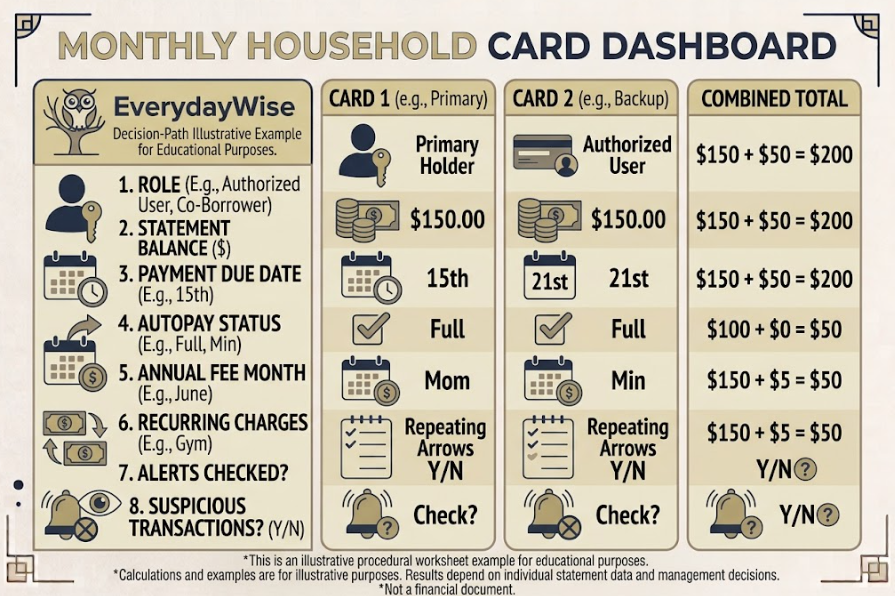
Put both due dates in one calendar
Record the statement close date, payment due date, annual-fee month, and any promotional end date. If the issuer allows a due-date change, a common payment week may simplify cash flow—but confirm when the change takes effect.
Set alerts on both accounts
Useful alerts may include:
- every transaction or transactions above a low threshold;
- balance milestones;
- payment due soon;
- payment posted or failed;
- international or online use; and
- profile or password changes.
Alerts support awareness; statements remain the authoritative monthly record.
Pay from a funded account
If using autopay, choose the amount deliberately and keep the linked account funded. Paying the statement balance generally supports interest avoidance on purchases when a grace period applies, but terms differ. See Article”APR Explained: What Cardholders Often Miss“ for grace periods and interest mechanics.
Review both statements together
Once a month, check:
- total spending across both cards;
- total amount owed;
- fees and interest;
- recurring charges;
- rewards actually earned and used;
- unfamiliar transactions; and
- whether each card still performs its assigned job.
Test the backup without creating debt
Confirm that the backup card is active, its contact information is current, and its payment process works. A small planned purchase paid through the normal system is enough. Do not carry a balance merely to keep a card active; ask the issuer about inactivity policies.
When One Card Is Probably Better
One card may be the stronger choice if:
- you are learning to manage your first card;
- card spending is already difficult to track;
- you sometimes miss the existing due date;
- you carry a balance and another card would extend borrowing;
- the second card has no distinct purpose;
- a bonus requires spending you would not otherwise do;
- fees exceed realistic household value; or
- account monitoring already feels burdensome.
One well-managed card is not an incomplete setup. FCAC advises consumers to keep only what they need and can manage responsibly. Simplicity can be a financial advantage.
When a Household May Prefer Two Independent Cards
Two independent accounts may be reasonable when each adult needs control over a payment method, the household can see and repay both balances, and the accounts support one coordinated plan. Jerome’s arrangement fits that logic: one account per adult, with rewards pointed toward the same family travel objective.
The important part is not copying his choice. It is copying the clarity:
- What problem does the second account solve?
- Who owns and pays it?
- How will both balances remain visible?
- What is the shared goal?
- What happens if income, fees, or travel plans change?
If those answers remain clear, two cards can be a practical system. If they become unclear, the system needs simplification—not another card.
The Bottom Line
Carry more than one credit card only when the additional account has a defined purpose and your payment system can absorb the extra responsibility.
For some households, one card is the clearest and safest structure. For others, a second independent card provides useful access, resilience, or a separate spending role. The number itself is not the decision. The decision is whether every account improves control after you count its fees, borrowing risk, credit application, security work, and monthly administration.
Before applying, document ownership, liability, purpose, full cost, payment method, alerts, and the household’s combined spending limit. If the plan cannot fit on one page, it is probably too complicated.
Money disclaimer: This article provides general educational information, not individualized financial, credit, legal, tax, or product advice. Credit reporting, liability, account ownership, fees, interest, and consumer protections vary by country, province or state, issuer, agreement, and personal circumstances. Review the agreement and official guidance, and seek qualified help when needed.
FAQ
Is it better for my credit score to have two credit cards?
Not necessarily. A second card may increase available credit, but the application may create a hard inquiry and a new account. Scores also reflect payment history, balances, account age, and other factors. Open a card for a real financial purpose, not a promised score result.
Is an authorized-user card the same as having my own card?
No. It is generally connected to the primary cardholder’s account. Ownership, repayment liability, control, and credit reporting differ from an independent primary account and from a joint account. Confirm the issuer’s written terms.
Should my backup card be from a different issuer or payment network?
Different infrastructure may reduce some shared failure points, but acceptance, fees, service, and account terms also matter. No arrangement guarantees access. Keep another lawful payment option and some emergency liquidity appropriate to your circumstances.
Should both spouses or partners have the same rewards card?
Only if independent accounts, fees, and program rules support a shared goal. Combining value in one program can reduce fragmentation, but duplicate fees and limited redemption options may outweigh that benefit.
How often should I use a backup credit card?
There is no universal frequency. Issuers may have different inactivity practices. Ask the issuer, monitor every statement, and use only planned purchases that you can repay. You do not need to carry a balance or pay interest to demonstrate use.
Can I use a second card when the first one reaches its limit?
You can use available credit subject to the agreement, but first determine why the first card is near its limit. If the purchases are not already funded, a second card may deepen a cash-flow problem rather than solve a payment-capacity issue.
How many credit cards are too many?
There is no universal number. You have too many when you cannot reliably track total spending, protect every account, justify all fees, understand liability, and pay on time. For one person that may be two; another may manage more. Need and control matter more than count.
References
- Financial Consumer Agency of Canada. “Joint credit cards.” Updated October 15, 2025. https://www.canada.ca/en/financial-consumer-agency/services/credit-cards/joint-credit-card.html
- Financial Consumer Agency of Canada. “How credit cards work.” Updated October 15, 2025. https://www.canada.ca/en/financial-consumer-agency/services/credit-cards/credit-card-work.html
- Financial Consumer Agency of Canada. “Paying off your credit card.” Updated October 15, 2025. https://www.canada.ca/en/financial-consumer-agency/services/credit-cards/pay-off-credit-card.html
- Consumer Financial Protection Bureau. “What is a credit inquiry?” Updated September 11, 2025. https://www.consumerfinance.gov/ask-cfpb/what-is-a-credit-inquiry-en-1317/
- Consumer Financial Protection Bureau. “I was an authorized user on my deceased relative’s credit card account. Am I liable to repay the debt?” Updated September 25, 2024. https://www.consumerfinance.gov/ask-cfpb/i-was-an-authorized-user-on-my-deceased-relatives-credit-card-account-am-i-liable-to-repay-the-debt-en-1485/
- Consumer Financial Protection Bureau. “Am I responsible for charges on a joint credit card account if I didn’t make them?” Updated February 2, 2024. https://www.consumerfinance.gov/ask-cfpb/am-i-responsible-for-charges-on-a-joint-credit-card-en-88/
- Consumer Financial Protection Bureau. “Credit card agreement database.” Accessed August 25, 2026. https://www.consumerfinance.gov/credit-cards/agreements/
More in This Cluster: Credit Card Decision Basics
- Credit Card vs. Debit Card: Which Should You Use?
- Cash Back vs. Travel Rewards: Which Card Fits You?
- How to Compare Credit Card Annual Fees
- APR Explained: What Cardholders Often Miss
- Should You Carry More Than One Credit Card? (you are here)
- When a Secured Credit Card Makes Sense
- How to Close a Credit Card Without Unintended Consequences