A secured credit card can be useful when you need a credit account but cannot qualify for a suitable unsecured card. It may help a newcomer, a person with little credit history, or someone rebuilding after past credit problems establish a record of manageable borrowing and on-time payments.
But “secured” does not mean risk-free, prepaid, guaranteed approval, or guaranteed credit improvement. You provide a refundable security deposit, yet you still borrow when you use the card. You still receive a bill. Interest and fees may still apply. A late or missed payment can still harm the credit record you are trying to build.
The right question is therefore not simply, “Can I get this card?” It is:
“Will this specific secured card report useful payment history at a total cost I can afford, while protecting a deposit I understand how to recover?”
The Quick Decision
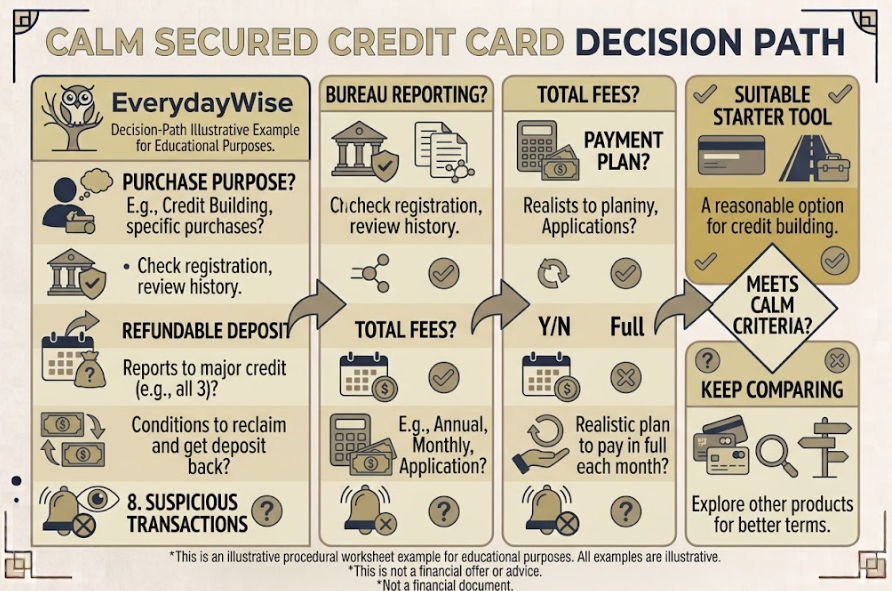
A secured credit card may make sense when all of the following are true:
- you have limited or damaged credit and a regular unsecured card is unavailable or unsuitable;
- the issuer reports account activity to the relevant credit bureaus;
- the deposit, fees, and payment obligations fit your cash flow;
- you can use the card for small planned purchases and pay on time;
- the deposit is held by a legitimate institution under clear terms; and
- you understand how the account may transition, close, or return the deposit.
It may not make sense when the card has high non-refundable fees, unclear reporting, an unaffordable deposit, aggressive marketing, or no practical path to recover the deposit. It is also a poor fit if you need the deposited money for rent, food, utilities, medication, or an emergency reserve.
What “Secured” Actually Means
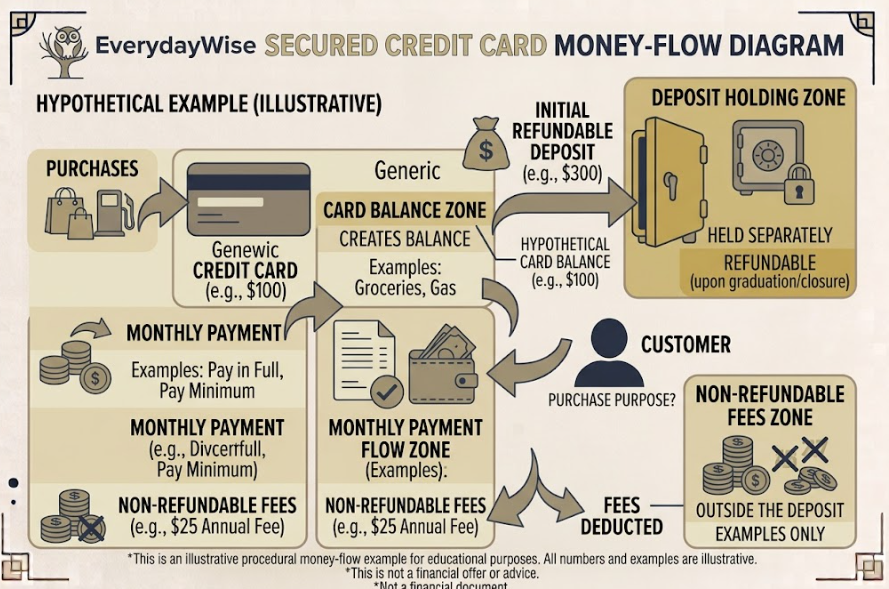
A secured credit card generally requires a cash security deposit. The issuer holds that money as protection if you fail to repay what you owe. The deposit often influences the credit limit, although the exact relationship depends on the issuer and agreement.
Suppose an issuer approves a secured card after you provide a hypothetical $500 deposit. You might receive a $500 credit limit. If you then spend $80, you do not subtract $80 from your deposit. You owe $80 on the card account and must pay the statement according to its terms. The $500 remains held separately as security.
That distinction prevents three common mistakes:
- It is not a prepaid card. With a prepaid card, you generally spend funds loaded onto the card. With a secured credit card, you borrow against a credit account and repay the bill.
- The deposit is not your monthly payment. You must still make required payments. The issuer’s ability to use the deposit after default does not excuse late or missed payments.
- The deposit does not cap every possible cost. Interest, fees, transactions, and account terms may create an amount owing beyond what a reader assumes from the deposit alone.
The Financial Consumer Agency of Canada says secured-card deposits may range from a few hundred to a few thousand dollars and that a financial institution may use the deposit if the cardholder does not make payments. U.S. product terms vary as well. Always read the disclosure rather than relying on a generic definition.
Who May Benefit From One
A newcomer without a local credit history
Moving to a new country can create a frustrating gap: a person may have stable income and a responsible history elsewhere, yet local lenders may have little information to evaluate. FCAC specifically identifies newcomers to Canada without a Canadian credit history as people who may consider a secured card.
Before paying a deposit, ask whether the institution offers another newcomer pathway based on income, employment, banking relationships, or foreign credit information. A secured card is an option—not an automatic first step.
A person starting credit for the first time
A young adult or another person with a “thin” credit file may use a secured card to begin creating account history. The goal is not frequent spending. It is a small, repeatable cycle:
- make a planned purchase;
- wait for it to appear correctly;
- receive the statement;
- pay by the due date; and
- verify that the account is reported accurately.
The account must actually report to the credit bureaus for this purpose. Ask which bureaus receive information, what information is reported, and when reporting begins. Do not accept “helps build credit” as sufficient disclosure.
Someone rebuilding after past problems
A secured card may provide access after missed payments, collections, insolvency, or other credit damage. It cannot erase accurate negative history, and it does not repair a score on a promised schedule. It simply creates an opportunity to add new account behavior over time.
Rebuilding should begin with current cash flow. If an existing debt plan is unstable, another required payment may increase risk. Check reports for errors, protect essential expenses, and decide whether a new account can be managed consistently.
Someone declined for an unsecured card
A denial does not mean the next step must be a secured card. First learn why the application was declined. The reason might involve income, identity verification, recent applications, an error, an existing balance, or a lender’s own criteria.
In the United States, an adverse-action notice generally gives reasons for a denial or explains how to obtain them; additional rights apply when a credit report informed the decision. Canadian processes differ. Review the notice and report before applying again.
When It Does Not Solve the Real Problem
You need spending money, not a credit-building tool
Locking $500 in a deposit and then borrowing against a $500 limit does not create $500 of new household wealth. If the deposit leaves you unable to handle an essential bill or emergency, the card may weaken the household even if it helps establish credit.
You are already struggling with card balances
A secured card can still charge interest and fees. It is not automatically a low-cost debt solution. If balances keep growing or minimum payments are difficult, focus on stabilization and qualified assistance rather than opening another card for its credit-building label.
The main problem is a credit-report error
An incorrect late payment, unknown account, mixed file, or identity-theft entry should be disputed. Adding a new account does not correct inaccurate information. In Canada, contact the lender and both major credit bureaus when appropriate. In the United States, follow the relevant bureau and furnisher dispute process.
The product is mostly fees
Some secured cards may include application, setup, annual, monthly, maintenance, replacement, or transaction fees. A fee may be charged even if an application is declined, depending on the terms and applicable law. FCAC warns that a setup or application fee may be separate from the security deposit and may not be refundable after a declined application.
The product is not useful merely because approval seems easier. Compare how much usable credit and reporting value remain after every fee.
The Seven Questions to Ask Before Applying
1. Does the issuer report to the credit bureaus?
Ask for the bureau names and reporting policy in writing. In Canada, determine whether reporting goes to Equifax Canada, TransUnion Canada, or both. In the United States, ask about the three nationwide credit reporting companies.
Reporting is central to the decision. A card that does not report may still function as a payment method, but it cannot serve the expected credit-history purpose in the same way.
Also ask how the account is classified. Do not assume any label changes a score predictably; accurate, consistent reporting is what matters.
2. Exactly how much money is refundable?
Separate these amounts:
- refundable security deposit;
- non-refundable application or setup fee;
- annual or monthly fee;
- optional service charge; and
- interest or transaction costs.
If you pay $500 at opening, that does not necessarily mean the full $500 is refundable. A hypothetical $400 deposit plus a $75 annual fee and $25 setup fee leaves only $400 categorized as security—assuming the agreement says it is refundable.
Do not submit money until the institution identifies the holder of the deposit, the conditions for using it, whether it earns interest, and the method and timing of return.
3. Is the institution legitimate, and how is the deposit protected?
Verify the issuer through an official regulator or deposit-insurance resource appropriate to your jurisdiction. Use contact information obtained independently, not merely a phone number in an advertisement or unsolicited message.
In Canada, FCAC advises consumers to check whether the financial institution has insured the deposit. The issuer may hold it directly or arrange for another institution to hold it. Deposit protection depends on the institution, account structure, and applicable rules; a marketing phrase is not enough.
Walk away from guaranteed-approval claims, unusual payment requests, immediate pressure, or refusal to provide the agreement before payment.
4. What is the total annual cost?
Add recurring fees and likely transaction costs. Then compare the result with the credit limit and the product’s purpose.
For example, $90 in hypothetical first-year fees on a $300-limit card equals 30% of the limit. That demands careful comparison.
Interest is avoidable only if your behavior and the card’s grace-period terms allow it. A secured card is still a credit card. Review purchase APR, cash-advance rules, foreign transaction fees, late-payment consequences, and how payments are applied.
5. Can I pay it without using most of the limit?
Low limits can make ordinary spending look large relative to available credit. With a $300 limit, a $150 reported balance represents half of the limit. Even if you later pay in full, the balance reported at a particular point may be higher than expected.
Keep purchases small relative to your budget and limit, avoid approaching the limit, and pay on time. You do not need to carry a balance or pay interest to build a payment record.
6. Is there a path to an unsecured card?
Some issuers periodically review secured accounts and may return the deposit or offer an unsecured account after a period of responsible use. Others do not. This process is often called “graduation,” but it is not guaranteed unless the agreement clearly commits to it.
Ask:
- Is review automatic or must I request it?
- When can the first review occur?
- Is another credit inquiry required?
- What account behavior is considered?
- Will the account number or age remain the same?
- Is the deposit returned before or after a new card is issued?
- Can the issuer decline graduation indefinitely?
7. How and when do I get the deposit back?
The agreement should explain whether the deposit is returned after graduation, account closure, or another qualifying event. It should also explain whether outstanding balances, pending transactions, disputes, or fees delay the refund.
Do not close the account casually just to retrieve cash. Account closure can affect available credit, account age, recurring payments, and future reporting. The next article, Article”How to Close a Credit Card Without Unintended Consequences”, owns that decision.
A Safe First-Year Operating Plan
If the card passes the seven-question review, decide how it will be used before it arrives.
Give it one small job
Choose one predictable expense already in the budget, such as a modest recurring bill. Keep enough cash available to pay it. The objective is not maximizing rewards or showing heavy use. It is demonstrating controlled account management.
Turn on alerts immediately
Set alerts for purchases, balance thresholds, payment due dates, payments posted or failed, and profile changes. Confirm that the issuer has your current email, phone number, and mailing address.
Use autopay carefully
Autopay can reduce missed-payment risk only when the linked account is funded and the instruction is active. Review early statements and confirm that payments post.
Review the statement, not just the app balance
Verify transactions, fees, statement balance, minimum payment, due date, and available credit. Report errors or unauthorized transactions promptly through the issuer’s official process.
Check the credit reports
After enough time for reporting, confirm that the account appears accurately. The account opening date, limit, balance, and payment status should not be assumed correct merely because the card works. Checking your own report does not itself lower your score.
Never carry interest “to build credit”
Carrying a balance does not create a special credit-building advantage. CFPB advises consumers rebuilding credit to pay card balances in full each month when possible and to pay on time, every time. Interest is a borrowing cost, not a credit-building fee.
Review the product at planned intervals
At six and twelve months, ask:
- Have all payments been on time?
- Is reporting accurate?
- Have fees or terms changed?
- Is the deposit still affordable to leave locked?
- Has the issuer reviewed the account for graduation?
- Are suitable unsecured options now available?
- Does keeping the card still support the original goal?

Alternatives Worth Checking
A secured card is one path, not the only path.
Depending on the country and institution, alternatives may include:
- an unsecured newcomer or starter card based on eligibility;
- a credit-builder loan that reports payments;
- becoming an authorized user on a responsibly managed account, where reporting and control terms support the purpose;
- a co-signed or joint product, with full understanding of shared liability;
- reporting of eligible rent, utility, or other payments through a legitimate service; or
- waiting while correcting report errors and improving cash flow.
Each option has different costs, reporting, control, and liability. An authorized user may lack independent control; a co-signer or joint borrower may become responsible for the debt.
Compare the purpose first: Are you trying to establish a file, recover after damage, obtain a payment method, or qualify for a future loan? One product should not be expected to solve every problem.
Warning Signs to Walk Away
Stop and verify further if:
- approval is described as guaranteed;
- the issuer will not state where the deposit is held;
- the refundable and non-refundable amounts are mixed together;
- bureau reporting is vague or verbal only;
- fees consume a large share of a very small limit;
- the seller pressures you to pay immediately;
- payment is requested by gift card, cryptocurrency, wire to an individual, or another unusual method;
- the agreement is unavailable before payment;
- graduation or score improvement is promised by a fixed date; or
- customer-service contact information cannot be independently verified.
Legitimate credit building is usually slow. Urgency, secrecy, or certainty deserves scrutiny.
The Bottom Line
A secured credit card makes sense when it is a transparent, affordable bridge to a useful credit record—not when it is simply the easiest approval available.
The strongest candidate knows why the card is needed, can spare the deposit without weakening essential cash reserves, confirms bureau reporting, compares every fee, and has a plan to pay small balances on time. The candidate also understands that the deposit remains at risk if payments are not made and that graduation or deposit return may require specific steps.
Choose the account for its reporting quality, total cost, deposit protection, and exit path. Then use it quietly: one planned expense, one funded payment system, regular statement review, and periodic credit-report checks. Credit is built through repeated fulfillment of obligations—not through interest, heavy spending, or marketing promises.
Money disclaimer: This article provides general educational information, not individualized financial, credit, legal, tax, insolvency, or product advice. Approval, reporting, deposit protection, fees, interest, graduation, refund timing, and consumer rights vary by country, province or state, institution, agreement, and personal circumstances. Verify current terms and official guidance before applying or sending money.
FAQ
Does a secured credit card guarantee approval?
No. An issuer may still review identity, income, credit information, prior account history, or other eligibility criteria. A deposit reduces part of the issuer’s risk but does not create a universal right to approval.
Is the security deposit used to pay my monthly bill?
No. The deposit is normally held as security. You must make payments according to the statement and agreement. If you default, the issuer may use the deposit, and negative reporting or additional collection consequences may still follow.
Will a secured credit card build my credit score?
It can help create payment history if the issuer reports the account, but no product guarantees a particular score or timeline. Accurate reporting, on-time payments, manageable balances, limited applications, and time all matter.
How much should I deposit?
Deposit only an amount you can leave unavailable without compromising essential bills or emergency savings. The minimum, maximum, credit-limit relationship, and refund rules vary. A larger deposit is not automatically a better credit-building strategy.
Do I need to carry a balance or pay interest?
No. Carrying a balance is not required to build credit. Small planned use followed by on-time payment can establish account history without deliberately paying interest, subject to the card’s terms.
When will I get my deposit back?
That depends on the agreement. It may be returned after an approved graduation to an unsecured card, after closure and final settlement, or under another stated process. Pending transactions, unpaid balances, and processing periods may delay return.
Is a secured card the same as a prepaid card?
No. A prepaid card generally spends money loaded onto it. A secured credit card is a borrowing account backed by a security deposit. It produces statements and payment obligations and may report activity to credit bureaus.
References
- Financial Consumer Agency of Canada. “Choosing a credit card.” Updated October 15, 2025. https://www.canada.ca/en/financial-consumer-agency/services/credit-cards/choose-credit-card.html
- Financial Consumer Agency of Canada. “Credit report and score basics.” Updated July 1, 2026. https://www.canada.ca/en/financial-consumer-agency/services/credit-reports-score/credit-report-score-basics.html
- Financial Consumer Agency of Canada. “Improving your credit score.” Updated July 1, 2026. https://www.canada.ca/en/financial-consumer-agency/services/credit-reports-score/improve-credit-score.html
- Financial Consumer Agency of Canada. “Using your credit card responsibly.” Updated October 15, 2025. https://www.canada.ca/en/financial-consumer-agency/services/credit-cards/use-credit-responsibly.html
- Financial Consumer Agency of Canada. “Checking your credit report for errors and fraud.” Updated July 1, 2026. https://www.canada.ca/en/financial-consumer-agency/services/credit-reports-score/check-errors.html
- Consumer Financial Protection Bureau. “Financial Terms Glossary — Secured credit card.” Updated January 23, 2025. https://www.consumerfinance.gov/consumer-tools/educator-tools/youth-financial-education/glossary/
- Consumer Financial Protection Bureau. “Building credit from scratch.” Accessed August 25, 2026. https://files.consumerfinance.gov/f/documents/201612_cfpb_credit_invisible_checklist.PDF
- Consumer Financial Protection Bureau. “How to rebuild your credit.” Updated June 24, 2025. https://www.consumerfinance.gov/consumer-tools/credit-reports-and-scores/how-to-rebuild-your-credit/
- Consumer Financial Protection Bureau. “What can I do if my credit application was denied because of my credit report?” Updated February 20, 2026. https://www.consumerfinance.gov/ask-cfpb/my-credit-application-was-denied-because-of-my-credit-report-what-can-i-do-en-1253/
More in This Cluster: Credit Card Decision Basics
- Credit Card vs. Debit Card: Which Should You Use?
- Cash Back vs. Travel Rewards: Which Card Fits You?
- How to Compare Credit Card Annual Fees
- APR Explained: What Cardholders Often Miss
- Should You Carry More Than One Credit Card?
- When a Secured Credit Card Makes Sense (you are here)
- How to Close a Credit Card Without Unintended Consequences