Extra money finally arrives. The borrower opens the loan account, enters a large payment, and expects the balance to fall. Then a warning appears: the amount may exceed an annual privilege, trigger a charge, or fail to close the account in the way expected.
The desire to repay early was sensible. The missing step was learning how this particular debt defines “early.”
Some loans accept additional principal at any time. Some limit the amount, date, or frequency. Some charge when a mortgage is refinanced, transferred, sold, or paid out before the term ends. A payment may also be applied to interest or future installments differently than the borrower assumes.
Quick decision: Before making an extra payment, identify the loan type, current principal, allowed penalty-free amount, deadline and reset date, application instructions, penalty formula, other fees, and a written payoff amount for the intended date. Compare verified interest saved with the charge, lost liquidity, and other uses of the cash.
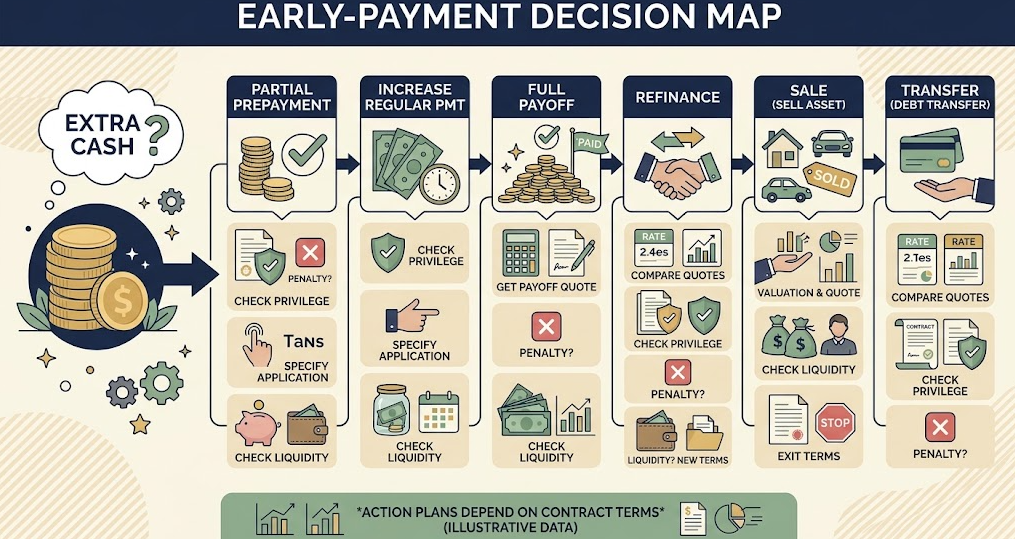
“Prepayment” Can Mean Several Actions
Do not treat these as interchangeable:
- making one extra principal payment;
- increasing each scheduled payment;
- changing payment frequency;
- paying the entire balance;
- refinancing into a new loan;
- selling the secured asset and discharging the loan;
- transferring or porting a mortgage; or
- closing a line of credit.
A contract may allow one action without allowing another on the same terms. A mortgage might permit an annual lump sum and a limited payment increase but still charge for full payout during a closed term. An auto loan may allow payoff under one jurisdiction and contract while another agreement includes a fee. A student loan may accept extra payments but keep the normal monthly payment due.
The first comparison is not “penalty or no penalty.” It is which action, on which date, under which clause.
Build a Prepayment Terms Sheet
Record the following from the agreement and a current lender quote.
| Field | What to capture |
|---|---|
| Loan identity | Lender, account, secured or unsecured, open or closed where applicable |
| Current principal | Balance before accrued interest and fees |
| Intended action | Partial payment, increase, payoff, sale, refinance, or transfer |
| Privilege | Percentage or dollar amount permitted without charge |
| Measurement base | Original principal, current balance, or another stated amount |
| Timing | Calendar year, contract year, anniversary date, or term |
| Frequency | Once annually, multiple times, or with each payment |
| Carry-forward | Whether unused privilege expires or carries forward |
| Penalty formula | Months of interest, interest-rate differential, fixed fee, or other method |
| Other charges | Administration, discharge, registration, legal, or closing fees |
| Application | Interest, principal, future installment, or specific instructions |
| Quote validity | Payoff date and expiry of the quoted amount |
If a field is unclear, ask the lender to point to the written clause. A verbal estimate may orient the decision but is insufficient for a major payment.
Mortgage Privileges and Penalties Are Different
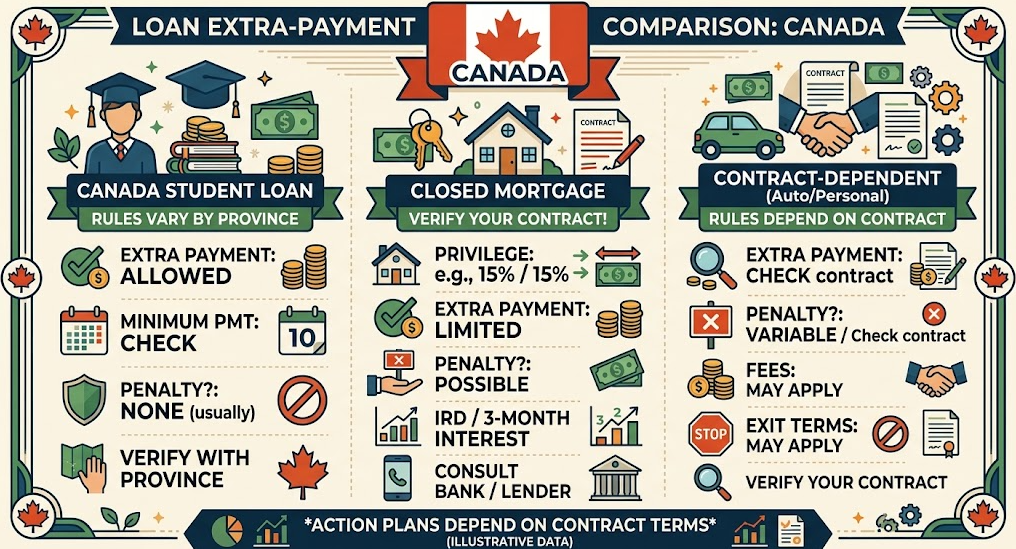
A prepayment privilege is the amount or method the contract permits without a prepayment charge. FCAC lists examples such as lump-sum payments, increased regular payments, and increased payment frequency. The agreement determines the actual amount, timing, and method.
A prepayment penalty—also called a prepayment charge or breakage cost—may apply when a borrower pays more than the allowed additional amount, breaks the mortgage contract, transfers to another lender before the term ends, or repays the full mortgage before the term ends, including in connection with a sale.
Canadian closed mortgages may describe calculations based on a stated number of months’ interest or an interest rate differential (IRD), but the exact formula and comparison rate are lender- and contract-specific. FCAC gives an example in which the borrower pays the higher calculated amount and may also owe an administration fee. That example is not a universal formula.
Open mortgages often provide more flexibility but may carry a higher rate. “Open” and “closed” are not quality labels; they price flexibility differently.
For federally regulated Canadian lenders, disclosure should identify privileges and explain penalty charges. The federal mortgage prepayment information code also calls for annual information about the permitted dollar amount, calculation method, factors that change the charge, calculators, and staff contacts.
From Jerome: One Intention, Two Contracts
From Jerome, EverydayWise Contributor
In my experience, I could make early payments on a student loan without a penalty. My mortgage was different. It allowed additional principal only within the amount set by the contract; paying more could create a penalty.
That leaves a real choice when extra money is available. Paying principal can reduce debt and bring peace of mind, but the result depends on the mortgage rate, the amount I am allowed to prepay, and what else the cash needs to do.
Jerome’s experience should not become “student loans never have penalties” or “mortgages always do.” It identifies the correct workflow: classify the actual loan, read its terms, and compare the action available.
For Canada Student Loans, the federal repayment page says extra payments may be made at any time to reduce or pay off the balance, while regular monthly payments remain due. During repayment, payments go to outstanding interest first and then principal. Provincial portions, private loans, refinanced loans, and loans elsewhere may follow different rules.
In the United States, CFPB says student loans generally do not involve penalties for early payoff but advises obtaining a payoff quote. That general statement does not replace the note, servicer instructions, or protections attached to a particular loan.
Estimate the Economic Benefit
The basic comparison is:
Net financial benefit = verified future interest avoided − prepayment charge − other transaction costs − value of alternatives given up
The first three items can often be estimated. The last requires judgment.
Obtain the Payoff Amount
The account balance may not equal the amount required to close the loan. CFPB explains that a payoff amount may include interest through the intended date, other unpaid fees, and a prepayment penalty.
Ask for current principal, payoff amount on the intended date, penalty-free partial capacity, every included or excluded fee, quote validity, and what happens after payment.
Estimate Interest Avoided
Compare two schedules from the same date:
- continue under the contract; and
- apply the extra principal exactly as the lender will apply it.
Use the current balance, contract rate, and remaining amortization. For a variable-rate product, test more than one rate. Confirm whether the payment falls, amortization shortens, or the payment remains unchanged.
Online calculators are estimates, not binding payoff figures. An IRD estimate may change with the comparison rate, remaining term, and payoff date.
Subtract Every Exit Cost
Include the prepayment charge, administration fee, discharge or registration charge, and any appraisal, legal, closing, or new-loan origination cost. Also identify lost promotional benefits and any tax consequences verified by a qualified source.
Do not compare the old rate with a new rate alone. Refinancing is a transaction, not merely a rate change.
Test the Break-Even Point
For a refinance:
Approximate break-even months = total switching costs ÷ monthly savings
Use comparable balances and amortization. A lower payment caused by extending the debt is not the same as interest savings. If the borrower may sell, refinance again, or repay before the break-even date, the transaction may not recover its cost.
The Cash Is Also Doing a Job
An interest-saving calculation can be correct while the household decision is wrong.
Before sending cash to principal, test whether the remaining liquid funds cover essential bills, an emergency reserve, known taxes or repairs, higher-cost debt, valuable employer matches, business working capital, and transaction costs.
Prepaid principal may be difficult or expensive to recover. FCAC notes that some lenders may permit re-borrowing of previous mortgage prepayments, but doing so adds principal and interest again. That possibility does not make prepaid cash equivalent to savings.
The emotional value of owing less is real, but it should be named rather than disguised as a guaranteed financial return. A borrower may accept a modest economic tradeoff for certainty, provided essential liquidity and contractual costs are understood.
Use the Privilege Before Paying a Penalty—After Verifying It
Possible approaches include:
- use part or all of the available lump-sum privilege;
- increase regular payments within the limit;
- change payment frequency if permitted;
- wait for the privilege reset date;
- wait for maturity or renewal;
- explore porting if moving; or
- request other lender options.
These are questions to investigate, not universal recommendations. A privilege may reset on the contract anniversary rather than January 1. Unused room may expire. A lender may require advance notice. Once payments are increased, later decreases may be restricted.
Ask the lender to quote at least two dates. A charge can change as the remaining term and comparison rate change.
Auto Loans, Personal Loans, and Lines of Credit
Do not assume non-mortgage debt is automatically open.
CFPB says an auto loan’s contract and applicable state law determine whether it can be prepaid without penalty. Some states prohibit penalties for certain loans; some contracts may include them.
For a personal loan, verify whether interest is calculated on the declining balance or precomputed, whether an extra payment immediately reduces principal, whether an origination fee is refundable, whether a payoff fee or rebate method applies, and whether automatic payments stop after payoff.
For a line of credit, extra principal may reduce the interest-bearing balance, but closing the account is a separate action. A home-equity line may have early-closure, discharge, or promotional-cost recovery provisions. Confirm whether the goal is to reduce the balance, eliminate access, or release collateral.
When Not to Rush
Pause when:
- the emergency cushion would disappear;
- the penalty quote is missing or expired;
- higher-cost debt remains;
- the payment may be treated as future installments rather than principal;
- public student-loan protections could be lost through refinancing;
- the mortgage is near maturity and waiting may avoid a charge;
- an expected sale changes the calculation;
- tax treatment has not been verified; or
- the decision is being made only because debt feels uncomfortable.
Debt discomfort deserves attention. It does not require an irreversible same-day transfer.
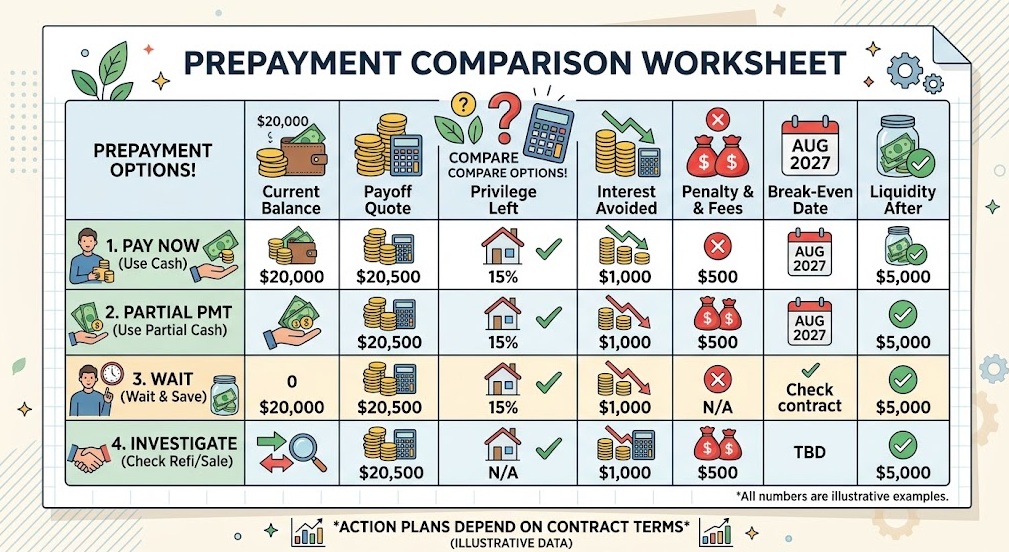
A Seven-Step Prepayment Check
- Name the action. Partial principal, payment increase, payoff, refinance, sale, transfer, or closure.
- Read the clause. Find privilege, timing, formula, and application rules.
- Request written figures. Obtain the payoff amount and penalty-free capacity for a specified date.
- Model both paths. Keep the loan versus prepay under identical assumptions.
- Add transaction costs. Include costs beyond the headline penalty.
- Protect liquidity. Rebuild the household budget after the payment.
- Give instructions and confirm. Retain proof and verify the new balance or closed status.
The EverydayWise View
Early repayment is not a virtue test. It is an exercise of a contractual option with financial and household consequences.
The useful question is: “What amount can I pay, on what date, under which clause, at what total cost, while leaving the rest of my financial life able to function?”
Sometimes the answer is a full payoff. Sometimes it is the annual privilege, a higher scheduled payment, waiting until maturity, or keeping cash available. The disciplined decision begins with a written quote and ends with confirmation that the money was applied as intended.
FAQ
Is a prepayment privilege the same as having no penalty?
No. A privilege permits specified extra payments without a charge. A penalty may still apply above the limit or when the loan is paid out, transferred, refinanced, or discharged early.
How can I find my mortgage’s penalty-free amount?
Check the agreement and current lender information. Ask for the available dollar amount, measurement period, reset date, and written confirmation for the planned payment date.
Is a three-month-interest penalty always cheaper than an IRD?
Not necessarily, and not every contract uses both. Some mortgages charge the higher of specified calculations. The contract and lender quote determine the method and amount.
Can I pay a Canada Student Loan early?
Federal guidance says extra payments may be made at any time while normal monthly payments remain due. Verify any provincial portion, private loan, or refinanced debt separately.
Why is my payoff amount higher than my balance?
It may include interest through the payoff date, unpaid fees, and a prepayment charge. Request an itemized quote valid for the intended date.
Should I empty savings to pay off a loan?
Test liquidity first. Compare interest saved with essential bills, emergencies, known costs, and higher-cost debt. Money committed to principal may not be easily recoverable.
Sources
- Financial Consumer Agency of Canada — Mortgage Fees: Prepayment Penalties
- Financial Consumer Agency of Canada — Mortgage Prepayment: Know Your Rights
- Financial Consumer Agency of Canada — Paying Off Your Mortgage Faster
- Government of Canada — Repay a Student Loan: Make Additional Payments
- Consumer Financial Protection Bureau — What Is a Prepayment Penalty?
- Consumer Financial Protection Bureau — Can I Prepay My Auto Loan Without Penalty?
- Consumer Financial Protection Bureau — What Is a Payoff Amount?
- Consumer Financial Protection Bureau — Can I Pay Off My Student Loan Early?
More in This Cluster: Borrowing and Personal Loans
- Personal Loan vs. Line of Credit: How to Choose
- Fixed vs. Variable Interest Rates: What Risk Are You Choosing?
- How Loan Terms Change the Total Cost
- What to Check Before Accepting a Loan Offer
- Good Debt vs. Bad Debt: A More Useful Framework
- When Borrowing for a Major Purchase May Be Reasonable
- How to Compare Early-Payment and Penalty Terms (you are here)