Before Jerome began a delayed work item, he could already see its entire path: the steps, the hours, the decisions, and the stress likely to arrive along the way. Familiarity should have made the work easier to start. Instead, a detailed view of the effort made beginning feel heavier.
That experience does not prove a particular cognitive mechanism. It does reveal a practical problem. A task can arrive as one line on a list while containing dozens of choices: what comes first, who needs to be consulted, what evidence is sufficient, which risk is acceptable, and what can wait. When several such tasks accumulate, “decide what to do” becomes work of its own.
Quick decision: Reduce decision load according to consequence. Standardize or batch repeated low-consequence choices; clarify or delegate decisions that belong elsewhere; schedule demanding reversible choices when attention is stronger; and protect adequate time, information, and human authority for safety-critical, legal, financial, medical, personnel, or irreversible decisions. If workload exceeds capacity, make the conflict visible rather than hiding it with a better personal system.
Use the Term Carefully
“Decision fatigue” is commonly used for greater difficulty, avoidance, shortcuts, or reduced consistency after repeated or demanding choices. It is not a medical diagnosis. Research does not support a simple law that every additional decision steadily depletes a fixed mental resource. Definitions and measures vary, and a recent large preregistered field study in healthcare found no evidence that decision quality declined merely because clinicians had made more previous decisions that day.
The uncertainty matters. Time of day alone should not be used to declare a decision unreliable, and a difficult choice should not automatically be blamed on decision fatigue. Sleep loss, long hours, interruptions, time pressure, emotional strain, inadequate information, unclear authority, depression, anxiety, pain, medication effects, and other factors can impair or complicate judgment.
Practical improvement does not require proving one theory. Repeated low-value choices can still be removed, work can be organized around consequences, and high-stakes judgment can be protected from avoidable noise.
First Find the Decisions Hidden Inside the Work
A short inventory is more useful than counting every choice for an entire day. Select one task that repeatedly stalls and write down the decisions embedded in it.
For example:
- What outcome is required?
- Which information must be collected?
- What can be assumed, and what needs verification?
- Who owns the final call?
- Which people must be consulted or informed?
- What deadline or sequence applies?
- What would make the decision unsafe or irreversible?
- What does “good enough to proceed” mean?
Jerome’s resistance grew partly because the whole path appeared at once. Separating the path into distinct choices would not remove the workload, but it could show where the real burden sat. Some choices might have been routine. Others might have required authority, additional information, or a trade-off that one person should not silently absorb.
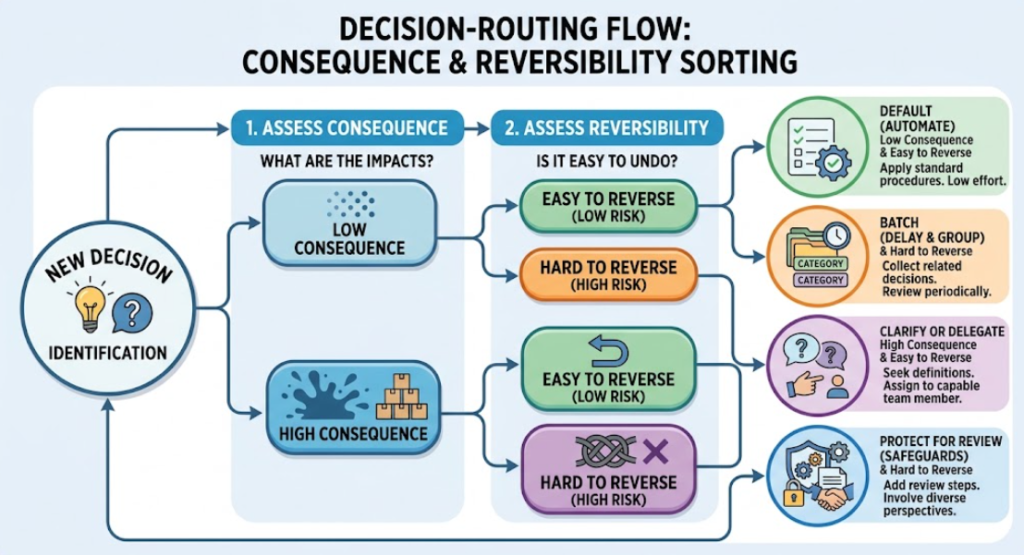
Sort Choices by Consequence and Reversibility
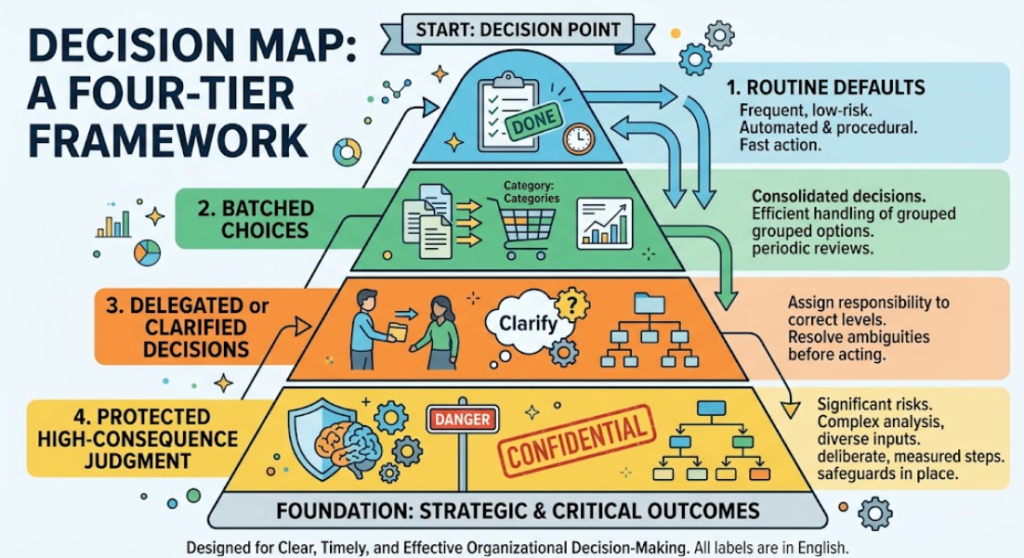
One decision-management method should not govern everything. Use four practical tiers.
Tier 1: Routine and low consequence
These choices recur, have limited downside, and are easy to reverse. Examples may include a standard meeting format, file location, routine supply level, or ordinary communication template.
Use a default, checklist, template, or standing rule. The rule should be easy to override when circumstances differ. Its purpose is to remove repeated reinvention, not to prohibit judgment.
Tier 2: Repeated choices that benefit from batching
Some decisions need attention but do not need continuous interruption. Routine approvals, scheduling choices, nonurgent replies, and similar items may be reviewed at one or two defined times.
Batching reduces repeated context switching. Keep an exception route for urgent matters so the queue does not delay a genuine safety or operational need.
Tier 3: Decisions that need clarification or delegation
A stalled choice may belong to another role, require information someone else holds, or depend on priorities a manager has not resolved. Mark the exact missing element: owner, authority, evidence, deadline, or trade-off.
Delegation should transfer sufficient authority and information, not merely move an unclear burden to someone with less power. When two priorities cannot both fit, ask the responsible decision-maker to choose the trade-off.
Tier 4: High-consequence or hard-to-reverse decisions
Safety-critical, clinical, legal, major financial, personnel, and irreversible decisions deserve protected judgment. Slow the process when possible. Use current evidence, independent review, required procedures, and a clear record of assumptions and authority.
Automation, defaults, or AI may help organize information, but they should not silently replace accountable human judgment. A tired worker also should not be expected to compensate for missing staffing, time, or safeguards.
Reduce the Number of Times a Decision Reopens
Some decisions consume attention repeatedly because they never reach a defined stopping point. A person gathers more information, reconsiders the same options, and carries the unresolved choice into the next hour.
For reversible decisions, establish a stopping rule before researching:
- the minimum information required;
- the person who owns the decision;
- the time available;
- the acceptable risk boundary; and
- the next review date if new evidence appears.
A stopping rule does not guarantee a perfect answer. It prevents unlimited analysis from becoming the default. High-consequence choices may require formal standards rather than a personal stopping rule; follow those standards.
After a decision is made, record it where the affected people can find it. Reopening should require new evidence, a changed condition, or a defined review point. This protects teams from repeatedly paying for the same unresolved choice.
Match Difficult Choices to Usable Capacity
Decision quality can be affected by fatigue even though decision fatigue itself is not a settled universal mechanism. NIOSH notes that sleep deprivation can make performance unstable, slow responses, increase the effort required to remain effective, and contribute to errors under time pressure. NIOSH also treats extended and nonstandard work schedules as important sources of workplace fatigue and safety risk.
Where control exists, place demanding choices in a period with fewer interruptions and enough time to examine consequences. Protect the interval rather than assuming “morning” is best for everyone. A night-shift worker, caregiver, or person with disrupted sleep may have a different window.
Before a consequential decision, check four conditions:
- Capacity: Am I sufficiently alert to do this safely?
- Information: Do I have the evidence required to proceed?
- Authority: Is this decision mine to make?
- Review: Does the consequence justify another qualified person checking it?
Delay a reversible decision when these conditions are missing. For an urgent decision, use the designated escalation or backup route rather than improvising alone.
Protect Decisions From Interruptions
Interruptions can create additional micro-decisions: whether to respond, what context to abandon, and how to reconstruct the original task. A short protected block may therefore help more than a longer period of fragmented availability.
Choose one consequential task, gather its materials, silence nonessential alerts, and state how urgent contact should reach you. At the end, write the next action before switching contexts. If the workplace requires constant interruption, that is an operating-design issue to raise, especially where missed details create safety risks.
This approach should not become a requirement to work secretly, skip breaks, or remain after hours. The protected block must fit within a sustainable workload.
Use Defaults Without Losing Human Authority
Good defaults make the ordinary case easier while leaving unusual cases visible. They work best when:
- the choice recurs often;
- one option is appropriate in most ordinary cases;
- the consequences are limited and reversible;
- exceptions are recognizable; and
- the default is reviewed when conditions change.
Defaults are poorly suited to choices that depend heavily on individual circumstances or carry serious consequences. A medical treatment, safety exception, disciplinary action, major purchase, or legal commitment should not be reduced to convenience because someone is tired of deciding.
If software suggests an answer, identify who remains accountable, what data informed the suggestion, and what requires human verification. Convenience must not obscure uncertainty or transfer authority without consent.
Make Excess Demand Visible
Personal organization can reduce avoidable decision load. It cannot create unlimited capacity.
WHO identifies excessive workload or pace, long or inflexible hours, understaffing, low control, unclear roles, and limited support as psychosocial risks at work. WHO recommends organizational interventions that assess and modify workplace conditions. For health workers specifically, WHO includes workload reduction, schedule changes, communication, teamwork, safe staffing, and regular breaks among preventive measures.
When the decision inventory exceeds available capacity, document the conflict in operational terms:
- the decisions awaiting action;
- their deadlines and consequences;
- the time, staffing, information, or authority required;
- what can be completed safely;
- what will be delayed; and
- who must approve the trade-off.
This record turns private strain into a visible capacity decision. It also prevents “be more efficient” from serving as the only response to structurally excessive demand.

When to Stop and Seek Help
Stop safety-critical work or driving when fatigue, distress, or substance use makes performance unsafe. Use the workplace’s escalation route or obtain qualified backup.
Persistent indecision, concentration difficulty, sleep disruption, worsening anxiety or mood, increasing alcohol or other substance use, or impairment across daily life may require clinical assessment. These experiences should not be reduced to a productivity problem. Use urgent local help for thoughts of self-harm or suicide, inability to remain safe, severe intoxication or withdrawal concerns, violence, or another immediate emergency.
Decision Summary
- Identify the choices hidden inside one stalled task.
- Sort them by consequence and reversibility.
- Default routine choices and batch nonurgent repeated ones.
- Clarify ownership and delegate with authority and information.
- Give high-consequence decisions time, evidence, safeguards, and human review.
- Establish stopping rules for reversible choices so they do not reopen without reason.
- Match demanding judgment to actual alertness and reduce interruptions.
- Document capacity conflicts when the workload cannot fit safely.
- Seek broader help when cognitive difficulty, distress, substance use, or impairment persists or becomes unsafe.
The aim is a smaller, clearer decision burden—not faster answers at any cost.
This article provides general health and workplace information. It does not diagnose burnout, cognitive impairment, or another condition and does not replace professional, legal, clinical, safety, or organizational requirements.
FAQ
Is decision fatigue a medical diagnosis?
No. It is a practical and research term used for difficulty or changing choice behaviour after repeated or demanding decisions. Other health and workplace factors may produce similar experiences.
Does everyone make worse decisions later in the day?
No universal rule supports that conclusion. Sleep, schedule, task type, interruptions, information, motivation, and individual circumstances matter. Protect consequential decisions according to actual capacity and safeguards.
Which decisions should I automate?
Automate or standardize frequent, low-consequence, reversible choices with recognizable exceptions. Keep accountable human judgment for safety-critical, clinical, legal, personnel, major financial, or irreversible decisions.
Is procrastination always caused by too many decisions?
No. Uncertainty, conflict, perfectionism, low priority, exhaustion, depression, anxiety, and other factors may contribute. Listing the embedded choices can reveal whether decision load is part of the delay.
Should I make important decisions first thing in the morning?
Use your most reliable alert period rather than a universal clock rule. Ensure adequate sleep, information, time, authority, and review.
What if my manager keeps delegating decisions without authority?
Document the decision, consequence, missing authority or information, deadline, and required trade-off. Request explicit ownership and escalation. Employment routes vary by workplace and jurisdiction.
When should decision difficulty be discussed with a clinician?
Seek assessment when it persists, worsens, spreads across daily life, or accompanies significant sleep, mood, anxiety, substance-use, memory, or safety concerns. Use urgent local help for immediate danger.
Sources
- No evidence for decision fatigue using large-scale field data from healthcare
- NIOSH — Sleep Is a Basic Need: Functioning
- NIOSH — Center for Work and Fatigue Research
- WHO — Mental health at work
- WHO — Psycho-social risks and mental health