Work can continue after one person’s capacity is full. Customers still call, patients still need care, equipment still runs, deadlines remain, and a construction site may keep moving through every shift. In that setting, “set a boundary” can sound like advice for someone with more authority, money, staffing, or job security.
Jerome experienced that tension while supervising work for a construction company in Korea. The construction operation did not simply pause when his energy was depleted. His decision responsibility grew, work accumulated, and the practical control available to him did not expand at the same rate. He still had choices, but they existed inside a system whose volume and continuity he could not determine alone.
Quick decision: When you cannot fully control incoming work, make capacity and trade-offs visible. Record what is assigned, what can be completed safely, what will be displaced, and who has authority to choose among competing priorities. Use direct limits for immediate safety; use clarification, sequencing, handoff, coverage, and escalation for the rest. A boundary is effective when responsibility for the consequence reaches the person or system that can act on it.
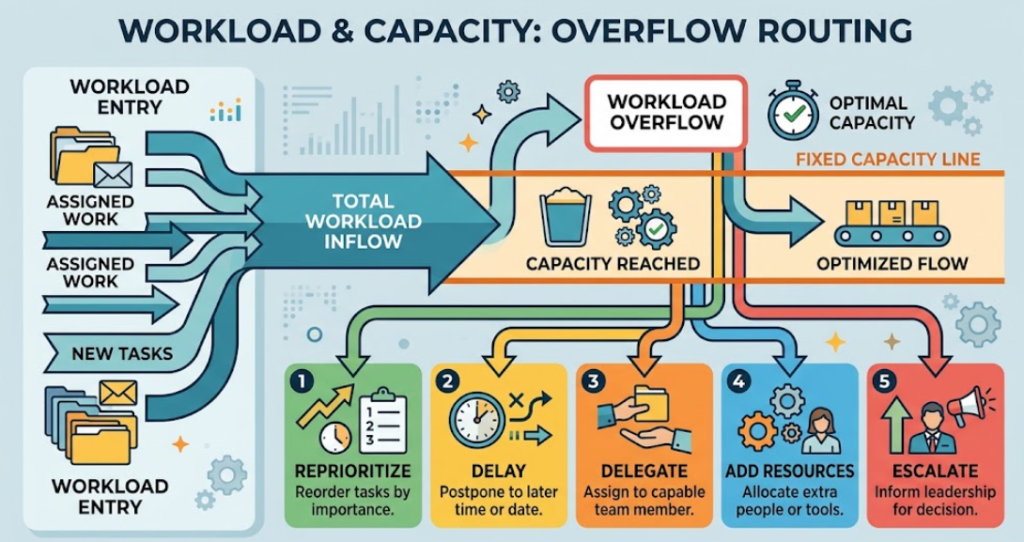
A Boundary Can Be Information Before It Becomes a Refusal
Some workers can decline an assignment. Others face contracts, caregiving obligations, customer expectations, professional duties, immigration concerns, financial pressure, or workplace cultures that make refusal costly. Treating every situation as a confidence problem ignores those differences.
A workload boundary can begin as accurate operational information:
- the work currently assigned;
- the time and resources each item requires;
- the deadlines and consequences;
- the safe capacity available;
- the new work being requested; and
- the decision needed from someone with authority.
This changes the conversation from a private statement—“I cannot cope”—to a visible conflict—“These three tasks require 18 hours before tomorrow; 10 hours are available. Which outcome should change?” The personal effect may still be important, but capacity evidence makes the work-design problem harder to dismiss as attitude.
Build a Capacity Snapshot
Do not create a perfect time study. Use a short snapshot covering the next day or week.
| Work item | Deadline | Consequence if delayed | Estimated effort | Required owner or support | Status |
|---|---|---|---|---|---|
| Existing priority | Tuesday | Customer or operational delay | 4 hours | Worker | In progress |
| Safety review | Tuesday | Unsafe release | 3 hours | Worker + qualified reviewer | Protected |
| New request | Tuesday | Desired, not safety-critical | 5 hours | Manager priority decision | Unresolved |
Include meetings, required administration, travel, handoffs, and interruptions. If uncertainty is large, use a range rather than false precision. Mark work that is safety-critical, legally required, clinically urgent, or difficult to reverse.
The snapshot does not prove that every estimate is correct. It gives other people something specific to challenge or change. If a manager believes the work takes less time, ask which step, standard, or resource makes the difference.
Return Priority Conflicts to the Priority Owner
When a new request arrives, avoid silently accepting it on top of everything else. State the current queue and ask for a decision.
Useful language includes:
- “I can complete A or B by Friday with the current time. Which has priority?”
- “Adding C moves the delivery of A to Monday unless coverage is added.”
- “This task requires a qualified review. Who will provide it, and what should pause while we wait?”
- “I can take ownership after X is handed off. Who can receive X?”
- “The current staffing supports this volume safely. The additional work needs a later date, reduced scope, or another person.”
These statements do not guarantee cooperation. They create a record that the trade-off was raised instead of being hidden through unpaid time, skipped rest, or unsafe speed.
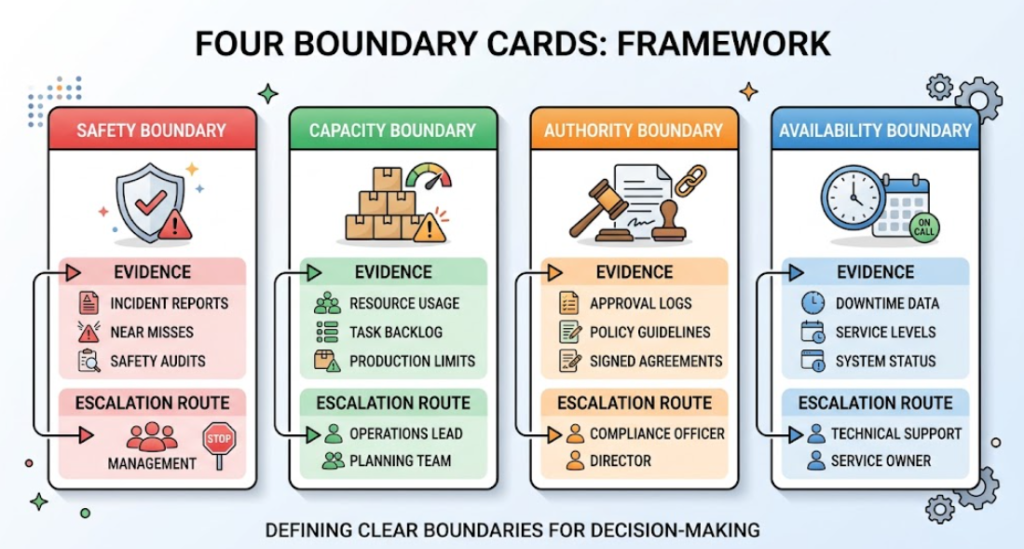
Separate Four Types of Limits
Safety limits
Use direct language when fatigue, missing equipment, inadequate staffing, lack of qualification, substance use, violence, or another condition creates immediate danger. Stop unsafe activity when required and use the designated escalation route. Do not negotiate away a safety rule merely to preserve a deadline.
Capacity limits
Capacity concerns volume and time. Show what fits and what does not. Offer the available options—delay, reduced scope, reassignment, added resources, or changed deadline—without promising that effort can close an impossible gap.
Authority limits
Responsibility sometimes arrives without the authority to obtain information, approve cost, alter scope, or direct other people. Identify the missing authority and the person who holds it. Do not accept accountability for a decision you are not permitted to make.
Availability limits
Define when ordinary contact ends and how genuine urgency will be handled. An on-call role needs coverage, response standards, and compensation or protections according to local policy and law. “Always reachable” is not a complete operating procedure.
Use a Handoff That Transfers Responsibility
A handoff is incomplete when the task moves but the original worker remains mentally and operationally responsible for every outcome.
A usable handoff identifies:
- the current state;
- the next required action;
- the deadline and consequence;
- known risks or uncertainty;
- the information or access provided;
- the person accepting responsibility; and
- the condition that would return the matter for escalation.
Confirm acceptance in the normal workplace record. This is especially important during leave, shift changes, or high-consequence work. A team that depends on one person remaining informally available has not created real coverage.
Jerome’s work occurred in an operation that continued across days. In such a system, personal time depends partly on whether responsibility can move safely between people. Without a credible handoff, the body may leave the site while attention remains on duty.
Escalate With a Clear Request
“The workload is too much” may be true but leaves the receiver to design the response. Add a specific request.
Structure an escalation in five parts:
- Condition: What volume, schedule, staffing, interruption, or role problem exists?
- Evidence: What hours, missed breaks, backlog, errors, near misses, or conflicts show it?
- Consequence: What will be delayed, degraded, or made unsafe?
- Request: Which priority, deadline, scope, staffing, coverage, or authority should change?
- Decision time: When is an answer required to avoid the consequence?
For example: “The two active inspections and tomorrow’s release review fill the available shift. The new site request requires four additional hours and travel. Without reassignment, the release review will move to Thursday. Please confirm by noon whether the site request, the inspection, or the release date should change.”
This language is firm without claiming control the worker does not have.
Document Patterns, Not Only Crises
One emergency may justify temporary flexibility. Repetition shows an operating model.
Track for a defined period:
- scheduled and actual hours;
- after-hours contacts;
- breaks missed or interrupted;
- duties added without something removed;
- vacancies or absences affecting volume;
- decisions made without sufficient information or review;
- work carried across leave or days off;
- errors, rework, near misses, and safety concerns; and
- prior requests and responses.
Keep records in a lawful, privacy-protective way. Do not remove confidential, proprietary, patient, customer, or personnel information from authorized systems. Local rules govern recording, documentation, union activity, accommodations, overtime, leave, and refusal of unsafe work.
Match the Route to the Workplace
The first route may be a direct manager, project lead, staffing office, occupational health service, health and safety representative, union, professional body, human resources office, regulator, or another channel. The appropriate route depends on the problem and jurisdiction.
WHO identifies excessive workload or pace, understaffing, long or inflexible hours, low control, limited support, and unclear roles as psychosocial risks. It recommends organizational interventions that assess and modify working conditions. NIOSH similarly emphasizes that situational demands embedded in work often require manager and organizational involvement because workers may not control assignments or resources.
In the United States, OSHA advises employers to examine workload, hours, understaffing, absences, rest opportunities, and fatigue hazards. That guidance does not establish one universal legal entitlement. Verify the rules for the relevant country, occupation, contract, and workplace.

If the Workplace Does Not Cooperate
A clear request may be ignored, minimized, or punished. Preserve accurate records, identify whether immediate safety is involved, and seek advice from an appropriate worker representative, occupational health service, regulator, qualified legal professional, or local support organization.
Avoid promising that one script will change a coercive or unsafe workplace. Financial and immigration realities may limit immediate options. A staged plan may include protecting the highest-risk tasks, obtaining confidential advice, identifying alternative coverage or employment, and seeking healthcare support for the effects of sustained strain.
Harassment, threats, discrimination, wage concerns, and unsafe-work rights require jurisdiction-specific guidance. Do not rely on a general health article to determine legal action or deadlines.
Protect Health While the Work Issue Is Being Addressed
Workload action and health support can proceed together. Persistent exhaustion, concentration difficulty, sleep disruption, mood or anxiety symptoms, increasing alcohol or other substance use, or reduced daily functioning may warrant professional assessment.
Stop driving or safety-critical activity when fatigue or distress makes it unsafe. Use urgent local help for thoughts of self-harm or suicide, inability to stay safe, severe intoxication or withdrawal concerns, violence, or another immediate emergency.
Decision Summary
- Turn private overload into a visible capacity snapshot.
- Separate safety, capacity, authority, and availability limits.
- Return conflicting priorities to the person authorized to choose.
- State what new work will displace instead of silently absorbing it.
- Use handoffs that transfer responsibility, information, and authority.
- Escalate with a condition, evidence, consequence, request, and decision time.
- Track recurring patterns while protecting confidential information.
- Use the workplace, representative, regulatory, clinical, or legal route appropriate to the problem and jurisdiction.
- Act directly when safety is at risk.
Limited control does not mean no agency. It changes the form of the boundary: from controlling every demand to making trade-offs, responsibility, and risk visible to those who can act.
This article provides general health and workplace information, not legal advice. Employment rights, safety rules, documentation requirements, and escalation routes vary by jurisdiction and occupation.
FAQ
What if I cannot say no to my manager?
State what the request will displace and ask the manager to choose the priority, deadline, scope, or resource. If the situation is coercive, unsafe, or retaliatory, seek appropriate local advice.
How do I prove my workload is excessive?
Use a short capacity record: assigned work, required time, deadlines, consequences, interruptions, actual hours, missed breaks, and staffing or authority gaps. Avoid false precision and protect confidential information.
Is a boundary always a refusal?
No. It may be a priority choice, delayed date, reduced scope, handoff, coverage request, authority clarification, or safety stop.
What if everything is called urgent?
Ask who owns the priority decision and require the consequences to be ranked. Genuine safety or legal urgency should be distinguished from preference or poor planning.
Should I work overtime to clear the backlog first?
Temporary overtime may be lawful and workable in some settings, but it can also conceal chronic understaffing and increase fatigue. Consider safety, recovery, compensation, local rules, and whether the backlog will simply return.
Can I document conversations with my employer?
Keep ordinary written records through authorized systems, but recording laws, privacy duties, confidentiality, and workplace policies vary. Obtain local advice before making audio recordings or removing workplace information.
When should workload stress be discussed with a clinician?
Seek assessment when symptoms persist, worsen, impair daily function, increase substance use, or affect safe work or driving. Workplace change and healthcare can occur together.
Sources
- WHO — Mental health at work
- NIOSH — Situational Demands Contributing to Burnout
- OSHA — Worker Fatigue Prevention
More in This Cluster: Stress and Burnout
- Stress vs Burnout
- Early Signs of Burnout
- How to Reduce Decision Fatigue
- Building Recovery Time into a Busy Week
- Workload Boundaries Without Perfect Control (you are here)
- When Self-Help Is Not Enough
- How to Support Someone Experiencing Burnout