Four provider profiles may all say they help with anxiety, grief, relationships, or stress. One may belong to a physician, another to a professional trained in psychological assessment, and two may use titles whose legal meaning changes at a provincial, state, or national border. The appointments can look similar while the training, authority, cost, and purpose differ.
That ambiguity can make an already personal decision harder. You do not need to master every credential before asking for help. Begin with the service you need, then verify whether the individual provider is qualified and legally authorized to deliver it where you live.
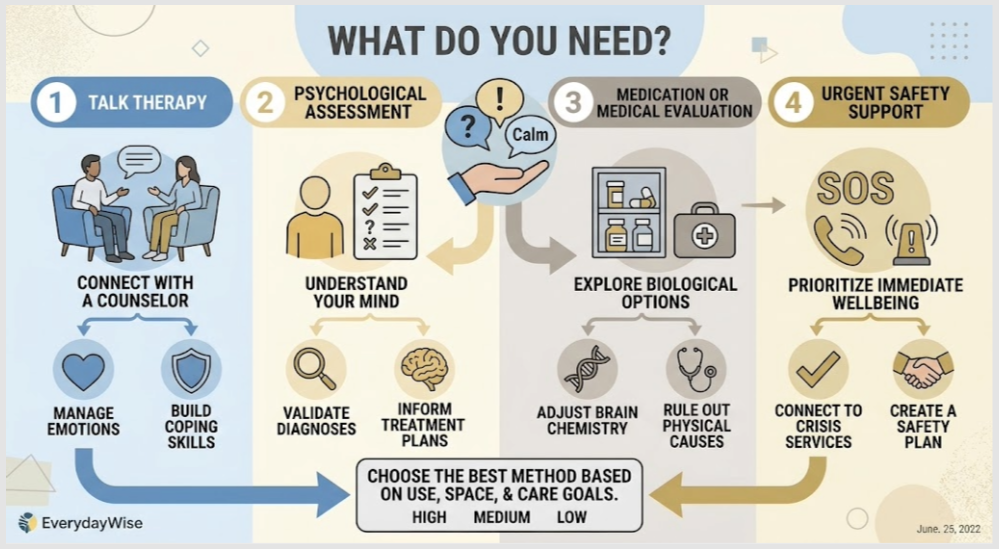
Quick decision: For ongoing talk therapy, look for a licensed or regulated professional whose training and experience match your concern. For formal psychological testing, seek a psychologist or another professional specifically authorized to perform the assessment. For medication or possible medical causes, start with a physician, psychiatrist, or another locally authorized prescriber. If you are unsure, primary care or a local mental-health access service can help identify the right entry point.
Why the Titles Do Not Translate Perfectly
Mental-health titles are shaped by local law. A word that identifies a regulated profession in one jurisdiction may be a broad service description in another. Education requirements, protected titles, diagnostic authority, insurance recognition, referral rules, and prescribing rights can all vary.
This is especially important for readers who move between countries. A familiar title may not represent the same training or scope after a border crossing. Even within one country, state, provincial, or territorial rules may differ.
Use the comparisons below as a starting map, not as proof of anyone’s qualifications. The provider’s regulator or licensing body is the authoritative place to confirm status and permitted practice.
Therapist: Usually a Broad Description
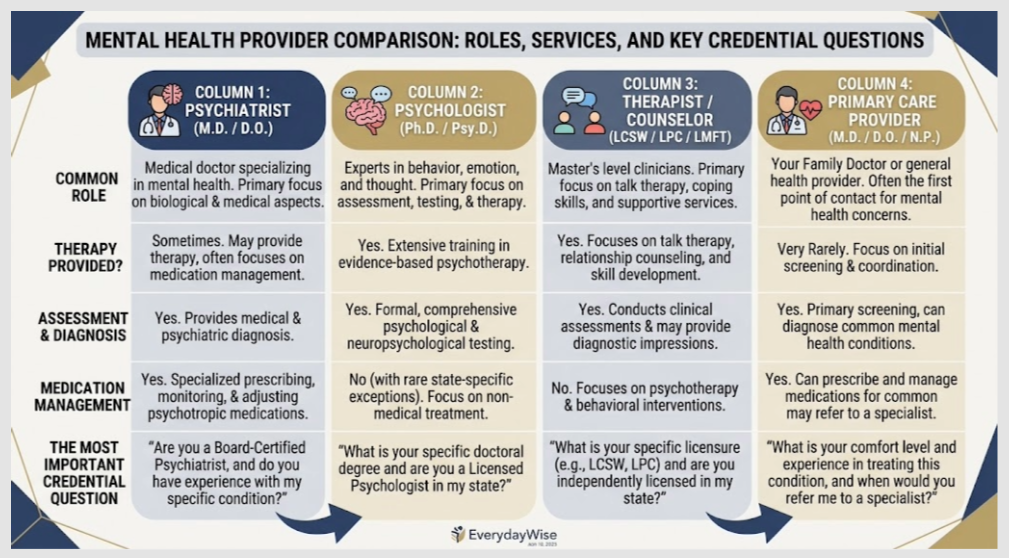
“Therapist” often describes the work a person does rather than one universal profession. A therapist may be a psychologist, counselor, clinical social worker, marriage and family therapist, psychotherapist, nurse, or another qualified professional. In some places, particular versions of the title are protected or regulated; elsewhere, the word alone tells you little.
A therapist commonly provides psychotherapy: structured conversations and therapeutic methods intended to help with distressing emotions, thoughts, behaviours, relationships, or patterns of coping. Psychotherapy may be short- or long-term and can be used by itself or alongside medication or other care.
Before booking, ask for the provider’s full credential—not only the word “therapist.” Confirm:
- the profession and license or registration they hold;
- whether that credential is active and verifiable;
- the ages and concerns they routinely work with;
- the therapeutic approaches they use and why;
- whether they can assess or diagnose within their scope;
- how they handle emergencies and care outside appointments; and
- whether your insurer recognizes their credential.
Counselor or Counsellor: The Local Rules Matter
Counselors commonly help people work through emotional distress, relationships, grief, life transitions, substance-use concerns, or other personal difficulties. Some hold a regulated clinical credential with defined education, supervised practice, ethics, and continuing-competence requirements. In other places, “counselor” is not a protected title or is used across several kinds of work.
The spelling—counselor or counsellor—does not establish the person’s qualification. Neither does a long list of certificates without context. Ask which legal or professional body oversees the provider and what services their credential permits.
A counselor may be an appropriate choice when you want talk therapy and the provider’s training fits your needs. If you require a formal diagnosis, a court or school document, disability paperwork, specialized testing, or medication, verify that the provider can supply exactly what the receiving organization requires.
Psychologist: Therapy, Assessment, or Both
“Psychologist” is a regulated or protected title in many jurisdictions. Psychologists receive graduate-level training in psychology, although the required degree and route to independent practice vary. Depending on their competence and local scope, they may provide psychotherapy, conduct psychological assessment and testing, diagnose mental-health conditions, consult with families or organizations, or carry out research.
Not every psychologist offers every service. One may focus on therapy but not testing. Another may specialize in learning, developmental, neuropsychological, forensic, or workplace assessment and may not accept general therapy clients.
If assessment is your main goal, ask:
- what question the assessment is designed to answer;
- whether the psychologist works with your age group and concern;
- which records or informants are needed;
- whether the final report will satisfy the school, employer, insurer, physician, or agency requesting it;
- what the full fee includes; and
- how results and follow-up recommendations will be explained.
Psychologists generally do not prescribe medication. A limited number of jurisdictions permit specially trained psychologists to prescribe under specific rules, so prescribing should be confirmed locally rather than assumed.
Psychiatrist: A Medical Specialist
A psychiatrist is a physician who specializes in mental health. Medical training allows psychiatrists to consider psychiatric symptoms alongside physical health, medications, substance use, sleep, neurological issues, and other possible contributors. They can diagnose and prescribe medication, and some also provide psychotherapy.
In many systems, psychiatrists concentrate on medical evaluation and medication management because of limited availability. A separate therapist may provide regular psychotherapy. Access may require a referral, and wait times, coverage, and private options differ by location.
A psychiatric consultation may be especially relevant when:
- symptoms are severe, complex, or changing quickly;
- medication is being considered or is causing concerns;
- several diagnoses or treatments need review;
- physical and mental-health factors may interact;
- psychosis, mania, severe depression, or major functional change is suspected; or
- another clinician recommends specialist medical assessment.
Medication is not evidence of personal failure. Jerome knows people who take medication for schizophrenia and other mental-health concerns. He views this as a form of caring for health, much as someone may take prescribed medicine for blood pressure. The comparison concerns the legitimacy of receiving care; it does not imply that the conditions or treatments are medically identical.
A Side-by-Side Starting Point
| Provider label | Common role | May provide talk therapy? | Formal assessment or testing? | Medication? | What to verify |
|---|---|---|---|---|---|
| Therapist | Broad description covering several professions | Often | Depends on underlying credential | Usually no | Full credential, license, scope, insurance eligibility |
| Counselor/counsellor | Counseling or psychotherapy for emotional, behavioural, relationship, or life concerns | Often | Varies; specialized testing may be outside scope | Usually no | Whether title is regulated, registration, training, permitted services |
| Psychologist | Psychological therapy, assessment, diagnosis, consultation, or research | Often | Often, when trained for the specific assessment | Usually no; limited exceptions | Specialty, assessment authority, local prescribing rules, report acceptance |
| Psychiatrist | Medical evaluation and treatment of mental-health conditions | Sometimes | Medical/psychiatric evaluation; not necessarily the same testing a psychologist performs | Yes | Referral route, appointment purpose, therapy availability, coverage |
“May” matters throughout this table. A title gives you a category; it does not establish that a particular person has experience with your concern.
Jerome’s Experience: The First Barrier Was Not a Directory
In Jerome’s experience in Korea, receiving mental-health care—or telling other people about it—could feel difficult because of concern about being viewed as abnormal. After moving to Canada and attending college, he noticed a different pattern among some classmates. During group projects, presentation preparation, and ordinary conversation, several spoke openly about their mental health or care they were receiving.
Needing care was not good news in itself. What stood out was that discussing care did not automatically seem to carry the same negative judgment. That observation helped Jerome see mental-health treatment as health management rather than a verdict on a person’s character.
This is one person’s experience, not a description of every Korean or Canadian community. Stigma, openness, culture, family expectations, privacy, and access vary within every country. Still, the practical lesson travels: uncertainty about a provider title can be solved step by step, and asking where to begin does not commit you to a diagnosis or treatment.
Choose the Service Before the Title
If you mainly want talk therapy
Several professions may be able to help. Compare the provider’s active credential, experience with your concern, therapeutic approach, language and cultural fit, cost, availability, and boundaries. A well-known title without relevant experience may be less useful than another properly regulated professional whose work matches your needs.
Ask how progress will be reviewed. A responsible provider should be able to explain the general approach, its relevance, the limits of confidentiality, fees, cancellation terms, and what happens if the service is not helping.
If you need a formal assessment
Name the decision the assessment must support. “I want testing” is less useful than “The school needs a learning assessment,” “My doctor asked about attention symptoms,” or “The insurer requires documentation from a particular regulated profession.”
Confirm the required provider type with the organization that will use the report before paying. The psychologist or other assessor should also confirm that the question falls within their competence and legal scope.
If you want to discuss medication
Start with a clinician who can evaluate and prescribe in your jurisdiction. This may be a family doctor or other primary-care clinician, psychiatrist, psychiatric mental-health nurse practitioner, or another authorized professional. The route depends on local law and the health system.
Bring a current medication list, relevant medical history, substance-use information, symptoms, duration, functional changes, and previous treatment responses. Do not stop or change prescribed medication solely because of general information online; speak with the prescriber or an appropriate urgent service.
If the concern involves a child or adolescent
Look for age-specific training and ask how the provider involves parents, caregivers, school information, and the young person. Development, language, learning, family context, and medical factors may need to be considered together.
The first conversation may be with primary care, a school support team, a pediatric service, or a mental-health professional, depending on the concern and local system. A consultation can clarify whether further assessment is warranted; it does not predetermine that a child has a disorder.
If you may need more than one professional
Care is often shared. A primary-care clinician may review physical contributors and prescribe; a psychologist may assess; a therapist may provide regular psychotherapy; and a psychiatrist may advise on complex diagnosis or medication. Ask who coordinates care, what information will be shared, and which consent forms are required.
Verify the Individual Provider
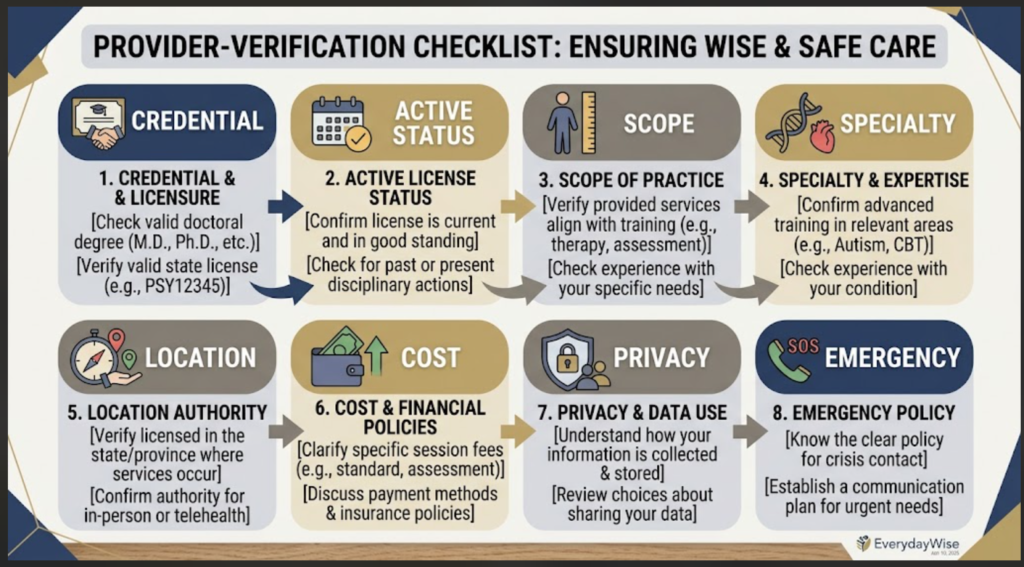
A polished profile, directory badge, or platform listing is not the same as independent verification. Use the official regulator or licensing board for the jurisdiction where the provider practices and where you receive care.
Check:
- Exact name and credential. Initials after a name can represent different qualifications.
- Active status. Confirm the person is currently licensed or registered and note any public restrictions or conditions.
- Authorized scope. Ask whether they can provide the specific therapy, diagnosis, assessment, or document you need.
- Relevant competence. Licensure establishes a professional threshold; it does not make every licensee a specialist in every condition, culture, age, or treatment.
- Location authority. Online care may be governed by where the client is physically located during the session.
- Insurance eligibility. Ask the insurer which credentials and billing details qualify before assuming reimbursement.
Professional association membership can be useful, but it may not substitute for government or statutory registration. If no regulator exists for the title, ask more detailed questions about education, supervision, complaints, ethics, and liability coverage.
Ask About Access, Cost, and Referral Rules Early
The best clinical match is not workable if the service is inaccessible. Before the first full appointment, ask:
- Is a referral required?
- Is there a waitlist, and how are urgent changes handled while waiting?
- What is the fee, and what does it include?
- Is the service publicly funded, employer-supported, school-based, or privately billed?
- Does insurance require a specific credential, diagnosis, referral, or preauthorization?
- Are virtual appointments allowed when you are in another province, state, or country?
- What is the cancellation policy?
- Are interpretation, accessibility, or culturally responsive services available?
Do not send detailed health information to an unverified account merely to ask about availability. Use the provider’s official contact route and ask how sensitive records are protected.
When the Ideal Provider Is Not Available
Long waits and cost limits are real. A safe first step can still create direction. Primary care may screen for urgent concerns, consider physical contributors, discuss medication, and make referrals. Community clinics, school or college services, employee assistance programs, public mental-health lines, nonprofit agencies, or supervised training clinics may offer other routes.
Ask to join a cancellation list and request an interim plan. If a provider cannot offer the needed service, ask what type of credential or program would be more appropriate. Avoid treating a long wait as a reason to remain entirely unsupported while symptoms worsen.
Know When Routine Comparison Should Stop
Choosing among provider titles is a routine-care task. It should not delay urgent help. Contact local emergency or crisis services when someone may act on suicidal or violent thoughts, cannot remain safe, is severely confused or detached from reality, has dangerous intoxication or possible withdrawal, or faces another immediate medical or safety emergency.
If you are unsure whether the situation is urgent, contact a qualified local crisis or medical service for real-time guidance. The later article in this cluster, What to Do During a Mental Health Crisis, addresses this decision in detail.
Decision Summary
- Start with the service needed: psychotherapy, assessment, medication, coordinated care, or urgent support.
- Treat “therapist” as incomplete information until you know the underlying credential.
- Verify counselor regulation and scope locally.
- Ask whether a psychologist provides therapy, the specific assessment you need, or both.
- Use a physician, psychiatrist, or another locally authorized prescriber for medication decisions and medical evaluation.
- Confirm active registration, relevant competence, location authority, insurance eligibility, fees, and referral rules.
- Seek urgent local help when safety cannot wait for a routine appointment.
This article provides general educational information and cannot determine which profession, diagnosis, or treatment is appropriate for an individual. Credentials and scopes of practice vary by jurisdiction. Verify providers with the relevant regulator and seek advice from a qualified local health professional. Use local emergency or crisis services for immediate danger.
FAQ
Is a therapist the same as a psychologist?
Not necessarily. “Therapist” is often a broad description. A psychologist may provide therapy, but therapists can also be counselors, social workers, marriage and family therapists, or members of other regulated professions. Ask for the full credential.
Can a psychologist prescribe medication?
Usually not, but limited jurisdictions permit specially trained psychologists to prescribe under specific rules. Verify locally. Psychiatrists and other authorized medical prescribers are the usual route for medication evaluation.
Do psychiatrists provide therapy?
Some do. Others focus mainly on medical assessment and medication management, with psychotherapy provided by another professional. Ask what the appointment includes.
Is a counselor qualified to diagnose a mental-health condition?
It depends on the credential and jurisdiction. Some regulated counselors have diagnostic authority within a defined scope; others do not. Confirm both the local rules and the requirements of any organization that needs the diagnosis or report.
Who should I see for ADHD, autism, or learning-disability testing?
The appropriate assessor depends on age, the question being asked, local scope rules, and who will use the report. Often a psychologist with relevant assessment training is involved, sometimes as part of a medical or multidisciplinary team. Confirm report requirements before booking.
Can my family doctor help even if they are not a mental-health specialist?
Often, yes. Primary care can be a practical entry point for discussing symptoms, reviewing medical factors, considering medication within scope, and making referrals. Available services and referral pathways vary.
What if I do not feel comfortable with the first provider?
You can raise the concern, ask how the approach could change, or seek another qualified provider. Fit is not the only consideration—competence, ethics, safety, and access also matter—but you do not have to continue simply because one appointment occurred.
Sources
National Institute of Mental Health — Psychotherapies
American Psychological Association Services — About Prescribing Psychologists
American Psychiatric Association — What Is Psychiatry?
More in This Cluster: Mental Health Navigation
- Therapist, Psychologist, Psychiatrist, and Counselor Compared (you are here)
- How to Prepare for a First Therapy Appointment
- How to Evaluate Online Therapy
- What to Do During a Mental Health Crisis
- How to Talk to a Doctor About Mental Health
- Mental Health Privacy and Insurance Questions to Ask
- How to Support a Family Member Without Taking Over