The easiest document bag to grab during an evacuation may also be the easiest one to steal on an ordinary day. That does not make portable records a bad idea. It means emergency access and everyday security must be designed together.
Jerome keeps passports, permanent resident documents, Korean banking information, home contracts, and vehicle and home insurance papers in one bag above the entry closet. His reason is practical: if fire or another emergency forced the household to leave quickly, the documents would already be together.
The stronger version of that plan does not put every original into one exposed container. It separates what must travel immediately, what should remain more securely protected, and what must still be accessible if the home and its files cannot be reached.
Quick decision: Build a portable emergency file primarily from copies, contact information, account and policy references, health and household instructions, and recovery details. Add an original only when carrying it is necessary and the theft risk is controlled. Keep difficult-to-replace originals in an appropriate protected location, maintain a separate secure digital or off-site recovery copy, and review the file at least annually and after major life changes.
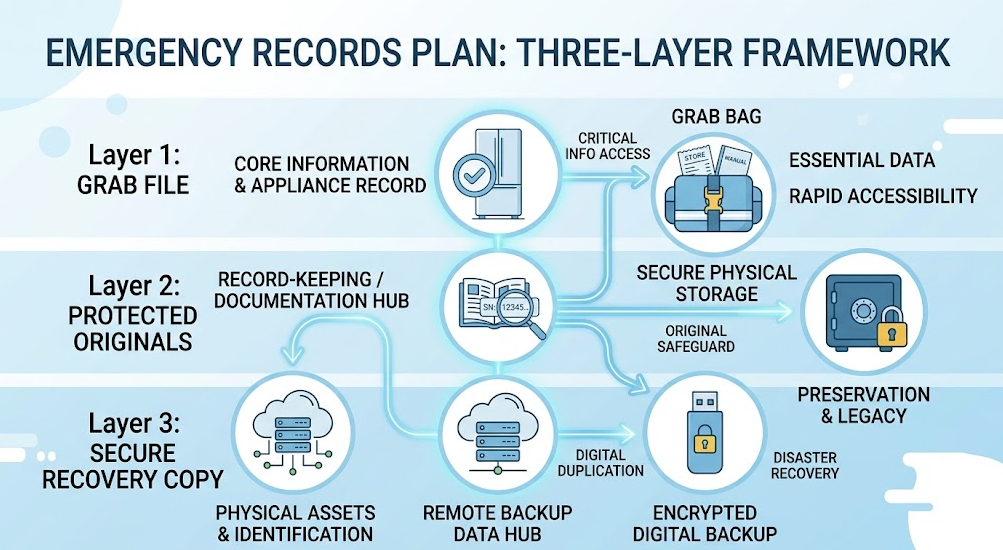
Use Three Layers, Not One Bag
An emergency document plan should survive more than one failure.
Layer 1: Portable grab file
This is the small, current set the household can take when leaving. It supports identification, contact, shelter, health, insurance, payment access, and immediate recovery.
Layer 2: Protected originals
These are authoritative documents that may be difficult to replace or unsafe to leave in an easily removable bag. Their location should balance fire, water, theft, legal access, and how quickly they may be needed.
Layer 3: Secure recovery copy
This is accessible if the home and portable file are both lost. It may be an encrypted digital copy, an appropriately protected off-site copy, or information held by an authorized trusted person. Article”How to Back Up Household Records“ will cover backup design in detail.
No layer is complete alone. A grab file may be stolen. Protected originals may become unreachable. A digital account may be locked. Separation reduces the chance that one event removes every route to recovery.
Put Immediate Recovery Information in the Grab File
Canada’s emergency kit checklist includes identification, an emergency plan, medication information, health and other insurance information, banking information, and next-of-kin contacts. Canadian guidance also recommends keeping copies of important records such as birth certificates, wills, passports, and insurance policies in the emergency kit.
Adapt those categories to the household:
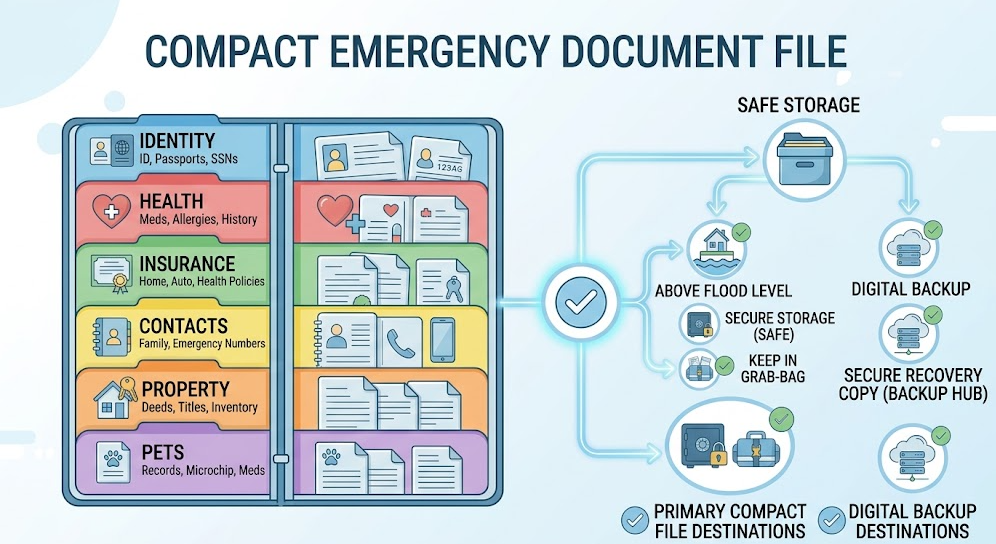
- copy of the household emergency plan and meeting locations;
- names, dates of birth, current photos, and contact information for household members;
- copies of passports, immigration or citizenship records, driver’s licences, and health cards as appropriate;
- emergency contacts, next of kin, doctors, pharmacists, insurers, landlord or mortgage contact, and utility emergency numbers;
- current medications, dosage, purpose, allergies, medical needs, and assistive-equipment instructions;
- insurance company, policy number, claim phone number, and essential coverage contact route;
- bank and payment-provider contact information plus enough reference information to identify accounts safely;
- home, vehicle, and key property identifiers;
- pet photos, microchip numbers, vaccination or medical information, and care contacts;
- essential legal or care instructions and the location of authoritative originals; and
- a brief household inventory or a secure route to it.
Do not include more information than the emergency purpose requires. A portable file with complete tax returns, years of statements, every contract, passwords, and full identity records creates a concentrated theft risk.
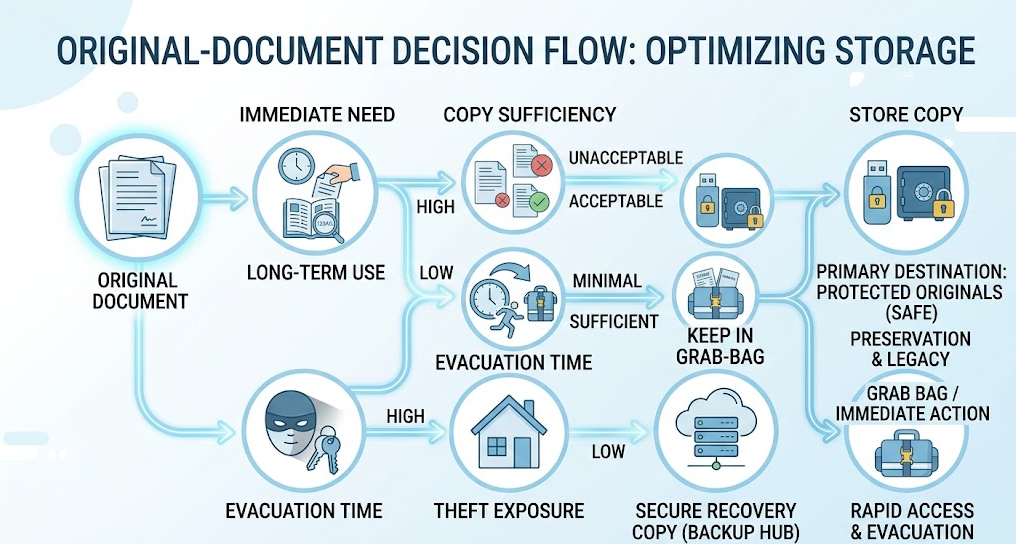
Decide Carefully Which Originals Travel
There is no universal answer for passports and other originals. The decision depends on evacuation type, destination, border or identity needs, replacement difficulty, household members, and the security of the storage location.
Ask:
- Will the original probably be required during displacement or travel?
- Can a copy support the immediate need until the original is recovered?
- Is the document replaceable, and what would replacement require?
- Is the home storage materially safer than the portable container?
- Can the original be added quickly only when an evacuation warning arrives?
- Could a trusted household member carry it securely on their person?
One approach is a two-stage file: the everyday grab file contains copies and recovery information, while a short checklist identifies originals to add when time and safety permit. For a sudden fire, leave immediately; no document is worth delaying evacuation or re-entering a dangerous building.
If originals remain in the grab file, use a locked, access-controlled container stored away from obvious theft points while remaining reachable to authorized adults. “Near the door” is convenient, but not if a visitor or intruder can remove the household’s entire identity and financial record set in seconds.
Keep Financial Information Usable but Limited
After displacement, a household may need to contact a bank, insurer, lender, employer, or government agency. The file should make those calls possible without becoming a portable account-takeover kit.
Include institution names, official contact methods, partial account identifiers sufficient for the household to recognize the account, and instructions for accessing a secure password manager or recovery process. Avoid writing passwords, PINs, security answers, full card details, or safe combinations in an unprotected paper file.
If a complete account number is genuinely needed, protect it at a higher level than the general contact sheet. Consider a separately encrypted digital record or sealed section with controlled access. Test whether an authorized adult can use the information without the primary account holder’s phone being available.
Keep a small amount of emergency cash only if appropriate to the household plan, and do not record its presence on an exposed file label.
Make Insurance and Property Recovery Faster
The first days after a loss often involve proving coverage, identifying property, finding temporary accommodation, and opening claims.
Keep:
- current insurer and policy contacts;
- policy numbers and named insureds;
- property address and vehicle identification details;
- claim instructions and emergency assistance numbers;
- mortgage, landlord, or property-manager contacts;
- a current household inventory with photographs, serial numbers, and major purchase evidence—or secure access instructions; and
- copies of essential home, vehicle, or tenancy records.
Do not carry full home-purchase and insurance archives merely because they are important. The grab file needs enough to start recovery and locate the complete protected record.
The FTC’s disaster-paper guidance recommends organizing financial and family records and describes lockable, fire-resistant boxes, protected storage, cloud access secured with strong passwords and multifactor authentication, and password-protected portable drives as possible tools. Product claims such as “fireproof” or “waterproof” still need scrutiny: protection depends on tested ratings and conditions.
Include Health, Children, Dependants, and Pets
Emergency records should reflect who may need help communicating or receiving care.
For health needs, include current medication names, dosage and purpose; allergies; health conditions; prescribing and pharmacy contacts; device instructions; and health coverage information. Canada’s preparedness guidance for persons with disabilities recommends sharing emergency plans with a support network and reviewing them annually.
For children and dependants, include current photos, school or care contacts, authorized pickup or guardian information where appropriate, communication needs, and reunification contacts. Protect custody and medical details from unnecessary exposure.
For pets, Government of Canada guidance recommends an emergency file with recent photos, contacts, medical and vaccination records, licence copies, and training information where applicable. Include veterinarian, medication, microchip, carrier, and accommodation information.
Choose a Container and Location by Real Hazards
The file must be portable enough for the person expected to carry it. A heavy safe that no one can move is protected storage, not a grab file.
Look for:
- a closing, durable container;
- water resistance appropriate to local risks;
- enough fire resistance for the intended role, based on tested specifications rather than marketing shorthand;
- a lock or access control appropriate to the contents;
- clear internal sections without an exterior label announcing “passports” or “bank records”;
- a location above known flood exposure and away from heat or plumbing; and
- access that does not block evacuation routes.
Everyone responsible for evacuation should know the file’s location and who carries it. Do not make children responsible for high-value originals unless the household plan carefully addresses age and circumstances.
Protect Digital Emergency Copies
A phone gallery is not a complete emergency archive. Phones are lost, damaged, shared, or inaccessible when batteries and networks fail.
For digital copies:
- use strong unique credentials and multifactor authentication;
- encrypt the device or portable drive;
- restrict shared access;
- avoid filenames that expose full identity or account numbers;
- make access possible for another authorized adult;
- keep a safe offline method for essential contacts; and
- test access without relying on the home network or primary phone alone.
Do not email unprotected passports, immigration records, tax files, or banking details to yourself as the default solution. Use a deliberately secured storage method and understand its recovery process.
Review and Practise the File
Review at least annually and after a move, birth, death, marriage, separation, immigration change, new diagnosis, medication change, insurance renewal, new vehicle, major purchase, or pet change.
During the review:
- replace expired identification and policies;
- update contacts, medications, photos, and account references;
- remove closed accounts and obsolete personal data;
- confirm protected originals remain where the map says;
- test the secure recovery copy;
- check the container and storage area for damage;
- confirm who carries the file; and
- practise leaving without delaying for documents.
The Government of Canada advises keeping emergency kits portable, accessible, and known to household members. That accessibility should shorten evacuation—not encourage anyone to stay behind gathering possessions.
The file succeeds when it helps the household identify itself, continue essential care, contact institutions, and begin recovery after leaving safely. It fails if its size, secrecy, or concentration of originals creates a new avoidable household hazard.
FAQ
Should an emergency grab file contain originals or copies?
Use copies for most immediate-reference needs. Carry originals only when they are likely to be required, replacement is difficult, and theft risk is controlled. Keep an originals-to-add checklist when evacuation warning time may allow it.
Should passports stay in the emergency bag all year?
That depends on travel and evacuation needs, storage security, and replacement risk. An easily removed bag can create theft exposure. A protected original plus a grab-file copy and a plan to add the passport when safe may be more appropriate.
What financial information should go in the file?
Include institution names, official contacts, policy or partial account identifiers, and secure recovery instructions. Avoid unprotected passwords, PINs, security answers, full card details, and broad financial archives.
Is a fire-resistant document box enough?
It is one layer, not complete protection. Check tested fire and water ratings, portability, lock security, location, and household ability to carry it. Maintain a separate recovery copy.
Where should the grab file be stored?
Choose a secure but accessible interior location above known flood exposure, away from heat and plumbing, and clear of evacuation routes. Avoid an obvious position where a visitor or intruder could take it easily.
What health information belongs in an emergency file?
Include current medications, dosage and purpose, allergies, key diagnoses or care needs, health coverage, clinicians and pharmacy contacts, and essential device or support instructions.
How often should the file be updated?
Review it at least annually and after major changes to identity, household membership, address, health, insurance, vehicles, finances, legal arrangements, or pets.
Should I keep the only digital copy on a USB drive in the bag?
No. The drive can be lost with the bag. Protect it with encryption or a password and maintain a separate secure recovery copy that authorized household members can access.
Sources
- Government of Canada — Emergency Kit Checklist
- Government of Canada — Emergency Kits
- Government of Canada — Emergency Preparedness for Persons with Disabilities
- Government of Canada — Emergency Preparedness for Pets and Service Animals
- Federal Trade Commission — How to Organize Important Papers Before a Disaster
- Ready.gov — Build a Kit
More in This Cluster: Paper and Digital Home Records
- Which Household Documents Should You Keep?
- How Long to Keep Bills and Receipts
- Home Filing System for Important Papers
- Digital vs. Paper Records: What Should You Keep?
- How to Organize Warranties and Manuals
- How to Build an Emergency Document Grab File (you are here)
- How to Back Up Household Records